
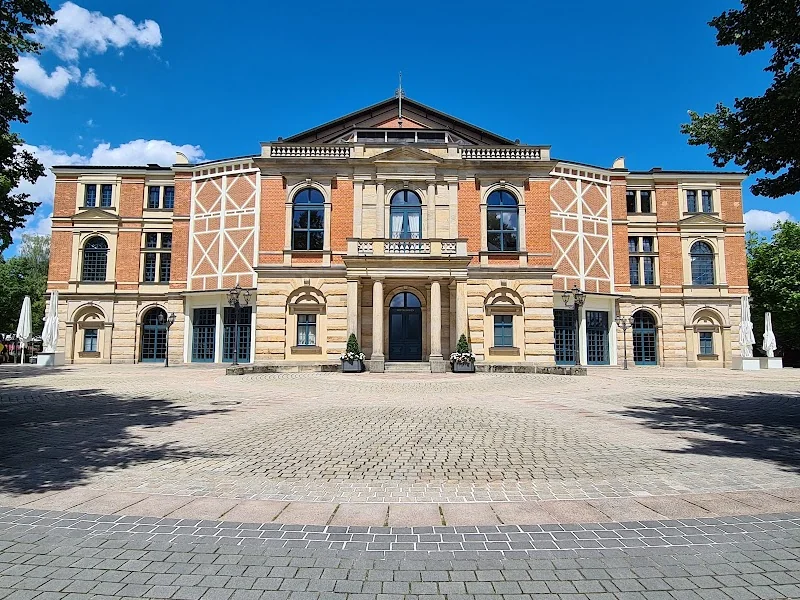
Bayreuth
Festspielhügel 1- 2, 95445 Bayreuth, Deutschland
Bayreuth Festival Theatre | Tours & Seating Plan
The Bayreuth Festival Theatre is much more than a famous opera stage on the Green Hill. It is a place where architecture, music history, and visitor information come together closely. Those looking for tours, seating plans, directions, parking, or the special features of the house will find the most important facts at a glance here. The house was created for the Bayreuth Festival, is closely associated with Richard Wagner, and still represents a unique connection between historical heritage and vibrant performance practice. The official website describes the house as a place with a dark wooden hall, a concealed orchestra, and an acoustics that delights around 58,000 guests each year. This blend of tradition and clarity makes the festival theatre unique to this day. ([bayreuther-festspiele.de](https://www.bayreuther-festspiele.de/?utm_source=openai))
For practical planning, four topics are particularly important: the current tours of the festival theatre, the seating plan with price zones, the directions via Bayreuth, and the parking situation at the festival hill. Additionally, the historical significance of the building, the special acoustics, and the virtual visit via the 3D tour are included. The official offering clearly shows why the festival theatre is exciting not only for Wagner fans but also for cultural travelers, architecture enthusiasts, and first-time visitors. Because the house has such a clear visitor structure, the most important questions can be answered well along the real search intentions: Where does the tour go, how do I get there, where can I sit well, and what makes this place famous? ([bayreuther-festspiele.de](https://www.bayreuther-festspiele.de/en/tickets-service/seat-selection-seasonal-overview/))
Tours at the Bayreuth Festival Theatre: Visit, Opening Hours, and Process
The tours are among the most sought-after topics related to the Bayreuth Festival Theatre, and for good reason: They make the architecture of the house experienceable even when no performance is taking place. Seasonal tours are officially offered, with the website listing several daily appointments for the summer of 2026 and additional time slots from the end of August. The 90-minute tour, where visitors can see the foyer, the King's Building, and the orchestra pit, is particularly attractive; depending on the situation, the stage or other rooms such as the workshop courtyard and rehearsal stages may also be accessible. As a highlight, a musical performance in the auditorium is even planned at the end. This combination of information, spatial experience, and sound makes the visit so special for many visitors. ([bayreuther-festspiele.de](https://www.bayreuther-festspiele.de/karten-service/fuehrungen/))
It is also practically important: The entrance for tours is located on the west side of the festival theatre, and admission for public tours takes place ten minutes before the start. Tickets are available online through the Bayreuth Tourist Information or at the box office, but only for cash payment. Group tours can be booked outside of regular dates, and the website points out that planned tours may also be canceled at short notice if technical work or renovations are taking place in the house. Therefore, anyone planning a visit should check the current schedule in advance and allow some time buffer. Especially in a house with ongoing festival usage, this is sensible, as the tours connect visitor experience and operational reality in a very direct way. ([bayreuther-festspiele.de](https://www.bayreuther-festspiele.de/karten-service/fuehrungen/))
Seating Plan, Hall Plan, and Seats in the Auditorium
At the Bayreuth Festival Theatre, the seating plan is not only a practical tool but also a central part of the visitor experience. The official hall plan for the 2026 season can be viewed, downloaded, and printed online. A total of 1,937 seats are available in the auditorium, and the amphitheater-like arrangement ensures, according to the official description, that the view from many seats is particularly good. That is why many visitors search for terms like seating plan, seats, or hall plan: They want to understand in advance how the space is structured and which categories are relevant for their visit. The 3D tour sensibly complements this offering, as one can also take a virtual look at the space in advance. ([bayreuther-festspiele.de](https://www.bayreuther-festspiele.de/festspiele/festspielhaus/))
The festival theatre also provides specific information for people with mobility impairments. According to the official accessibility page, up to six wheelchair spaces are available in the stalls for performances, as well as an additional space for an accompanying person. Additionally, there are up to 20 edge seats for visitors with limited mobility, accessible toilets, and an elevator in the eastern staircase for the box, balcony, and gallery on the right side. In the 30th row of the stalls, legroom is partially restricted, which may also be relevant when choosing a seat. Therefore, those looking for a good overview should not only pay attention to the pure number of seats but also to category, sightlines, and accessibility. The festival theatre is a good example of how strongly a classical opera venue relies on a precise seating and spatial concept. ([bayreuther-festspiele.de](https://www.bayreuther-festspiele.de/en/tickets-service/accessibility/?utm_source=openai))
Directions, Address, and Parking at the Festival Hill
The official address of the house is Festspielhügel 1-2 in 95445 Bayreuth. For arrival by car, the Bayreuth Festival GmbH recommends the A9 as well as the exits Bayreuth-Nord or Bayreuth-Süd, depending on the direction of travel. From there, the signs lead directly to the festival theatre or towards the city center. It is particularly important that the festival approach via Siegfried-Wagner-Allee and Festspielhügel road is temporarily closed around performances. The website points out that access to the site is closed about two hours before the start of the performance until approximately one hour after the end of the performance. Therefore, one should not plan too tightly and rather arrive early. ([bayreuther-festspiele.de](https://www.bayreuther-festspiele.de/en/tickets-service/arrival-parking-situation/))
For visitor parking, the official site mentions areas B and C; the parking fee there is 10 euros per day and is collected directly at the entrance to the parking areas. Additionally, there are three mobile AC charging stations with a total of six charging points for electric vehicles in parking lot B. For people with an official disabled parking permit, separate free spaces are provided in parking lot A, or on certain days also in parking lot B. Those arriving by taxi, rental car, or the BRK mobility service should also observe the official regulations, as there are also special access routes and partially designated waiting and stopping areas. Overall, the parking situation at the festival hill clearly shows that the festival theatre expects a strong visitor turnout and that the arrival must therefore be clearly organized. ([bayreuther-festspiele.de](https://www.bayreuther-festspiele.de/en/tickets-service/arrival-parking-situation/))
History of the Bayreuth Festival Theatre from 1872 to Today
The history of the Bayreuth Festival Theatre begins with a very specific artistic ambition: Richard Wagner wanted to create a place for his works. According to the official history, Bayreuth was not the first choice from the beginning, but the city ultimately convinced Wagner. On May 22, 1872, the foundation stone was laid, after which the work initially stalled until financing picked up again with the help of King Ludwig II. The architect of the house was Otto Brückwald from Leipzig, the earth and foundation work was carried out by Wölfel & Weiß from Bayreuth, and Carl Run(c)kwitz acted as the construction supervisor. Scenic and musical rehearsals began in 1875, and on August 13, 1876, the first festival began with the Rheingold. This not only opened a building but also established a cultural model that continues to have an impact today. ([bayreuther-festspiele.de](https://www.bayreuther-festspiele.de/festspiele/historie/?utm_source=openai))
The later development of the house is also remarkable. In 1882, the King's Building was completed, in 1888 electric lighting was added, and in 1914 an iron curtain was installed. After the interruptions and burdens of wartime, reconstruction began in 1951 because the house was in poor condition and only the most necessary repairs were initially possible. In the following decades, the festival theatre was gradually renovated, expanded, and technically improved, for example, through new electrical systems, the expansion of magazine and rehearsal rooms, renovations in the orchestra pit, and later measures on the stage and infrastructure. The official festival theatre page also mentions more recent work such as the completion of a sprinkler system and the commissioning of the passenger elevator in the east stair tower. This shows: This house has grown historically, but is by no means a museum in stagnation. It is continuously maintained, adapted, and technically further developed. ([bayreuther-festspiele.de](https://www.bayreuther-festspiele.de/festspiele/festspielhaus/))
Orchestra Pit, Stage, and Acoustics: The Special Features of the House
The Bayreuth Festival Theatre is especially famous for its unique spatial concept. Wagner did not rely on splendor here, but on understatement: simple elegance, a dark wooden hall, and a concealed orchestra shape the impression. This combination creates, according to the official representation, the unique acoustics that make the house so distinctive. The amphitheater-like construction also supports the sightlines in the auditorium. Therefore, those searching for the special features of the festival theatre quickly land on terms like interior, orchestra pit, seats, and acoustics, as they explain the effect of the house almost better than any general description. ([bayreuther-festspiele.de](https://www.bayreuther-festspiele.de/festspiele/festspielhaus/?utm_source=openai))
The technical data underscores this impression. The auditorium has 1,937 seats, the orchestra pit is 140 square meters in size and can accommodate up to 110 musicians depending on the work. The main stage measures 730 square meters with a width of 32 meters and a depth of 23 meters; additionally, there are backstage and other technical areas. The official site also mentions a reverberation time of 1.5 seconds. For visitors, this means: The festival theatre is not just any performance venue, but a precisely designed sound instrument. This also explains why Wagner performances here merge so strongly with the space. The effect arises not only from the music but from the interplay of architecture, sightlines, stage, and concealed pit. Thus, entering the house means experiencing not just a hall but a historically developed system for music theatre. ([bayreuther-festspiele.de](https://www.bayreuther-festspiele.de/festspiele/festspielhaus/))
Program, 3D Tour, Photos, and Helpful Visitor Information
Many search queries revolve not only around the building itself but also around the program of the Bayreuth Festival Theatre. The official website makes it clear that the place has been closely associated with the Bayreuth Festival and the works of Richard Wagner since 1876. For the 2026 season, the site refers to the performance schedule, the festival magazine, various program formats, and special open-air offerings. Additionally, there are fanfares and firmly established rituals that have been part of the experience since the first festival season. Therefore, those looking for programs, performances, or current highlights will find the best overview of the season and its respective works on the official festival site. The house thus remains a highly specialized performance venue with a clear curatorial line. ([bayreuther-festspiele.de](https://www.bayreuther-festspiele.de/?utm_source=openai))
For preparing a visit, the 3D tour and the image world on the website are also helpful. The official 3D tour allows for a virtual tour of the historic festival theatre, and the site additionally refers to the seasonal overview with seating plan and price zones. This is particularly useful for users looking for photos, interior views, or initial orientation: One can take a look at the space in advance, better understand the hall, and plan the arrival and desired seating category more specifically afterward. This creates a coherent picture of anticipation and orientation aid. Those visiting the festival theatre for the first time particularly benefit from this, as the combination of digital preview, real visit, and classical festival operation makes the house very comprehensible even before the actual performance visit. ([bayreuther-festspiele.de](https://www.bayreuther-festspiele.de/en/tickets-service/seat-selection-seasonal-overview/))
Sources:
Show moreShow less
Bayreuth Festival Theatre | Tours & Seating Plan
The Bayreuth Festival Theatre is much more than a famous opera stage on the Green Hill. It is a place where architecture, music history, and visitor information come together closely. Those looking for tours, seating plans, directions, parking, or the special features of the house will find the most important facts at a glance here. The house was created for the Bayreuth Festival, is closely associated with Richard Wagner, and still represents a unique connection between historical heritage and vibrant performance practice. The official website describes the house as a place with a dark wooden hall, a concealed orchestra, and an acoustics that delights around 58,000 guests each year. This blend of tradition and clarity makes the festival theatre unique to this day. ([bayreuther-festspiele.de](https://www.bayreuther-festspiele.de/?utm_source=openai))
For practical planning, four topics are particularly important: the current tours of the festival theatre, the seating plan with price zones, the directions via Bayreuth, and the parking situation at the festival hill. Additionally, the historical significance of the building, the special acoustics, and the virtual visit via the 3D tour are included. The official offering clearly shows why the festival theatre is exciting not only for Wagner fans but also for cultural travelers, architecture enthusiasts, and first-time visitors. Because the house has such a clear visitor structure, the most important questions can be answered well along the real search intentions: Where does the tour go, how do I get there, where can I sit well, and what makes this place famous? ([bayreuther-festspiele.de](https://www.bayreuther-festspiele.de/en/tickets-service/seat-selection-seasonal-overview/))
Tours at the Bayreuth Festival Theatre: Visit, Opening Hours, and Process
The tours are among the most sought-after topics related to the Bayreuth Festival Theatre, and for good reason: They make the architecture of the house experienceable even when no performance is taking place. Seasonal tours are officially offered, with the website listing several daily appointments for the summer of 2026 and additional time slots from the end of August. The 90-minute tour, where visitors can see the foyer, the King's Building, and the orchestra pit, is particularly attractive; depending on the situation, the stage or other rooms such as the workshop courtyard and rehearsal stages may also be accessible. As a highlight, a musical performance in the auditorium is even planned at the end. This combination of information, spatial experience, and sound makes the visit so special for many visitors. ([bayreuther-festspiele.de](https://www.bayreuther-festspiele.de/karten-service/fuehrungen/))
It is also practically important: The entrance for tours is located on the west side of the festival theatre, and admission for public tours takes place ten minutes before the start. Tickets are available online through the Bayreuth Tourist Information or at the box office, but only for cash payment. Group tours can be booked outside of regular dates, and the website points out that planned tours may also be canceled at short notice if technical work or renovations are taking place in the house. Therefore, anyone planning a visit should check the current schedule in advance and allow some time buffer. Especially in a house with ongoing festival usage, this is sensible, as the tours connect visitor experience and operational reality in a very direct way. ([bayreuther-festspiele.de](https://www.bayreuther-festspiele.de/karten-service/fuehrungen/))
Seating Plan, Hall Plan, and Seats in the Auditorium
At the Bayreuth Festival Theatre, the seating plan is not only a practical tool but also a central part of the visitor experience. The official hall plan for the 2026 season can be viewed, downloaded, and printed online. A total of 1,937 seats are available in the auditorium, and the amphitheater-like arrangement ensures, according to the official description, that the view from many seats is particularly good. That is why many visitors search for terms like seating plan, seats, or hall plan: They want to understand in advance how the space is structured and which categories are relevant for their visit. The 3D tour sensibly complements this offering, as one can also take a virtual look at the space in advance. ([bayreuther-festspiele.de](https://www.bayreuther-festspiele.de/festspiele/festspielhaus/))
The festival theatre also provides specific information for people with mobility impairments. According to the official accessibility page, up to six wheelchair spaces are available in the stalls for performances, as well as an additional space for an accompanying person. Additionally, there are up to 20 edge seats for visitors with limited mobility, accessible toilets, and an elevator in the eastern staircase for the box, balcony, and gallery on the right side. In the 30th row of the stalls, legroom is partially restricted, which may also be relevant when choosing a seat. Therefore, those looking for a good overview should not only pay attention to the pure number of seats but also to category, sightlines, and accessibility. The festival theatre is a good example of how strongly a classical opera venue relies on a precise seating and spatial concept. ([bayreuther-festspiele.de](https://www.bayreuther-festspiele.de/en/tickets-service/accessibility/?utm_source=openai))
Directions, Address, and Parking at the Festival Hill
The official address of the house is Festspielhügel 1-2 in 95445 Bayreuth. For arrival by car, the Bayreuth Festival GmbH recommends the A9 as well as the exits Bayreuth-Nord or Bayreuth-Süd, depending on the direction of travel. From there, the signs lead directly to the festival theatre or towards the city center. It is particularly important that the festival approach via Siegfried-Wagner-Allee and Festspielhügel road is temporarily closed around performances. The website points out that access to the site is closed about two hours before the start of the performance until approximately one hour after the end of the performance. Therefore, one should not plan too tightly and rather arrive early. ([bayreuther-festspiele.de](https://www.bayreuther-festspiele.de/en/tickets-service/arrival-parking-situation/))
For visitor parking, the official site mentions areas B and C; the parking fee there is 10 euros per day and is collected directly at the entrance to the parking areas. Additionally, there are three mobile AC charging stations with a total of six charging points for electric vehicles in parking lot B. For people with an official disabled parking permit, separate free spaces are provided in parking lot A, or on certain days also in parking lot B. Those arriving by taxi, rental car, or the BRK mobility service should also observe the official regulations, as there are also special access routes and partially designated waiting and stopping areas. Overall, the parking situation at the festival hill clearly shows that the festival theatre expects a strong visitor turnout and that the arrival must therefore be clearly organized. ([bayreuther-festspiele.de](https://www.bayreuther-festspiele.de/en/tickets-service/arrival-parking-situation/))
History of the Bayreuth Festival Theatre from 1872 to Today
The history of the Bayreuth Festival Theatre begins with a very specific artistic ambition: Richard Wagner wanted to create a place for his works. According to the official history, Bayreuth was not the first choice from the beginning, but the city ultimately convinced Wagner. On May 22, 1872, the foundation stone was laid, after which the work initially stalled until financing picked up again with the help of King Ludwig II. The architect of the house was Otto Brückwald from Leipzig, the earth and foundation work was carried out by Wölfel & Weiß from Bayreuth, and Carl Run(c)kwitz acted as the construction supervisor. Scenic and musical rehearsals began in 1875, and on August 13, 1876, the first festival began with the Rheingold. This not only opened a building but also established a cultural model that continues to have an impact today. ([bayreuther-festspiele.de](https://www.bayreuther-festspiele.de/festspiele/historie/?utm_source=openai))
The later development of the house is also remarkable. In 1882, the King's Building was completed, in 1888 electric lighting was added, and in 1914 an iron curtain was installed. After the interruptions and burdens of wartime, reconstruction began in 1951 because the house was in poor condition and only the most necessary repairs were initially possible. In the following decades, the festival theatre was gradually renovated, expanded, and technically improved, for example, through new electrical systems, the expansion of magazine and rehearsal rooms, renovations in the orchestra pit, and later measures on the stage and infrastructure. The official festival theatre page also mentions more recent work such as the completion of a sprinkler system and the commissioning of the passenger elevator in the east stair tower. This shows: This house has grown historically, but is by no means a museum in stagnation. It is continuously maintained, adapted, and technically further developed. ([bayreuther-festspiele.de](https://www.bayreuther-festspiele.de/festspiele/festspielhaus/))
Orchestra Pit, Stage, and Acoustics: The Special Features of the House
The Bayreuth Festival Theatre is especially famous for its unique spatial concept. Wagner did not rely on splendor here, but on understatement: simple elegance, a dark wooden hall, and a concealed orchestra shape the impression. This combination creates, according to the official representation, the unique acoustics that make the house so distinctive. The amphitheater-like construction also supports the sightlines in the auditorium. Therefore, those searching for the special features of the festival theatre quickly land on terms like interior, orchestra pit, seats, and acoustics, as they explain the effect of the house almost better than any general description. ([bayreuther-festspiele.de](https://www.bayreuther-festspiele.de/festspiele/festspielhaus/?utm_source=openai))
The technical data underscores this impression. The auditorium has 1,937 seats, the orchestra pit is 140 square meters in size and can accommodate up to 110 musicians depending on the work. The main stage measures 730 square meters with a width of 32 meters and a depth of 23 meters; additionally, there are backstage and other technical areas. The official site also mentions a reverberation time of 1.5 seconds. For visitors, this means: The festival theatre is not just any performance venue, but a precisely designed sound instrument. This also explains why Wagner performances here merge so strongly with the space. The effect arises not only from the music but from the interplay of architecture, sightlines, stage, and concealed pit. Thus, entering the house means experiencing not just a hall but a historically developed system for music theatre. ([bayreuther-festspiele.de](https://www.bayreuther-festspiele.de/festspiele/festspielhaus/))
Program, 3D Tour, Photos, and Helpful Visitor Information
Many search queries revolve not only around the building itself but also around the program of the Bayreuth Festival Theatre. The official website makes it clear that the place has been closely associated with the Bayreuth Festival and the works of Richard Wagner since 1876. For the 2026 season, the site refers to the performance schedule, the festival magazine, various program formats, and special open-air offerings. Additionally, there are fanfares and firmly established rituals that have been part of the experience since the first festival season. Therefore, those looking for programs, performances, or current highlights will find the best overview of the season and its respective works on the official festival site. The house thus remains a highly specialized performance venue with a clear curatorial line. ([bayreuther-festspiele.de](https://www.bayreuther-festspiele.de/?utm_source=openai))
For preparing a visit, the 3D tour and the image world on the website are also helpful. The official 3D tour allows for a virtual tour of the historic festival theatre, and the site additionally refers to the seasonal overview with seating plan and price zones. This is particularly useful for users looking for photos, interior views, or initial orientation: One can take a look at the space in advance, better understand the hall, and plan the arrival and desired seating category more specifically afterward. This creates a coherent picture of anticipation and orientation aid. Those visiting the festival theatre for the first time particularly benefit from this, as the combination of digital preview, real visit, and classical festival operation makes the house very comprehensible even before the actual performance visit. ([bayreuther-festspiele.de](https://www.bayreuther-festspiele.de/en/tickets-service/seat-selection-seasonal-overview/))
Sources:
Bayreuth Festival Theatre | Tours & Seating Plan
The Bayreuth Festival Theatre is much more than a famous opera stage on the Green Hill. It is a place where architecture, music history, and visitor information come together closely. Those looking for tours, seating plans, directions, parking, or the special features of the house will find the most important facts at a glance here. The house was created for the Bayreuth Festival, is closely associated with Richard Wagner, and still represents a unique connection between historical heritage and vibrant performance practice. The official website describes the house as a place with a dark wooden hall, a concealed orchestra, and an acoustics that delights around 58,000 guests each year. This blend of tradition and clarity makes the festival theatre unique to this day. ([bayreuther-festspiele.de](https://www.bayreuther-festspiele.de/?utm_source=openai))
For practical planning, four topics are particularly important: the current tours of the festival theatre, the seating plan with price zones, the directions via Bayreuth, and the parking situation at the festival hill. Additionally, the historical significance of the building, the special acoustics, and the virtual visit via the 3D tour are included. The official offering clearly shows why the festival theatre is exciting not only for Wagner fans but also for cultural travelers, architecture enthusiasts, and first-time visitors. Because the house has such a clear visitor structure, the most important questions can be answered well along the real search intentions: Where does the tour go, how do I get there, where can I sit well, and what makes this place famous? ([bayreuther-festspiele.de](https://www.bayreuther-festspiele.de/en/tickets-service/seat-selection-seasonal-overview/))
Tours at the Bayreuth Festival Theatre: Visit, Opening Hours, and Process
The tours are among the most sought-after topics related to the Bayreuth Festival Theatre, and for good reason: They make the architecture of the house experienceable even when no performance is taking place. Seasonal tours are officially offered, with the website listing several daily appointments for the summer of 2026 and additional time slots from the end of August. The 90-minute tour, where visitors can see the foyer, the King's Building, and the orchestra pit, is particularly attractive; depending on the situation, the stage or other rooms such as the workshop courtyard and rehearsal stages may also be accessible. As a highlight, a musical performance in the auditorium is even planned at the end. This combination of information, spatial experience, and sound makes the visit so special for many visitors. ([bayreuther-festspiele.de](https://www.bayreuther-festspiele.de/karten-service/fuehrungen/))
It is also practically important: The entrance for tours is located on the west side of the festival theatre, and admission for public tours takes place ten minutes before the start. Tickets are available online through the Bayreuth Tourist Information or at the box office, but only for cash payment. Group tours can be booked outside of regular dates, and the website points out that planned tours may also be canceled at short notice if technical work or renovations are taking place in the house. Therefore, anyone planning a visit should check the current schedule in advance and allow some time buffer. Especially in a house with ongoing festival usage, this is sensible, as the tours connect visitor experience and operational reality in a very direct way. ([bayreuther-festspiele.de](https://www.bayreuther-festspiele.de/karten-service/fuehrungen/))
Seating Plan, Hall Plan, and Seats in the Auditorium
At the Bayreuth Festival Theatre, the seating plan is not only a practical tool but also a central part of the visitor experience. The official hall plan for the 2026 season can be viewed, downloaded, and printed online. A total of 1,937 seats are available in the auditorium, and the amphitheater-like arrangement ensures, according to the official description, that the view from many seats is particularly good. That is why many visitors search for terms like seating plan, seats, or hall plan: They want to understand in advance how the space is structured and which categories are relevant for their visit. The 3D tour sensibly complements this offering, as one can also take a virtual look at the space in advance. ([bayreuther-festspiele.de](https://www.bayreuther-festspiele.de/festspiele/festspielhaus/))
The festival theatre also provides specific information for people with mobility impairments. According to the official accessibility page, up to six wheelchair spaces are available in the stalls for performances, as well as an additional space for an accompanying person. Additionally, there are up to 20 edge seats for visitors with limited mobility, accessible toilets, and an elevator in the eastern staircase for the box, balcony, and gallery on the right side. In the 30th row of the stalls, legroom is partially restricted, which may also be relevant when choosing a seat. Therefore, those looking for a good overview should not only pay attention to the pure number of seats but also to category, sightlines, and accessibility. The festival theatre is a good example of how strongly a classical opera venue relies on a precise seating and spatial concept. ([bayreuther-festspiele.de](https://www.bayreuther-festspiele.de/en/tickets-service/accessibility/?utm_source=openai))
Directions, Address, and Parking at the Festival Hill
The official address of the house is Festspielhügel 1-2 in 95445 Bayreuth. For arrival by car, the Bayreuth Festival GmbH recommends the A9 as well as the exits Bayreuth-Nord or Bayreuth-Süd, depending on the direction of travel. From there, the signs lead directly to the festival theatre or towards the city center. It is particularly important that the festival approach via Siegfried-Wagner-Allee and Festspielhügel road is temporarily closed around performances. The website points out that access to the site is closed about two hours before the start of the performance until approximately one hour after the end of the performance. Therefore, one should not plan too tightly and rather arrive early. ([bayreuther-festspiele.de](https://www.bayreuther-festspiele.de/en/tickets-service/arrival-parking-situation/))
For visitor parking, the official site mentions areas B and C; the parking fee there is 10 euros per day and is collected directly at the entrance to the parking areas. Additionally, there are three mobile AC charging stations with a total of six charging points for electric vehicles in parking lot B. For people with an official disabled parking permit, separate free spaces are provided in parking lot A, or on certain days also in parking lot B. Those arriving by taxi, rental car, or the BRK mobility service should also observe the official regulations, as there are also special access routes and partially designated waiting and stopping areas. Overall, the parking situation at the festival hill clearly shows that the festival theatre expects a strong visitor turnout and that the arrival must therefore be clearly organized. ([bayreuther-festspiele.de](https://www.bayreuther-festspiele.de/en/tickets-service/arrival-parking-situation/))
History of the Bayreuth Festival Theatre from 1872 to Today
The history of the Bayreuth Festival Theatre begins with a very specific artistic ambition: Richard Wagner wanted to create a place for his works. According to the official history, Bayreuth was not the first choice from the beginning, but the city ultimately convinced Wagner. On May 22, 1872, the foundation stone was laid, after which the work initially stalled until financing picked up again with the help of King Ludwig II. The architect of the house was Otto Brückwald from Leipzig, the earth and foundation work was carried out by Wölfel & Weiß from Bayreuth, and Carl Run(c)kwitz acted as the construction supervisor. Scenic and musical rehearsals began in 1875, and on August 13, 1876, the first festival began with the Rheingold. This not only opened a building but also established a cultural model that continues to have an impact today. ([bayreuther-festspiele.de](https://www.bayreuther-festspiele.de/festspiele/historie/?utm_source=openai))
The later development of the house is also remarkable. In 1882, the King's Building was completed, in 1888 electric lighting was added, and in 1914 an iron curtain was installed. After the interruptions and burdens of wartime, reconstruction began in 1951 because the house was in poor condition and only the most necessary repairs were initially possible. In the following decades, the festival theatre was gradually renovated, expanded, and technically improved, for example, through new electrical systems, the expansion of magazine and rehearsal rooms, renovations in the orchestra pit, and later measures on the stage and infrastructure. The official festival theatre page also mentions more recent work such as the completion of a sprinkler system and the commissioning of the passenger elevator in the east stair tower. This shows: This house has grown historically, but is by no means a museum in stagnation. It is continuously maintained, adapted, and technically further developed. ([bayreuther-festspiele.de](https://www.bayreuther-festspiele.de/festspiele/festspielhaus/))
Orchestra Pit, Stage, and Acoustics: The Special Features of the House
The Bayreuth Festival Theatre is especially famous for its unique spatial concept. Wagner did not rely on splendor here, but on understatement: simple elegance, a dark wooden hall, and a concealed orchestra shape the impression. This combination creates, according to the official representation, the unique acoustics that make the house so distinctive. The amphitheater-like construction also supports the sightlines in the auditorium. Therefore, those searching for the special features of the festival theatre quickly land on terms like interior, orchestra pit, seats, and acoustics, as they explain the effect of the house almost better than any general description. ([bayreuther-festspiele.de](https://www.bayreuther-festspiele.de/festspiele/festspielhaus/?utm_source=openai))
The technical data underscores this impression. The auditorium has 1,937 seats, the orchestra pit is 140 square meters in size and can accommodate up to 110 musicians depending on the work. The main stage measures 730 square meters with a width of 32 meters and a depth of 23 meters; additionally, there are backstage and other technical areas. The official site also mentions a reverberation time of 1.5 seconds. For visitors, this means: The festival theatre is not just any performance venue, but a precisely designed sound instrument. This also explains why Wagner performances here merge so strongly with the space. The effect arises not only from the music but from the interplay of architecture, sightlines, stage, and concealed pit. Thus, entering the house means experiencing not just a hall but a historically developed system for music theatre. ([bayreuther-festspiele.de](https://www.bayreuther-festspiele.de/festspiele/festspielhaus/))
Program, 3D Tour, Photos, and Helpful Visitor Information
Many search queries revolve not only around the building itself but also around the program of the Bayreuth Festival Theatre. The official website makes it clear that the place has been closely associated with the Bayreuth Festival and the works of Richard Wagner since 1876. For the 2026 season, the site refers to the performance schedule, the festival magazine, various program formats, and special open-air offerings. Additionally, there are fanfares and firmly established rituals that have been part of the experience since the first festival season. Therefore, those looking for programs, performances, or current highlights will find the best overview of the season and its respective works on the official festival site. The house thus remains a highly specialized performance venue with a clear curatorial line. ([bayreuther-festspiele.de](https://www.bayreuther-festspiele.de/?utm_source=openai))
For preparing a visit, the 3D tour and the image world on the website are also helpful. The official 3D tour allows for a virtual tour of the historic festival theatre, and the site additionally refers to the seasonal overview with seating plan and price zones. This is particularly useful for users looking for photos, interior views, or initial orientation: One can take a look at the space in advance, better understand the hall, and plan the arrival and desired seating category more specifically afterward. This creates a coherent picture of anticipation and orientation aid. Those visiting the festival theatre for the first time particularly benefit from this, as the combination of digital preview, real visit, and classical festival operation makes the house very comprehensible even before the actual performance visit. ([bayreuther-festspiele.de](https://www.bayreuther-festspiele.de/en/tickets-service/seat-selection-seasonal-overview/))
Sources:
Upcoming Events
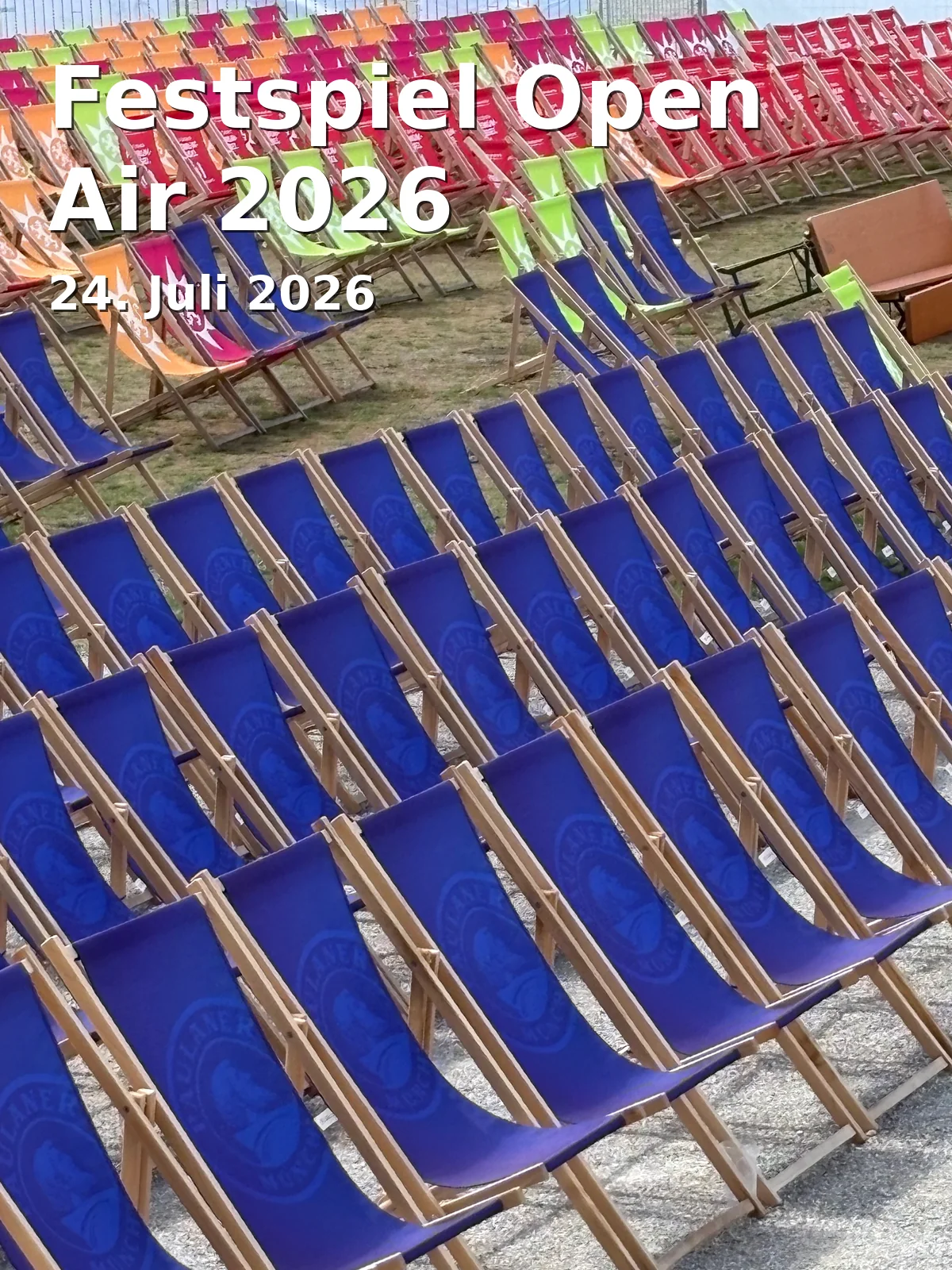
Festival Open Air 2026
Join the Festival Open Air 2026: A free concert of the festival orchestra in the picturesque festival park on July 24.
Small Gallery at the Festival Park
A special art evening at the Festival Park: Painting, printmaking, and objects meet Bayreuth's festival aura. On 07.24.2026, free. #Bayreuth #Art
Children’s Opera 2026: The Ring of the Nibelungen
A child-friendly version of Wagner's opera at the Little Festival House in Bayreuth. Ideal for families!

Wagner's Opera 'Rienzi' at the Bayreuth Festival
Visit the performance of Wagner's “Rienzi” at the Bayreuth Festival 2026. A highlight in the anniversary year!
Bayreuth Festival 2026: Rienzi
Experience Wagner's masterpiece Rienzi as part of the Bayreuth Festival 2026.
Rienzi - A Special Performance
Be part of the special anniversary performance of Wagner's "Rienzi" at the famous Bayreuth Festival Theatre.
Rienzi – Bayreuth Festival 2026
Dive into Wagner's world at the Bayreuth Festival with "Rienzi" on July 27, 2026.
The Rhinegold
Experience an innovative staging of Wagner's 'The Rhinegold' for the 150th festival anniversary in Bayreuth.
The Flying Dutchman
Visit the impressive performance of The Flying Dutchman at the Bayreuth Festival Theater. An experience for all opera lovers.
Parsifal
Experience Wagner's Parsifal in the production by Jay Scheib, a highlight of the Bayreuth Festival.
Frequently Asked Questions
Reviews
Swede Samurai
7. September 2025
Really enjoyed my evening here. The sound in the opera hall is really great. With every seat sold the theater was really fully packed, but even though the place was so crowded, the politeness and hospitality of the attendees and the staffs at the various venues lent to a very enjoyable and stress-free evening. I would recommend anyone to attend this venue. I watched Tristan and Isolde, the Performances, the staging, and choreography especially between the orchestra and the singers was unmatched, as this is one of the most difficult operas to coordinate. It was excellently done and a pleasure to experience.
Gabriel Bioinginer
25. August 2025
Beautiful opera house with amazing acoustics. The only downside is the lack of translation of the libretto… I know, many would say: ‘that’s how Wagner left it’🥹 Summer 2025: Tristan and Isolde had fabulous musical performance and Meistersinger had beautiful staging.
Carl E.
7. August 2025
Attending the Bayreuth Festival is an indelible experience for all Wagner fans and also for anyone who loves or is interested in Western culture. The productions can be uneven because of the German love of theatrical deconstructionism (Regietheater), but the music making and all the craziness surrounding the festival itself is truly something to be experienced at least once in one's life.
Frankfurt Runner #LocationScout #1001Trips
1. September 2024
The Bayreuther Festspielhaus is for all Opera enthusiasts and culture lovers. This place is worth a longer visit. Of course especially for the Wagner Opera weeks in summer. It might just be a bit tricky to get tickets, just be patient. Here are also a few very disappointing things. First of all… parking is 10€ to be paid in cash (just be aware). Also, you are not allowed to bring in bags bigger than a small handbag, also sitting pillows are not any longer allowed to bring in - you need to get them inside (if you are lucky). One last thing, a small Mineral Water (0,25l) is 5,50€. - Just a pity they take such an advantage out of their guests.
Razvan Ioan Dinca
30. July 2024
A Must-Visit in Bayreuth - Amazing and Classy Experience An amazing and classy experience! The best music and a great opera house with the best acoustics. Bayreuth is a must-visit at least once in a lifetime. And the festival - don’t miss this experience if you have the chance!