
Bayreuth
Eremitage 1, 95448 Bayreuth, Deutschland
Eremitage Bayreuth | Parking & Admission
The Eremitage in Bayreuth is not an ordinary park, but a historic site with great allure, where courtly garden art, architecture, water displays, and summer cultural events combine to create an extraordinary overall experience. The site is considered one of the highlights of the city and holds a special position among the garden facilities of the 18th century. Therefore, those searching for the Eremitage Bayreuth are looking for not just a place to walk, but a lively historical site with the Old Castle, Orangerie, Sun Temple, grottos, water features, and a park that is accessible year-round. However, the Old Castle can only be visited as part of a guided tour. For visitors, the Eremitage serves as a destination, photo motif, cultural site, and a place for quiet moments between baroque staging and natural expanses. This mixture makes it so attractive: during the day, a walk through the park landscape, in summer the water displays and events, and in the historical core, the memory of the time of the Margraves of Bayreuth. ([bayreuth-tourismus.de](https://www.bayreuth-tourismus.de/sehenswertes/gaerten-und-parks/eremitage/))
Parking and Access to the Eremitage Bayreuth
For those arriving by car, the access to the Eremitage is uncomplicated and visitor-friendly. The official visitor address is listed as Eremitage 4, 95448 Bayreuth, and there are free parking spaces for cars and buses directly at the entrance to the park. This is an important advantage, especially for families, groups, and tour buses, as one can start in close proximity to the park without long searching. Public transport is also well connected: According to the Bavarian Palace Administration, the bus runs on lines 302 and 303; one can get off at the stops “Parkplatz Eremitage” or “Eremitage.” This allows the site to be comfortably reached even without a personal vehicle. For a city walk from the Bayreuth city center, the Eremitage is also a well-connected destination, as it is located in a historically and scenically attractive area on the edge of the city and is connected to the surroundings by various paths. Those planning a visit should allow some extra time for the walk through the site, as the Eremitage reveals its charm not in passing, but in slow exploration. Even the path to the entrance, the sightlines into the park, and the first impression of castle, water, and vegetation are part of the experience. The parking situation is a real plus, as it makes the visit particularly accessible: arrive, get out, and dive directly into the historical backdrop. ([bayreuth-tourismus.de](https://www.bayreuth-tourismus.de/sehenswertes/gaerten-und-parks/eremitage/))
Admission, Opening Hours, and Tours in the Old Castle
For planning a visit, the current opening hours are particularly important. The park of the Eremitage is open continuously, allowing one to experience the site from the outside at any time of day. The Old Castle, on the other hand, follows a fixed seasonal schedule: From April to September, it is open daily from 9 AM to 6 PM, from October 1 to 12 daily from 10 AM to 4 PM, and from October 13 to March it remains closed. The Old Castle is generally closed on Mondays, except for certain holidays such as Easter Monday, May 1, Whit Monday, August 15, and October 3. Visits are only possible as part of a guided tour; these are offered every 45 minutes during the season and last about 30 minutes. The last tour time in summer is at 5:15 PM, and in early October at 3:15 PM. The admission prices are also officially set: For 2026, the Bavarian Palace Administration lists 6 euros regular and 5 euros reduced; the combined ticket “The World of Wilhelmine” for all Bayreuth sites costs 21 euros regular and 19 euros reduced. Children under 18 have free admission. Those visiting in late spring should also pay attention to the notice regarding the water display season: Due to renovation work, the start in 2026 could not take place as usual on May 1, but is expected to be postponed to the end of May. This shows that the Eremitage is also a place that is maintained and continually restored without losing its historical character. ([bayreuth-tourismus.de](https://www.bayreuth-tourismus.de/sehenswertes/gaerten-und-parks/eremitage/))
History of the Eremitage: From Forest Enclosure to Court Complex
The history of the Eremitage does not begin with a romantic park, but with a forest enclosure. In 1664, Margrave Christian Ernst had the area converted into a wildlife park and filled it with game through a drive hunt. To provide the court's guests with an impressive experience, the park was expanded and supplemented with a pleasure house, grotto, and fountain house. The decisive transformation into a courtly Eremitage was initiated by Georg Wilhelm, who used the site as a stage for an eremitic play: The margravial court staged the “simple life” of a hermitage, with monk's robes, small cells, and a consciously ascetic presentation. In 1715, the Old Castle with the Inner Grotto became the centerpiece of this complex. Another milestone followed in 1735 when Margrave Friedrich gifted the site to his wife Wilhelmine for her birthday. Wilhelmine began extensive redesigning that same year, expanding the Old Castle into a summer residence with lavish interior decor and adding rooms such as the Japanese Cabinet, the Music Room, and the Chinese Mirror Shard Cabinet. Between 1743 and 1745, further architectures and fountain systems such as the Ruin Theatre and the Lower Grotto were created; the New Castle with the Upper Grotto was built from 1749 to 1753 and completed in 1751 with the Orangerie. Thus, the Eremitage became a baroque total work of art, where garden, art, and courtly representation are closely intertwined. The name also fits historically well: Duden describes an Eremitage as a secluded grotto or as an imitation of a hermitage in park facilities of the 18th century. This is exactly how the Bayreuth site can be read today. ([bayreuth-tourismus.de](https://www.bayreuth-tourismus.de/sehenswertes/gaerten-und-parks/eremitage/))
Sun Temple, Orangerie, and Café in the Park
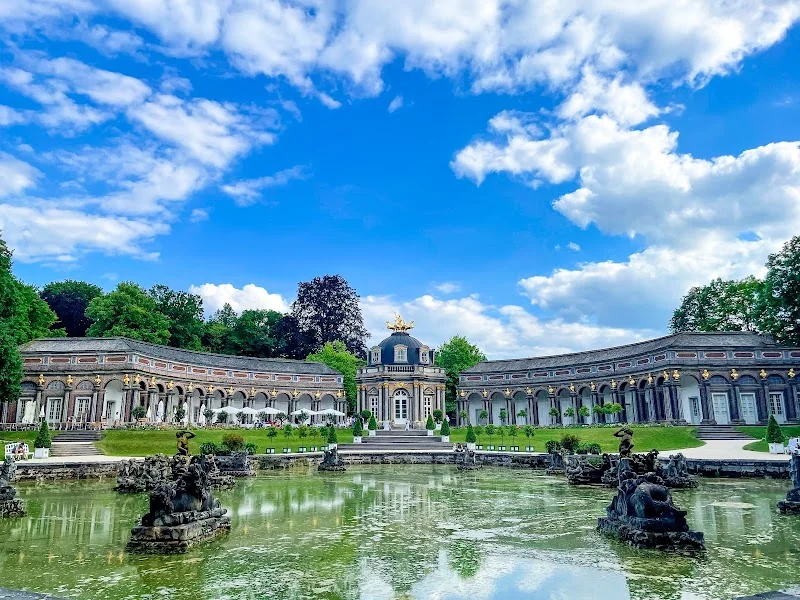
The visual heart of the Eremitage is the impressive Orangerie with the Sun Temple as its centerpiece. Even the first glance at this area shows why the site is so strongly associated with terms like baroque, fairy-tale, and romantic. The Orangerie is not only an architectural anchor but also a place to linger: In the east wing, there is a café, while the west wing regularly hosts art exhibitions during the summer months. Thus, the site fulfills several functions simultaneously: it is a monument, a destination, and a cultural space. Particularly noteworthy is the special color effect of the Sun Temple and Orangerie. The informational materials of the Bavarian Palace Administration describe that the unique coloring is created by countless colored glass stones and rock crystals that adorn the facades. These details are not mere embellishments but part of the staging that makes the place so distinctive. Those who take their time will notice how well the pathways in the park lead to this central zone: The Sun Temple sets a glorious accent, the Orangerie opens the view, and the café makes the place a pleasant stop during longer visits. Particularly for travelers searching for the keyword Eremitage Bayreuth Café, this note is important, as the café is not hidden somewhere on the edge but is located directly in the heart of the site. Thus, the Eremitage is not only a destination for historical interests but also a place for a break with atmosphere, for conversations, for a coffee between art and garden, and for a leisurely visit with a view of one of the most characteristic baroque backdrops in Bayreuth. ([bayreuth-tourismus.de](https://www.bayreuth-tourismus.de/sehenswertes/gaerten-und-parks/eremitage/))
Water Displays and the Walk Through the Park
Among the most impressive experiences of the Eremitage are the grotto and water displays. They combine technology, staging, and landscape into a visual spectacle that has shaped the site for centuries. The official description lists several stations: In the Upper Grotto in front of the Orangerie, the water displays take place hourly from May to mid-October between 10 AM and 5 PM, in the Lower Grotto 15 minutes later, and in the grotto tower of the Old Castle during the tours. Additionally, reference is made to the water tower and the Red Main, which surrounds the site and is integrated into the historical water technology. This makes the walk particularly varied, as it consists not only of views of buildings but also of a constant change of perspectives, sounds, and movements. Those who explore the Eremitage on foot do not simply experience a linear walk but a sequence of small stagings: quiet stretches of path, open garden images, surprising ruin forms, and then again the lively element of water. Baroque design elements such as hedge quarters, arcades, water displays, and artificial ruin buildings structure the site and make visible how much the Eremitage is designed for effect. That the start of the water displays in 2026 was delayed due to renovation work shows that even historical sites must be continuously maintained. For visitors, this means: A look at the current notices is always worthwhile, but the magic remains. Especially in good weather, this part of the Eremitage is one of the most impressive in Bayreuth, as it does not let the historical character become museum-like but sets it in motion. ([bayreuth-tourismus.de](https://www.bayreuth-tourismus.de/sehenswertes/gaerten-und-parks/eremitage/))
Summer Night Festival, Theater, and Film Set
The Eremitage is not only a place for history and walks but also a vibrant stage. The most famous event is the Bayreuth Summer Night Festival, whose tradition can be traced back to Margrave Friedrich and Margravine Wilhelmine. Since 1970, the Eremitage has annually become the venue for this festival in summer, which is considered one of the most beautiful and romantic events in Franconia. In this way, the modern festival consciously connects to the courtly festival culture of the past. This profile is complemented by regular theater performances of the studio stage in the old Roman theater and on the stage at the water tower; the historical backdrop gives pieces from the Brothers Grimm to Shakespeare a special atmosphere. Additionally, the Eremitage is also known as a film set. The Bayreuth tourism site lists it as a filming location for the Netflix production The Empress, in which, among other things, the Marble Hall in the Old Castle, the arcades, the Lower Grotto, and other areas of the site can be seen. This is an additional incentive for many visitors, as one can compare well-known series images with the real architecture. Furthermore, the Eremitage serves as an event location: It is officially listed for 80 people, and the room table includes, among others, the Sun Temple with 40 m² and the west wing with 140 m². This shows that the site remains interesting not only for tourism but also for smaller events, celebrations, and special occasions. For search queries related to Eremitage Bayreuth events, this is the central message: Here, a historical park lives not only from its past but also from its continued use as a cultural and experiential space. ([bayreuth-tourismus.de](https://www.bayreuth-tourismus.de/sehenswertes/gaerten-und-parks/eremitage/))
Sources:
Show moreShow less
Eremitage Bayreuth | Parking & Admission
The Eremitage in Bayreuth is not an ordinary park, but a historic site with great allure, where courtly garden art, architecture, water displays, and summer cultural events combine to create an extraordinary overall experience. The site is considered one of the highlights of the city and holds a special position among the garden facilities of the 18th century. Therefore, those searching for the Eremitage Bayreuth are looking for not just a place to walk, but a lively historical site with the Old Castle, Orangerie, Sun Temple, grottos, water features, and a park that is accessible year-round. However, the Old Castle can only be visited as part of a guided tour. For visitors, the Eremitage serves as a destination, photo motif, cultural site, and a place for quiet moments between baroque staging and natural expanses. This mixture makes it so attractive: during the day, a walk through the park landscape, in summer the water displays and events, and in the historical core, the memory of the time of the Margraves of Bayreuth. ([bayreuth-tourismus.de](https://www.bayreuth-tourismus.de/sehenswertes/gaerten-und-parks/eremitage/))
Parking and Access to the Eremitage Bayreuth
For those arriving by car, the access to the Eremitage is uncomplicated and visitor-friendly. The official visitor address is listed as Eremitage 4, 95448 Bayreuth, and there are free parking spaces for cars and buses directly at the entrance to the park. This is an important advantage, especially for families, groups, and tour buses, as one can start in close proximity to the park without long searching. Public transport is also well connected: According to the Bavarian Palace Administration, the bus runs on lines 302 and 303; one can get off at the stops “Parkplatz Eremitage” or “Eremitage.” This allows the site to be comfortably reached even without a personal vehicle. For a city walk from the Bayreuth city center, the Eremitage is also a well-connected destination, as it is located in a historically and scenically attractive area on the edge of the city and is connected to the surroundings by various paths. Those planning a visit should allow some extra time for the walk through the site, as the Eremitage reveals its charm not in passing, but in slow exploration. Even the path to the entrance, the sightlines into the park, and the first impression of castle, water, and vegetation are part of the experience. The parking situation is a real plus, as it makes the visit particularly accessible: arrive, get out, and dive directly into the historical backdrop. ([bayreuth-tourismus.de](https://www.bayreuth-tourismus.de/sehenswertes/gaerten-und-parks/eremitage/))
Admission, Opening Hours, and Tours in the Old Castle
For planning a visit, the current opening hours are particularly important. The park of the Eremitage is open continuously, allowing one to experience the site from the outside at any time of day. The Old Castle, on the other hand, follows a fixed seasonal schedule: From April to September, it is open daily from 9 AM to 6 PM, from October 1 to 12 daily from 10 AM to 4 PM, and from October 13 to March it remains closed. The Old Castle is generally closed on Mondays, except for certain holidays such as Easter Monday, May 1, Whit Monday, August 15, and October 3. Visits are only possible as part of a guided tour; these are offered every 45 minutes during the season and last about 30 minutes. The last tour time in summer is at 5:15 PM, and in early October at 3:15 PM. The admission prices are also officially set: For 2026, the Bavarian Palace Administration lists 6 euros regular and 5 euros reduced; the combined ticket “The World of Wilhelmine” for all Bayreuth sites costs 21 euros regular and 19 euros reduced. Children under 18 have free admission. Those visiting in late spring should also pay attention to the notice regarding the water display season: Due to renovation work, the start in 2026 could not take place as usual on May 1, but is expected to be postponed to the end of May. This shows that the Eremitage is also a place that is maintained and continually restored without losing its historical character. ([bayreuth-tourismus.de](https://www.bayreuth-tourismus.de/sehenswertes/gaerten-und-parks/eremitage/))
History of the Eremitage: From Forest Enclosure to Court Complex
The history of the Eremitage does not begin with a romantic park, but with a forest enclosure. In 1664, Margrave Christian Ernst had the area converted into a wildlife park and filled it with game through a drive hunt. To provide the court's guests with an impressive experience, the park was expanded and supplemented with a pleasure house, grotto, and fountain house. The decisive transformation into a courtly Eremitage was initiated by Georg Wilhelm, who used the site as a stage for an eremitic play: The margravial court staged the “simple life” of a hermitage, with monk's robes, small cells, and a consciously ascetic presentation. In 1715, the Old Castle with the Inner Grotto became the centerpiece of this complex. Another milestone followed in 1735 when Margrave Friedrich gifted the site to his wife Wilhelmine for her birthday. Wilhelmine began extensive redesigning that same year, expanding the Old Castle into a summer residence with lavish interior decor and adding rooms such as the Japanese Cabinet, the Music Room, and the Chinese Mirror Shard Cabinet. Between 1743 and 1745, further architectures and fountain systems such as the Ruin Theatre and the Lower Grotto were created; the New Castle with the Upper Grotto was built from 1749 to 1753 and completed in 1751 with the Orangerie. Thus, the Eremitage became a baroque total work of art, where garden, art, and courtly representation are closely intertwined. The name also fits historically well: Duden describes an Eremitage as a secluded grotto or as an imitation of a hermitage in park facilities of the 18th century. This is exactly how the Bayreuth site can be read today. ([bayreuth-tourismus.de](https://www.bayreuth-tourismus.de/sehenswertes/gaerten-und-parks/eremitage/))
Sun Temple, Orangerie, and Café in the Park
The visual heart of the Eremitage is the impressive Orangerie with the Sun Temple as its centerpiece. Even the first glance at this area shows why the site is so strongly associated with terms like baroque, fairy-tale, and romantic. The Orangerie is not only an architectural anchor but also a place to linger: In the east wing, there is a café, while the west wing regularly hosts art exhibitions during the summer months. Thus, the site fulfills several functions simultaneously: it is a monument, a destination, and a cultural space. Particularly noteworthy is the special color effect of the Sun Temple and Orangerie. The informational materials of the Bavarian Palace Administration describe that the unique coloring is created by countless colored glass stones and rock crystals that adorn the facades. These details are not mere embellishments but part of the staging that makes the place so distinctive. Those who take their time will notice how well the pathways in the park lead to this central zone: The Sun Temple sets a glorious accent, the Orangerie opens the view, and the café makes the place a pleasant stop during longer visits. Particularly for travelers searching for the keyword Eremitage Bayreuth Café, this note is important, as the café is not hidden somewhere on the edge but is located directly in the heart of the site. Thus, the Eremitage is not only a destination for historical interests but also a place for a break with atmosphere, for conversations, for a coffee between art and garden, and for a leisurely visit with a view of one of the most characteristic baroque backdrops in Bayreuth. ([bayreuth-tourismus.de](https://www.bayreuth-tourismus.de/sehenswertes/gaerten-und-parks/eremitage/))
Water Displays and the Walk Through the Park
Among the most impressive experiences of the Eremitage are the grotto and water displays. They combine technology, staging, and landscape into a visual spectacle that has shaped the site for centuries. The official description lists several stations: In the Upper Grotto in front of the Orangerie, the water displays take place hourly from May to mid-October between 10 AM and 5 PM, in the Lower Grotto 15 minutes later, and in the grotto tower of the Old Castle during the tours. Additionally, reference is made to the water tower and the Red Main, which surrounds the site and is integrated into the historical water technology. This makes the walk particularly varied, as it consists not only of views of buildings but also of a constant change of perspectives, sounds, and movements. Those who explore the Eremitage on foot do not simply experience a linear walk but a sequence of small stagings: quiet stretches of path, open garden images, surprising ruin forms, and then again the lively element of water. Baroque design elements such as hedge quarters, arcades, water displays, and artificial ruin buildings structure the site and make visible how much the Eremitage is designed for effect. That the start of the water displays in 2026 was delayed due to renovation work shows that even historical sites must be continuously maintained. For visitors, this means: A look at the current notices is always worthwhile, but the magic remains. Especially in good weather, this part of the Eremitage is one of the most impressive in Bayreuth, as it does not let the historical character become museum-like but sets it in motion. ([bayreuth-tourismus.de](https://www.bayreuth-tourismus.de/sehenswertes/gaerten-und-parks/eremitage/))
Summer Night Festival, Theater, and Film Set
The Eremitage is not only a place for history and walks but also a vibrant stage. The most famous event is the Bayreuth Summer Night Festival, whose tradition can be traced back to Margrave Friedrich and Margravine Wilhelmine. Since 1970, the Eremitage has annually become the venue for this festival in summer, which is considered one of the most beautiful and romantic events in Franconia. In this way, the modern festival consciously connects to the courtly festival culture of the past. This profile is complemented by regular theater performances of the studio stage in the old Roman theater and on the stage at the water tower; the historical backdrop gives pieces from the Brothers Grimm to Shakespeare a special atmosphere. Additionally, the Eremitage is also known as a film set. The Bayreuth tourism site lists it as a filming location for the Netflix production The Empress, in which, among other things, the Marble Hall in the Old Castle, the arcades, the Lower Grotto, and other areas of the site can be seen. This is an additional incentive for many visitors, as one can compare well-known series images with the real architecture. Furthermore, the Eremitage serves as an event location: It is officially listed for 80 people, and the room table includes, among others, the Sun Temple with 40 m² and the west wing with 140 m². This shows that the site remains interesting not only for tourism but also for smaller events, celebrations, and special occasions. For search queries related to Eremitage Bayreuth events, this is the central message: Here, a historical park lives not only from its past but also from its continued use as a cultural and experiential space. ([bayreuth-tourismus.de](https://www.bayreuth-tourismus.de/sehenswertes/gaerten-und-parks/eremitage/))
Sources:
Eremitage Bayreuth | Parking & Admission
The Eremitage in Bayreuth is not an ordinary park, but a historic site with great allure, where courtly garden art, architecture, water displays, and summer cultural events combine to create an extraordinary overall experience. The site is considered one of the highlights of the city and holds a special position among the garden facilities of the 18th century. Therefore, those searching for the Eremitage Bayreuth are looking for not just a place to walk, but a lively historical site with the Old Castle, Orangerie, Sun Temple, grottos, water features, and a park that is accessible year-round. However, the Old Castle can only be visited as part of a guided tour. For visitors, the Eremitage serves as a destination, photo motif, cultural site, and a place for quiet moments between baroque staging and natural expanses. This mixture makes it so attractive: during the day, a walk through the park landscape, in summer the water displays and events, and in the historical core, the memory of the time of the Margraves of Bayreuth. ([bayreuth-tourismus.de](https://www.bayreuth-tourismus.de/sehenswertes/gaerten-und-parks/eremitage/))
Parking and Access to the Eremitage Bayreuth
For those arriving by car, the access to the Eremitage is uncomplicated and visitor-friendly. The official visitor address is listed as Eremitage 4, 95448 Bayreuth, and there are free parking spaces for cars and buses directly at the entrance to the park. This is an important advantage, especially for families, groups, and tour buses, as one can start in close proximity to the park without long searching. Public transport is also well connected: According to the Bavarian Palace Administration, the bus runs on lines 302 and 303; one can get off at the stops “Parkplatz Eremitage” or “Eremitage.” This allows the site to be comfortably reached even without a personal vehicle. For a city walk from the Bayreuth city center, the Eremitage is also a well-connected destination, as it is located in a historically and scenically attractive area on the edge of the city and is connected to the surroundings by various paths. Those planning a visit should allow some extra time for the walk through the site, as the Eremitage reveals its charm not in passing, but in slow exploration. Even the path to the entrance, the sightlines into the park, and the first impression of castle, water, and vegetation are part of the experience. The parking situation is a real plus, as it makes the visit particularly accessible: arrive, get out, and dive directly into the historical backdrop. ([bayreuth-tourismus.de](https://www.bayreuth-tourismus.de/sehenswertes/gaerten-und-parks/eremitage/))
Admission, Opening Hours, and Tours in the Old Castle
For planning a visit, the current opening hours are particularly important. The park of the Eremitage is open continuously, allowing one to experience the site from the outside at any time of day. The Old Castle, on the other hand, follows a fixed seasonal schedule: From April to September, it is open daily from 9 AM to 6 PM, from October 1 to 12 daily from 10 AM to 4 PM, and from October 13 to March it remains closed. The Old Castle is generally closed on Mondays, except for certain holidays such as Easter Monday, May 1, Whit Monday, August 15, and October 3. Visits are only possible as part of a guided tour; these are offered every 45 minutes during the season and last about 30 minutes. The last tour time in summer is at 5:15 PM, and in early October at 3:15 PM. The admission prices are also officially set: For 2026, the Bavarian Palace Administration lists 6 euros regular and 5 euros reduced; the combined ticket “The World of Wilhelmine” for all Bayreuth sites costs 21 euros regular and 19 euros reduced. Children under 18 have free admission. Those visiting in late spring should also pay attention to the notice regarding the water display season: Due to renovation work, the start in 2026 could not take place as usual on May 1, but is expected to be postponed to the end of May. This shows that the Eremitage is also a place that is maintained and continually restored without losing its historical character. ([bayreuth-tourismus.de](https://www.bayreuth-tourismus.de/sehenswertes/gaerten-und-parks/eremitage/))
History of the Eremitage: From Forest Enclosure to Court Complex
The history of the Eremitage does not begin with a romantic park, but with a forest enclosure. In 1664, Margrave Christian Ernst had the area converted into a wildlife park and filled it with game through a drive hunt. To provide the court's guests with an impressive experience, the park was expanded and supplemented with a pleasure house, grotto, and fountain house. The decisive transformation into a courtly Eremitage was initiated by Georg Wilhelm, who used the site as a stage for an eremitic play: The margravial court staged the “simple life” of a hermitage, with monk's robes, small cells, and a consciously ascetic presentation. In 1715, the Old Castle with the Inner Grotto became the centerpiece of this complex. Another milestone followed in 1735 when Margrave Friedrich gifted the site to his wife Wilhelmine for her birthday. Wilhelmine began extensive redesigning that same year, expanding the Old Castle into a summer residence with lavish interior decor and adding rooms such as the Japanese Cabinet, the Music Room, and the Chinese Mirror Shard Cabinet. Between 1743 and 1745, further architectures and fountain systems such as the Ruin Theatre and the Lower Grotto were created; the New Castle with the Upper Grotto was built from 1749 to 1753 and completed in 1751 with the Orangerie. Thus, the Eremitage became a baroque total work of art, where garden, art, and courtly representation are closely intertwined. The name also fits historically well: Duden describes an Eremitage as a secluded grotto or as an imitation of a hermitage in park facilities of the 18th century. This is exactly how the Bayreuth site can be read today. ([bayreuth-tourismus.de](https://www.bayreuth-tourismus.de/sehenswertes/gaerten-und-parks/eremitage/))
Sun Temple, Orangerie, and Café in the Park
The visual heart of the Eremitage is the impressive Orangerie with the Sun Temple as its centerpiece. Even the first glance at this area shows why the site is so strongly associated with terms like baroque, fairy-tale, and romantic. The Orangerie is not only an architectural anchor but also a place to linger: In the east wing, there is a café, while the west wing regularly hosts art exhibitions during the summer months. Thus, the site fulfills several functions simultaneously: it is a monument, a destination, and a cultural space. Particularly noteworthy is the special color effect of the Sun Temple and Orangerie. The informational materials of the Bavarian Palace Administration describe that the unique coloring is created by countless colored glass stones and rock crystals that adorn the facades. These details are not mere embellishments but part of the staging that makes the place so distinctive. Those who take their time will notice how well the pathways in the park lead to this central zone: The Sun Temple sets a glorious accent, the Orangerie opens the view, and the café makes the place a pleasant stop during longer visits. Particularly for travelers searching for the keyword Eremitage Bayreuth Café, this note is important, as the café is not hidden somewhere on the edge but is located directly in the heart of the site. Thus, the Eremitage is not only a destination for historical interests but also a place for a break with atmosphere, for conversations, for a coffee between art and garden, and for a leisurely visit with a view of one of the most characteristic baroque backdrops in Bayreuth. ([bayreuth-tourismus.de](https://www.bayreuth-tourismus.de/sehenswertes/gaerten-und-parks/eremitage/))
Water Displays and the Walk Through the Park
Among the most impressive experiences of the Eremitage are the grotto and water displays. They combine technology, staging, and landscape into a visual spectacle that has shaped the site for centuries. The official description lists several stations: In the Upper Grotto in front of the Orangerie, the water displays take place hourly from May to mid-October between 10 AM and 5 PM, in the Lower Grotto 15 minutes later, and in the grotto tower of the Old Castle during the tours. Additionally, reference is made to the water tower and the Red Main, which surrounds the site and is integrated into the historical water technology. This makes the walk particularly varied, as it consists not only of views of buildings but also of a constant change of perspectives, sounds, and movements. Those who explore the Eremitage on foot do not simply experience a linear walk but a sequence of small stagings: quiet stretches of path, open garden images, surprising ruin forms, and then again the lively element of water. Baroque design elements such as hedge quarters, arcades, water displays, and artificial ruin buildings structure the site and make visible how much the Eremitage is designed for effect. That the start of the water displays in 2026 was delayed due to renovation work shows that even historical sites must be continuously maintained. For visitors, this means: A look at the current notices is always worthwhile, but the magic remains. Especially in good weather, this part of the Eremitage is one of the most impressive in Bayreuth, as it does not let the historical character become museum-like but sets it in motion. ([bayreuth-tourismus.de](https://www.bayreuth-tourismus.de/sehenswertes/gaerten-und-parks/eremitage/))
Summer Night Festival, Theater, and Film Set
The Eremitage is not only a place for history and walks but also a vibrant stage. The most famous event is the Bayreuth Summer Night Festival, whose tradition can be traced back to Margrave Friedrich and Margravine Wilhelmine. Since 1970, the Eremitage has annually become the venue for this festival in summer, which is considered one of the most beautiful and romantic events in Franconia. In this way, the modern festival consciously connects to the courtly festival culture of the past. This profile is complemented by regular theater performances of the studio stage in the old Roman theater and on the stage at the water tower; the historical backdrop gives pieces from the Brothers Grimm to Shakespeare a special atmosphere. Additionally, the Eremitage is also known as a film set. The Bayreuth tourism site lists it as a filming location for the Netflix production The Empress, in which, among other things, the Marble Hall in the Old Castle, the arcades, the Lower Grotto, and other areas of the site can be seen. This is an additional incentive for many visitors, as one can compare well-known series images with the real architecture. Furthermore, the Eremitage serves as an event location: It is officially listed for 80 people, and the room table includes, among others, the Sun Temple with 40 m² and the west wing with 140 m². This shows that the site remains interesting not only for tourism but also for smaller events, celebrations, and special occasions. For search queries related to Eremitage Bayreuth events, this is the central message: Here, a historical park lives not only from its past but also from its continued use as a cultural and experiential space. ([bayreuth-tourismus.de](https://www.bayreuth-tourismus.de/sehenswertes/gaerten-und-parks/eremitage/))
Sources:
Upcoming Events
Wagner and His Contemporaries
Visit the summer matinee of the Bayreuth Orchestra Association in the Park of the Eremitage and enjoy Wagner arrangements.

International Bat Night 2026
A special evening in Bayreuth: During the International Bat Night at the Eremitage, visitors listen to bats with detectors. Free, nature-oriented, exciting. #Bayreuth #BatNight
Frequently Asked Questions
Reviews
Philip Smith
23. September 2025
Beautiful grounds a short drive away from Bayreuth. Spend a few hours wandering around very peaceful and serene landscapes and enjoy watching the fountains (be careful with the grotto or else you'll get wet when those fountains start!). There is a cafe on site for food and drink as well. Free entry and also plenty of free parking available.
Uplander Góral
3. August 2025
We visited the Eermitage because we love palaces, and especially the gardens surrounding them. Before arriving, we carefully reviewed maps and websites, checking the attractiveness of the place in terms of landscape architecture, both large and small. Upon arrival, we were shocked; what we saw exceeded our expectations and imaginations. I'll start with the convenient and spacious parking lot right at the park entrance. Beyond the gate, a different world begins: a world of paths, water, fountains, and secluded romantic spots. The new palace, the old palace, the Chinese pavilion, the orangery, the dragon's cave, lakes, streams, waterfalls, canals, and many other charming and beautiful places, all nestled among the greenery and miles of park paths. The entire experience captivated us. The park is very extensive, and we got a little lost, traversing some of the paths several times. Although there are information boards and signposts, we felt they were a bit lacking. A brochure with a park map would have been very helpful. The parking lot lacked a designated spot for a camper. We visited the park in May and will definitely return in the fall because it's a beautiful, charming, interesting, and noteworthy place.
Gabriel Bioinginer
21. October 2025
Beautiful gardens and very well looked after. The ideal place for a walk while being in Bayreuth… no admission fees 🙂
Israa Samir
14. September 2025
This place is just breathtaking! From the buildings, details to the gardens (yes, they are multiple). I had the best two occasions in my life celebrated there and will always be close to my heart.
Tadib Jobair
14. December 2024
Really nice garden for sightseers and pass 3 hours with family. Well maintained, though the water fountains were closed and covered during winter time. There is a big parking for free beside the garden.