
Bayreuth
Ludwigstraße 29, 95444 Bayreuth, Deutschland
Evangelical Family Education Center Bayreuth | Program & Registration
The Evangelical Family Education Center plus Multigenerational House Bayreuth is one of the central contact points for family education in the city. It combines courses, counseling, intergenerational encounters, and practical help in everyday life. As a recognized institution for adult and family education under the sponsorship of the Evangelical Lutheran Community Church Bayreuth, it is certified according to quality management QVB and is open to people of all ages and cultures. Those looking for a place where parents, children, grandparents, single parents, and interested parties can come together will find a house with a clear stance, a wide range of offerings, and a long history. Even the structure of the website shows how much comes together at one location: program, multigenerational house, family support center, service areas, and current announcements. This is particularly practical for visitors, as they can quickly switch between course offerings, counseling, and background information without losing the thread. ([fbs.bayreuth.org](https://www.fbs.bayreuth.org/))
Program, Courses, and Registration in Bayreuth
The heart of public perception is the program of the Family Education Center. The official program page clearly states that the booklet is published twice a year: at the beginning of December for the course offerings of the following year in spring and summer, and at the beginning of July for the offerings in autumn of the current year. Those interested in a course should check the page early, as some offerings are known to fill up quickly. This interplay of annual program, online search, and direct registration makes the institution practical for families, adults, and groups. For orientation, there is a search function for courses and offerings on the website, and the complete program booklet can also be downloaded. Registration is possible via the homepage, by phone, or in person. ([fbs.bayreuth.org](https://www.fbs.bayreuth.org/))
Content-wise, the spectrum is broad and clearly focused on families, education, and practical life assistance. The program page mentions, among other things, children's courses and ballet, seminars on education, health, competence, and media, parent-child courses, sewing and creative courses, lectures, events, and flea markets, as well as offerings for single parents and digital topics. The homepage complements this variety with current highlights such as infant care, first aid for toddlers, healthy breakfast, bioidentical hormone counseling, and a Greek fairy tale cooking class. This makes it clear that the institution not only offers classic family education but also everyday learning and encounter formats that address very different life situations. The mix of early childhood support, parent empowerment, health education, and creative offerings makes the location a true educational and meeting center. ([fbs.bayreuth.org](https://www.fbs.bayreuth.org/programm/))
Multigenerational House and Family Support Center: Offerings for All Generations
The multigenerational house is a central unique feature of the institution. The official multigenerational house page describes the place as a meeting space where the coexistence of generations is actively lived. There is space for seminars, courses, counseling, support, joint activities, and encounters. Openness is particularly important: the multigenerational house is open to all people, regardless of age or origin. This attitude is also reflected in the self-description of the institution on the homepage, where it is emphasized that pregnant women, mothers, fathers, children, single parents, seniors, and families with and without a migration background are supported. The institution thus sees itself not only as a course provider but as a social place where encounter, exchange, and concrete help come together. ([fbs.bayreuth.org](https://www.fbs.bayreuth.org/mehrgenerationenhaus/))
Under the roof of the multigenerational house, numerous concrete offerings gather that are immediately tangible in the everyday lives of visitors. The website features, among other things, a stork café, an open children's bookshelf, media consultation, babysitter & nanny services, offerings at Menzelplatz, open all-day school, family support center, consumer support center, counseling for single parents, early childhood counseling, health offerings, and a St. Nicholas service. The city of Bayreuth adds to this perspective with further information: lectures and seminars, birth preparation, writing counseling, practical help for families after birth, intergenerational offerings, creative courses, meeting points for single parents, volunteer mediation, daytime meeting points in the stork café, a café meeting for dementia, and a babysitter exchange are mentioned. This mix makes the location particularly interesting, as it is not about a single format but about a network of help, education, and community. This makes the institution relevant for very different target groups, from new parents to grandparents, from digitally inexperienced individuals to those simply seeking an open place for exchange. ([fbs.bayreuth.org](https://www.fbs.bayreuth.org/mehrgenerationenhaus/))
Address, Opening Hours, and Central Location on Ludwigstraße
The location is at Ludwigstraße 29 in 95444 Bayreuth. The official contact page directly states this address, and the city of Bayreuth lists the same location in the area of family education with a city map reference. This is helpful for visitors because it clearly places the institution in the urban context. The term central location is not just a marketing phrase but is also explicitly used on the city page. Therefore, those looking for the Family Education Center will find a well-accessible house on a well-known street in the Bayreuth city center. Additionally, it is useful for orientation that the website refers to online registration, making the visit well-planned in advance. ([fbs.bayreuth.org](https://www.fbs.bayreuth.org/infos/kontakt-ansprechpartner/))
The opening hours are clearly structured and practical for everyday life. It is open Monday to Friday from 09:30 to 12:30, additionally Monday, Tuesday, and Thursday from 14:30 to 17:30, and Wednesday from 14:30 to 16:30. The website also points out that opening hours may vary during school holidays. This transparency is valuable, especially for families with tight schedules, as registrations, inquiries, and consultations can be well integrated into everyday life. Those who prefer to contact by phone or email will also find the appropriate information on the contact page. This also speaks for a practical organization: the institution relies not only on programs but also on reliable accessibility. Combined with the central address, this creates a place that appears both structured and easily accessible. ([fbs.bayreuth.org](https://www.fbs.bayreuth.org/infos/kontakt-ansprechpartner/))
The Stork House: History, Renovation, and Remembrance
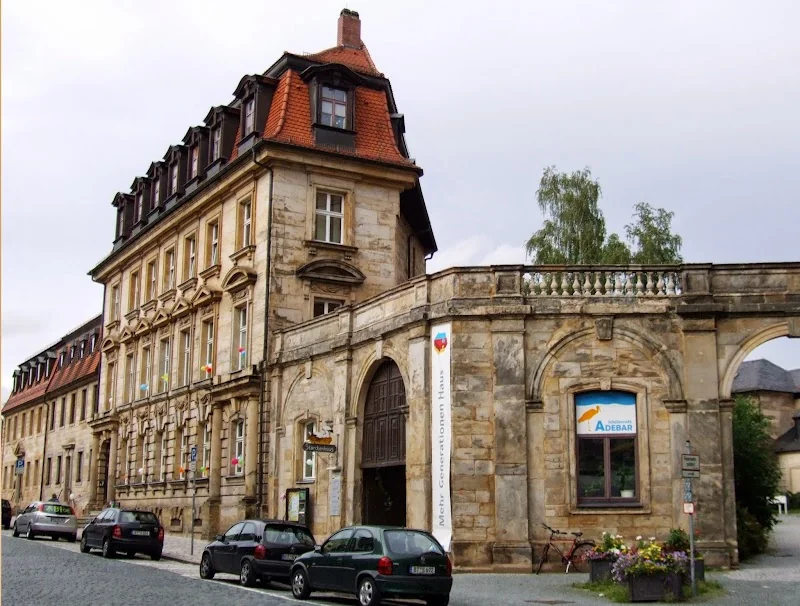
Visitors to the Family Education Center Bayreuth enter a house with a remarkable history. The official about us page describes the Stork House as a building from the year 1758, designed by the margravial master builder Carl Gontard. The page also explains that the unusual, narrow floor plan is related to the urban planning situation at the time. The architect combined Rococo forms with early neoclassical elements and later influenced other buildings in Potsdam and Berlin. The house only received its name in the 19th century when, according to reports, storks actually nested there. This origin already makes it clear that the location is more than just a functional educational building: it is a historic town house with its own character and high recognition value. ([fbs.bayreuth.org](https://www.fbs.bayreuth.org/infos/ueber-uns/))
However, the history of the Stork House also has a serious side. The website remembers the Jewish owners Josef and Rosette Weinberger, who were forced to sell the house to the Evangelical Community Church Administration in 1940, and their later fate in Theresienstadt. The former Reichstag member Friedrich Puchta, who lived in the house and died in 1945, is also mentioned. This culture of remembrance is part of the house and is not overlooked. At the same time, the house's history shows that the building urgently needed renovation and remodeling in 2004 and 2005. At that time, a barrier-free courtyard with access to the administration and course rooms was created, and a modern registration area was established. In this way, a historic building was transformed into a contemporary learning and meeting place without losing the character of the house. In 2009, a memorial plaque was added to keep the history visible and mark the place as a space for remembrance. ([fbs.bayreuth.org](https://www.fbs.bayreuth.org/infos/ueber-uns/))
Target Groups, Pedagogy, and Everyday Service
The pedagogical self-presentation of the institution is clear and practice-oriented. The official texts describe that the Family Education Center accompanies families from the time before birth through babies and toddlers to adulthood and also into the transition to senior age. The heart of the center is the diverse parent-child groups. The pedagogical concept also emphasizes that the institution works preventively and resource-oriented, strengthening existing abilities rather than just addressing problems. Cultural diversity, inclusion, single parents, and blended families also play a role. The offerings aim to promote parenting competence, independent thinking, and social responsibility. This fundamental attitude is particularly important for a family education center because it explains why not only courses but also counseling, exchange, and low-threshold support take place there. ([fbs.bayreuth.org](https://www.fbs.bayreuth.org/wp-content/uploads/2024/01/fps-paedagogisches-konzept.pdf))
The practical organization includes a clearly named team and a comprehensible responsibility structure. The contact page lists Stefanie Ogurok as management and overall pedagogical leadership, Andrea Ertl as deputy head for the multigenerational house, single parents, and family support center, Petra Bogner as a pedagogical staff member, and Tobias Sellner as head of the open all-day school; in administration, Jennifer Schreiner, Martina Schmittroth, and Melanie Kurz work. This also conveys reliability: those with questions about courses, offerings, or responsibilities can quickly find the right contact point. The homepage additionally emphasizes that inquiries and registrations are welcome. Especially in connection with the program, service pages, and recurring offerings, a place is created that not only bundles events but also provides orientation. For visitors, this is particularly pleasant because they do not have to search among many scattered institutions but can cover several topics of family life at a central location. ([fbs.bayreuth.org](https://www.fbs.bayreuth.org/infos/kontakt-ansprechpartner/))
What Visitors Can Experience On-Site
The website makes it clear that visiting the Family Education Center is not limited to a single hall or offering. Some programs take place in the Stork House, others in the Löhe House, and still others in St. Georgen or at Menzelplatz. This shows how closely the institution is networked with various locations in the Bayreuth urban area. For visitors, this means: depending on the course or topic, the venue may vary, but the organizational center remains the Family Education Center with its clear program structure. Current examples such as infant care in the Stork House, healthy breakfast in the Löhe House, or first aid for toddlers in St. Georgen make this variety visible. This creates a vibrant educational landscape in which the Family Education Center acts as a coordinating center. ([fbs.bayreuth.org](https://www.fbs.bayreuth.org/))
Content-wise, the place is tailored to different needs. Those coming with small children will find parent-child courses, infant care, babysitter offerings, early assistance, and family-oriented counseling. Those interested in personal development will encounter seminars on education, health, personality, creativity, media, and digital topics. Those seeking exchange will find meeting points, discussion groups, the stork café, and intergenerational formats. And those who simply want an overview can browse the program on the website, download the booklet, and register by phone or online. The house thus does not come across as anonymous but rather personal and well-organized. This combination of historical atmosphere, social openness, and modern program structure makes the Evangelical Family Education Center plus Multigenerational House Bayreuth a particularly versatile address in the city. ([fbs.bayreuth.org](https://www.fbs.bayreuth.org/programm/))
Sources:
- Family Education Bayreuth - Official Website ([fbs.bayreuth.org](https://www.fbs.bayreuth.org/))
- Contact & Contacts - Family Education Center Bayreuth ([fbs.bayreuth.org](https://www.fbs.bayreuth.org/infos/kontakt-ansprechpartner/))
- About Us - Family Education Center Bayreuth ([fbs.bayreuth.org](https://www.fbs.bayreuth.org/infos/ueber-uns/))
- City of Bayreuth - Multigenerational House Bayreuth ([bayreuth.de](https://www.bayreuth.de/rathaus-buergerservice/leben-in-bayreuth/senioren/mehrgenerationenhaus/))
- Program - Family Education Center Bayreuth ([fbs.bayreuth.org](https://www.fbs.bayreuth.org/programm/))
- Pedagogical Concept - Family Education Center Bayreuth ([fbs.bayreuth.org](https://www.fbs.bayreuth.org/wp-content/uploads/2024/01/fps-paedagogisches-konzept.pdf))
Show moreShow less
Evangelical Family Education Center Bayreuth | Program & Registration
The Evangelical Family Education Center plus Multigenerational House Bayreuth is one of the central contact points for family education in the city. It combines courses, counseling, intergenerational encounters, and practical help in everyday life. As a recognized institution for adult and family education under the sponsorship of the Evangelical Lutheran Community Church Bayreuth, it is certified according to quality management QVB and is open to people of all ages and cultures. Those looking for a place where parents, children, grandparents, single parents, and interested parties can come together will find a house with a clear stance, a wide range of offerings, and a long history. Even the structure of the website shows how much comes together at one location: program, multigenerational house, family support center, service areas, and current announcements. This is particularly practical for visitors, as they can quickly switch between course offerings, counseling, and background information without losing the thread. ([fbs.bayreuth.org](https://www.fbs.bayreuth.org/))
Program, Courses, and Registration in Bayreuth
The heart of public perception is the program of the Family Education Center. The official program page clearly states that the booklet is published twice a year: at the beginning of December for the course offerings of the following year in spring and summer, and at the beginning of July for the offerings in autumn of the current year. Those interested in a course should check the page early, as some offerings are known to fill up quickly. This interplay of annual program, online search, and direct registration makes the institution practical for families, adults, and groups. For orientation, there is a search function for courses and offerings on the website, and the complete program booklet can also be downloaded. Registration is possible via the homepage, by phone, or in person. ([fbs.bayreuth.org](https://www.fbs.bayreuth.org/))
Content-wise, the spectrum is broad and clearly focused on families, education, and practical life assistance. The program page mentions, among other things, children's courses and ballet, seminars on education, health, competence, and media, parent-child courses, sewing and creative courses, lectures, events, and flea markets, as well as offerings for single parents and digital topics. The homepage complements this variety with current highlights such as infant care, first aid for toddlers, healthy breakfast, bioidentical hormone counseling, and a Greek fairy tale cooking class. This makes it clear that the institution not only offers classic family education but also everyday learning and encounter formats that address very different life situations. The mix of early childhood support, parent empowerment, health education, and creative offerings makes the location a true educational and meeting center. ([fbs.bayreuth.org](https://www.fbs.bayreuth.org/programm/))
Multigenerational House and Family Support Center: Offerings for All Generations
The multigenerational house is a central unique feature of the institution. The official multigenerational house page describes the place as a meeting space where the coexistence of generations is actively lived. There is space for seminars, courses, counseling, support, joint activities, and encounters. Openness is particularly important: the multigenerational house is open to all people, regardless of age or origin. This attitude is also reflected in the self-description of the institution on the homepage, where it is emphasized that pregnant women, mothers, fathers, children, single parents, seniors, and families with and without a migration background are supported. The institution thus sees itself not only as a course provider but as a social place where encounter, exchange, and concrete help come together. ([fbs.bayreuth.org](https://www.fbs.bayreuth.org/mehrgenerationenhaus/))
Under the roof of the multigenerational house, numerous concrete offerings gather that are immediately tangible in the everyday lives of visitors. The website features, among other things, a stork café, an open children's bookshelf, media consultation, babysitter & nanny services, offerings at Menzelplatz, open all-day school, family support center, consumer support center, counseling for single parents, early childhood counseling, health offerings, and a St. Nicholas service. The city of Bayreuth adds to this perspective with further information: lectures and seminars, birth preparation, writing counseling, practical help for families after birth, intergenerational offerings, creative courses, meeting points for single parents, volunteer mediation, daytime meeting points in the stork café, a café meeting for dementia, and a babysitter exchange are mentioned. This mix makes the location particularly interesting, as it is not about a single format but about a network of help, education, and community. This makes the institution relevant for very different target groups, from new parents to grandparents, from digitally inexperienced individuals to those simply seeking an open place for exchange. ([fbs.bayreuth.org](https://www.fbs.bayreuth.org/mehrgenerationenhaus/))
Address, Opening Hours, and Central Location on Ludwigstraße
The location is at Ludwigstraße 29 in 95444 Bayreuth. The official contact page directly states this address, and the city of Bayreuth lists the same location in the area of family education with a city map reference. This is helpful for visitors because it clearly places the institution in the urban context. The term central location is not just a marketing phrase but is also explicitly used on the city page. Therefore, those looking for the Family Education Center will find a well-accessible house on a well-known street in the Bayreuth city center. Additionally, it is useful for orientation that the website refers to online registration, making the visit well-planned in advance. ([fbs.bayreuth.org](https://www.fbs.bayreuth.org/infos/kontakt-ansprechpartner/))
The opening hours are clearly structured and practical for everyday life. It is open Monday to Friday from 09:30 to 12:30, additionally Monday, Tuesday, and Thursday from 14:30 to 17:30, and Wednesday from 14:30 to 16:30. The website also points out that opening hours may vary during school holidays. This transparency is valuable, especially for families with tight schedules, as registrations, inquiries, and consultations can be well integrated into everyday life. Those who prefer to contact by phone or email will also find the appropriate information on the contact page. This also speaks for a practical organization: the institution relies not only on programs but also on reliable accessibility. Combined with the central address, this creates a place that appears both structured and easily accessible. ([fbs.bayreuth.org](https://www.fbs.bayreuth.org/infos/kontakt-ansprechpartner/))
The Stork House: History, Renovation, and Remembrance
Visitors to the Family Education Center Bayreuth enter a house with a remarkable history. The official about us page describes the Stork House as a building from the year 1758, designed by the margravial master builder Carl Gontard. The page also explains that the unusual, narrow floor plan is related to the urban planning situation at the time. The architect combined Rococo forms with early neoclassical elements and later influenced other buildings in Potsdam and Berlin. The house only received its name in the 19th century when, according to reports, storks actually nested there. This origin already makes it clear that the location is more than just a functional educational building: it is a historic town house with its own character and high recognition value. ([fbs.bayreuth.org](https://www.fbs.bayreuth.org/infos/ueber-uns/))
However, the history of the Stork House also has a serious side. The website remembers the Jewish owners Josef and Rosette Weinberger, who were forced to sell the house to the Evangelical Community Church Administration in 1940, and their later fate in Theresienstadt. The former Reichstag member Friedrich Puchta, who lived in the house and died in 1945, is also mentioned. This culture of remembrance is part of the house and is not overlooked. At the same time, the house's history shows that the building urgently needed renovation and remodeling in 2004 and 2005. At that time, a barrier-free courtyard with access to the administration and course rooms was created, and a modern registration area was established. In this way, a historic building was transformed into a contemporary learning and meeting place without losing the character of the house. In 2009, a memorial plaque was added to keep the history visible and mark the place as a space for remembrance. ([fbs.bayreuth.org](https://www.fbs.bayreuth.org/infos/ueber-uns/))
Target Groups, Pedagogy, and Everyday Service
The pedagogical self-presentation of the institution is clear and practice-oriented. The official texts describe that the Family Education Center accompanies families from the time before birth through babies and toddlers to adulthood and also into the transition to senior age. The heart of the center is the diverse parent-child groups. The pedagogical concept also emphasizes that the institution works preventively and resource-oriented, strengthening existing abilities rather than just addressing problems. Cultural diversity, inclusion, single parents, and blended families also play a role. The offerings aim to promote parenting competence, independent thinking, and social responsibility. This fundamental attitude is particularly important for a family education center because it explains why not only courses but also counseling, exchange, and low-threshold support take place there. ([fbs.bayreuth.org](https://www.fbs.bayreuth.org/wp-content/uploads/2024/01/fps-paedagogisches-konzept.pdf))
The practical organization includes a clearly named team and a comprehensible responsibility structure. The contact page lists Stefanie Ogurok as management and overall pedagogical leadership, Andrea Ertl as deputy head for the multigenerational house, single parents, and family support center, Petra Bogner as a pedagogical staff member, and Tobias Sellner as head of the open all-day school; in administration, Jennifer Schreiner, Martina Schmittroth, and Melanie Kurz work. This also conveys reliability: those with questions about courses, offerings, or responsibilities can quickly find the right contact point. The homepage additionally emphasizes that inquiries and registrations are welcome. Especially in connection with the program, service pages, and recurring offerings, a place is created that not only bundles events but also provides orientation. For visitors, this is particularly pleasant because they do not have to search among many scattered institutions but can cover several topics of family life at a central location. ([fbs.bayreuth.org](https://www.fbs.bayreuth.org/infos/kontakt-ansprechpartner/))
What Visitors Can Experience On-Site
The website makes it clear that visiting the Family Education Center is not limited to a single hall or offering. Some programs take place in the Stork House, others in the Löhe House, and still others in St. Georgen or at Menzelplatz. This shows how closely the institution is networked with various locations in the Bayreuth urban area. For visitors, this means: depending on the course or topic, the venue may vary, but the organizational center remains the Family Education Center with its clear program structure. Current examples such as infant care in the Stork House, healthy breakfast in the Löhe House, or first aid for toddlers in St. Georgen make this variety visible. This creates a vibrant educational landscape in which the Family Education Center acts as a coordinating center. ([fbs.bayreuth.org](https://www.fbs.bayreuth.org/))
Content-wise, the place is tailored to different needs. Those coming with small children will find parent-child courses, infant care, babysitter offerings, early assistance, and family-oriented counseling. Those interested in personal development will encounter seminars on education, health, personality, creativity, media, and digital topics. Those seeking exchange will find meeting points, discussion groups, the stork café, and intergenerational formats. And those who simply want an overview can browse the program on the website, download the booklet, and register by phone or online. The house thus does not come across as anonymous but rather personal and well-organized. This combination of historical atmosphere, social openness, and modern program structure makes the Evangelical Family Education Center plus Multigenerational House Bayreuth a particularly versatile address in the city. ([fbs.bayreuth.org](https://www.fbs.bayreuth.org/programm/))
Sources:
- Family Education Bayreuth - Official Website ([fbs.bayreuth.org](https://www.fbs.bayreuth.org/))
- Contact & Contacts - Family Education Center Bayreuth ([fbs.bayreuth.org](https://www.fbs.bayreuth.org/infos/kontakt-ansprechpartner/))
- About Us - Family Education Center Bayreuth ([fbs.bayreuth.org](https://www.fbs.bayreuth.org/infos/ueber-uns/))
- City of Bayreuth - Multigenerational House Bayreuth ([bayreuth.de](https://www.bayreuth.de/rathaus-buergerservice/leben-in-bayreuth/senioren/mehrgenerationenhaus/))
- Program - Family Education Center Bayreuth ([fbs.bayreuth.org](https://www.fbs.bayreuth.org/programm/))
- Pedagogical Concept - Family Education Center Bayreuth ([fbs.bayreuth.org](https://www.fbs.bayreuth.org/wp-content/uploads/2024/01/fps-paedagogisches-konzept.pdf))
Evangelical Family Education Center Bayreuth | Program & Registration
The Evangelical Family Education Center plus Multigenerational House Bayreuth is one of the central contact points for family education in the city. It combines courses, counseling, intergenerational encounters, and practical help in everyday life. As a recognized institution for adult and family education under the sponsorship of the Evangelical Lutheran Community Church Bayreuth, it is certified according to quality management QVB and is open to people of all ages and cultures. Those looking for a place where parents, children, grandparents, single parents, and interested parties can come together will find a house with a clear stance, a wide range of offerings, and a long history. Even the structure of the website shows how much comes together at one location: program, multigenerational house, family support center, service areas, and current announcements. This is particularly practical for visitors, as they can quickly switch between course offerings, counseling, and background information without losing the thread. ([fbs.bayreuth.org](https://www.fbs.bayreuth.org/))
Program, Courses, and Registration in Bayreuth
The heart of public perception is the program of the Family Education Center. The official program page clearly states that the booklet is published twice a year: at the beginning of December for the course offerings of the following year in spring and summer, and at the beginning of July for the offerings in autumn of the current year. Those interested in a course should check the page early, as some offerings are known to fill up quickly. This interplay of annual program, online search, and direct registration makes the institution practical for families, adults, and groups. For orientation, there is a search function for courses and offerings on the website, and the complete program booklet can also be downloaded. Registration is possible via the homepage, by phone, or in person. ([fbs.bayreuth.org](https://www.fbs.bayreuth.org/))
Content-wise, the spectrum is broad and clearly focused on families, education, and practical life assistance. The program page mentions, among other things, children's courses and ballet, seminars on education, health, competence, and media, parent-child courses, sewing and creative courses, lectures, events, and flea markets, as well as offerings for single parents and digital topics. The homepage complements this variety with current highlights such as infant care, first aid for toddlers, healthy breakfast, bioidentical hormone counseling, and a Greek fairy tale cooking class. This makes it clear that the institution not only offers classic family education but also everyday learning and encounter formats that address very different life situations. The mix of early childhood support, parent empowerment, health education, and creative offerings makes the location a true educational and meeting center. ([fbs.bayreuth.org](https://www.fbs.bayreuth.org/programm/))
Multigenerational House and Family Support Center: Offerings for All Generations
The multigenerational house is a central unique feature of the institution. The official multigenerational house page describes the place as a meeting space where the coexistence of generations is actively lived. There is space for seminars, courses, counseling, support, joint activities, and encounters. Openness is particularly important: the multigenerational house is open to all people, regardless of age or origin. This attitude is also reflected in the self-description of the institution on the homepage, where it is emphasized that pregnant women, mothers, fathers, children, single parents, seniors, and families with and without a migration background are supported. The institution thus sees itself not only as a course provider but as a social place where encounter, exchange, and concrete help come together. ([fbs.bayreuth.org](https://www.fbs.bayreuth.org/mehrgenerationenhaus/))
Under the roof of the multigenerational house, numerous concrete offerings gather that are immediately tangible in the everyday lives of visitors. The website features, among other things, a stork café, an open children's bookshelf, media consultation, babysitter & nanny services, offerings at Menzelplatz, open all-day school, family support center, consumer support center, counseling for single parents, early childhood counseling, health offerings, and a St. Nicholas service. The city of Bayreuth adds to this perspective with further information: lectures and seminars, birth preparation, writing counseling, practical help for families after birth, intergenerational offerings, creative courses, meeting points for single parents, volunteer mediation, daytime meeting points in the stork café, a café meeting for dementia, and a babysitter exchange are mentioned. This mix makes the location particularly interesting, as it is not about a single format but about a network of help, education, and community. This makes the institution relevant for very different target groups, from new parents to grandparents, from digitally inexperienced individuals to those simply seeking an open place for exchange. ([fbs.bayreuth.org](https://www.fbs.bayreuth.org/mehrgenerationenhaus/))
Address, Opening Hours, and Central Location on Ludwigstraße
The location is at Ludwigstraße 29 in 95444 Bayreuth. The official contact page directly states this address, and the city of Bayreuth lists the same location in the area of family education with a city map reference. This is helpful for visitors because it clearly places the institution in the urban context. The term central location is not just a marketing phrase but is also explicitly used on the city page. Therefore, those looking for the Family Education Center will find a well-accessible house on a well-known street in the Bayreuth city center. Additionally, it is useful for orientation that the website refers to online registration, making the visit well-planned in advance. ([fbs.bayreuth.org](https://www.fbs.bayreuth.org/infos/kontakt-ansprechpartner/))
The opening hours are clearly structured and practical for everyday life. It is open Monday to Friday from 09:30 to 12:30, additionally Monday, Tuesday, and Thursday from 14:30 to 17:30, and Wednesday from 14:30 to 16:30. The website also points out that opening hours may vary during school holidays. This transparency is valuable, especially for families with tight schedules, as registrations, inquiries, and consultations can be well integrated into everyday life. Those who prefer to contact by phone or email will also find the appropriate information on the contact page. This also speaks for a practical organization: the institution relies not only on programs but also on reliable accessibility. Combined with the central address, this creates a place that appears both structured and easily accessible. ([fbs.bayreuth.org](https://www.fbs.bayreuth.org/infos/kontakt-ansprechpartner/))
The Stork House: History, Renovation, and Remembrance
Visitors to the Family Education Center Bayreuth enter a house with a remarkable history. The official about us page describes the Stork House as a building from the year 1758, designed by the margravial master builder Carl Gontard. The page also explains that the unusual, narrow floor plan is related to the urban planning situation at the time. The architect combined Rococo forms with early neoclassical elements and later influenced other buildings in Potsdam and Berlin. The house only received its name in the 19th century when, according to reports, storks actually nested there. This origin already makes it clear that the location is more than just a functional educational building: it is a historic town house with its own character and high recognition value. ([fbs.bayreuth.org](https://www.fbs.bayreuth.org/infos/ueber-uns/))
However, the history of the Stork House also has a serious side. The website remembers the Jewish owners Josef and Rosette Weinberger, who were forced to sell the house to the Evangelical Community Church Administration in 1940, and their later fate in Theresienstadt. The former Reichstag member Friedrich Puchta, who lived in the house and died in 1945, is also mentioned. This culture of remembrance is part of the house and is not overlooked. At the same time, the house's history shows that the building urgently needed renovation and remodeling in 2004 and 2005. At that time, a barrier-free courtyard with access to the administration and course rooms was created, and a modern registration area was established. In this way, a historic building was transformed into a contemporary learning and meeting place without losing the character of the house. In 2009, a memorial plaque was added to keep the history visible and mark the place as a space for remembrance. ([fbs.bayreuth.org](https://www.fbs.bayreuth.org/infos/ueber-uns/))
Target Groups, Pedagogy, and Everyday Service
The pedagogical self-presentation of the institution is clear and practice-oriented. The official texts describe that the Family Education Center accompanies families from the time before birth through babies and toddlers to adulthood and also into the transition to senior age. The heart of the center is the diverse parent-child groups. The pedagogical concept also emphasizes that the institution works preventively and resource-oriented, strengthening existing abilities rather than just addressing problems. Cultural diversity, inclusion, single parents, and blended families also play a role. The offerings aim to promote parenting competence, independent thinking, and social responsibility. This fundamental attitude is particularly important for a family education center because it explains why not only courses but also counseling, exchange, and low-threshold support take place there. ([fbs.bayreuth.org](https://www.fbs.bayreuth.org/wp-content/uploads/2024/01/fps-paedagogisches-konzept.pdf))
The practical organization includes a clearly named team and a comprehensible responsibility structure. The contact page lists Stefanie Ogurok as management and overall pedagogical leadership, Andrea Ertl as deputy head for the multigenerational house, single parents, and family support center, Petra Bogner as a pedagogical staff member, and Tobias Sellner as head of the open all-day school; in administration, Jennifer Schreiner, Martina Schmittroth, and Melanie Kurz work. This also conveys reliability: those with questions about courses, offerings, or responsibilities can quickly find the right contact point. The homepage additionally emphasizes that inquiries and registrations are welcome. Especially in connection with the program, service pages, and recurring offerings, a place is created that not only bundles events but also provides orientation. For visitors, this is particularly pleasant because they do not have to search among many scattered institutions but can cover several topics of family life at a central location. ([fbs.bayreuth.org](https://www.fbs.bayreuth.org/infos/kontakt-ansprechpartner/))
What Visitors Can Experience On-Site
The website makes it clear that visiting the Family Education Center is not limited to a single hall or offering. Some programs take place in the Stork House, others in the Löhe House, and still others in St. Georgen or at Menzelplatz. This shows how closely the institution is networked with various locations in the Bayreuth urban area. For visitors, this means: depending on the course or topic, the venue may vary, but the organizational center remains the Family Education Center with its clear program structure. Current examples such as infant care in the Stork House, healthy breakfast in the Löhe House, or first aid for toddlers in St. Georgen make this variety visible. This creates a vibrant educational landscape in which the Family Education Center acts as a coordinating center. ([fbs.bayreuth.org](https://www.fbs.bayreuth.org/))
Content-wise, the place is tailored to different needs. Those coming with small children will find parent-child courses, infant care, babysitter offerings, early assistance, and family-oriented counseling. Those interested in personal development will encounter seminars on education, health, personality, creativity, media, and digital topics. Those seeking exchange will find meeting points, discussion groups, the stork café, and intergenerational formats. And those who simply want an overview can browse the program on the website, download the booklet, and register by phone or online. The house thus does not come across as anonymous but rather personal and well-organized. This combination of historical atmosphere, social openness, and modern program structure makes the Evangelical Family Education Center plus Multigenerational House Bayreuth a particularly versatile address in the city. ([fbs.bayreuth.org](https://www.fbs.bayreuth.org/programm/))
Sources:
- Family Education Bayreuth - Official Website ([fbs.bayreuth.org](https://www.fbs.bayreuth.org/))
- Contact & Contacts - Family Education Center Bayreuth ([fbs.bayreuth.org](https://www.fbs.bayreuth.org/infos/kontakt-ansprechpartner/))
- About Us - Family Education Center Bayreuth ([fbs.bayreuth.org](https://www.fbs.bayreuth.org/infos/ueber-uns/))
- City of Bayreuth - Multigenerational House Bayreuth ([bayreuth.de](https://www.bayreuth.de/rathaus-buergerservice/leben-in-bayreuth/senioren/mehrgenerationenhaus/))
- Program - Family Education Center Bayreuth ([fbs.bayreuth.org](https://www.fbs.bayreuth.org/programm/))
- Pedagogical Concept - Family Education Center Bayreuth ([fbs.bayreuth.org](https://www.fbs.bayreuth.org/wp-content/uploads/2024/01/fps-paedagogisches-konzept.pdf))
Upcoming Events
Internet Compact III, IV and V
Three lectures, many Aha moments: Internet Compact III, IV and V brings digital security to Bayreuth. Free, understandable, practical. #Bayreuth #DigitalEducation
Children on the Internet - Risks and Opportunities
A strong family evening in Bayreuth: Children on the Internet - Risks and Opportunities gives parents security for the digital everyday life. Free, practical, valuable. #Family #MediaCompetence
Artificial Intelligence in Bayreuth: Information and Conversation
An open AI evening in Bayreuth: information, conversation, and orientation in the Storchenhaus. Free on July 14, 2026. Note it now. #Bayreuth #AI

Compact Course Infant Care
Practical knowledge for expectant parents in the Stork House Bayreuth: care, bathing, diapering, and safe handling. 08.08.2026, from 45 €. #FamilyTime
Frequently Asked Questions
Reviews
No reviews found