
Sanspareil 34, Wonsees-Sanspareil
Sanspareil 34, 96197 Wonsees, Germany
Felsengarten Sanspareil | Opening Hours & Directions
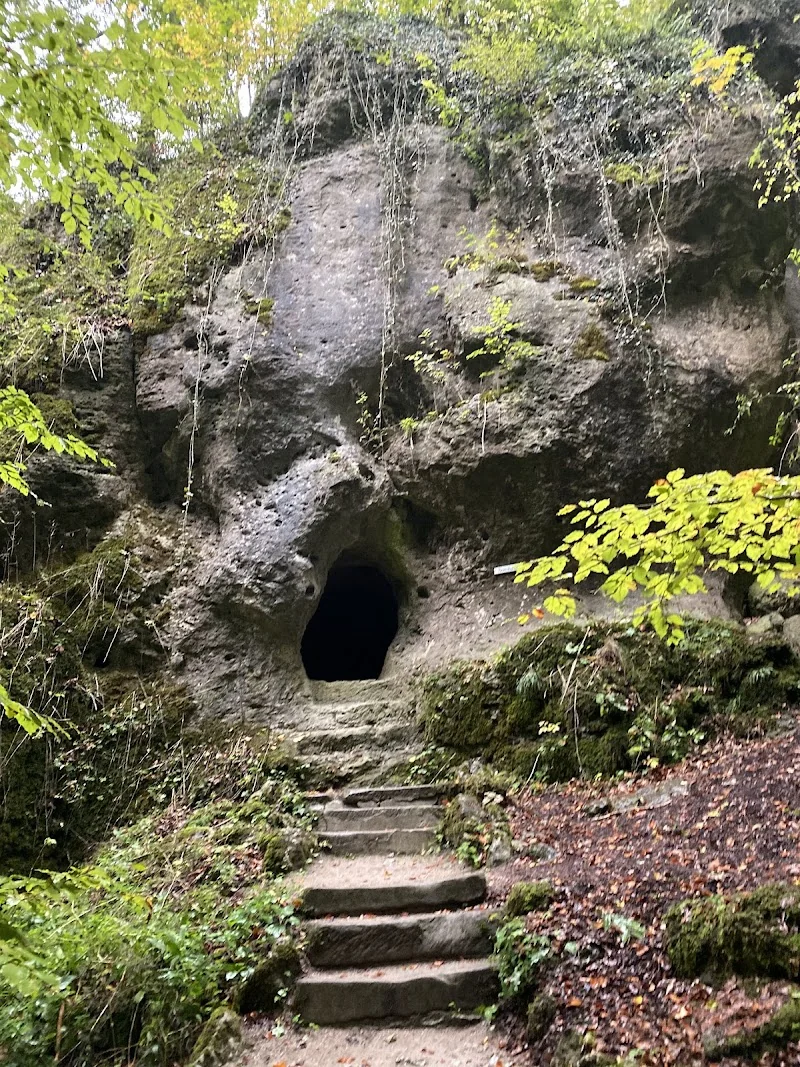
The Felsengarten Sanspareil in Wonsees is not a classic park with strictly drawn axes, but a historical landscape space where nature, architecture, and courtly fantasy have merged since the 18th century. The Bavarian Palace Administration describes the facility as a rock garden, whose image is shaped by natural, bizarre rock formations. Already in the 18th century, a pleasure garden was developed here according to a literary program, which is still considered one of the most extraordinary garden facilities in Franconia today. Those who visit Sanspareil experience not only rocks, caves, and forest paths but also the interplay with the castle Zwernitz and the Oriental Building. The place is suitable for a relaxed half-day trip, for history enthusiasts, and for anyone looking for landscapes with a special atmosphere. Since the park is accessible year-round and the main buildings are open seasonally, the visit can be planned flexibly. ([schloesser.bayern.de](https://www.schloesser.bayern.de/deutsch/garten/objekte/bay_morg.htm))
Opening Hours, Admission, and Tours in the Felsengarten Sanspareil
For planning your visit, it is especially important that the Felsengarten itself is accessible at any time. However, the opening hours of the individual buildings differ significantly. According to current visitor information, the castle Zwernitz is open daily from April to September 2026 from 9 AM to 6 PM, from October 1 to 18 from 10 AM to 5 PM, and then closed until March. The Oriental Building is accessible from mid-May to September 2026 from 9 AM to 6 PM and from October 1 to 18 from 10 AM to 5 PM; here, too, there is a winter break from mid-October to mid-May. These restrictions do not apply to the park, as the Felsengarten Sanspareil remains open all year round. This combination of freely accessible landscape and seasonally open buildings makes the place particularly attractive for flexible day trips. So, if you just want to go for a walk, you can also experience Sanspareil outside of museum hours, while a visit during the season is worthwhile for architecture and interiors. ([bayreuth-wilhelmine.de](https://www.bayreuth-wilhelmine.de/deutsch/tourist/oeffnung.htm))
The tours are also clearly regulated and therefore well planned. The park tours in the Felsengarten Sanspareil take place in 2026 between mid-May and October 18 on Saturdays, Sundays, and public holidays at 10:30 AM. The number of participants is limited, and in case of rain or storm, the tour is canceled. The duration is about 60 minutes, and participation costs 3 euros per person in addition to the admission for the respective buildings. The meeting point is the museum ticket office at castle Zwernitz, and registration takes place from April to mid-October from Tuesday to Sunday by phone. Tours for groups are available upon request. The castle Zwernitz can also be visited independently, and specifically for children, there is an audio guide created by students. This makes Sanspareil suitable for both individual visitors and families and groups looking for a mix of nature experience, information, and movement. Those who time their visit well can combine the same stay with the Oriental Building and castle Zwernitz. ([bayreuth-tourismus.de](https://www.bayreuth-tourismus.de/sehenswertes/wilhelmine/sanspareil/))
The History of Sanspareil: Wilhelmine, Telemachus, and the Rocks
The history of Sanspareil begins with a courtly idea that went far beyond an ordinary garden. As early as 1744, the plan was created to establish a wonder garden at this remote location near the medieval castle Zwernitz. From 1744 to 1748, there was lively construction activity there. The naturally grown rock grove was to be adorned with small castles, a belvedere, a ruin theater, and other embellishments by the time of the daughter of the margrave's wedding. Although the area around the castle had already served the margrave's hunting before, it was only with the design by Friedrich and Wilhelmine that it took on the form of a consciously composed landscape. Particularly influential is the literary thought behind the facility: Around 1748, caves and rocks were interpreted by Margravine Wilhelmine as stations of the Telemachy according to a French educational novel. Even today, names like Calypso Cave or Mentor's Cave remind us of this program. Thus, Sanspareil is understood not only as a natural space but also as a space for thought, where reading, interpreting, and walking were interconnected. ([bayreuth-wilhelmine.de](https://www.bayreuth-wilhelmine.de/deutsch/sanspar/felseng.htm))
The name Sanspareil also tells of this ambition. The story is handed down that a lady-in-waiting is said to have exclaimed in delight at the sight of the facility that the place was unlike any other. This led to the naming Sanspareil, which aptly describes the special character of the garden facility to this day. Nature always remained the central theme: Bizarre rock formations, forests, caves, and smaller buildings form an ensemble that does not arrange itself like a classic castle park but rather appears as a staged natural space. The Bavarian Palace Administration emphasizes that individual rocks and caves in the time of the margraves were associated with scenes from the French novel The Adventures of Telemachus. Many of the embellishments built at that time fell into disrepair over time or were sold in the 19th century. However, important parts such as the rock theater, the Oriental Building, and the kitchen building have been preserved. Additionally, in 1984, the lowered parterre between the Oriental Building and the kitchen building was reconstructed according to a historical model from 1748. Therefore, Sanspareil is not only historically significant but also a living example of how a baroque idea can remain visible to this day. ([bayreuth-wilhelmine.de](https://www.bayreuth-wilhelmine.de/deutsch/sanspar/felseng.htm))
Oriental Building, Ruin Theater, and Castle Zwernitz
Among the most impressive elements on site is the Oriental Building, which was constructed between 1744 and 1748. During the time of the margrave couple, it served as a summer palace and a venue for festivities. Today, it is a central attraction of the entire ensemble because it combines the garden idea with architectural sophistication. Equally influential is the ruin theater in the grove, which is described as a mixture of grotto and ruin. The audience area lies under a powerful natural rock arch, while the orchestra pit, scenery arches, and back wall are built of rubble stones. This combination of natural backdrop and constructed scene gives Sanspareil its unmistakable character. Not far away is castle Zwernitz, which directly borders the rock garden. From its keep, a wide view opens over the Franconian Switzerland, which significantly enhances the visit. The castle itself is officially traced back to the year 1300 and was the administrative seat of various counts. Later, among others, the burgraves of Nuremberg as well as the counts of Kulmbach and Bayreuth managed their affairs there. Thus, the castle complements the garden facility not only visually but also historically. ([bayreuth-tourismus.de](https://www.bayreuth-tourismus.de/sehenswertes/wilhelmine/sanspareil/))
The ensemble also offers substantial content for families and culture-interested visitors. Castle Zwernitz can be visited in 2026 without a guided tour, and its permanent exhibition focuses on the margravial hunting. Several interactive stations have been set up for children, playfully conveying the themes of hunting and knighthood. The Oriental Building can also be visited without a guided tour, and the official accessibility page points out that it is accessible via a ramp. Additionally, there are seating areas in the park, making longer stays comfortable. The overall effect is therefore very balanced: Sanspareil offers not only images for a quick photo stop but also a genuine tour through different epochs and functions. Those who love architecture will find courtly representation, romantic ruin aesthetics, and landscape staging in one place. Those traveling with children benefit from the interactive offerings and the audio guide. And those simply seeking peace will find it here among rock arches, forest light, and historic paths. ([bayreuth-tourismus.de](https://www.bayreuth-tourismus.de/sehenswertes/wilhelmine/sanspareil/))
Directions, Parking, and Accessibility on Site
The journey to the Felsengarten Sanspareil is easy to follow for day visitors. According to official visitor information, the facility is located about 40 kilometers west of Bayreuth near Wonsees. It can be reached via the B22 or the A70 with the exit Schirradorf. Those arriving by car or bus will find parking spaces at the entrance to the park. This is particularly convenient because the first contact with the grounds begins directly at the visitor area, and one does not have to search long for a parking space. Additionally, the accessibility page mentions a visitor parking lot in the southwest of the rock garden with about 50 parking spaces; the path to the visitor center of the castle leads about 200 meters uphill, partly over a slope of more than 6 percent and over differently paved paths. For planning, this means: Sanspareil is well suited for a trip by car, but the path through the facility itself remains consciously landscape-shaped and is not flat everywhere. This topography is part of the character of the place. Those arriving by bus will also find a functional solution directly at the entrance. ([bayreuth-wilhelmine.de](https://www.bayreuth-wilhelmine.de/deutsch/tourist/anfahrt.htm))
When it comes to accessibility, a differentiated picture emerges, which is important for planning visits. The Bavarian Palace Administration states that the rock garden is largely wheelchair accessible, but is restricted in some areas by steep paths and steps. The Oriental Building is accessible via a ramp and can be visited barrier-free. For people with visual impairments, there are no official tactile guiding systems, but in the interior areas of the Oriental Building, a tactile plan and tactile and auditory stations are available. For people with hearing impairments, information is available in written form. As a result, Sanspareil is not a completely barrier-free place in the modern sense, but a historical ensemble with clearly defined access points, aids, and areas that are well usable. This transparency is valuable for visitors because it realistically shows what is possible on site and where the terrain has still preserved its historical topography. ([bayreuth-wilhelmine.de](https://www.bayreuth-wilhelmine.de/deutsch/tourist/mobilitaet_sanspareil.htm))
Hiking, Photos, and Practical Visit Tips for Sanspareil
Sanspareil is not only a sight for history enthusiasts but also a very good starting point for walks and light hikes. The Bayreuth Tourism page explicitly describes the place as an ideal excursion destination for hikers and walkers and refers to tours of varying difficulty levels. This fits well with the facility itself, as rock groups, narrow paths, small caves, and open sightlines alternate here. Those who enjoy photography will find particularly striking motifs in the interplay of the ruin theater, rock arches, tree canopies, and the bright areas of the Oriental Building. Additionally, the Bavarian Palace Administration designates the rock garden as open year-round, while the beds and gardens are maintained in the season. For 2026, seasonal spring awakening began as early as March, and on the season opening on April 1, visitors expected colorful spring flowers. Thus, Sanspareil is worthwhile not only in the height of summer but also in early spring when the facility appears quieter and the flower beds begin to set the first color accents. Those who want to deliberately absorb the atmosphere of the park should take enough time for the path between the main points and not just briefly stop at a viewpoint. ([bayreuth-tourismus.de](https://www.bayreuth-tourismus.de/sehenswertes/wilhelmine/sanspareil/))
It is also practical to combine it with other offerings on site. In the official visitor information, a castle café Sanspareil is mentioned, which is open seasonally and remains closed from November to March, with Mondays also being a day off. This allows for a trip to be well combined with a break without having to leave the grounds. This is particularly sensible for families or visitors who want to experience several stations in one day. It is also advisable to check the tour dates in advance if you want to experience the rock garden with professional guidance, as the park tours are concentrated on Saturdays, Sundays, and public holidays between mid-May and mid-October. However, those who prefer to explore on their own can freely walk through the park at any time. The special charm of Sanspareil lies precisely in this mix of openness and staging: The place can be experienced spontaneously but also rewards careful preparation. It is not a place for haste but for observation, discovery, and peace. Those who are alert will not only perceive rocks and buildings but also the historical idea behind each sightline and every name. ([bayreuth-wilhelmine.de](https://www.bayreuth-wilhelmine.de/deutsch/tourist/gastst.htm?utm_source=openai))
Sources:
- Bavarian Palace Administration - Felsengarten Sanspareil
- Bayreuth-Wilhelmine - Felsengarten Sanspareil
- Bayreuth-Wilhelmine - Opening Hours
- Bayreuth-Wilhelmine - Directions
- Bayreuth-Wilhelmine - Accessibility Sanspareil
- Bayreuth-Wilhelmine - Admission Prices 2026
- Bayreuth Tourism - Sanspareil Excursion Destination
Show moreShow less
Felsengarten Sanspareil | Opening Hours & Directions
The Felsengarten Sanspareil in Wonsees is not a classic park with strictly drawn axes, but a historical landscape space where nature, architecture, and courtly fantasy have merged since the 18th century. The Bavarian Palace Administration describes the facility as a rock garden, whose image is shaped by natural, bizarre rock formations. Already in the 18th century, a pleasure garden was developed here according to a literary program, which is still considered one of the most extraordinary garden facilities in Franconia today. Those who visit Sanspareil experience not only rocks, caves, and forest paths but also the interplay with the castle Zwernitz and the Oriental Building. The place is suitable for a relaxed half-day trip, for history enthusiasts, and for anyone looking for landscapes with a special atmosphere. Since the park is accessible year-round and the main buildings are open seasonally, the visit can be planned flexibly. ([schloesser.bayern.de](https://www.schloesser.bayern.de/deutsch/garten/objekte/bay_morg.htm))
Opening Hours, Admission, and Tours in the Felsengarten Sanspareil
For planning your visit, it is especially important that the Felsengarten itself is accessible at any time. However, the opening hours of the individual buildings differ significantly. According to current visitor information, the castle Zwernitz is open daily from April to September 2026 from 9 AM to 6 PM, from October 1 to 18 from 10 AM to 5 PM, and then closed until March. The Oriental Building is accessible from mid-May to September 2026 from 9 AM to 6 PM and from October 1 to 18 from 10 AM to 5 PM; here, too, there is a winter break from mid-October to mid-May. These restrictions do not apply to the park, as the Felsengarten Sanspareil remains open all year round. This combination of freely accessible landscape and seasonally open buildings makes the place particularly attractive for flexible day trips. So, if you just want to go for a walk, you can also experience Sanspareil outside of museum hours, while a visit during the season is worthwhile for architecture and interiors. ([bayreuth-wilhelmine.de](https://www.bayreuth-wilhelmine.de/deutsch/tourist/oeffnung.htm))
The tours are also clearly regulated and therefore well planned. The park tours in the Felsengarten Sanspareil take place in 2026 between mid-May and October 18 on Saturdays, Sundays, and public holidays at 10:30 AM. The number of participants is limited, and in case of rain or storm, the tour is canceled. The duration is about 60 minutes, and participation costs 3 euros per person in addition to the admission for the respective buildings. The meeting point is the museum ticket office at castle Zwernitz, and registration takes place from April to mid-October from Tuesday to Sunday by phone. Tours for groups are available upon request. The castle Zwernitz can also be visited independently, and specifically for children, there is an audio guide created by students. This makes Sanspareil suitable for both individual visitors and families and groups looking for a mix of nature experience, information, and movement. Those who time their visit well can combine the same stay with the Oriental Building and castle Zwernitz. ([bayreuth-tourismus.de](https://www.bayreuth-tourismus.de/sehenswertes/wilhelmine/sanspareil/))
The History of Sanspareil: Wilhelmine, Telemachus, and the Rocks
The history of Sanspareil begins with a courtly idea that went far beyond an ordinary garden. As early as 1744, the plan was created to establish a wonder garden at this remote location near the medieval castle Zwernitz. From 1744 to 1748, there was lively construction activity there. The naturally grown rock grove was to be adorned with small castles, a belvedere, a ruin theater, and other embellishments by the time of the daughter of the margrave's wedding. Although the area around the castle had already served the margrave's hunting before, it was only with the design by Friedrich and Wilhelmine that it took on the form of a consciously composed landscape. Particularly influential is the literary thought behind the facility: Around 1748, caves and rocks were interpreted by Margravine Wilhelmine as stations of the Telemachy according to a French educational novel. Even today, names like Calypso Cave or Mentor's Cave remind us of this program. Thus, Sanspareil is understood not only as a natural space but also as a space for thought, where reading, interpreting, and walking were interconnected. ([bayreuth-wilhelmine.de](https://www.bayreuth-wilhelmine.de/deutsch/sanspar/felseng.htm))
The name Sanspareil also tells of this ambition. The story is handed down that a lady-in-waiting is said to have exclaimed in delight at the sight of the facility that the place was unlike any other. This led to the naming Sanspareil, which aptly describes the special character of the garden facility to this day. Nature always remained the central theme: Bizarre rock formations, forests, caves, and smaller buildings form an ensemble that does not arrange itself like a classic castle park but rather appears as a staged natural space. The Bavarian Palace Administration emphasizes that individual rocks and caves in the time of the margraves were associated with scenes from the French novel The Adventures of Telemachus. Many of the embellishments built at that time fell into disrepair over time or were sold in the 19th century. However, important parts such as the rock theater, the Oriental Building, and the kitchen building have been preserved. Additionally, in 1984, the lowered parterre between the Oriental Building and the kitchen building was reconstructed according to a historical model from 1748. Therefore, Sanspareil is not only historically significant but also a living example of how a baroque idea can remain visible to this day. ([bayreuth-wilhelmine.de](https://www.bayreuth-wilhelmine.de/deutsch/sanspar/felseng.htm))
Oriental Building, Ruin Theater, and Castle Zwernitz
Among the most impressive elements on site is the Oriental Building, which was constructed between 1744 and 1748. During the time of the margrave couple, it served as a summer palace and a venue for festivities. Today, it is a central attraction of the entire ensemble because it combines the garden idea with architectural sophistication. Equally influential is the ruin theater in the grove, which is described as a mixture of grotto and ruin. The audience area lies under a powerful natural rock arch, while the orchestra pit, scenery arches, and back wall are built of rubble stones. This combination of natural backdrop and constructed scene gives Sanspareil its unmistakable character. Not far away is castle Zwernitz, which directly borders the rock garden. From its keep, a wide view opens over the Franconian Switzerland, which significantly enhances the visit. The castle itself is officially traced back to the year 1300 and was the administrative seat of various counts. Later, among others, the burgraves of Nuremberg as well as the counts of Kulmbach and Bayreuth managed their affairs there. Thus, the castle complements the garden facility not only visually but also historically. ([bayreuth-tourismus.de](https://www.bayreuth-tourismus.de/sehenswertes/wilhelmine/sanspareil/))
The ensemble also offers substantial content for families and culture-interested visitors. Castle Zwernitz can be visited in 2026 without a guided tour, and its permanent exhibition focuses on the margravial hunting. Several interactive stations have been set up for children, playfully conveying the themes of hunting and knighthood. The Oriental Building can also be visited without a guided tour, and the official accessibility page points out that it is accessible via a ramp. Additionally, there are seating areas in the park, making longer stays comfortable. The overall effect is therefore very balanced: Sanspareil offers not only images for a quick photo stop but also a genuine tour through different epochs and functions. Those who love architecture will find courtly representation, romantic ruin aesthetics, and landscape staging in one place. Those traveling with children benefit from the interactive offerings and the audio guide. And those simply seeking peace will find it here among rock arches, forest light, and historic paths. ([bayreuth-tourismus.de](https://www.bayreuth-tourismus.de/sehenswertes/wilhelmine/sanspareil/))
Directions, Parking, and Accessibility on Site
The journey to the Felsengarten Sanspareil is easy to follow for day visitors. According to official visitor information, the facility is located about 40 kilometers west of Bayreuth near Wonsees. It can be reached via the B22 or the A70 with the exit Schirradorf. Those arriving by car or bus will find parking spaces at the entrance to the park. This is particularly convenient because the first contact with the grounds begins directly at the visitor area, and one does not have to search long for a parking space. Additionally, the accessibility page mentions a visitor parking lot in the southwest of the rock garden with about 50 parking spaces; the path to the visitor center of the castle leads about 200 meters uphill, partly over a slope of more than 6 percent and over differently paved paths. For planning, this means: Sanspareil is well suited for a trip by car, but the path through the facility itself remains consciously landscape-shaped and is not flat everywhere. This topography is part of the character of the place. Those arriving by bus will also find a functional solution directly at the entrance. ([bayreuth-wilhelmine.de](https://www.bayreuth-wilhelmine.de/deutsch/tourist/anfahrt.htm))
When it comes to accessibility, a differentiated picture emerges, which is important for planning visits. The Bavarian Palace Administration states that the rock garden is largely wheelchair accessible, but is restricted in some areas by steep paths and steps. The Oriental Building is accessible via a ramp and can be visited barrier-free. For people with visual impairments, there are no official tactile guiding systems, but in the interior areas of the Oriental Building, a tactile plan and tactile and auditory stations are available. For people with hearing impairments, information is available in written form. As a result, Sanspareil is not a completely barrier-free place in the modern sense, but a historical ensemble with clearly defined access points, aids, and areas that are well usable. This transparency is valuable for visitors because it realistically shows what is possible on site and where the terrain has still preserved its historical topography. ([bayreuth-wilhelmine.de](https://www.bayreuth-wilhelmine.de/deutsch/tourist/mobilitaet_sanspareil.htm))
Hiking, Photos, and Practical Visit Tips for Sanspareil
Sanspareil is not only a sight for history enthusiasts but also a very good starting point for walks and light hikes. The Bayreuth Tourism page explicitly describes the place as an ideal excursion destination for hikers and walkers and refers to tours of varying difficulty levels. This fits well with the facility itself, as rock groups, narrow paths, small caves, and open sightlines alternate here. Those who enjoy photography will find particularly striking motifs in the interplay of the ruin theater, rock arches, tree canopies, and the bright areas of the Oriental Building. Additionally, the Bavarian Palace Administration designates the rock garden as open year-round, while the beds and gardens are maintained in the season. For 2026, seasonal spring awakening began as early as March, and on the season opening on April 1, visitors expected colorful spring flowers. Thus, Sanspareil is worthwhile not only in the height of summer but also in early spring when the facility appears quieter and the flower beds begin to set the first color accents. Those who want to deliberately absorb the atmosphere of the park should take enough time for the path between the main points and not just briefly stop at a viewpoint. ([bayreuth-tourismus.de](https://www.bayreuth-tourismus.de/sehenswertes/wilhelmine/sanspareil/))
It is also practical to combine it with other offerings on site. In the official visitor information, a castle café Sanspareil is mentioned, which is open seasonally and remains closed from November to March, with Mondays also being a day off. This allows for a trip to be well combined with a break without having to leave the grounds. This is particularly sensible for families or visitors who want to experience several stations in one day. It is also advisable to check the tour dates in advance if you want to experience the rock garden with professional guidance, as the park tours are concentrated on Saturdays, Sundays, and public holidays between mid-May and mid-October. However, those who prefer to explore on their own can freely walk through the park at any time. The special charm of Sanspareil lies precisely in this mix of openness and staging: The place can be experienced spontaneously but also rewards careful preparation. It is not a place for haste but for observation, discovery, and peace. Those who are alert will not only perceive rocks and buildings but also the historical idea behind each sightline and every name. ([bayreuth-wilhelmine.de](https://www.bayreuth-wilhelmine.de/deutsch/tourist/gastst.htm?utm_source=openai))
Sources:
- Bavarian Palace Administration - Felsengarten Sanspareil
- Bayreuth-Wilhelmine - Felsengarten Sanspareil
- Bayreuth-Wilhelmine - Opening Hours
- Bayreuth-Wilhelmine - Directions
- Bayreuth-Wilhelmine - Accessibility Sanspareil
- Bayreuth-Wilhelmine - Admission Prices 2026
- Bayreuth Tourism - Sanspareil Excursion Destination
Felsengarten Sanspareil | Opening Hours & Directions
The Felsengarten Sanspareil in Wonsees is not a classic park with strictly drawn axes, but a historical landscape space where nature, architecture, and courtly fantasy have merged since the 18th century. The Bavarian Palace Administration describes the facility as a rock garden, whose image is shaped by natural, bizarre rock formations. Already in the 18th century, a pleasure garden was developed here according to a literary program, which is still considered one of the most extraordinary garden facilities in Franconia today. Those who visit Sanspareil experience not only rocks, caves, and forest paths but also the interplay with the castle Zwernitz and the Oriental Building. The place is suitable for a relaxed half-day trip, for history enthusiasts, and for anyone looking for landscapes with a special atmosphere. Since the park is accessible year-round and the main buildings are open seasonally, the visit can be planned flexibly. ([schloesser.bayern.de](https://www.schloesser.bayern.de/deutsch/garten/objekte/bay_morg.htm))
Opening Hours, Admission, and Tours in the Felsengarten Sanspareil
For planning your visit, it is especially important that the Felsengarten itself is accessible at any time. However, the opening hours of the individual buildings differ significantly. According to current visitor information, the castle Zwernitz is open daily from April to September 2026 from 9 AM to 6 PM, from October 1 to 18 from 10 AM to 5 PM, and then closed until March. The Oriental Building is accessible from mid-May to September 2026 from 9 AM to 6 PM and from October 1 to 18 from 10 AM to 5 PM; here, too, there is a winter break from mid-October to mid-May. These restrictions do not apply to the park, as the Felsengarten Sanspareil remains open all year round. This combination of freely accessible landscape and seasonally open buildings makes the place particularly attractive for flexible day trips. So, if you just want to go for a walk, you can also experience Sanspareil outside of museum hours, while a visit during the season is worthwhile for architecture and interiors. ([bayreuth-wilhelmine.de](https://www.bayreuth-wilhelmine.de/deutsch/tourist/oeffnung.htm))
The tours are also clearly regulated and therefore well planned. The park tours in the Felsengarten Sanspareil take place in 2026 between mid-May and October 18 on Saturdays, Sundays, and public holidays at 10:30 AM. The number of participants is limited, and in case of rain or storm, the tour is canceled. The duration is about 60 minutes, and participation costs 3 euros per person in addition to the admission for the respective buildings. The meeting point is the museum ticket office at castle Zwernitz, and registration takes place from April to mid-October from Tuesday to Sunday by phone. Tours for groups are available upon request. The castle Zwernitz can also be visited independently, and specifically for children, there is an audio guide created by students. This makes Sanspareil suitable for both individual visitors and families and groups looking for a mix of nature experience, information, and movement. Those who time their visit well can combine the same stay with the Oriental Building and castle Zwernitz. ([bayreuth-tourismus.de](https://www.bayreuth-tourismus.de/sehenswertes/wilhelmine/sanspareil/))
The History of Sanspareil: Wilhelmine, Telemachus, and the Rocks
The history of Sanspareil begins with a courtly idea that went far beyond an ordinary garden. As early as 1744, the plan was created to establish a wonder garden at this remote location near the medieval castle Zwernitz. From 1744 to 1748, there was lively construction activity there. The naturally grown rock grove was to be adorned with small castles, a belvedere, a ruin theater, and other embellishments by the time of the daughter of the margrave's wedding. Although the area around the castle had already served the margrave's hunting before, it was only with the design by Friedrich and Wilhelmine that it took on the form of a consciously composed landscape. Particularly influential is the literary thought behind the facility: Around 1748, caves and rocks were interpreted by Margravine Wilhelmine as stations of the Telemachy according to a French educational novel. Even today, names like Calypso Cave or Mentor's Cave remind us of this program. Thus, Sanspareil is understood not only as a natural space but also as a space for thought, where reading, interpreting, and walking were interconnected. ([bayreuth-wilhelmine.de](https://www.bayreuth-wilhelmine.de/deutsch/sanspar/felseng.htm))
The name Sanspareil also tells of this ambition. The story is handed down that a lady-in-waiting is said to have exclaimed in delight at the sight of the facility that the place was unlike any other. This led to the naming Sanspareil, which aptly describes the special character of the garden facility to this day. Nature always remained the central theme: Bizarre rock formations, forests, caves, and smaller buildings form an ensemble that does not arrange itself like a classic castle park but rather appears as a staged natural space. The Bavarian Palace Administration emphasizes that individual rocks and caves in the time of the margraves were associated with scenes from the French novel The Adventures of Telemachus. Many of the embellishments built at that time fell into disrepair over time or were sold in the 19th century. However, important parts such as the rock theater, the Oriental Building, and the kitchen building have been preserved. Additionally, in 1984, the lowered parterre between the Oriental Building and the kitchen building was reconstructed according to a historical model from 1748. Therefore, Sanspareil is not only historically significant but also a living example of how a baroque idea can remain visible to this day. ([bayreuth-wilhelmine.de](https://www.bayreuth-wilhelmine.de/deutsch/sanspar/felseng.htm))
Oriental Building, Ruin Theater, and Castle Zwernitz
Among the most impressive elements on site is the Oriental Building, which was constructed between 1744 and 1748. During the time of the margrave couple, it served as a summer palace and a venue for festivities. Today, it is a central attraction of the entire ensemble because it combines the garden idea with architectural sophistication. Equally influential is the ruin theater in the grove, which is described as a mixture of grotto and ruin. The audience area lies under a powerful natural rock arch, while the orchestra pit, scenery arches, and back wall are built of rubble stones. This combination of natural backdrop and constructed scene gives Sanspareil its unmistakable character. Not far away is castle Zwernitz, which directly borders the rock garden. From its keep, a wide view opens over the Franconian Switzerland, which significantly enhances the visit. The castle itself is officially traced back to the year 1300 and was the administrative seat of various counts. Later, among others, the burgraves of Nuremberg as well as the counts of Kulmbach and Bayreuth managed their affairs there. Thus, the castle complements the garden facility not only visually but also historically. ([bayreuth-tourismus.de](https://www.bayreuth-tourismus.de/sehenswertes/wilhelmine/sanspareil/))
The ensemble also offers substantial content for families and culture-interested visitors. Castle Zwernitz can be visited in 2026 without a guided tour, and its permanent exhibition focuses on the margravial hunting. Several interactive stations have been set up for children, playfully conveying the themes of hunting and knighthood. The Oriental Building can also be visited without a guided tour, and the official accessibility page points out that it is accessible via a ramp. Additionally, there are seating areas in the park, making longer stays comfortable. The overall effect is therefore very balanced: Sanspareil offers not only images for a quick photo stop but also a genuine tour through different epochs and functions. Those who love architecture will find courtly representation, romantic ruin aesthetics, and landscape staging in one place. Those traveling with children benefit from the interactive offerings and the audio guide. And those simply seeking peace will find it here among rock arches, forest light, and historic paths. ([bayreuth-tourismus.de](https://www.bayreuth-tourismus.de/sehenswertes/wilhelmine/sanspareil/))
Directions, Parking, and Accessibility on Site
The journey to the Felsengarten Sanspareil is easy to follow for day visitors. According to official visitor information, the facility is located about 40 kilometers west of Bayreuth near Wonsees. It can be reached via the B22 or the A70 with the exit Schirradorf. Those arriving by car or bus will find parking spaces at the entrance to the park. This is particularly convenient because the first contact with the grounds begins directly at the visitor area, and one does not have to search long for a parking space. Additionally, the accessibility page mentions a visitor parking lot in the southwest of the rock garden with about 50 parking spaces; the path to the visitor center of the castle leads about 200 meters uphill, partly over a slope of more than 6 percent and over differently paved paths. For planning, this means: Sanspareil is well suited for a trip by car, but the path through the facility itself remains consciously landscape-shaped and is not flat everywhere. This topography is part of the character of the place. Those arriving by bus will also find a functional solution directly at the entrance. ([bayreuth-wilhelmine.de](https://www.bayreuth-wilhelmine.de/deutsch/tourist/anfahrt.htm))
When it comes to accessibility, a differentiated picture emerges, which is important for planning visits. The Bavarian Palace Administration states that the rock garden is largely wheelchair accessible, but is restricted in some areas by steep paths and steps. The Oriental Building is accessible via a ramp and can be visited barrier-free. For people with visual impairments, there are no official tactile guiding systems, but in the interior areas of the Oriental Building, a tactile plan and tactile and auditory stations are available. For people with hearing impairments, information is available in written form. As a result, Sanspareil is not a completely barrier-free place in the modern sense, but a historical ensemble with clearly defined access points, aids, and areas that are well usable. This transparency is valuable for visitors because it realistically shows what is possible on site and where the terrain has still preserved its historical topography. ([bayreuth-wilhelmine.de](https://www.bayreuth-wilhelmine.de/deutsch/tourist/mobilitaet_sanspareil.htm))
Hiking, Photos, and Practical Visit Tips for Sanspareil
Sanspareil is not only a sight for history enthusiasts but also a very good starting point for walks and light hikes. The Bayreuth Tourism page explicitly describes the place as an ideal excursion destination for hikers and walkers and refers to tours of varying difficulty levels. This fits well with the facility itself, as rock groups, narrow paths, small caves, and open sightlines alternate here. Those who enjoy photography will find particularly striking motifs in the interplay of the ruin theater, rock arches, tree canopies, and the bright areas of the Oriental Building. Additionally, the Bavarian Palace Administration designates the rock garden as open year-round, while the beds and gardens are maintained in the season. For 2026, seasonal spring awakening began as early as March, and on the season opening on April 1, visitors expected colorful spring flowers. Thus, Sanspareil is worthwhile not only in the height of summer but also in early spring when the facility appears quieter and the flower beds begin to set the first color accents. Those who want to deliberately absorb the atmosphere of the park should take enough time for the path between the main points and not just briefly stop at a viewpoint. ([bayreuth-tourismus.de](https://www.bayreuth-tourismus.de/sehenswertes/wilhelmine/sanspareil/))
It is also practical to combine it with other offerings on site. In the official visitor information, a castle café Sanspareil is mentioned, which is open seasonally and remains closed from November to March, with Mondays also being a day off. This allows for a trip to be well combined with a break without having to leave the grounds. This is particularly sensible for families or visitors who want to experience several stations in one day. It is also advisable to check the tour dates in advance if you want to experience the rock garden with professional guidance, as the park tours are concentrated on Saturdays, Sundays, and public holidays between mid-May and mid-October. However, those who prefer to explore on their own can freely walk through the park at any time. The special charm of Sanspareil lies precisely in this mix of openness and staging: The place can be experienced spontaneously but also rewards careful preparation. It is not a place for haste but for observation, discovery, and peace. Those who are alert will not only perceive rocks and buildings but also the historical idea behind each sightline and every name. ([bayreuth-wilhelmine.de](https://www.bayreuth-wilhelmine.de/deutsch/tourist/gastst.htm?utm_source=openai))
Sources:
- Bavarian Palace Administration - Felsengarten Sanspareil
- Bayreuth-Wilhelmine - Felsengarten Sanspareil
- Bayreuth-Wilhelmine - Opening Hours
- Bayreuth-Wilhelmine - Directions
- Bayreuth-Wilhelmine - Accessibility Sanspareil
- Bayreuth-Wilhelmine - Admission Prices 2026
- Bayreuth Tourism - Sanspareil Excursion Destination

Frequently Asked Questions
Reviews
Mfn Mln
27. November 2025
In an area that is not rich in spectacular landscapes, this is not bad. Seeing the pictures others have posted, my expectations were a bit higher... the pictures are real, but it is overall a pretty flat area. Don't expect jaw-dropping cliffs like Tüchersfeld, but more something like a boulder garden.
Jennifer Isaacs
24. August 2022
Another fabulous castle brought to you by princess Wilhelmine of Bayreuth! This castle is thousands of years old and you can wander around it. 😃 There is a short introduction in German, then you are left to adventure through the structures on your own. Outside, there is an amazing park with walking trails and giant rocks. Bring a small picnic if you want to hike, and you will find beautiful places to sit inside the park.
Ines Schmidt
4. December 2022
We did not get to visit the castle but took the walk through the Rock garden. It was in autumn and so green and calm. And yes, there are some interesting remains of the original constructs. Follow our adventures #SLYSTRX
code- epic
19. March 2025
Very mythical and beautiful, some of the history here has been removed, mainly structures, but the Roman and medieval history here makes it a must-see.
Mary Ann Merka
2. August 2020
Beautiful and so peaceful, seeing those rocks and trees, and when we came it was super hot in Bavaria, but when you go there you don't feel it because of those trees.