
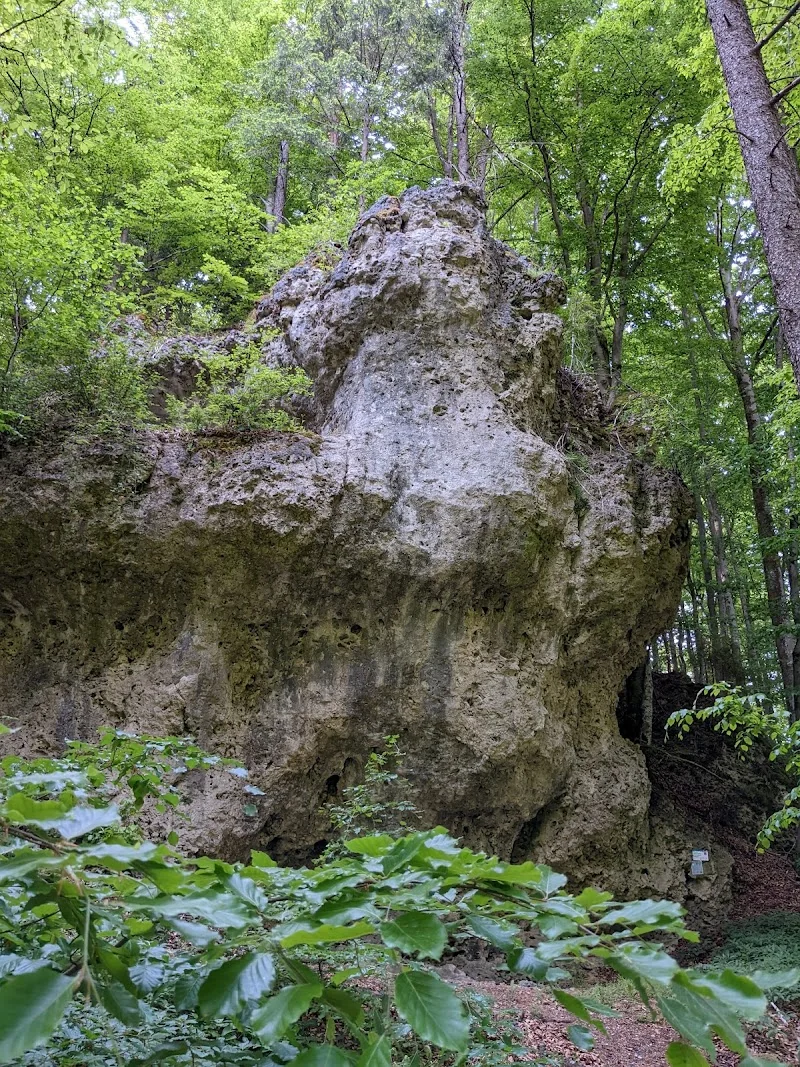
MC98+RH, Betzenstein
MC98+RH, 91282 Betzenstein, Germany
Hetzendorfer Felsengnom | Climbing Rock & Access
The Hetzendorfer Felsengnom is one of those small Frankenjura rocks where it becomes immediately clear why Betzenstein holds such a firm place on the map for climbers. Instead of long approaches, high wall heights, and extensive sectors, this location offers a very compact, direct, and clear climbing experience. The rock is south-facing, about 10 meters high, strongly overhanging, and made of limestone. The description speaks of a small wall with a typically Franconian, powerful pulling character, complemented by perfect protection and a very short approach situation. In the region around Betzenstein, this is not an isolated case, but the combination of small area, good accessibility, and sporting difficulty makes the Felsengnom particularly memorable. Those who know the area also understand that Betzenstein consists not only of one destination but of a whole network of rewarding climbing rocks, making it a true center for recreational and sport climbing in northern Frankenjura. ([frankenjura.com](https://www.frankenjura.com/gemeinden/poi/455))
From an SEO and user perspective, the Hetzendorfer Felsengnom is particularly interesting because the most common search intentions converge very well here: access, parking, approach, climbing character, zone, and routes. These points ultimately determine whether a destination fits for the day or not. The rock is not large, but it delivers a clear profile: only two documented lines, both in the upper difficulty range, a short access, and a rock that, despite its size, has a real sporting appeal. Additionally, the location is in Zone 2, meaning it is integrated into a clearly regulated framework that is environmentally friendly. So, if you are looking for a precise, quiet, and short climbing appointment in Frankenjura, you will find a very tidy option here. At the same time, the Felsengnom remains part of a larger climbing area, where other walls like the Hetzendorfer Wand or the rocks at Stierberg and Leupoldstein are also in high demand. ([frankenjura.com](https://www.frankenjura.com/gemeinden/poi/455?utm_source=openai))
Access, Parking, and Approach to the Hetzendorfer Felsengnom
The access to the Hetzendorfer Felsengnom is pleasantly direct and is one of the biggest practical advantages of this destination. From Betzenstein, you drive south towards Klausberg. After about 900 meters, you turn right at the junction to Hetzendorf. After another approximately 300 meters, the small massif is located on the right at the edge of the forest. Parking is along the roadside, so careful and space-saving parking is particularly important. The rock description explicitly points out to park intelligently, which in Frankenjura is not just a matter of courtesy but often also a question of smooth coexistence. Especially since the rock is so close to the road, it makes sense to think in advance about how to park the vehicle so that other road users and agricultural use are not hindered. For a short climbing appointment, this location is ideal because you can get from the car to the rock without detours and do not need long organizational preparation. ([frankenjura.com](https://www.frankenjura.com/gemeinden/poi/455))
The approach is very short, taking about one minute, making the Hetzendorfer Felsengnom particularly attractive for sessions that are planned purposefully and efficiently. Those who are on the way after work, in the morning, or as a short stopover benefit from this immediate accessibility. This is especially practical if you want to combine the rock with other destinations in the Betzenstein area. Compared to the larger Hetzendorfer Wand, whose approach is indicated to take about 10 minutes, the Felsengnom feels almost like a direct access to the wall. This brevity is not a disadvantage but part of the appeal: you quickly stand at the rock and can immediately focus on the lines. In a region where many climbers already work with closely spaced destinations, this form of directness is very valuable. Those who have little time still get a real Frankenjura feeling, and that is exactly what makes small rocks with short approaches so popular. ([frankenjura.com](https://www.frankenjura.com/gemeinden/poi/455))
Practically, this also means that the Felsengnom serves well as a starting point for a short climbing day. You do not need to plan a large material depot or long walking times but can go to the rock with minimal logistics. This is particularly interesting for climbers who prefer to make several short, focused attempts on a difficult line rather than planning a long wall day. At the same time, one should not confuse the compact character with arbitrariness: especially with small rock blocks, consideration for access, driving lane, and forest edge is crucial because any incorrectly parked vehicle immediately stands out more than at a large parking rock. Therefore, the recommendation is clear: park as cleanly, consciously, and stress-free as possible, then use the short approach and keep the stay as uncomplicated as possible. This way, the Felsengnom remains exactly what it should be: a distinctive, quiet, and very direct destination in the Betzenstein climbing triangle. ([frankenjura.com](https://www.frankenjura.com/gemeinden/poi/455))
Routes and Difficulty: the Two Lines at the Small Massif
The Hetzendorfer Felsengnom is not a place for a wide selection of routes but a small, very clear climbing destination with exactly two documented lines. These are called Schluß mit lustig with the rating 9- and Laughparade with the rating 9-/9. Even this information shows that while the location is compact, it is by no means in the beginner range. Those who want to climb here need solid experience in the upper medium to lower hard range and should be able to handle powerful moves, body tension, and precise gripping. This makes the Felsengnom a destination for climbers who consciously seek a short, intense line and do not hope for a large number of easy paths. The clarity is therefore no coincidence but a profile feature: few, but striking routes in a small space. ([frankenjura.com](https://www.frankenjura.com/gemeinden/poi/455))
The character of the rock supports this classification very clearly. The wall is described as strongly overhanging or slightly overhanging, the rock structure consists of holes and slopers, and the protection is indicated as perfect. In practice, this points to a climbing style that is typically Franconian and at the same time very direct: little residual difficulty from complicated protection, but a lot of action on the wall itself. Those who want to succeed here need clean foot technique, a stable hip, and the willingness to solve moves dynamically or with a lot of body tension. This makes the two tours striking short lines that are more suitable for concentrated attempts than for relaxed climbing through. Especially the combination of overhanging geometry and grippy hole climbing provides a form of movement that is particularly appreciated in Frankenjura. ([frankenjura.com](https://www.frankenjura.com/gemeinden/poi/455))
It is also important to have the right expectations. Although the Felsengnom is described as good for children and the approach is extremely short, the actual tours are demanding. Family-friendly here refers primarily to the access and the compact surroundings, not the difficulty of the lines. So, if you are traveling with a mixed group, you can use the location as a destination point well, but should not expect that there are many easy rope lengths or warm-up routes waiting here. This is exactly what makes the Felsengnom interesting for climbers who specifically seek a hard, short challenge. For a quick visit to Betzenstein, this is ideal: little effort, clear structure, sporty lines, and a rock where you can focus on the essentials. ([frankenjura.com](https://www.frankenjura.com/gemeinden/poi/455))
Zone 2, Nature Conservation, and Proper Behavior at the Rock
The Hetzendorfer Felsengnom is assigned to Zone 2. This is important for planning because Zone 2 in the climbing concept means that climbing is only allowed on the existing routes and no new routes should be established. The IG Klettern explains this logic very clearly: Zone 1 stands for quiet areas without climbing, Zone 2 for existing routes without new routes, and Zone 3 for existing routes with limited possibilities for new lines outside of vegetation zones. For the Felsengnom, this means concretely that the existing state must be respected and creative expansions have no place there. Therefore, anyone visiting the location should not only see themselves as a user but also as a co-responsible party for the preservation of the area. Especially small rocks like this benefit when the existing lines are used cleanly and the rules on site are adhered to consistently. ([frankenjura.com](https://www.frankenjura.com/gemeinden/poi/455?utm_source=openai))
This set of rules is not an end in itself but part of environmentally friendly climbing in Frankenjura. The IG Klettern also explains that rocks without a zone sign initially count as Zone 1 and that a regulated procedure with authorities' contact is necessary for new routes or developments. For visitors, this means: On-site signs, markings, and local hints are decisive, not personal assessments or old rumors. In an area like Betzenstein, where many rocks are closely spaced and some areas may be seasonally or point-restricted, this attention is particularly important. Responsible handling of the location begins even before preparing the tour: those who inform themselves, park respectfully, and accept the existing zoning contribute directly to the long-term preservation of such small climbing destinations. ([ig-klettern.org](https://ig-klettern.org/faq/))
The general understanding of ethics in the Betzenstein area also fits this framework. The theCrag area data for Betzenstein-Stierberg-Leupoldstein refer to the zoning of Frankenjura, to consideration when parking, and to the protection of rocks and surroundings. This includes, among other things, leaving nature clean, not making unnecessary noise, and treating local rules with respect. For the Hetzendorfer Felsengnom, this is particularly obvious because the place is small and the rock is directly at the edge of the forest. The smaller and more direct a destination, the more visible misconduct becomes, and the quicker owners, hunters, or residents react to disturbances. Therefore, anyone who wants to use the rock should act consciously quietly, orderly, and in an environmentally friendly manner. This way, the Felsengnom remains a calm, functioning climbing point rather than a problem case. ([thecrag.com](https://www.thecrag.com/de/klettern/germany/frankenjura/betzenstein))
Rock Character, Weather, and Who Particularly Benefits Here
The Felsengnom is small but characterful. With a height of about 10 meters, south-facing, limestone, and a structure of holes and slopers, it is a very typical representative of the Frankenjura climbing culture. The description also emphasizes that the rock is strongly overhanging or slightly overhanging and that the protection is perfect. This makes it technically interesting because the line works not over length but over intensity. You do not get an extensive wall ride but a short, very concentrated movement experience. For many climbers, that is exactly what is attractive: few meters, but a lot of substance within them. Such rocks are often ideal for specifically working on body tension, foothold precision, and pulling power. The Hetzendorfer Felsengnom is, in this sense, not a casual rock but a small precision tool in Frankenjura. ([frankenjura.com](https://www.frankenjura.com/gemeinden/poi/455))
Regarding the weather, the location is also interesting. The rock description mentions rain safety as a positive aspect but simultaneously points out that the rock can remain wet for a long time. This sounds contradictory at first but is practically understandable: a south-facing rock can still dry sluggishly after precipitation or in unfavorable humidity, especially when the structure is overhanging and certain parts receive little sun. Therefore, those who want to visit the Felsengnom should pay attention not only to the calendar but also to the current dryness. A sunny, stable day is likely better suited than a borderline morning after rain. For climbers who consciously plan a short session, this is an advantage because the visit can be well aligned with a suitable weather window. This way, unnecessary failures are avoided, and the likelihood that the short unit will be truly rewarding is increased. ([frankenjura.com](https://www.frankenjura.com/gemeinden/poi/455))
The suitability for children and mixed groups is also to be read differently. The rock description rates the location as perfect for children, even with or without a babysitter. However, this refers to the overall situation at the rock: short paths, manageable surroundings, and a small wall without significant organizational effort. The climbing lines themselves remain demanding and are clearly in the upper range. For families or groups where not everyone climbs the same difficulty, this is still practical. Some can enjoy the short access and the quiet location, while others use the two lines as a sporting challenge. This mixture of logistically simple location and sportingly hard climbing is one of the reasons why small Frankenjura rocks like the Felsengnom are often highly valued. ([frankenjura.com](https://www.frankenjura.com/gemeinden/poi/455))
Comparison of Hetzendorfer Felsengnom and Hetzendorfer Wand
When one hears the name Hetzendorfer Felsengnom, one almost automatically thinks of the Hetzendorfer Wand. This is sensible because both destinations lie in the same Betzenstein climbing environment and are clearly listed next to each other in the area data. However, the Hetzendorfer Wand is the significantly larger format: the sectors there reach heights of about 15 meters, the orientation is also south-facing, and the approach takes about 10 minutes. Zone 2 also applies there, meaning climbing is only allowed on existing routes without new routes. Additionally, the rock description for the Hetzendorfer Wand indicates that climbing should only be done until 6 PM, as the area may otherwise be closed under pressure from hunters. This information applies to the Hetzendorfer Wand, not automatically to the Felsengnom, but it shows very well how sensitively the environment in the Betzenstein forest is used. ([frankenjura.com](https://www.frankenjura.com/klettern/poi/443))
In direct comparison, the Felsengnom thus appears almost like the concentrated short form of the neighboring wall. It is smaller, more quickly accessible, and with only two routes, significantly clearer. While the Hetzendorfer Wand lists a total of 29 routes and thus represents a full-fledged climbing area, the Felsengnom remains a compact individual massif with a clearly defined appeal. This is particularly interesting for climbers who do not necessarily plan a long wall day but specifically aim for a short, intense line. The low number of routes is not a deficiency but a quality feature of compactness. Those who know the area can view both destinations as complementary: the wall for longer sessions and more options, the Felsengnom for short, concentrated attempts without much effort. ([frankenjura.com](https://www.frankenjura.com/gemeinden/poi/455))
From a regional perspective, this comparison is also important. The theCrag area Betzenstein-Stierberg-Leupoldstein lists the Hetzendorfer Felsengnom and the Hetzendorfer Wand as separate destinations within a large, very climbing-strong area with a total of 478 routes. This makes it clear that the Felsengnom should not be viewed in isolation but is part of a densely structured climbing space. For visitors, this means: you can use the Felsengnom for a pinpoint session and, if needed, complement it with other destinations in the surrounding area. This selection is what makes Betzenstein interesting for Frankenjura climbers. When arriving at a location, one finds not just a rock but usually a whole list of sensibly combinable destinations. The Felsengnom stands for the short, precise, and low-effort variant of this system. ([thecrag.com](https://www.thecrag.com/de/klettern/germany/frankenjura/betzenstein))
Betzenstein as a Climbing Location in Frankenjura
Betzenstein is much more than just the place where the Hetzendorfer Felsengnom is located in Frankenjura. The community and area pages clearly show that there is an extraordinarily dense climbing landscape here. Among other things, the Dreistaffelfels, the Hetzendorfer Wand, and the rocks at Stierberg and Münchs are mentioned. For recreational climbers, the area is an enormous field of activity, while ambitious climbers find sporty lines in various difficulty levels at the same locations. The Felsengnom fits into this picture as a small, distinctive building block. Especially in a region with many possibilities, it is valuable when individual rocks have a clear profile. This way, one knows before the approach whether a destination is more for a quick detour, an intensive project session, or an entire climbing day. The Hetzendorfer Felsengnom clearly belongs to the first and second categories at the same time. ([frankenjura.com](https://www.frankenjura.com/klettern/kommune/22?utm_source=openai))
The location near Betzenstein also brings practical advantages for daily planning. Because the approaches in the area are very different, you can easily combine the Hetzendorfer Felsengnom with other destinations or use it as a warm start to a longer day. The short path to the rock and the easy accessibility from the roadside make it particularly efficient. At the same time, the region is not only interesting for climbing but also for infrastructure such as camping and accommodation, which is repeatedly visible in the community pages and surrounding hints. So, if you spend several days in Frankenjura, you can consider Betzenstein as a good base. The Felsengnom thus becomes, for example, the kind of rock that does not dictate the entire daily logistics but fits seamlessly into a versatile stay. This is ideal for many visitors because it combines flexibility and quality. ([frankenjura.com](https://www.frankenjura.com/winter/poi/455?utm_source=openai))
In summary, the Hetzendorfer Felsengnom beautifully illustrates what makes Betzenstein a climbing location: short paths, clear rules, many destinations, and a strongly pronounced Frankenjura character. The area does not live from a single super rock but from the density and variety of its short, precise options. Those who adhere to the zoning, park respectfully, and assess the weather and approach conditions soberly receive a very good, very direct climbing appointment here. The Felsengnom is thus an ideal search and click point for all those who do not seek just any rock in Betzenstein but exactly a small, steep, and clearly defined limestone location. Precisely because it is small, it remains memorable. And precisely because it is so clearly structured, it fits perfectly into a high-quality location page for Frankenjura. ([frankenjura.com](https://www.frankenjura.com/gemeinden/poi/455))
Sources:
Show moreShow less
Hetzendorfer Felsengnom | Climbing Rock & Access
The Hetzendorfer Felsengnom is one of those small Frankenjura rocks where it becomes immediately clear why Betzenstein holds such a firm place on the map for climbers. Instead of long approaches, high wall heights, and extensive sectors, this location offers a very compact, direct, and clear climbing experience. The rock is south-facing, about 10 meters high, strongly overhanging, and made of limestone. The description speaks of a small wall with a typically Franconian, powerful pulling character, complemented by perfect protection and a very short approach situation. In the region around Betzenstein, this is not an isolated case, but the combination of small area, good accessibility, and sporting difficulty makes the Felsengnom particularly memorable. Those who know the area also understand that Betzenstein consists not only of one destination but of a whole network of rewarding climbing rocks, making it a true center for recreational and sport climbing in northern Frankenjura. ([frankenjura.com](https://www.frankenjura.com/gemeinden/poi/455))
From an SEO and user perspective, the Hetzendorfer Felsengnom is particularly interesting because the most common search intentions converge very well here: access, parking, approach, climbing character, zone, and routes. These points ultimately determine whether a destination fits for the day or not. The rock is not large, but it delivers a clear profile: only two documented lines, both in the upper difficulty range, a short access, and a rock that, despite its size, has a real sporting appeal. Additionally, the location is in Zone 2, meaning it is integrated into a clearly regulated framework that is environmentally friendly. So, if you are looking for a precise, quiet, and short climbing appointment in Frankenjura, you will find a very tidy option here. At the same time, the Felsengnom remains part of a larger climbing area, where other walls like the Hetzendorfer Wand or the rocks at Stierberg and Leupoldstein are also in high demand. ([frankenjura.com](https://www.frankenjura.com/gemeinden/poi/455?utm_source=openai))
Access, Parking, and Approach to the Hetzendorfer Felsengnom
The access to the Hetzendorfer Felsengnom is pleasantly direct and is one of the biggest practical advantages of this destination. From Betzenstein, you drive south towards Klausberg. After about 900 meters, you turn right at the junction to Hetzendorf. After another approximately 300 meters, the small massif is located on the right at the edge of the forest. Parking is along the roadside, so careful and space-saving parking is particularly important. The rock description explicitly points out to park intelligently, which in Frankenjura is not just a matter of courtesy but often also a question of smooth coexistence. Especially since the rock is so close to the road, it makes sense to think in advance about how to park the vehicle so that other road users and agricultural use are not hindered. For a short climbing appointment, this location is ideal because you can get from the car to the rock without detours and do not need long organizational preparation. ([frankenjura.com](https://www.frankenjura.com/gemeinden/poi/455))
The approach is very short, taking about one minute, making the Hetzendorfer Felsengnom particularly attractive for sessions that are planned purposefully and efficiently. Those who are on the way after work, in the morning, or as a short stopover benefit from this immediate accessibility. This is especially practical if you want to combine the rock with other destinations in the Betzenstein area. Compared to the larger Hetzendorfer Wand, whose approach is indicated to take about 10 minutes, the Felsengnom feels almost like a direct access to the wall. This brevity is not a disadvantage but part of the appeal: you quickly stand at the rock and can immediately focus on the lines. In a region where many climbers already work with closely spaced destinations, this form of directness is very valuable. Those who have little time still get a real Frankenjura feeling, and that is exactly what makes small rocks with short approaches so popular. ([frankenjura.com](https://www.frankenjura.com/gemeinden/poi/455))
Practically, this also means that the Felsengnom serves well as a starting point for a short climbing day. You do not need to plan a large material depot or long walking times but can go to the rock with minimal logistics. This is particularly interesting for climbers who prefer to make several short, focused attempts on a difficult line rather than planning a long wall day. At the same time, one should not confuse the compact character with arbitrariness: especially with small rock blocks, consideration for access, driving lane, and forest edge is crucial because any incorrectly parked vehicle immediately stands out more than at a large parking rock. Therefore, the recommendation is clear: park as cleanly, consciously, and stress-free as possible, then use the short approach and keep the stay as uncomplicated as possible. This way, the Felsengnom remains exactly what it should be: a distinctive, quiet, and very direct destination in the Betzenstein climbing triangle. ([frankenjura.com](https://www.frankenjura.com/gemeinden/poi/455))
Routes and Difficulty: the Two Lines at the Small Massif
The Hetzendorfer Felsengnom is not a place for a wide selection of routes but a small, very clear climbing destination with exactly two documented lines. These are called Schluß mit lustig with the rating 9- and Laughparade with the rating 9-/9. Even this information shows that while the location is compact, it is by no means in the beginner range. Those who want to climb here need solid experience in the upper medium to lower hard range and should be able to handle powerful moves, body tension, and precise gripping. This makes the Felsengnom a destination for climbers who consciously seek a short, intense line and do not hope for a large number of easy paths. The clarity is therefore no coincidence but a profile feature: few, but striking routes in a small space. ([frankenjura.com](https://www.frankenjura.com/gemeinden/poi/455))
The character of the rock supports this classification very clearly. The wall is described as strongly overhanging or slightly overhanging, the rock structure consists of holes and slopers, and the protection is indicated as perfect. In practice, this points to a climbing style that is typically Franconian and at the same time very direct: little residual difficulty from complicated protection, but a lot of action on the wall itself. Those who want to succeed here need clean foot technique, a stable hip, and the willingness to solve moves dynamically or with a lot of body tension. This makes the two tours striking short lines that are more suitable for concentrated attempts than for relaxed climbing through. Especially the combination of overhanging geometry and grippy hole climbing provides a form of movement that is particularly appreciated in Frankenjura. ([frankenjura.com](https://www.frankenjura.com/gemeinden/poi/455))
It is also important to have the right expectations. Although the Felsengnom is described as good for children and the approach is extremely short, the actual tours are demanding. Family-friendly here refers primarily to the access and the compact surroundings, not the difficulty of the lines. So, if you are traveling with a mixed group, you can use the location as a destination point well, but should not expect that there are many easy rope lengths or warm-up routes waiting here. This is exactly what makes the Felsengnom interesting for climbers who specifically seek a hard, short challenge. For a quick visit to Betzenstein, this is ideal: little effort, clear structure, sporty lines, and a rock where you can focus on the essentials. ([frankenjura.com](https://www.frankenjura.com/gemeinden/poi/455))
Zone 2, Nature Conservation, and Proper Behavior at the Rock
The Hetzendorfer Felsengnom is assigned to Zone 2. This is important for planning because Zone 2 in the climbing concept means that climbing is only allowed on the existing routes and no new routes should be established. The IG Klettern explains this logic very clearly: Zone 1 stands for quiet areas without climbing, Zone 2 for existing routes without new routes, and Zone 3 for existing routes with limited possibilities for new lines outside of vegetation zones. For the Felsengnom, this means concretely that the existing state must be respected and creative expansions have no place there. Therefore, anyone visiting the location should not only see themselves as a user but also as a co-responsible party for the preservation of the area. Especially small rocks like this benefit when the existing lines are used cleanly and the rules on site are adhered to consistently. ([frankenjura.com](https://www.frankenjura.com/gemeinden/poi/455?utm_source=openai))
This set of rules is not an end in itself but part of environmentally friendly climbing in Frankenjura. The IG Klettern also explains that rocks without a zone sign initially count as Zone 1 and that a regulated procedure with authorities' contact is necessary for new routes or developments. For visitors, this means: On-site signs, markings, and local hints are decisive, not personal assessments or old rumors. In an area like Betzenstein, where many rocks are closely spaced and some areas may be seasonally or point-restricted, this attention is particularly important. Responsible handling of the location begins even before preparing the tour: those who inform themselves, park respectfully, and accept the existing zoning contribute directly to the long-term preservation of such small climbing destinations. ([ig-klettern.org](https://ig-klettern.org/faq/))
The general understanding of ethics in the Betzenstein area also fits this framework. The theCrag area data for Betzenstein-Stierberg-Leupoldstein refer to the zoning of Frankenjura, to consideration when parking, and to the protection of rocks and surroundings. This includes, among other things, leaving nature clean, not making unnecessary noise, and treating local rules with respect. For the Hetzendorfer Felsengnom, this is particularly obvious because the place is small and the rock is directly at the edge of the forest. The smaller and more direct a destination, the more visible misconduct becomes, and the quicker owners, hunters, or residents react to disturbances. Therefore, anyone who wants to use the rock should act consciously quietly, orderly, and in an environmentally friendly manner. This way, the Felsengnom remains a calm, functioning climbing point rather than a problem case. ([thecrag.com](https://www.thecrag.com/de/klettern/germany/frankenjura/betzenstein))
Rock Character, Weather, and Who Particularly Benefits Here
The Felsengnom is small but characterful. With a height of about 10 meters, south-facing, limestone, and a structure of holes and slopers, it is a very typical representative of the Frankenjura climbing culture. The description also emphasizes that the rock is strongly overhanging or slightly overhanging and that the protection is perfect. This makes it technically interesting because the line works not over length but over intensity. You do not get an extensive wall ride but a short, very concentrated movement experience. For many climbers, that is exactly what is attractive: few meters, but a lot of substance within them. Such rocks are often ideal for specifically working on body tension, foothold precision, and pulling power. The Hetzendorfer Felsengnom is, in this sense, not a casual rock but a small precision tool in Frankenjura. ([frankenjura.com](https://www.frankenjura.com/gemeinden/poi/455))
Regarding the weather, the location is also interesting. The rock description mentions rain safety as a positive aspect but simultaneously points out that the rock can remain wet for a long time. This sounds contradictory at first but is practically understandable: a south-facing rock can still dry sluggishly after precipitation or in unfavorable humidity, especially when the structure is overhanging and certain parts receive little sun. Therefore, those who want to visit the Felsengnom should pay attention not only to the calendar but also to the current dryness. A sunny, stable day is likely better suited than a borderline morning after rain. For climbers who consciously plan a short session, this is an advantage because the visit can be well aligned with a suitable weather window. This way, unnecessary failures are avoided, and the likelihood that the short unit will be truly rewarding is increased. ([frankenjura.com](https://www.frankenjura.com/gemeinden/poi/455))
The suitability for children and mixed groups is also to be read differently. The rock description rates the location as perfect for children, even with or without a babysitter. However, this refers to the overall situation at the rock: short paths, manageable surroundings, and a small wall without significant organizational effort. The climbing lines themselves remain demanding and are clearly in the upper range. For families or groups where not everyone climbs the same difficulty, this is still practical. Some can enjoy the short access and the quiet location, while others use the two lines as a sporting challenge. This mixture of logistically simple location and sportingly hard climbing is one of the reasons why small Frankenjura rocks like the Felsengnom are often highly valued. ([frankenjura.com](https://www.frankenjura.com/gemeinden/poi/455))
Comparison of Hetzendorfer Felsengnom and Hetzendorfer Wand
When one hears the name Hetzendorfer Felsengnom, one almost automatically thinks of the Hetzendorfer Wand. This is sensible because both destinations lie in the same Betzenstein climbing environment and are clearly listed next to each other in the area data. However, the Hetzendorfer Wand is the significantly larger format: the sectors there reach heights of about 15 meters, the orientation is also south-facing, and the approach takes about 10 minutes. Zone 2 also applies there, meaning climbing is only allowed on existing routes without new routes. Additionally, the rock description for the Hetzendorfer Wand indicates that climbing should only be done until 6 PM, as the area may otherwise be closed under pressure from hunters. This information applies to the Hetzendorfer Wand, not automatically to the Felsengnom, but it shows very well how sensitively the environment in the Betzenstein forest is used. ([frankenjura.com](https://www.frankenjura.com/klettern/poi/443))
In direct comparison, the Felsengnom thus appears almost like the concentrated short form of the neighboring wall. It is smaller, more quickly accessible, and with only two routes, significantly clearer. While the Hetzendorfer Wand lists a total of 29 routes and thus represents a full-fledged climbing area, the Felsengnom remains a compact individual massif with a clearly defined appeal. This is particularly interesting for climbers who do not necessarily plan a long wall day but specifically aim for a short, intense line. The low number of routes is not a deficiency but a quality feature of compactness. Those who know the area can view both destinations as complementary: the wall for longer sessions and more options, the Felsengnom for short, concentrated attempts without much effort. ([frankenjura.com](https://www.frankenjura.com/gemeinden/poi/455))
From a regional perspective, this comparison is also important. The theCrag area Betzenstein-Stierberg-Leupoldstein lists the Hetzendorfer Felsengnom and the Hetzendorfer Wand as separate destinations within a large, very climbing-strong area with a total of 478 routes. This makes it clear that the Felsengnom should not be viewed in isolation but is part of a densely structured climbing space. For visitors, this means: you can use the Felsengnom for a pinpoint session and, if needed, complement it with other destinations in the surrounding area. This selection is what makes Betzenstein interesting for Frankenjura climbers. When arriving at a location, one finds not just a rock but usually a whole list of sensibly combinable destinations. The Felsengnom stands for the short, precise, and low-effort variant of this system. ([thecrag.com](https://www.thecrag.com/de/klettern/germany/frankenjura/betzenstein))
Betzenstein as a Climbing Location in Frankenjura
Betzenstein is much more than just the place where the Hetzendorfer Felsengnom is located in Frankenjura. The community and area pages clearly show that there is an extraordinarily dense climbing landscape here. Among other things, the Dreistaffelfels, the Hetzendorfer Wand, and the rocks at Stierberg and Münchs are mentioned. For recreational climbers, the area is an enormous field of activity, while ambitious climbers find sporty lines in various difficulty levels at the same locations. The Felsengnom fits into this picture as a small, distinctive building block. Especially in a region with many possibilities, it is valuable when individual rocks have a clear profile. This way, one knows before the approach whether a destination is more for a quick detour, an intensive project session, or an entire climbing day. The Hetzendorfer Felsengnom clearly belongs to the first and second categories at the same time. ([frankenjura.com](https://www.frankenjura.com/klettern/kommune/22?utm_source=openai))
The location near Betzenstein also brings practical advantages for daily planning. Because the approaches in the area are very different, you can easily combine the Hetzendorfer Felsengnom with other destinations or use it as a warm start to a longer day. The short path to the rock and the easy accessibility from the roadside make it particularly efficient. At the same time, the region is not only interesting for climbing but also for infrastructure such as camping and accommodation, which is repeatedly visible in the community pages and surrounding hints. So, if you spend several days in Frankenjura, you can consider Betzenstein as a good base. The Felsengnom thus becomes, for example, the kind of rock that does not dictate the entire daily logistics but fits seamlessly into a versatile stay. This is ideal for many visitors because it combines flexibility and quality. ([frankenjura.com](https://www.frankenjura.com/winter/poi/455?utm_source=openai))
In summary, the Hetzendorfer Felsengnom beautifully illustrates what makes Betzenstein a climbing location: short paths, clear rules, many destinations, and a strongly pronounced Frankenjura character. The area does not live from a single super rock but from the density and variety of its short, precise options. Those who adhere to the zoning, park respectfully, and assess the weather and approach conditions soberly receive a very good, very direct climbing appointment here. The Felsengnom is thus an ideal search and click point for all those who do not seek just any rock in Betzenstein but exactly a small, steep, and clearly defined limestone location. Precisely because it is small, it remains memorable. And precisely because it is so clearly structured, it fits perfectly into a high-quality location page for Frankenjura. ([frankenjura.com](https://www.frankenjura.com/gemeinden/poi/455))
Sources:
Hetzendorfer Felsengnom | Climbing Rock & Access
The Hetzendorfer Felsengnom is one of those small Frankenjura rocks where it becomes immediately clear why Betzenstein holds such a firm place on the map for climbers. Instead of long approaches, high wall heights, and extensive sectors, this location offers a very compact, direct, and clear climbing experience. The rock is south-facing, about 10 meters high, strongly overhanging, and made of limestone. The description speaks of a small wall with a typically Franconian, powerful pulling character, complemented by perfect protection and a very short approach situation. In the region around Betzenstein, this is not an isolated case, but the combination of small area, good accessibility, and sporting difficulty makes the Felsengnom particularly memorable. Those who know the area also understand that Betzenstein consists not only of one destination but of a whole network of rewarding climbing rocks, making it a true center for recreational and sport climbing in northern Frankenjura. ([frankenjura.com](https://www.frankenjura.com/gemeinden/poi/455))
From an SEO and user perspective, the Hetzendorfer Felsengnom is particularly interesting because the most common search intentions converge very well here: access, parking, approach, climbing character, zone, and routes. These points ultimately determine whether a destination fits for the day or not. The rock is not large, but it delivers a clear profile: only two documented lines, both in the upper difficulty range, a short access, and a rock that, despite its size, has a real sporting appeal. Additionally, the location is in Zone 2, meaning it is integrated into a clearly regulated framework that is environmentally friendly. So, if you are looking for a precise, quiet, and short climbing appointment in Frankenjura, you will find a very tidy option here. At the same time, the Felsengnom remains part of a larger climbing area, where other walls like the Hetzendorfer Wand or the rocks at Stierberg and Leupoldstein are also in high demand. ([frankenjura.com](https://www.frankenjura.com/gemeinden/poi/455?utm_source=openai))
Access, Parking, and Approach to the Hetzendorfer Felsengnom
The access to the Hetzendorfer Felsengnom is pleasantly direct and is one of the biggest practical advantages of this destination. From Betzenstein, you drive south towards Klausberg. After about 900 meters, you turn right at the junction to Hetzendorf. After another approximately 300 meters, the small massif is located on the right at the edge of the forest. Parking is along the roadside, so careful and space-saving parking is particularly important. The rock description explicitly points out to park intelligently, which in Frankenjura is not just a matter of courtesy but often also a question of smooth coexistence. Especially since the rock is so close to the road, it makes sense to think in advance about how to park the vehicle so that other road users and agricultural use are not hindered. For a short climbing appointment, this location is ideal because you can get from the car to the rock without detours and do not need long organizational preparation. ([frankenjura.com](https://www.frankenjura.com/gemeinden/poi/455))
The approach is very short, taking about one minute, making the Hetzendorfer Felsengnom particularly attractive for sessions that are planned purposefully and efficiently. Those who are on the way after work, in the morning, or as a short stopover benefit from this immediate accessibility. This is especially practical if you want to combine the rock with other destinations in the Betzenstein area. Compared to the larger Hetzendorfer Wand, whose approach is indicated to take about 10 minutes, the Felsengnom feels almost like a direct access to the wall. This brevity is not a disadvantage but part of the appeal: you quickly stand at the rock and can immediately focus on the lines. In a region where many climbers already work with closely spaced destinations, this form of directness is very valuable. Those who have little time still get a real Frankenjura feeling, and that is exactly what makes small rocks with short approaches so popular. ([frankenjura.com](https://www.frankenjura.com/gemeinden/poi/455))
Practically, this also means that the Felsengnom serves well as a starting point for a short climbing day. You do not need to plan a large material depot or long walking times but can go to the rock with minimal logistics. This is particularly interesting for climbers who prefer to make several short, focused attempts on a difficult line rather than planning a long wall day. At the same time, one should not confuse the compact character with arbitrariness: especially with small rock blocks, consideration for access, driving lane, and forest edge is crucial because any incorrectly parked vehicle immediately stands out more than at a large parking rock. Therefore, the recommendation is clear: park as cleanly, consciously, and stress-free as possible, then use the short approach and keep the stay as uncomplicated as possible. This way, the Felsengnom remains exactly what it should be: a distinctive, quiet, and very direct destination in the Betzenstein climbing triangle. ([frankenjura.com](https://www.frankenjura.com/gemeinden/poi/455))
Routes and Difficulty: the Two Lines at the Small Massif
The Hetzendorfer Felsengnom is not a place for a wide selection of routes but a small, very clear climbing destination with exactly two documented lines. These are called Schluß mit lustig with the rating 9- and Laughparade with the rating 9-/9. Even this information shows that while the location is compact, it is by no means in the beginner range. Those who want to climb here need solid experience in the upper medium to lower hard range and should be able to handle powerful moves, body tension, and precise gripping. This makes the Felsengnom a destination for climbers who consciously seek a short, intense line and do not hope for a large number of easy paths. The clarity is therefore no coincidence but a profile feature: few, but striking routes in a small space. ([frankenjura.com](https://www.frankenjura.com/gemeinden/poi/455))
The character of the rock supports this classification very clearly. The wall is described as strongly overhanging or slightly overhanging, the rock structure consists of holes and slopers, and the protection is indicated as perfect. In practice, this points to a climbing style that is typically Franconian and at the same time very direct: little residual difficulty from complicated protection, but a lot of action on the wall itself. Those who want to succeed here need clean foot technique, a stable hip, and the willingness to solve moves dynamically or with a lot of body tension. This makes the two tours striking short lines that are more suitable for concentrated attempts than for relaxed climbing through. Especially the combination of overhanging geometry and grippy hole climbing provides a form of movement that is particularly appreciated in Frankenjura. ([frankenjura.com](https://www.frankenjura.com/gemeinden/poi/455))
It is also important to have the right expectations. Although the Felsengnom is described as good for children and the approach is extremely short, the actual tours are demanding. Family-friendly here refers primarily to the access and the compact surroundings, not the difficulty of the lines. So, if you are traveling with a mixed group, you can use the location as a destination point well, but should not expect that there are many easy rope lengths or warm-up routes waiting here. This is exactly what makes the Felsengnom interesting for climbers who specifically seek a hard, short challenge. For a quick visit to Betzenstein, this is ideal: little effort, clear structure, sporty lines, and a rock where you can focus on the essentials. ([frankenjura.com](https://www.frankenjura.com/gemeinden/poi/455))
Zone 2, Nature Conservation, and Proper Behavior at the Rock
The Hetzendorfer Felsengnom is assigned to Zone 2. This is important for planning because Zone 2 in the climbing concept means that climbing is only allowed on the existing routes and no new routes should be established. The IG Klettern explains this logic very clearly: Zone 1 stands for quiet areas without climbing, Zone 2 for existing routes without new routes, and Zone 3 for existing routes with limited possibilities for new lines outside of vegetation zones. For the Felsengnom, this means concretely that the existing state must be respected and creative expansions have no place there. Therefore, anyone visiting the location should not only see themselves as a user but also as a co-responsible party for the preservation of the area. Especially small rocks like this benefit when the existing lines are used cleanly and the rules on site are adhered to consistently. ([frankenjura.com](https://www.frankenjura.com/gemeinden/poi/455?utm_source=openai))
This set of rules is not an end in itself but part of environmentally friendly climbing in Frankenjura. The IG Klettern also explains that rocks without a zone sign initially count as Zone 1 and that a regulated procedure with authorities' contact is necessary for new routes or developments. For visitors, this means: On-site signs, markings, and local hints are decisive, not personal assessments or old rumors. In an area like Betzenstein, where many rocks are closely spaced and some areas may be seasonally or point-restricted, this attention is particularly important. Responsible handling of the location begins even before preparing the tour: those who inform themselves, park respectfully, and accept the existing zoning contribute directly to the long-term preservation of such small climbing destinations. ([ig-klettern.org](https://ig-klettern.org/faq/))
The general understanding of ethics in the Betzenstein area also fits this framework. The theCrag area data for Betzenstein-Stierberg-Leupoldstein refer to the zoning of Frankenjura, to consideration when parking, and to the protection of rocks and surroundings. This includes, among other things, leaving nature clean, not making unnecessary noise, and treating local rules with respect. For the Hetzendorfer Felsengnom, this is particularly obvious because the place is small and the rock is directly at the edge of the forest. The smaller and more direct a destination, the more visible misconduct becomes, and the quicker owners, hunters, or residents react to disturbances. Therefore, anyone who wants to use the rock should act consciously quietly, orderly, and in an environmentally friendly manner. This way, the Felsengnom remains a calm, functioning climbing point rather than a problem case. ([thecrag.com](https://www.thecrag.com/de/klettern/germany/frankenjura/betzenstein))
Rock Character, Weather, and Who Particularly Benefits Here
The Felsengnom is small but characterful. With a height of about 10 meters, south-facing, limestone, and a structure of holes and slopers, it is a very typical representative of the Frankenjura climbing culture. The description also emphasizes that the rock is strongly overhanging or slightly overhanging and that the protection is perfect. This makes it technically interesting because the line works not over length but over intensity. You do not get an extensive wall ride but a short, very concentrated movement experience. For many climbers, that is exactly what is attractive: few meters, but a lot of substance within them. Such rocks are often ideal for specifically working on body tension, foothold precision, and pulling power. The Hetzendorfer Felsengnom is, in this sense, not a casual rock but a small precision tool in Frankenjura. ([frankenjura.com](https://www.frankenjura.com/gemeinden/poi/455))
Regarding the weather, the location is also interesting. The rock description mentions rain safety as a positive aspect but simultaneously points out that the rock can remain wet for a long time. This sounds contradictory at first but is practically understandable: a south-facing rock can still dry sluggishly after precipitation or in unfavorable humidity, especially when the structure is overhanging and certain parts receive little sun. Therefore, those who want to visit the Felsengnom should pay attention not only to the calendar but also to the current dryness. A sunny, stable day is likely better suited than a borderline morning after rain. For climbers who consciously plan a short session, this is an advantage because the visit can be well aligned with a suitable weather window. This way, unnecessary failures are avoided, and the likelihood that the short unit will be truly rewarding is increased. ([frankenjura.com](https://www.frankenjura.com/gemeinden/poi/455))
The suitability for children and mixed groups is also to be read differently. The rock description rates the location as perfect for children, even with or without a babysitter. However, this refers to the overall situation at the rock: short paths, manageable surroundings, and a small wall without significant organizational effort. The climbing lines themselves remain demanding and are clearly in the upper range. For families or groups where not everyone climbs the same difficulty, this is still practical. Some can enjoy the short access and the quiet location, while others use the two lines as a sporting challenge. This mixture of logistically simple location and sportingly hard climbing is one of the reasons why small Frankenjura rocks like the Felsengnom are often highly valued. ([frankenjura.com](https://www.frankenjura.com/gemeinden/poi/455))
Comparison of Hetzendorfer Felsengnom and Hetzendorfer Wand
When one hears the name Hetzendorfer Felsengnom, one almost automatically thinks of the Hetzendorfer Wand. This is sensible because both destinations lie in the same Betzenstein climbing environment and are clearly listed next to each other in the area data. However, the Hetzendorfer Wand is the significantly larger format: the sectors there reach heights of about 15 meters, the orientation is also south-facing, and the approach takes about 10 minutes. Zone 2 also applies there, meaning climbing is only allowed on existing routes without new routes. Additionally, the rock description for the Hetzendorfer Wand indicates that climbing should only be done until 6 PM, as the area may otherwise be closed under pressure from hunters. This information applies to the Hetzendorfer Wand, not automatically to the Felsengnom, but it shows very well how sensitively the environment in the Betzenstein forest is used. ([frankenjura.com](https://www.frankenjura.com/klettern/poi/443))
In direct comparison, the Felsengnom thus appears almost like the concentrated short form of the neighboring wall. It is smaller, more quickly accessible, and with only two routes, significantly clearer. While the Hetzendorfer Wand lists a total of 29 routes and thus represents a full-fledged climbing area, the Felsengnom remains a compact individual massif with a clearly defined appeal. This is particularly interesting for climbers who do not necessarily plan a long wall day but specifically aim for a short, intense line. The low number of routes is not a deficiency but a quality feature of compactness. Those who know the area can view both destinations as complementary: the wall for longer sessions and more options, the Felsengnom for short, concentrated attempts without much effort. ([frankenjura.com](https://www.frankenjura.com/gemeinden/poi/455))
From a regional perspective, this comparison is also important. The theCrag area Betzenstein-Stierberg-Leupoldstein lists the Hetzendorfer Felsengnom and the Hetzendorfer Wand as separate destinations within a large, very climbing-strong area with a total of 478 routes. This makes it clear that the Felsengnom should not be viewed in isolation but is part of a densely structured climbing space. For visitors, this means: you can use the Felsengnom for a pinpoint session and, if needed, complement it with other destinations in the surrounding area. This selection is what makes Betzenstein interesting for Frankenjura climbers. When arriving at a location, one finds not just a rock but usually a whole list of sensibly combinable destinations. The Felsengnom stands for the short, precise, and low-effort variant of this system. ([thecrag.com](https://www.thecrag.com/de/klettern/germany/frankenjura/betzenstein))
Betzenstein as a Climbing Location in Frankenjura
Betzenstein is much more than just the place where the Hetzendorfer Felsengnom is located in Frankenjura. The community and area pages clearly show that there is an extraordinarily dense climbing landscape here. Among other things, the Dreistaffelfels, the Hetzendorfer Wand, and the rocks at Stierberg and Münchs are mentioned. For recreational climbers, the area is an enormous field of activity, while ambitious climbers find sporty lines in various difficulty levels at the same locations. The Felsengnom fits into this picture as a small, distinctive building block. Especially in a region with many possibilities, it is valuable when individual rocks have a clear profile. This way, one knows before the approach whether a destination is more for a quick detour, an intensive project session, or an entire climbing day. The Hetzendorfer Felsengnom clearly belongs to the first and second categories at the same time. ([frankenjura.com](https://www.frankenjura.com/klettern/kommune/22?utm_source=openai))
The location near Betzenstein also brings practical advantages for daily planning. Because the approaches in the area are very different, you can easily combine the Hetzendorfer Felsengnom with other destinations or use it as a warm start to a longer day. The short path to the rock and the easy accessibility from the roadside make it particularly efficient. At the same time, the region is not only interesting for climbing but also for infrastructure such as camping and accommodation, which is repeatedly visible in the community pages and surrounding hints. So, if you spend several days in Frankenjura, you can consider Betzenstein as a good base. The Felsengnom thus becomes, for example, the kind of rock that does not dictate the entire daily logistics but fits seamlessly into a versatile stay. This is ideal for many visitors because it combines flexibility and quality. ([frankenjura.com](https://www.frankenjura.com/winter/poi/455?utm_source=openai))
In summary, the Hetzendorfer Felsengnom beautifully illustrates what makes Betzenstein a climbing location: short paths, clear rules, many destinations, and a strongly pronounced Frankenjura character. The area does not live from a single super rock but from the density and variety of its short, precise options. Those who adhere to the zoning, park respectfully, and assess the weather and approach conditions soberly receive a very good, very direct climbing appointment here. The Felsengnom is thus an ideal search and click point for all those who do not seek just any rock in Betzenstein but exactly a small, steep, and clearly defined limestone location. Precisely because it is small, it remains memorable. And precisely because it is so clearly structured, it fits perfectly into a high-quality location page for Frankenjura. ([frankenjura.com](https://www.frankenjura.com/gemeinden/poi/455))
Sources:
Upcoming Events
No events found
Frequently Asked Questions
Reviews
No reviews found