
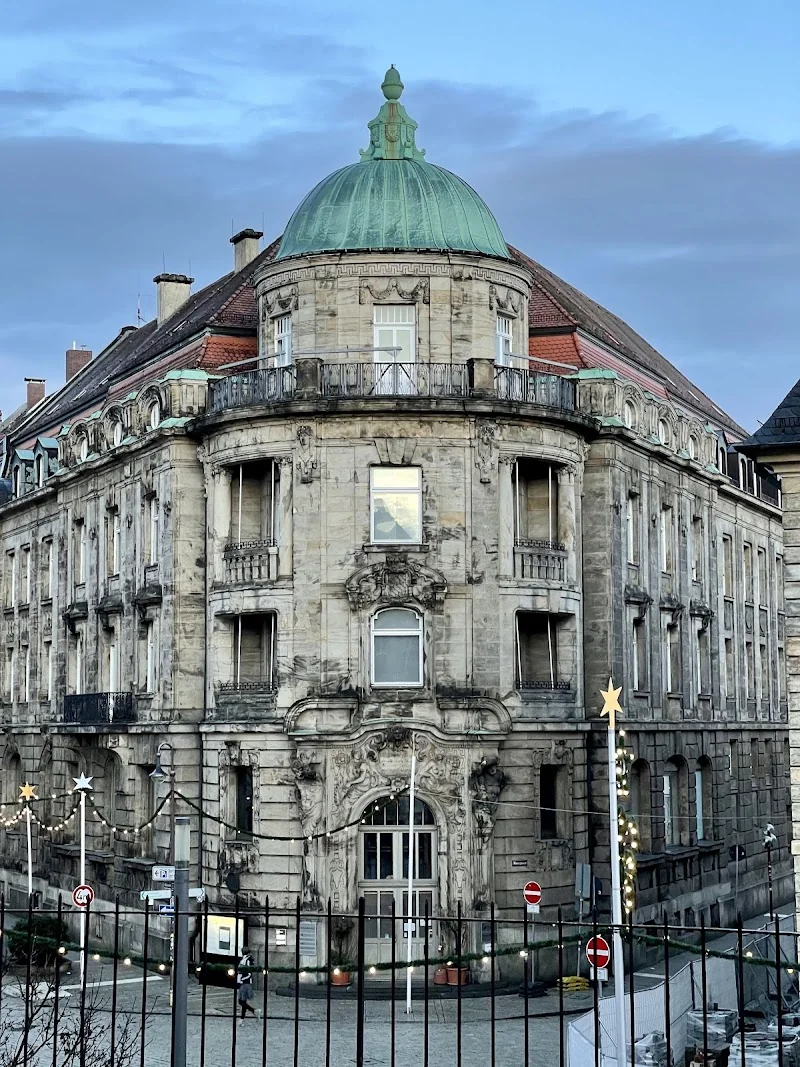
Wölfelstraße 2, Bayreuth
Wölfelstraße 2, 95444 Bayreuth, Germany
Iwalewahaus, University of Bayreuth | Exhibitions & Directions
The Iwalewahaus of the University of Bayreuth is a special place for all who want to connect African art, cultural diversity, and scientific perspectives. Since its founding in 1981, the house has developed from a Bayreuth institution with a clear focus on Africa into an internationally recognized center for art, research, and exchange. Its name is derived from the Yoruba proverb iwa l’ewa, which conceptually connects character and beauty. This connection of aesthetic power and intellectual ambition continues to shape the house today. With over 12,000 works from Africa, the African diaspora, Asia, and the Pacific, as well as around 2300 square meters of space for exhibitions, archives, discussions, and workshops, the Iwalewahaus is much more than an exhibition space. It is a vibrant place where science, museum practice, and contemporary culture intersect. Those searching for Iwalewahaus Bayreuth, Iwalewahaus Uni Bayreuth, or simply Iwalewa Bayreuth will find a house with a clear mission, a strong collection, and remarkable charisma. ([uni-bayreuth.de](https://www.uni-bayreuth.de/uninotizen-22-2026-ausstellung-iwalewahaus))
What is the Iwalewahaus at the University of Bayreuth?
The history of the Iwalewahaus is closely linked to the history of the University of Bayreuth. The university itself opened in 1975, and in 1981, the Africa Center Iwalewahaus was established, focusing on African art, culture, and knowledge. Later, the house was located in the former margravial mint in downtown Bayreuth; thus, it received a site with historical character and a very central location. The name Iwalewahaus refers to the Yoruba proverb iwa l’ewa, meaning that character is beauty. This substantive depth is not a decorative detail but describes the fundamental attitude of the house: art is not viewed in isolation but in connection with history, social issues, and cultural negotiations. In the recent presentation of the University of Bayreuth, the Iwalewahaus is explicitly described as a unit of the IAS, thus as part of an academic structure that connects research and teaching. For this reason, the house in Bayreuth has a dual role: it is a cultural attraction and simultaneously a scientific workplace. ([uni-bayreuth.de](https://www.uni-bayreuth.de/geschichte-der-universitaet))
Particularly important is the collection. Officially, it is described as having over 12,000 contemporary artworks from Africa, the African diaspora, Asia, and the Pacific. The University of Bayreuth also emphasizes that the Iwalewahaus houses the largest institutional collection of contemporary African art in Europe. This is remarkable for a house of this size and explains why it receives attention far beyond the region. The collection is not static but is used for exhibitions, scientific projects, collaborations, and international mediation. In official descriptions, the house is also classified as a center for postcolonial and decolonial research, which makes its current thematic focus very clear. Visitors will therefore not encounter a mere gallery but an institution that brings together art, research, and global perspectives. Those searching for Iwalewahaus photos or the unique character of the place will thus receive not only a beautiful building but primarily access to a significant collection and a specific cultural mission. ([ias.uni-bayreuth.de](https://www.ias.uni-bayreuth.de/de/das-institut/Einheiten-des-IAS/index.html))
Opening Hours, Admission, and Current Exhibitions
The Iwalewahaus operates exhibition-related, so opening hours and access are not always communicated as a rigid standard model. For the currently mentioned exhibition Journey Through the Collections: African Art at Iwalewahaus, there will be a vernissage on March 10, 2026, at 5 PM; admission is free, but registration at 0921/55 45 00 is required. This form of communication is typical for a house that offers not only permanent exhibitions but also changing formats. Therefore, those interested in Iwalewahaus opening hours should always pay attention to the currently advertised exhibition. This flexibility and individuality make planning easier. Unlike many classical museums, exhibition dates, tours, and access are often linked to specific occasions here. This aligns with the house's orientation, which showcases both academic events and curated exhibitions, discussions, and research results in varying constellations. For visitors, this is an advantage because there are regularly new contents, and the duration of stay remains well-planned. ([uni-bayreuth.de](https://www.uni-bayreuth.de/uninotizen-22-2026-ausstellung-iwalewahaus))
A look at past and recent exhibitions shows how diverse the program is. The house has showcased photo-essay exhibitions, pop-up formats, collection presentations, and thematic shows like Black History Month, Malangatana, or With These Hands. The University of Bayreuth regularly communicates new vernissages, durations, and languages. In some cases, admission is free, and no registration is required; in other cases, appointments, tours, or office hours are offered by arrangement. This mix of openness and curatorial precision makes the search for Iwalewahaus program or Iwalewahaus events so interesting: there is no one-dimensional calendar, but a house that responds to current questions while continually making its collection readable anew. Those wanting to see current Iwalewahaus photos will usually find images of the exhibitions themselves on the official pages, allowing for a very good impression of the spatial effect, hanging, and atmosphere in advance. ([uni-bayreuth.de](https://www.uni-bayreuth.de/pressemitteilung/black-history-month-ausstellung?utm_source=openai))
Directions, Address, and Way to the Iwalewahaus
The official address is Wölfelstraße 2, 95444 Bayreuth. The house is located in the city center, at the corner of Münzgasse/Wölfelstraße, and is described by the University of Bayreuth as a place in the heart of Bayreuth. For orientation, it is also important that the Iwalewahaus is located directly next to the Margravial Opera House, one of the city's most famous landmarks. Therefore, those searching for Iwalewahaus directions will find not only an address but also a very well-placed city point. According to the visitor page, the best way to reach the house is by bus or on foot from the city center. For guests arriving by train, the indicated routes are also practical: from Bayreuth Hbf, the VGN lines 302, 303, 305, 309, and 328 head towards ZOH, with exits at ZOH or Luitpoldplatz; from ZOH, line 304 continues towards the Opera House. Thus, the arrival by public transport is clearly described and easily understandable for visitors without a car. ([iwalewahaus.uni-bayreuth.de](https://www.iwalewahaus.uni-bayreuth.de/de/besuch/index.html))
Additionally, the official page mentions a barrier-free entrance in the courtyard, accessible via Münzgasse. This is particularly helpful for planning, as the entrance does not only have to be considered via the main address but also through the courtyard access. For Iwalewahaus Bayreuth, it can be said: those moving in the city center will find the way relatively easily, and those who pay attention to accessibility will receive a clearly named access point. The page also provides the phone number and email address of the house, so inquiries before a visit can be clarified easily. This is particularly useful for changing exhibitions and registration requirements. The Iwalewahaus is not a place with complicated access on the outskirts of the city but a centrally located house with good public transport connections, short walking distance, and a clearly described entrance situation. This practical information is particularly relevant for search queries like Iwalewahaus bus or Iwalewahaus contact, as it directly facilitates planning. ([iwalewahaus.uni-bayreuth.de](https://www.iwalewahaus.uni-bayreuth.de/de/besuch/index.html))
Art, Research, and Events at the Iwalewahaus
The Iwalewahaus is not only an exhibition venue but also a scientifically shaped cultural center. The University of Bayreuth describes it as a unit of the IAS and as part of a research environment closely connected to the excellence cluster Africa Multiple. Officially, the house is characterized as a center for modern and contemporary African art and culture or as a place for contemporary art and the cultures of Africa. At the same time, it is emphasized that it makes an important contribution to intercultural dialogue. This dual role is crucial for the profile of the house: here, artworks are not only displayed but also documented, scientifically explored, contextualized, and integrated into public discussions. For search queries like Iwalewahaus program or Iwalewahaus events, not only the exhibition calendar is interesting, but also the fact that the house is a place for research, knowledge transfer, and cultural debate. The Friends' Circle, founded in 2013, additionally supports this task and shows that the house is also anchored in the local community. ([ias.uni-bayreuth.de](https://www.ias.uni-bayreuth.de/de/das-institut/Einheiten-des-IAS/index.html))
The event formats range from exhibitions to lectures and film nights to conferences, discussions with artists, and workshops. The official pages of the University of Bayreuth also feature the Bayreuth City Talks at the Iwalewahaus, which prepare scientific and societal questions for a broad audience. This aligns with the idea of a house that not only collects but also mediates. Especially with current exhibitions, it becomes clear that international collaborations play a significant role: there are projects with partners in Africa and beyond, curatorial collaboration with researchers and students, and formats in which collection objects are newly questioned. An example of this is the exhibition Journey Through the Collections: African Art at Iwalewahaus, which is accompanied by a curatorial training program. This makes it visible that the house not only presents finished results but also promotes young talent and understands its collection as a learning and research space. Therefore, those interested in African art in Bayreuth will find a house that brings together exhibition, academy, and public in a rarely clear form. ([uni-bayreuth.de](https://www.uni-bayreuth.de/en/city-talks))
Photos, Spaces, and Equipment On-Site
With around 2300 square meters of space, the Iwalewahaus is spatially significantly larger than many visitors initially expect. The official information mentions offices, archives, and spaces for exhibitions, lectures, films, conferences, discussions with artists, and workshops. Additionally, there are accommodations for artists. This is important because it shows that the house is not just a showcase for works but has a productive infrastructure. Those searching for Iwalewahaus photos will therefore discover no standardized museum architecture but a mix of historical building, research environment, and changing presentation areas. The university also emphasizes that the house is housed in architecture with history: the location in the former margravial mint gives the rooms a special atmosphere. This makes a visit appealing because one not only sees objects but also moves in a house that is itself part of Bayreuth's cultural history. The connection between historical context and contemporary art creates the tension that makes the Iwalewahaus so distinctive. ([ias.uni-bayreuth.de](https://www.ias.uni-bayreuth.de/de/das-institut/Einheiten-des-IAS/index.html))
The house is also visually present. The official pages regularly incorporate images of the exhibitions, the building, and the current events. The University of Bayreuth also describes the Iwalewahaus as a museum with an on-site gallery for rotating exhibitions, which well describes the dynamics of the house. Not only the collection but also the space itself becomes part of the experience. For visitors, this means: the house is suitable for focused exhibition visits as well as for brief visits where one wants to get an impression of its working methods. The spaces are designed not only to show objects but also to enable encounters. This is also a reason why the house is relevant for students, researchers, and culture enthusiasts alike. Those informing themselves about Iwalewahaus Uni Bayreuth will thus receive not only a picture of a collection but also of a spatial structure that productively links research, mediation, and exhibition. ([africamultiple.uni-bayreuth.de](https://www.africamultiple.uni-bayreuth.de/en/news/2025/2025-05-14_Inaugurates-New-Research-Centre/index.html?utm_source=openai))
Tickets, Parking, and Seating Plan: What Visitors Should Know
For many inquiries regarding the Iwalewahaus, the end concerns very practical questions: Are there tickets, where can one park, and is there a seating plan? The official answer is nuanced. Many exhibitions at the Iwalewahaus are free, but individual formats work with registration, time-limited access, or advance registration by phone or email. This is not a classic ticket model like in large arenas or theaters but a visitor-friendly, exhibition-related system. For the topic of Iwalewahaus parking, it is important that the official visitor page primarily recommends arriving by bus or on foot; a separate parking information page is not highlighted there. Therefore, it is sensible to plan the visit more with public transport than to rely on a personal parking space. Those who are currently on the go should also check in advance whether registration is required for the desired exhibition. This mix of free admission, modern exhibition organization, and central location makes the house attractive for both spontaneous and planned visits. ([iwalewahaus.uni-bayreuth.de](https://www.iwalewahaus.uni-bayreuth.de/de/besuch/index.html))
A general seating plan is not the right idea for the Iwalewahaus because it is not a pure seating or concert hall but a house for exhibitions, discussions, and changing formats. For individual lectures or events, the respective notices of the event itself apply. Those searching for Iwalewahaus seating plan will practically find better information in the respective invitation, program item, or exhibition announcement than in a rigid floor plan. This is also where the strength of the house lies: it is not a rigid event container but a flexible place that continually adapts to content. For planning, it is therefore advisable to use the website or the contact of the house in advance. The contacts are clearly named, and the team can be easily reached for questions about opening hours, directions, registration, or tours. Thus, a simple search for Iwalewahaus Bayreuth ultimately becomes a concretely plannable visit to a unique cultural and research institution. ([ias.uni-bayreuth.de](https://www.ias.uni-bayreuth.de/de/das-institut/Einheiten-des-IAS/index.html))
Sources:
Show moreShow less
Iwalewahaus, University of Bayreuth | Exhibitions & Directions
The Iwalewahaus of the University of Bayreuth is a special place for all who want to connect African art, cultural diversity, and scientific perspectives. Since its founding in 1981, the house has developed from a Bayreuth institution with a clear focus on Africa into an internationally recognized center for art, research, and exchange. Its name is derived from the Yoruba proverb iwa l’ewa, which conceptually connects character and beauty. This connection of aesthetic power and intellectual ambition continues to shape the house today. With over 12,000 works from Africa, the African diaspora, Asia, and the Pacific, as well as around 2300 square meters of space for exhibitions, archives, discussions, and workshops, the Iwalewahaus is much more than an exhibition space. It is a vibrant place where science, museum practice, and contemporary culture intersect. Those searching for Iwalewahaus Bayreuth, Iwalewahaus Uni Bayreuth, or simply Iwalewa Bayreuth will find a house with a clear mission, a strong collection, and remarkable charisma. ([uni-bayreuth.de](https://www.uni-bayreuth.de/uninotizen-22-2026-ausstellung-iwalewahaus))
What is the Iwalewahaus at the University of Bayreuth?
The history of the Iwalewahaus is closely linked to the history of the University of Bayreuth. The university itself opened in 1975, and in 1981, the Africa Center Iwalewahaus was established, focusing on African art, culture, and knowledge. Later, the house was located in the former margravial mint in downtown Bayreuth; thus, it received a site with historical character and a very central location. The name Iwalewahaus refers to the Yoruba proverb iwa l’ewa, meaning that character is beauty. This substantive depth is not a decorative detail but describes the fundamental attitude of the house: art is not viewed in isolation but in connection with history, social issues, and cultural negotiations. In the recent presentation of the University of Bayreuth, the Iwalewahaus is explicitly described as a unit of the IAS, thus as part of an academic structure that connects research and teaching. For this reason, the house in Bayreuth has a dual role: it is a cultural attraction and simultaneously a scientific workplace. ([uni-bayreuth.de](https://www.uni-bayreuth.de/geschichte-der-universitaet))
Particularly important is the collection. Officially, it is described as having over 12,000 contemporary artworks from Africa, the African diaspora, Asia, and the Pacific. The University of Bayreuth also emphasizes that the Iwalewahaus houses the largest institutional collection of contemporary African art in Europe. This is remarkable for a house of this size and explains why it receives attention far beyond the region. The collection is not static but is used for exhibitions, scientific projects, collaborations, and international mediation. In official descriptions, the house is also classified as a center for postcolonial and decolonial research, which makes its current thematic focus very clear. Visitors will therefore not encounter a mere gallery but an institution that brings together art, research, and global perspectives. Those searching for Iwalewahaus photos or the unique character of the place will thus receive not only a beautiful building but primarily access to a significant collection and a specific cultural mission. ([ias.uni-bayreuth.de](https://www.ias.uni-bayreuth.de/de/das-institut/Einheiten-des-IAS/index.html))
Opening Hours, Admission, and Current Exhibitions
The Iwalewahaus operates exhibition-related, so opening hours and access are not always communicated as a rigid standard model. For the currently mentioned exhibition Journey Through the Collections: African Art at Iwalewahaus, there will be a vernissage on March 10, 2026, at 5 PM; admission is free, but registration at 0921/55 45 00 is required. This form of communication is typical for a house that offers not only permanent exhibitions but also changing formats. Therefore, those interested in Iwalewahaus opening hours should always pay attention to the currently advertised exhibition. This flexibility and individuality make planning easier. Unlike many classical museums, exhibition dates, tours, and access are often linked to specific occasions here. This aligns with the house's orientation, which showcases both academic events and curated exhibitions, discussions, and research results in varying constellations. For visitors, this is an advantage because there are regularly new contents, and the duration of stay remains well-planned. ([uni-bayreuth.de](https://www.uni-bayreuth.de/uninotizen-22-2026-ausstellung-iwalewahaus))
A look at past and recent exhibitions shows how diverse the program is. The house has showcased photo-essay exhibitions, pop-up formats, collection presentations, and thematic shows like Black History Month, Malangatana, or With These Hands. The University of Bayreuth regularly communicates new vernissages, durations, and languages. In some cases, admission is free, and no registration is required; in other cases, appointments, tours, or office hours are offered by arrangement. This mix of openness and curatorial precision makes the search for Iwalewahaus program or Iwalewahaus events so interesting: there is no one-dimensional calendar, but a house that responds to current questions while continually making its collection readable anew. Those wanting to see current Iwalewahaus photos will usually find images of the exhibitions themselves on the official pages, allowing for a very good impression of the spatial effect, hanging, and atmosphere in advance. ([uni-bayreuth.de](https://www.uni-bayreuth.de/pressemitteilung/black-history-month-ausstellung?utm_source=openai))
Directions, Address, and Way to the Iwalewahaus
The official address is Wölfelstraße 2, 95444 Bayreuth. The house is located in the city center, at the corner of Münzgasse/Wölfelstraße, and is described by the University of Bayreuth as a place in the heart of Bayreuth. For orientation, it is also important that the Iwalewahaus is located directly next to the Margravial Opera House, one of the city's most famous landmarks. Therefore, those searching for Iwalewahaus directions will find not only an address but also a very well-placed city point. According to the visitor page, the best way to reach the house is by bus or on foot from the city center. For guests arriving by train, the indicated routes are also practical: from Bayreuth Hbf, the VGN lines 302, 303, 305, 309, and 328 head towards ZOH, with exits at ZOH or Luitpoldplatz; from ZOH, line 304 continues towards the Opera House. Thus, the arrival by public transport is clearly described and easily understandable for visitors without a car. ([iwalewahaus.uni-bayreuth.de](https://www.iwalewahaus.uni-bayreuth.de/de/besuch/index.html))
Additionally, the official page mentions a barrier-free entrance in the courtyard, accessible via Münzgasse. This is particularly helpful for planning, as the entrance does not only have to be considered via the main address but also through the courtyard access. For Iwalewahaus Bayreuth, it can be said: those moving in the city center will find the way relatively easily, and those who pay attention to accessibility will receive a clearly named access point. The page also provides the phone number and email address of the house, so inquiries before a visit can be clarified easily. This is particularly useful for changing exhibitions and registration requirements. The Iwalewahaus is not a place with complicated access on the outskirts of the city but a centrally located house with good public transport connections, short walking distance, and a clearly described entrance situation. This practical information is particularly relevant for search queries like Iwalewahaus bus or Iwalewahaus contact, as it directly facilitates planning. ([iwalewahaus.uni-bayreuth.de](https://www.iwalewahaus.uni-bayreuth.de/de/besuch/index.html))
Art, Research, and Events at the Iwalewahaus
The Iwalewahaus is not only an exhibition venue but also a scientifically shaped cultural center. The University of Bayreuth describes it as a unit of the IAS and as part of a research environment closely connected to the excellence cluster Africa Multiple. Officially, the house is characterized as a center for modern and contemporary African art and culture or as a place for contemporary art and the cultures of Africa. At the same time, it is emphasized that it makes an important contribution to intercultural dialogue. This dual role is crucial for the profile of the house: here, artworks are not only displayed but also documented, scientifically explored, contextualized, and integrated into public discussions. For search queries like Iwalewahaus program or Iwalewahaus events, not only the exhibition calendar is interesting, but also the fact that the house is a place for research, knowledge transfer, and cultural debate. The Friends' Circle, founded in 2013, additionally supports this task and shows that the house is also anchored in the local community. ([ias.uni-bayreuth.de](https://www.ias.uni-bayreuth.de/de/das-institut/Einheiten-des-IAS/index.html))
The event formats range from exhibitions to lectures and film nights to conferences, discussions with artists, and workshops. The official pages of the University of Bayreuth also feature the Bayreuth City Talks at the Iwalewahaus, which prepare scientific and societal questions for a broad audience. This aligns with the idea of a house that not only collects but also mediates. Especially with current exhibitions, it becomes clear that international collaborations play a significant role: there are projects with partners in Africa and beyond, curatorial collaboration with researchers and students, and formats in which collection objects are newly questioned. An example of this is the exhibition Journey Through the Collections: African Art at Iwalewahaus, which is accompanied by a curatorial training program. This makes it visible that the house not only presents finished results but also promotes young talent and understands its collection as a learning and research space. Therefore, those interested in African art in Bayreuth will find a house that brings together exhibition, academy, and public in a rarely clear form. ([uni-bayreuth.de](https://www.uni-bayreuth.de/en/city-talks))
Photos, Spaces, and Equipment On-Site
With around 2300 square meters of space, the Iwalewahaus is spatially significantly larger than many visitors initially expect. The official information mentions offices, archives, and spaces for exhibitions, lectures, films, conferences, discussions with artists, and workshops. Additionally, there are accommodations for artists. This is important because it shows that the house is not just a showcase for works but has a productive infrastructure. Those searching for Iwalewahaus photos will therefore discover no standardized museum architecture but a mix of historical building, research environment, and changing presentation areas. The university also emphasizes that the house is housed in architecture with history: the location in the former margravial mint gives the rooms a special atmosphere. This makes a visit appealing because one not only sees objects but also moves in a house that is itself part of Bayreuth's cultural history. The connection between historical context and contemporary art creates the tension that makes the Iwalewahaus so distinctive. ([ias.uni-bayreuth.de](https://www.ias.uni-bayreuth.de/de/das-institut/Einheiten-des-IAS/index.html))
The house is also visually present. The official pages regularly incorporate images of the exhibitions, the building, and the current events. The University of Bayreuth also describes the Iwalewahaus as a museum with an on-site gallery for rotating exhibitions, which well describes the dynamics of the house. Not only the collection but also the space itself becomes part of the experience. For visitors, this means: the house is suitable for focused exhibition visits as well as for brief visits where one wants to get an impression of its working methods. The spaces are designed not only to show objects but also to enable encounters. This is also a reason why the house is relevant for students, researchers, and culture enthusiasts alike. Those informing themselves about Iwalewahaus Uni Bayreuth will thus receive not only a picture of a collection but also of a spatial structure that productively links research, mediation, and exhibition. ([africamultiple.uni-bayreuth.de](https://www.africamultiple.uni-bayreuth.de/en/news/2025/2025-05-14_Inaugurates-New-Research-Centre/index.html?utm_source=openai))
Tickets, Parking, and Seating Plan: What Visitors Should Know
For many inquiries regarding the Iwalewahaus, the end concerns very practical questions: Are there tickets, where can one park, and is there a seating plan? The official answer is nuanced. Many exhibitions at the Iwalewahaus are free, but individual formats work with registration, time-limited access, or advance registration by phone or email. This is not a classic ticket model like in large arenas or theaters but a visitor-friendly, exhibition-related system. For the topic of Iwalewahaus parking, it is important that the official visitor page primarily recommends arriving by bus or on foot; a separate parking information page is not highlighted there. Therefore, it is sensible to plan the visit more with public transport than to rely on a personal parking space. Those who are currently on the go should also check in advance whether registration is required for the desired exhibition. This mix of free admission, modern exhibition organization, and central location makes the house attractive for both spontaneous and planned visits. ([iwalewahaus.uni-bayreuth.de](https://www.iwalewahaus.uni-bayreuth.de/de/besuch/index.html))
A general seating plan is not the right idea for the Iwalewahaus because it is not a pure seating or concert hall but a house for exhibitions, discussions, and changing formats. For individual lectures or events, the respective notices of the event itself apply. Those searching for Iwalewahaus seating plan will practically find better information in the respective invitation, program item, or exhibition announcement than in a rigid floor plan. This is also where the strength of the house lies: it is not a rigid event container but a flexible place that continually adapts to content. For planning, it is therefore advisable to use the website or the contact of the house in advance. The contacts are clearly named, and the team can be easily reached for questions about opening hours, directions, registration, or tours. Thus, a simple search for Iwalewahaus Bayreuth ultimately becomes a concretely plannable visit to a unique cultural and research institution. ([ias.uni-bayreuth.de](https://www.ias.uni-bayreuth.de/de/das-institut/Einheiten-des-IAS/index.html))
Sources:
Iwalewahaus, University of Bayreuth | Exhibitions & Directions
The Iwalewahaus of the University of Bayreuth is a special place for all who want to connect African art, cultural diversity, and scientific perspectives. Since its founding in 1981, the house has developed from a Bayreuth institution with a clear focus on Africa into an internationally recognized center for art, research, and exchange. Its name is derived from the Yoruba proverb iwa l’ewa, which conceptually connects character and beauty. This connection of aesthetic power and intellectual ambition continues to shape the house today. With over 12,000 works from Africa, the African diaspora, Asia, and the Pacific, as well as around 2300 square meters of space for exhibitions, archives, discussions, and workshops, the Iwalewahaus is much more than an exhibition space. It is a vibrant place where science, museum practice, and contemporary culture intersect. Those searching for Iwalewahaus Bayreuth, Iwalewahaus Uni Bayreuth, or simply Iwalewa Bayreuth will find a house with a clear mission, a strong collection, and remarkable charisma. ([uni-bayreuth.de](https://www.uni-bayreuth.de/uninotizen-22-2026-ausstellung-iwalewahaus))
What is the Iwalewahaus at the University of Bayreuth?
The history of the Iwalewahaus is closely linked to the history of the University of Bayreuth. The university itself opened in 1975, and in 1981, the Africa Center Iwalewahaus was established, focusing on African art, culture, and knowledge. Later, the house was located in the former margravial mint in downtown Bayreuth; thus, it received a site with historical character and a very central location. The name Iwalewahaus refers to the Yoruba proverb iwa l’ewa, meaning that character is beauty. This substantive depth is not a decorative detail but describes the fundamental attitude of the house: art is not viewed in isolation but in connection with history, social issues, and cultural negotiations. In the recent presentation of the University of Bayreuth, the Iwalewahaus is explicitly described as a unit of the IAS, thus as part of an academic structure that connects research and teaching. For this reason, the house in Bayreuth has a dual role: it is a cultural attraction and simultaneously a scientific workplace. ([uni-bayreuth.de](https://www.uni-bayreuth.de/geschichte-der-universitaet))
Particularly important is the collection. Officially, it is described as having over 12,000 contemporary artworks from Africa, the African diaspora, Asia, and the Pacific. The University of Bayreuth also emphasizes that the Iwalewahaus houses the largest institutional collection of contemporary African art in Europe. This is remarkable for a house of this size and explains why it receives attention far beyond the region. The collection is not static but is used for exhibitions, scientific projects, collaborations, and international mediation. In official descriptions, the house is also classified as a center for postcolonial and decolonial research, which makes its current thematic focus very clear. Visitors will therefore not encounter a mere gallery but an institution that brings together art, research, and global perspectives. Those searching for Iwalewahaus photos or the unique character of the place will thus receive not only a beautiful building but primarily access to a significant collection and a specific cultural mission. ([ias.uni-bayreuth.de](https://www.ias.uni-bayreuth.de/de/das-institut/Einheiten-des-IAS/index.html))
Opening Hours, Admission, and Current Exhibitions
The Iwalewahaus operates exhibition-related, so opening hours and access are not always communicated as a rigid standard model. For the currently mentioned exhibition Journey Through the Collections: African Art at Iwalewahaus, there will be a vernissage on March 10, 2026, at 5 PM; admission is free, but registration at 0921/55 45 00 is required. This form of communication is typical for a house that offers not only permanent exhibitions but also changing formats. Therefore, those interested in Iwalewahaus opening hours should always pay attention to the currently advertised exhibition. This flexibility and individuality make planning easier. Unlike many classical museums, exhibition dates, tours, and access are often linked to specific occasions here. This aligns with the house's orientation, which showcases both academic events and curated exhibitions, discussions, and research results in varying constellations. For visitors, this is an advantage because there are regularly new contents, and the duration of stay remains well-planned. ([uni-bayreuth.de](https://www.uni-bayreuth.de/uninotizen-22-2026-ausstellung-iwalewahaus))
A look at past and recent exhibitions shows how diverse the program is. The house has showcased photo-essay exhibitions, pop-up formats, collection presentations, and thematic shows like Black History Month, Malangatana, or With These Hands. The University of Bayreuth regularly communicates new vernissages, durations, and languages. In some cases, admission is free, and no registration is required; in other cases, appointments, tours, or office hours are offered by arrangement. This mix of openness and curatorial precision makes the search for Iwalewahaus program or Iwalewahaus events so interesting: there is no one-dimensional calendar, but a house that responds to current questions while continually making its collection readable anew. Those wanting to see current Iwalewahaus photos will usually find images of the exhibitions themselves on the official pages, allowing for a very good impression of the spatial effect, hanging, and atmosphere in advance. ([uni-bayreuth.de](https://www.uni-bayreuth.de/pressemitteilung/black-history-month-ausstellung?utm_source=openai))
Directions, Address, and Way to the Iwalewahaus
The official address is Wölfelstraße 2, 95444 Bayreuth. The house is located in the city center, at the corner of Münzgasse/Wölfelstraße, and is described by the University of Bayreuth as a place in the heart of Bayreuth. For orientation, it is also important that the Iwalewahaus is located directly next to the Margravial Opera House, one of the city's most famous landmarks. Therefore, those searching for Iwalewahaus directions will find not only an address but also a very well-placed city point. According to the visitor page, the best way to reach the house is by bus or on foot from the city center. For guests arriving by train, the indicated routes are also practical: from Bayreuth Hbf, the VGN lines 302, 303, 305, 309, and 328 head towards ZOH, with exits at ZOH or Luitpoldplatz; from ZOH, line 304 continues towards the Opera House. Thus, the arrival by public transport is clearly described and easily understandable for visitors without a car. ([iwalewahaus.uni-bayreuth.de](https://www.iwalewahaus.uni-bayreuth.de/de/besuch/index.html))
Additionally, the official page mentions a barrier-free entrance in the courtyard, accessible via Münzgasse. This is particularly helpful for planning, as the entrance does not only have to be considered via the main address but also through the courtyard access. For Iwalewahaus Bayreuth, it can be said: those moving in the city center will find the way relatively easily, and those who pay attention to accessibility will receive a clearly named access point. The page also provides the phone number and email address of the house, so inquiries before a visit can be clarified easily. This is particularly useful for changing exhibitions and registration requirements. The Iwalewahaus is not a place with complicated access on the outskirts of the city but a centrally located house with good public transport connections, short walking distance, and a clearly described entrance situation. This practical information is particularly relevant for search queries like Iwalewahaus bus or Iwalewahaus contact, as it directly facilitates planning. ([iwalewahaus.uni-bayreuth.de](https://www.iwalewahaus.uni-bayreuth.de/de/besuch/index.html))
Art, Research, and Events at the Iwalewahaus
The Iwalewahaus is not only an exhibition venue but also a scientifically shaped cultural center. The University of Bayreuth describes it as a unit of the IAS and as part of a research environment closely connected to the excellence cluster Africa Multiple. Officially, the house is characterized as a center for modern and contemporary African art and culture or as a place for contemporary art and the cultures of Africa. At the same time, it is emphasized that it makes an important contribution to intercultural dialogue. This dual role is crucial for the profile of the house: here, artworks are not only displayed but also documented, scientifically explored, contextualized, and integrated into public discussions. For search queries like Iwalewahaus program or Iwalewahaus events, not only the exhibition calendar is interesting, but also the fact that the house is a place for research, knowledge transfer, and cultural debate. The Friends' Circle, founded in 2013, additionally supports this task and shows that the house is also anchored in the local community. ([ias.uni-bayreuth.de](https://www.ias.uni-bayreuth.de/de/das-institut/Einheiten-des-IAS/index.html))
The event formats range from exhibitions to lectures and film nights to conferences, discussions with artists, and workshops. The official pages of the University of Bayreuth also feature the Bayreuth City Talks at the Iwalewahaus, which prepare scientific and societal questions for a broad audience. This aligns with the idea of a house that not only collects but also mediates. Especially with current exhibitions, it becomes clear that international collaborations play a significant role: there are projects with partners in Africa and beyond, curatorial collaboration with researchers and students, and formats in which collection objects are newly questioned. An example of this is the exhibition Journey Through the Collections: African Art at Iwalewahaus, which is accompanied by a curatorial training program. This makes it visible that the house not only presents finished results but also promotes young talent and understands its collection as a learning and research space. Therefore, those interested in African art in Bayreuth will find a house that brings together exhibition, academy, and public in a rarely clear form. ([uni-bayreuth.de](https://www.uni-bayreuth.de/en/city-talks))
Photos, Spaces, and Equipment On-Site
With around 2300 square meters of space, the Iwalewahaus is spatially significantly larger than many visitors initially expect. The official information mentions offices, archives, and spaces for exhibitions, lectures, films, conferences, discussions with artists, and workshops. Additionally, there are accommodations for artists. This is important because it shows that the house is not just a showcase for works but has a productive infrastructure. Those searching for Iwalewahaus photos will therefore discover no standardized museum architecture but a mix of historical building, research environment, and changing presentation areas. The university also emphasizes that the house is housed in architecture with history: the location in the former margravial mint gives the rooms a special atmosphere. This makes a visit appealing because one not only sees objects but also moves in a house that is itself part of Bayreuth's cultural history. The connection between historical context and contemporary art creates the tension that makes the Iwalewahaus so distinctive. ([ias.uni-bayreuth.de](https://www.ias.uni-bayreuth.de/de/das-institut/Einheiten-des-IAS/index.html))
The house is also visually present. The official pages regularly incorporate images of the exhibitions, the building, and the current events. The University of Bayreuth also describes the Iwalewahaus as a museum with an on-site gallery for rotating exhibitions, which well describes the dynamics of the house. Not only the collection but also the space itself becomes part of the experience. For visitors, this means: the house is suitable for focused exhibition visits as well as for brief visits where one wants to get an impression of its working methods. The spaces are designed not only to show objects but also to enable encounters. This is also a reason why the house is relevant for students, researchers, and culture enthusiasts alike. Those informing themselves about Iwalewahaus Uni Bayreuth will thus receive not only a picture of a collection but also of a spatial structure that productively links research, mediation, and exhibition. ([africamultiple.uni-bayreuth.de](https://www.africamultiple.uni-bayreuth.de/en/news/2025/2025-05-14_Inaugurates-New-Research-Centre/index.html?utm_source=openai))
Tickets, Parking, and Seating Plan: What Visitors Should Know
For many inquiries regarding the Iwalewahaus, the end concerns very practical questions: Are there tickets, where can one park, and is there a seating plan? The official answer is nuanced. Many exhibitions at the Iwalewahaus are free, but individual formats work with registration, time-limited access, or advance registration by phone or email. This is not a classic ticket model like in large arenas or theaters but a visitor-friendly, exhibition-related system. For the topic of Iwalewahaus parking, it is important that the official visitor page primarily recommends arriving by bus or on foot; a separate parking information page is not highlighted there. Therefore, it is sensible to plan the visit more with public transport than to rely on a personal parking space. Those who are currently on the go should also check in advance whether registration is required for the desired exhibition. This mix of free admission, modern exhibition organization, and central location makes the house attractive for both spontaneous and planned visits. ([iwalewahaus.uni-bayreuth.de](https://www.iwalewahaus.uni-bayreuth.de/de/besuch/index.html))
A general seating plan is not the right idea for the Iwalewahaus because it is not a pure seating or concert hall but a house for exhibitions, discussions, and changing formats. For individual lectures or events, the respective notices of the event itself apply. Those searching for Iwalewahaus seating plan will practically find better information in the respective invitation, program item, or exhibition announcement than in a rigid floor plan. This is also where the strength of the house lies: it is not a rigid event container but a flexible place that continually adapts to content. For planning, it is therefore advisable to use the website or the contact of the house in advance. The contacts are clearly named, and the team can be easily reached for questions about opening hours, directions, registration, or tours. Thus, a simple search for Iwalewahaus Bayreuth ultimately becomes a concretely plannable visit to a unique cultural and research institution. ([ias.uni-bayreuth.de](https://www.ias.uni-bayreuth.de/de/das-institut/Einheiten-des-IAS/index.html))
Sources:
Upcoming Events
Ayeye - Ruth Baumgarte at Iwalewahaus
A vibrant dialogue between Ruth Baumgarte and the collection of Iwalewahaus awaits in Bayreuth. Free admission, smart curation, big questions. #Art

Bayreuth City Talks: Water Crisis at Our Doorstep?
Water becomes a question of the future: The Bayreuth City Talks at Iwalewahaus connect research, dialogue, and regional relevance. July 1, 2026, 6 PM, free admission. #Bayreuth #Water

Lecture-Performance: Do you know what it was like?
A special morning for opera and culture fans: At the Iwalewahaus Bayreuth, Wagner research meets lively language and singing art. #Bayreuth #Wagner
Frequently Asked Questions
Reviews
david antoun
5. October 2024
baroque building, part of the university, serves art and culture.
Mr. Reed
3. June 2016
The BigsasAfrican & African Diasporic Literatures Festival
AlechenuTV.
2. December 2022
Such a lovely place.
Christoph Römer
30. July 2025
A beautiful building with changing and consistently interesting exhibitions. The staff is also extremely friendly. I always enjoy coming back.
Heydi Grünert
26. August 2019
An interesting museum and cultural center right in the heart of Bayreuth. Admission was free. The building itself is worth seeing.