
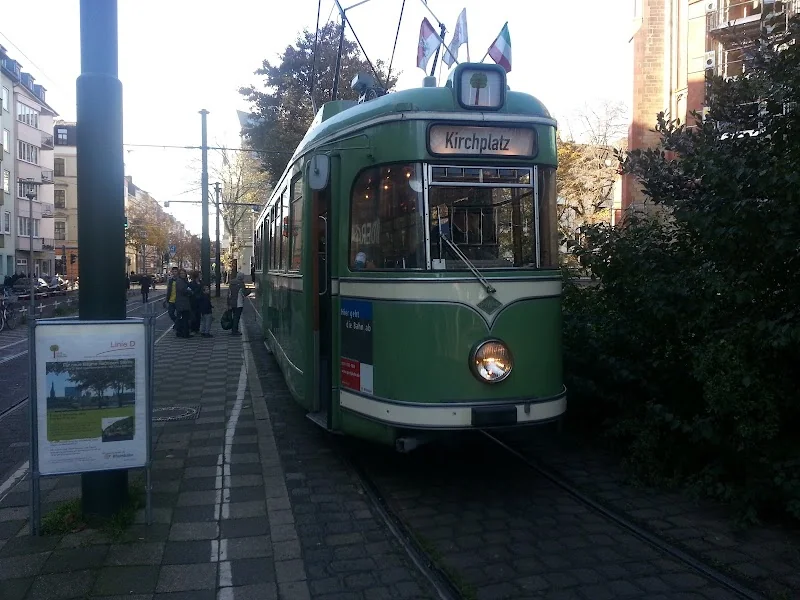
Düsseldorf
Kirchpl., 40217 Düsseldorf-Stadtbezirk 3, Germany
Kirchplatz | Weekly Market & Public Transport
The Kirchplatz in Düsseldorf is much more than just a place name on the map. It is located in Unterbilk, south of the city center, and is described by the city itself as part of a very urban district with a central location and good infrastructure. Those who come here experience not an anonymous transit space, but a real meeting point between market, church, neighborhood, and mobility. The square has been a place in Düsseldorf for years where everyday life and city feeling are closely intertwined. This is particularly evident in the combination of the daily weekly market, the distinctive St. Peter church, and the modern mobility station, which today makes Kirchplatz one of the connected places in the district. Visit Düsseldorf also describes the square as a green oasis with raised beds, fountains, seating areas, drinking fountains, photovoltaic elements, and a misting system for hot days. This creates a space that is not only functional but also atmospherically strong and consciously understood as a place to stay. ([duesseldorf.de](https://www.duesseldorf.de/stadtplanungsamt/stadtentwicklung/integrierte-quartiersentwicklung/handlungsraeume/-unterbilk-ost))
Therefore, when searching for Kirchplatz Düsseldorf, several topics are often relevant at the same time: the weekly market, access, parking, the stop, St. Peter, and the question of what makes this square so important in everyday life. This is precisely where its special SEO strength lies. Kirchplatz is not a classic event area, but an urban piece of the city that changes throughout the day: in the morning and during the day, it is a market, in between a meeting point, a traffic hub for commuters, and for the neighborhood, a place with growing quality of stay. The city of Düsseldorf is also continuously anchoring new ideas for climate adaptation, mobility, and neighborhood development here. Therefore, those looking for practical information will find not only an address but a lively place where the neighborhood logic of Unterbilk and Friedrichstadt can be very clearly read. ([duesseldorf.de](https://www.duesseldorf.de/stadtplanungsamt/stadtentwicklung/integrierte-quartiersentwicklung/handlungsraeume/-unterbilk-ost))
Weekly Market at Kirchplatz in Unterbilk
The weekly market is one of the strongest features of Kirchplatz and at the same time the central search topic for many visitors. According to the city of Düsseldorf, the market takes place from Monday to Friday from 7:00 AM to 6:00 PM, and on Saturdays from 7:00 AM to 2:00 PM; on Saturdays, there are also snack offerings starting at 11:30 AM. These times clearly indicate that Kirchplatz is not an occasional special location, but a market with a high everyday function. For residents, it is part of their daily supply, for visitors, a good address for fresh products, and for everyone who wants to experience the district through its rhythm, a very authentic place. The district of Unterbilk is thus one of the neighborhoods where the weekly market not only fulfills a shopping function but also significantly shapes the street scene and social use of the square. ([duesseldorf.de](https://www.duesseldorf.de/umweltamt/umwelt-und-verbraucherthemen-von-a-z/marktmanagement/wochenmaerkte/termine))
Historically, this character was further strengthened by the redesign in 2004 and 2005. As part of the Platzda! project by the city of Düsseldorf, fixed market pavilions were erected at Kirchplatz, similar to those on Carlsplatz. These pavilions serve the daily sale of fresh goods such as flowers, fruits, vegetables, and fish; there are also gastronomic offerings of various origins. This mixture of market and small neighborhood gastronomy ensures that Kirchplatz is more than just a sales location. It is a place where one does not just shop quickly but stays, looks around, meets people, and perceives the district. This is also important for search intent: those searching for kirchplatz weekly market, kirchplatz events, or kirchplatz unterbilk expect a lively mix of supply function, neighborhood, and urban atmosphere. ([de.wikipedia.org](https://de.wikipedia.org/wiki/Kirchplatz_%28D%C3%BCsseldorf%29))
The market structure is also a reason why Kirchplatz is perceived as an urban center in the district. The market stalls give the square a clear daily structure, and the permanent presence of offerings and movement creates a stability that is particularly valuable in a dense urban area. Even if one visits Kirchplatz only briefly, the market conveys a very clear picture of the character of the district: close, urban, easily accessible, and suitable for everyday life. Those seeking fresh products, short distances, and a lively environment will find excellent service here. The combination of regular opening hours, fixed pavilions, and integration into a dense residential and working environment makes the market a permanent attraction in Düsseldorf-Unterbilk. ([duesseldorf.de](https://www.duesseldorf.de/umweltamt/umwelt-und-verbraucherthemen-von-a-z/marktmanagement/wochenmaerkte/termine))
Access to Kirchplatz: Public Transport, Stop, and Mobility Station
Access is one of the most important topics surrounding Kirchplatz, and here the square scores with its very good public transport connections. The city of Düsseldorf describes the mobility station at Kirchplatz as the first station with direct public transport connections that improves the intermodal transfer between bus and train, bike, and car sharing. According to the current public transport overview at the Kirchplatz U stop, the lines U71, U72, U73, and U83 as well as the bus lines 736, 835, 836, and M3 stop there. Thus, Kirchplatz is not only a market location but also a real mobility hub where different modes of transport intersect. This fits very well with the location south of the city center, as the square is particularly practical for both everyday routes and errands and meetings. ([duesseldorf.de](https://www.duesseldorf.de/leben-in-duesseldorf/verkehr/detail/newsdetail/oepnv-mobilitaetsstation-am-kirchplatz-eroeffnet-1/))
However, the mobility station goes beyond mere stop functionality. The city describes it as a component of a network of mobility stations in Bilk, Unterbilk, and Friedrichstadt. The bus and train stops are complemented by taxi stands, the parking garage under the square, car-sharing spaces, and sharing offers for micromobility. The city communication also mentions six new car-sharing spaces and two sharing stations that sensibly expand the offer for the first and last mile. This is practical for everyone who not only wants to go to Kirchplatz but also continue into the neighborhood, to Friedrichstraße, or towards the city center. Kirchplatz is thus understood as a place where mobility is no longer thought of separately from the quality of stay but as part of an urban overall concept. ([duesseldorf.de](https://www.duesseldorf.de/leben-in-duesseldorf/verkehr/detail/newsdetail/oepnv-mobilitaetsstation-am-kirchplatz-eroeffnet-1/))
From the perspective of accessibility, the location is also very well integrated. The Kirchplatz subway station is accessible from Elisabethstraße and, according to the historical square article, has access with escalators, stairs, and elevators directly from the square. For people with strollers, wheelchairs, or luggage, this is a clear advantage, as the square is comfortably integrated into the urban network. Those traveling in Düsseldorf and wishing to visit Kirchplatz can thus easily tailor their journey to their own needs: by subway, bus, bicycle, sharing vehicle, or on foot from the surrounding neighborhoods. This mix of accessibility and everyday suitability makes the place highly relevant for search queries related to access, public transport, or bus train. ([de.wikipedia.org](https://de.wikipedia.org/wiki/Kirchplatz_%28D%C3%BCsseldorf%29))
Parking at Kirchplatz: Underground Garage, Evening Parking, and Short Distances
For those arriving by car, Kirchplatz is also well equipped, even though it is clearly designed as a multimodal urban space. There is a parking garage under the square, and the city of Düsseldorf lists the location in the evening parking offer as Kirchplatz, Fürstenwall 111, at Q-Park. This is particularly interesting for those who want to use the square in the evening or overnight or are looking for a central parking solution in the southern city center area. Additionally, the city mentions 35 parking spaces for the Kirchplatz location in connection with the expansion of evening parking. The location is thus particularly attractive for short visits, errands, or combined market and city strolls. However, those coming by car should still consider the urban environment: Kirchplatz is not a peripheral location with a large forecourt but a compact square within a dense urban fabric. ([duesseldorf.de](https://www.duesseldorf.de/verkehrsmanagement/mobil-in-duesseldorf/mit-dem-auto/parken-in-duesseldorf/feierabend-parken))
It is particularly practical that parking does not feel isolated but is directly intertwined with the other uses of the square. Under Kirchplatz lies the underground garage, above are the market, church, and seating areas, and at the edges, the important streets Fürstenwall, Elisabethstraße, and Friedrichstraße connect. This spatial compactness means for visitors: park once, then continue on foot. This is ideal for a place with a weekly market and neighborhood use, as one hardly loses time in long walks. At the same time, the parking concept fits the urban mobility logic, which consciously does not rely on a single mode of transport at Kirchplatz. The square is thus neither purely a car area nor a pure public transport station but a flexible urban space that brings together various arrivals in a small area. ([de.wikipedia.org](https://de.wikipedia.org/wiki/Kirchplatz_%28D%C3%BCsseldorf%29))
This topic is particularly important for SEO searches, as many users search for kirchplatz parking, kirchplatz parking garage, or kirchplatz access when they want to reach the place in everyday life. In content, the square provides clear answers: parking garage under the square, evening parking at Fürstenwall 111, good public transport connections, and short distances into the neighborhood. Although Kirchplatz is not a classic large event arena, it functions as a well-accessible city center square with surprisingly high usage density. This makes the parking question relevant: those driving here usually want to be targeted and quickly at the location without having to drive through the entire city center. ([duesseldorf.de](https://www.duesseldorf.de/verkehrsmanagement/mobil-in-duesseldorf/mit-dem-auto/parken-in-duesseldorf/feierabend-parken))
St. Peter and the History of Kirchplatz
The history of Kirchplatz is closely linked to St. Peter. The square did not simply emerge as a neutral open space but grew over decades in connection with the development of Friedrichstadt and the construction of the church. According to the historical square article, the area was structured differently in the 18th century; a map from 1759 describes areas with the designation Am Hasenbusche. The adjacent Friedrichstadt was still sparsely built at that time. Elisabethstraße and Friedrichstraße were laid out in 1854, the intersection with Kirchfeldstraße was paved in 1876, the future Kirchplatz was leveled in 1882, and in 1883 it was planted with chestnut trees. At that time, there was also a tall bowl fountain, which later had to make way for the construction of the church. This early development shows that Kirchplatz already took on an important urban planning role in the 19th century. ([de.wikipedia.org](https://de.wikipedia.org/wiki/Kirchplatz_%28D%C3%BCsseldorf%29))
The church itself continues to shape the square to this day. St. Peter in Düsseldorf-Unterbilk was built according to designs by architect Caspar Clemens Pickel and was consecrated in 1898. It is one of the largest churches in the state capital and has been part of the parish of St. Martin since 2026. Its construction and usage history is also remarkable: the church was partially destroyed in World War II and reconstructed in various phases until 1981. In 2007, the roof structure was severely damaged by a fire; the solemn reopening took place in 2011. Thus, St. Peter is not only an architectural landmark but also a symbol of continuity, reconstruction, and identity in the neighborhood. The perception of Kirchplatz benefits greatly from this architectural dominance, as the square would not have the same clear center without the church. ([de.wikipedia.org](https://de.wikipedia.org/wiki/St._Peter_%28D%C3%BCsseldorf%29))
For the use of the square, this is historically significant: the name Kirchplatz is not merely descriptive but refers to a context of religion, urban development, and public space that has grown over decades. The redesign of the square in the early 21st century also built on this by creating market pavilions and a clearer square structure instead of overforming the space. This way, the historical core remains visible while the square can also be used in a contemporary manner. Especially in a city like Düsseldorf, where many squares carry different epochs within them, Kirchplatz is a good example of how an ecclesiastically influenced environment can evolve into an urban mixed-use space that today connects market, encounter, and mobility. ([de.wikipedia.org](https://de.wikipedia.org/wiki/Kirchplatz_%28D%C3%BCsseldorf%29))
Quality of Stay, Greenery, and Modern Square Design
In recent years, Kirchplatz has increasingly been reimagined as a green and social urban space. Visit Düsseldorf currently describes it as a kind of green oasis with raised beds, fountains, new seating areas, a public drinking fountain, PV elements on the market stalls, and a misting system that provides cooling on hot days. This is remarkable for an inner-city square because it complements the classic market and transport function with real quality of stay. The initiative Schöner Kirchplatz is also involved with litter collection actions and greening for a well-kept environment. This creates a place that convinces not only through its use but also through its appearance. Thus, those visiting Kirchplatz experience a place that is consciously designed for lingering and not just for transit. ([visitduesseldorf.de](https://www.visitduesseldorf.de/attraktionen/kirchplatz-b41a77c325))
The city itself is also continuing to focus on enhancement. In February 2025, Düsseldorf announced a redesign of Kirchplatz in Unterbilk. Plans include a new playground in the southwestern part, a boules area, paved paths to the church, grassy areas, and a grove of eight tall trees. The historic tree population around the church is to be preserved. Such measures are important because they position the square even more strongly as a meeting point for different age groups. Families, market visitors, strollers, and people from the neighborhood will thus have additional reasons to visit the place regularly. For the perception of the square, this means: Kirchplatz is not only functionally managed but is actively developed as an urban living space. ([duesseldorf.de](https://www.duesseldorf.de/medienportal/pressedienst-einzelansicht/pld/landeshauptstadt-gestaltet-den-kirchplatz-in-unterbilk-neu))
The dynamics between preservation and renewal make Kirchplatz particularly interesting. On the one hand, there is the historic church as a fixed center, and on the other, a modern design with a mobility station, seating areas, green structures, and water-related climate adaptation elements. Additionally, there is a clear urban objective to strengthen the square as a pleasant place in a dense neighborhood. This connection of history, utility, and quality of stay is one reason why Kirchplatz can perform so well in search queries related to redesign, history, special features, or events. The square exemplifies how an urban space can be both rich in tradition and future-oriented. ([visitduesseldorf.de](https://www.visitduesseldorf.de/attraktionen/kirchplatz-b41a77c325))
Events and Kirchplatz as an Urban Center
Kirchplatz is not only a market, transport, and church location but also an important event venue in the district. The city of Düsseldorf explicitly describes Kirchplatz in the action area Friedrichstadt / Unterbilk East as a special quality of the area and highlights the daily weekly market. With around 35,000 residents on about 232 hectares, the area is considered very urban and benefits from local supply, gastronomy, and many services. For this reason, Kirchplatz is regularly used for festivals, neighborhood actions, and community formats. For the search intent of kirchplatz events or kirchplatz program, it is important to understand: this is less about a single event location and more about a square that is repeatedly activated temporarily. ([duesseldorf.de](https://www.duesseldorf.de/stadtplanungsamt/stadtentwicklung/integrierte-quartiersentwicklung/handlungsraeume/-unterbilk-ost))
A good example is the neighborhood festival in Friedrichstadt, where Kirchplatz was one of the stations from 12:00 PM to 2:00 PM in 2025. The summer festival at Kirchplatz and the collaboration with the Friedrichstraße center management also show how well the square functions as a meeting point for the neighborhood. The city emphasizes that Kirchplatz should be used as an urban center in Friedrichstadt and encourages citizens to use the square. Such formats combine information, music, encounters, and local supply, making the square temporarily even more visible. Therefore, those searching for programs, events, or neighborhood life will find primarily lively, local, and low-threshold formats instead of large stage productions at Kirchplatz. ([duesseldorf.de](https://www.duesseldorf.de/stadtplanungsamt/stadtentwicklung/integrierte-quartiersentwicklung/handlungsraeume/-unterbilk-ost))
From an SEO perspective, this mix is particularly exciting: Kirchplatz appears in search queries as a weekly market, a meeting point, a mobility hub, and a place for neighborhood events. This fits with a city center location where the boundaries between everyday life and events are fluid. Through long-term neighborhood work, the Friedrichstraße center management, and projects like the Future Quarter Friedrichstadt, the square remains urban planning relevant. Thus, a location is created that not only functions today but can continue to change in the coming years. Kirchplatz is therefore a very good example of a Düsseldorf square that preserves its historical identity while also thinking towards modern, climate- and neighborhood-oriented urban development. ([duesseldorf.de](https://www.duesseldorf.de/zm-friedrichstrasse))
Sources:
- State Capital Düsseldorf – Weekly Market Dates
- State Capital Düsseldorf – Public Transport Mobility Station at Kirchplatz Opened
- State Capital Düsseldorf – Evening Parking
- State Capital Düsseldorf – Action Area 08 Friedrichstadt / Unterbilk East
- State Capital Düsseldorf – Kirchplatz in Unterbilk to be Redesigned
- Visit Düsseldorf – Kirchplatz
- Wikipedia – Kirchplatz (Düsseldorf)
- Wikipedia – St. Peter (Düsseldorf)
Show moreShow less
Kirchplatz | Weekly Market & Public Transport
The Kirchplatz in Düsseldorf is much more than just a place name on the map. It is located in Unterbilk, south of the city center, and is described by the city itself as part of a very urban district with a central location and good infrastructure. Those who come here experience not an anonymous transit space, but a real meeting point between market, church, neighborhood, and mobility. The square has been a place in Düsseldorf for years where everyday life and city feeling are closely intertwined. This is particularly evident in the combination of the daily weekly market, the distinctive St. Peter church, and the modern mobility station, which today makes Kirchplatz one of the connected places in the district. Visit Düsseldorf also describes the square as a green oasis with raised beds, fountains, seating areas, drinking fountains, photovoltaic elements, and a misting system for hot days. This creates a space that is not only functional but also atmospherically strong and consciously understood as a place to stay. ([duesseldorf.de](https://www.duesseldorf.de/stadtplanungsamt/stadtentwicklung/integrierte-quartiersentwicklung/handlungsraeume/-unterbilk-ost))
Therefore, when searching for Kirchplatz Düsseldorf, several topics are often relevant at the same time: the weekly market, access, parking, the stop, St. Peter, and the question of what makes this square so important in everyday life. This is precisely where its special SEO strength lies. Kirchplatz is not a classic event area, but an urban piece of the city that changes throughout the day: in the morning and during the day, it is a market, in between a meeting point, a traffic hub for commuters, and for the neighborhood, a place with growing quality of stay. The city of Düsseldorf is also continuously anchoring new ideas for climate adaptation, mobility, and neighborhood development here. Therefore, those looking for practical information will find not only an address but a lively place where the neighborhood logic of Unterbilk and Friedrichstadt can be very clearly read. ([duesseldorf.de](https://www.duesseldorf.de/stadtplanungsamt/stadtentwicklung/integrierte-quartiersentwicklung/handlungsraeume/-unterbilk-ost))
Weekly Market at Kirchplatz in Unterbilk
The weekly market is one of the strongest features of Kirchplatz and at the same time the central search topic for many visitors. According to the city of Düsseldorf, the market takes place from Monday to Friday from 7:00 AM to 6:00 PM, and on Saturdays from 7:00 AM to 2:00 PM; on Saturdays, there are also snack offerings starting at 11:30 AM. These times clearly indicate that Kirchplatz is not an occasional special location, but a market with a high everyday function. For residents, it is part of their daily supply, for visitors, a good address for fresh products, and for everyone who wants to experience the district through its rhythm, a very authentic place. The district of Unterbilk is thus one of the neighborhoods where the weekly market not only fulfills a shopping function but also significantly shapes the street scene and social use of the square. ([duesseldorf.de](https://www.duesseldorf.de/umweltamt/umwelt-und-verbraucherthemen-von-a-z/marktmanagement/wochenmaerkte/termine))
Historically, this character was further strengthened by the redesign in 2004 and 2005. As part of the Platzda! project by the city of Düsseldorf, fixed market pavilions were erected at Kirchplatz, similar to those on Carlsplatz. These pavilions serve the daily sale of fresh goods such as flowers, fruits, vegetables, and fish; there are also gastronomic offerings of various origins. This mixture of market and small neighborhood gastronomy ensures that Kirchplatz is more than just a sales location. It is a place where one does not just shop quickly but stays, looks around, meets people, and perceives the district. This is also important for search intent: those searching for kirchplatz weekly market, kirchplatz events, or kirchplatz unterbilk expect a lively mix of supply function, neighborhood, and urban atmosphere. ([de.wikipedia.org](https://de.wikipedia.org/wiki/Kirchplatz_%28D%C3%BCsseldorf%29))
The market structure is also a reason why Kirchplatz is perceived as an urban center in the district. The market stalls give the square a clear daily structure, and the permanent presence of offerings and movement creates a stability that is particularly valuable in a dense urban area. Even if one visits Kirchplatz only briefly, the market conveys a very clear picture of the character of the district: close, urban, easily accessible, and suitable for everyday life. Those seeking fresh products, short distances, and a lively environment will find excellent service here. The combination of regular opening hours, fixed pavilions, and integration into a dense residential and working environment makes the market a permanent attraction in Düsseldorf-Unterbilk. ([duesseldorf.de](https://www.duesseldorf.de/umweltamt/umwelt-und-verbraucherthemen-von-a-z/marktmanagement/wochenmaerkte/termine))
Access to Kirchplatz: Public Transport, Stop, and Mobility Station
Access is one of the most important topics surrounding Kirchplatz, and here the square scores with its very good public transport connections. The city of Düsseldorf describes the mobility station at Kirchplatz as the first station with direct public transport connections that improves the intermodal transfer between bus and train, bike, and car sharing. According to the current public transport overview at the Kirchplatz U stop, the lines U71, U72, U73, and U83 as well as the bus lines 736, 835, 836, and M3 stop there. Thus, Kirchplatz is not only a market location but also a real mobility hub where different modes of transport intersect. This fits very well with the location south of the city center, as the square is particularly practical for both everyday routes and errands and meetings. ([duesseldorf.de](https://www.duesseldorf.de/leben-in-duesseldorf/verkehr/detail/newsdetail/oepnv-mobilitaetsstation-am-kirchplatz-eroeffnet-1/))
However, the mobility station goes beyond mere stop functionality. The city describes it as a component of a network of mobility stations in Bilk, Unterbilk, and Friedrichstadt. The bus and train stops are complemented by taxi stands, the parking garage under the square, car-sharing spaces, and sharing offers for micromobility. The city communication also mentions six new car-sharing spaces and two sharing stations that sensibly expand the offer for the first and last mile. This is practical for everyone who not only wants to go to Kirchplatz but also continue into the neighborhood, to Friedrichstraße, or towards the city center. Kirchplatz is thus understood as a place where mobility is no longer thought of separately from the quality of stay but as part of an urban overall concept. ([duesseldorf.de](https://www.duesseldorf.de/leben-in-duesseldorf/verkehr/detail/newsdetail/oepnv-mobilitaetsstation-am-kirchplatz-eroeffnet-1/))
From the perspective of accessibility, the location is also very well integrated. The Kirchplatz subway station is accessible from Elisabethstraße and, according to the historical square article, has access with escalators, stairs, and elevators directly from the square. For people with strollers, wheelchairs, or luggage, this is a clear advantage, as the square is comfortably integrated into the urban network. Those traveling in Düsseldorf and wishing to visit Kirchplatz can thus easily tailor their journey to their own needs: by subway, bus, bicycle, sharing vehicle, or on foot from the surrounding neighborhoods. This mix of accessibility and everyday suitability makes the place highly relevant for search queries related to access, public transport, or bus train. ([de.wikipedia.org](https://de.wikipedia.org/wiki/Kirchplatz_%28D%C3%BCsseldorf%29))
Parking at Kirchplatz: Underground Garage, Evening Parking, and Short Distances
For those arriving by car, Kirchplatz is also well equipped, even though it is clearly designed as a multimodal urban space. There is a parking garage under the square, and the city of Düsseldorf lists the location in the evening parking offer as Kirchplatz, Fürstenwall 111, at Q-Park. This is particularly interesting for those who want to use the square in the evening or overnight or are looking for a central parking solution in the southern city center area. Additionally, the city mentions 35 parking spaces for the Kirchplatz location in connection with the expansion of evening parking. The location is thus particularly attractive for short visits, errands, or combined market and city strolls. However, those coming by car should still consider the urban environment: Kirchplatz is not a peripheral location with a large forecourt but a compact square within a dense urban fabric. ([duesseldorf.de](https://www.duesseldorf.de/verkehrsmanagement/mobil-in-duesseldorf/mit-dem-auto/parken-in-duesseldorf/feierabend-parken))
It is particularly practical that parking does not feel isolated but is directly intertwined with the other uses of the square. Under Kirchplatz lies the underground garage, above are the market, church, and seating areas, and at the edges, the important streets Fürstenwall, Elisabethstraße, and Friedrichstraße connect. This spatial compactness means for visitors: park once, then continue on foot. This is ideal for a place with a weekly market and neighborhood use, as one hardly loses time in long walks. At the same time, the parking concept fits the urban mobility logic, which consciously does not rely on a single mode of transport at Kirchplatz. The square is thus neither purely a car area nor a pure public transport station but a flexible urban space that brings together various arrivals in a small area. ([de.wikipedia.org](https://de.wikipedia.org/wiki/Kirchplatz_%28D%C3%BCsseldorf%29))
This topic is particularly important for SEO searches, as many users search for kirchplatz parking, kirchplatz parking garage, or kirchplatz access when they want to reach the place in everyday life. In content, the square provides clear answers: parking garage under the square, evening parking at Fürstenwall 111, good public transport connections, and short distances into the neighborhood. Although Kirchplatz is not a classic large event arena, it functions as a well-accessible city center square with surprisingly high usage density. This makes the parking question relevant: those driving here usually want to be targeted and quickly at the location without having to drive through the entire city center. ([duesseldorf.de](https://www.duesseldorf.de/verkehrsmanagement/mobil-in-duesseldorf/mit-dem-auto/parken-in-duesseldorf/feierabend-parken))
St. Peter and the History of Kirchplatz
The history of Kirchplatz is closely linked to St. Peter. The square did not simply emerge as a neutral open space but grew over decades in connection with the development of Friedrichstadt and the construction of the church. According to the historical square article, the area was structured differently in the 18th century; a map from 1759 describes areas with the designation Am Hasenbusche. The adjacent Friedrichstadt was still sparsely built at that time. Elisabethstraße and Friedrichstraße were laid out in 1854, the intersection with Kirchfeldstraße was paved in 1876, the future Kirchplatz was leveled in 1882, and in 1883 it was planted with chestnut trees. At that time, there was also a tall bowl fountain, which later had to make way for the construction of the church. This early development shows that Kirchplatz already took on an important urban planning role in the 19th century. ([de.wikipedia.org](https://de.wikipedia.org/wiki/Kirchplatz_%28D%C3%BCsseldorf%29))
The church itself continues to shape the square to this day. St. Peter in Düsseldorf-Unterbilk was built according to designs by architect Caspar Clemens Pickel and was consecrated in 1898. It is one of the largest churches in the state capital and has been part of the parish of St. Martin since 2026. Its construction and usage history is also remarkable: the church was partially destroyed in World War II and reconstructed in various phases until 1981. In 2007, the roof structure was severely damaged by a fire; the solemn reopening took place in 2011. Thus, St. Peter is not only an architectural landmark but also a symbol of continuity, reconstruction, and identity in the neighborhood. The perception of Kirchplatz benefits greatly from this architectural dominance, as the square would not have the same clear center without the church. ([de.wikipedia.org](https://de.wikipedia.org/wiki/St._Peter_%28D%C3%BCsseldorf%29))
For the use of the square, this is historically significant: the name Kirchplatz is not merely descriptive but refers to a context of religion, urban development, and public space that has grown over decades. The redesign of the square in the early 21st century also built on this by creating market pavilions and a clearer square structure instead of overforming the space. This way, the historical core remains visible while the square can also be used in a contemporary manner. Especially in a city like Düsseldorf, where many squares carry different epochs within them, Kirchplatz is a good example of how an ecclesiastically influenced environment can evolve into an urban mixed-use space that today connects market, encounter, and mobility. ([de.wikipedia.org](https://de.wikipedia.org/wiki/Kirchplatz_%28D%C3%BCsseldorf%29))
Quality of Stay, Greenery, and Modern Square Design
In recent years, Kirchplatz has increasingly been reimagined as a green and social urban space. Visit Düsseldorf currently describes it as a kind of green oasis with raised beds, fountains, new seating areas, a public drinking fountain, PV elements on the market stalls, and a misting system that provides cooling on hot days. This is remarkable for an inner-city square because it complements the classic market and transport function with real quality of stay. The initiative Schöner Kirchplatz is also involved with litter collection actions and greening for a well-kept environment. This creates a place that convinces not only through its use but also through its appearance. Thus, those visiting Kirchplatz experience a place that is consciously designed for lingering and not just for transit. ([visitduesseldorf.de](https://www.visitduesseldorf.de/attraktionen/kirchplatz-b41a77c325))
The city itself is also continuing to focus on enhancement. In February 2025, Düsseldorf announced a redesign of Kirchplatz in Unterbilk. Plans include a new playground in the southwestern part, a boules area, paved paths to the church, grassy areas, and a grove of eight tall trees. The historic tree population around the church is to be preserved. Such measures are important because they position the square even more strongly as a meeting point for different age groups. Families, market visitors, strollers, and people from the neighborhood will thus have additional reasons to visit the place regularly. For the perception of the square, this means: Kirchplatz is not only functionally managed but is actively developed as an urban living space. ([duesseldorf.de](https://www.duesseldorf.de/medienportal/pressedienst-einzelansicht/pld/landeshauptstadt-gestaltet-den-kirchplatz-in-unterbilk-neu))
The dynamics between preservation and renewal make Kirchplatz particularly interesting. On the one hand, there is the historic church as a fixed center, and on the other, a modern design with a mobility station, seating areas, green structures, and water-related climate adaptation elements. Additionally, there is a clear urban objective to strengthen the square as a pleasant place in a dense neighborhood. This connection of history, utility, and quality of stay is one reason why Kirchplatz can perform so well in search queries related to redesign, history, special features, or events. The square exemplifies how an urban space can be both rich in tradition and future-oriented. ([visitduesseldorf.de](https://www.visitduesseldorf.de/attraktionen/kirchplatz-b41a77c325))
Events and Kirchplatz as an Urban Center
Kirchplatz is not only a market, transport, and church location but also an important event venue in the district. The city of Düsseldorf explicitly describes Kirchplatz in the action area Friedrichstadt / Unterbilk East as a special quality of the area and highlights the daily weekly market. With around 35,000 residents on about 232 hectares, the area is considered very urban and benefits from local supply, gastronomy, and many services. For this reason, Kirchplatz is regularly used for festivals, neighborhood actions, and community formats. For the search intent of kirchplatz events or kirchplatz program, it is important to understand: this is less about a single event location and more about a square that is repeatedly activated temporarily. ([duesseldorf.de](https://www.duesseldorf.de/stadtplanungsamt/stadtentwicklung/integrierte-quartiersentwicklung/handlungsraeume/-unterbilk-ost))
A good example is the neighborhood festival in Friedrichstadt, where Kirchplatz was one of the stations from 12:00 PM to 2:00 PM in 2025. The summer festival at Kirchplatz and the collaboration with the Friedrichstraße center management also show how well the square functions as a meeting point for the neighborhood. The city emphasizes that Kirchplatz should be used as an urban center in Friedrichstadt and encourages citizens to use the square. Such formats combine information, music, encounters, and local supply, making the square temporarily even more visible. Therefore, those searching for programs, events, or neighborhood life will find primarily lively, local, and low-threshold formats instead of large stage productions at Kirchplatz. ([duesseldorf.de](https://www.duesseldorf.de/stadtplanungsamt/stadtentwicklung/integrierte-quartiersentwicklung/handlungsraeume/-unterbilk-ost))
From an SEO perspective, this mix is particularly exciting: Kirchplatz appears in search queries as a weekly market, a meeting point, a mobility hub, and a place for neighborhood events. This fits with a city center location where the boundaries between everyday life and events are fluid. Through long-term neighborhood work, the Friedrichstraße center management, and projects like the Future Quarter Friedrichstadt, the square remains urban planning relevant. Thus, a location is created that not only functions today but can continue to change in the coming years. Kirchplatz is therefore a very good example of a Düsseldorf square that preserves its historical identity while also thinking towards modern, climate- and neighborhood-oriented urban development. ([duesseldorf.de](https://www.duesseldorf.de/zm-friedrichstrasse))
Sources:
- State Capital Düsseldorf – Weekly Market Dates
- State Capital Düsseldorf – Public Transport Mobility Station at Kirchplatz Opened
- State Capital Düsseldorf – Evening Parking
- State Capital Düsseldorf – Action Area 08 Friedrichstadt / Unterbilk East
- State Capital Düsseldorf – Kirchplatz in Unterbilk to be Redesigned
- Visit Düsseldorf – Kirchplatz
- Wikipedia – Kirchplatz (Düsseldorf)
- Wikipedia – St. Peter (Düsseldorf)
Kirchplatz | Weekly Market & Public Transport
The Kirchplatz in Düsseldorf is much more than just a place name on the map. It is located in Unterbilk, south of the city center, and is described by the city itself as part of a very urban district with a central location and good infrastructure. Those who come here experience not an anonymous transit space, but a real meeting point between market, church, neighborhood, and mobility. The square has been a place in Düsseldorf for years where everyday life and city feeling are closely intertwined. This is particularly evident in the combination of the daily weekly market, the distinctive St. Peter church, and the modern mobility station, which today makes Kirchplatz one of the connected places in the district. Visit Düsseldorf also describes the square as a green oasis with raised beds, fountains, seating areas, drinking fountains, photovoltaic elements, and a misting system for hot days. This creates a space that is not only functional but also atmospherically strong and consciously understood as a place to stay. ([duesseldorf.de](https://www.duesseldorf.de/stadtplanungsamt/stadtentwicklung/integrierte-quartiersentwicklung/handlungsraeume/-unterbilk-ost))
Therefore, when searching for Kirchplatz Düsseldorf, several topics are often relevant at the same time: the weekly market, access, parking, the stop, St. Peter, and the question of what makes this square so important in everyday life. This is precisely where its special SEO strength lies. Kirchplatz is not a classic event area, but an urban piece of the city that changes throughout the day: in the morning and during the day, it is a market, in between a meeting point, a traffic hub for commuters, and for the neighborhood, a place with growing quality of stay. The city of Düsseldorf is also continuously anchoring new ideas for climate adaptation, mobility, and neighborhood development here. Therefore, those looking for practical information will find not only an address but a lively place where the neighborhood logic of Unterbilk and Friedrichstadt can be very clearly read. ([duesseldorf.de](https://www.duesseldorf.de/stadtplanungsamt/stadtentwicklung/integrierte-quartiersentwicklung/handlungsraeume/-unterbilk-ost))
Weekly Market at Kirchplatz in Unterbilk
The weekly market is one of the strongest features of Kirchplatz and at the same time the central search topic for many visitors. According to the city of Düsseldorf, the market takes place from Monday to Friday from 7:00 AM to 6:00 PM, and on Saturdays from 7:00 AM to 2:00 PM; on Saturdays, there are also snack offerings starting at 11:30 AM. These times clearly indicate that Kirchplatz is not an occasional special location, but a market with a high everyday function. For residents, it is part of their daily supply, for visitors, a good address for fresh products, and for everyone who wants to experience the district through its rhythm, a very authentic place. The district of Unterbilk is thus one of the neighborhoods where the weekly market not only fulfills a shopping function but also significantly shapes the street scene and social use of the square. ([duesseldorf.de](https://www.duesseldorf.de/umweltamt/umwelt-und-verbraucherthemen-von-a-z/marktmanagement/wochenmaerkte/termine))
Historically, this character was further strengthened by the redesign in 2004 and 2005. As part of the Platzda! project by the city of Düsseldorf, fixed market pavilions were erected at Kirchplatz, similar to those on Carlsplatz. These pavilions serve the daily sale of fresh goods such as flowers, fruits, vegetables, and fish; there are also gastronomic offerings of various origins. This mixture of market and small neighborhood gastronomy ensures that Kirchplatz is more than just a sales location. It is a place where one does not just shop quickly but stays, looks around, meets people, and perceives the district. This is also important for search intent: those searching for kirchplatz weekly market, kirchplatz events, or kirchplatz unterbilk expect a lively mix of supply function, neighborhood, and urban atmosphere. ([de.wikipedia.org](https://de.wikipedia.org/wiki/Kirchplatz_%28D%C3%BCsseldorf%29))
The market structure is also a reason why Kirchplatz is perceived as an urban center in the district. The market stalls give the square a clear daily structure, and the permanent presence of offerings and movement creates a stability that is particularly valuable in a dense urban area. Even if one visits Kirchplatz only briefly, the market conveys a very clear picture of the character of the district: close, urban, easily accessible, and suitable for everyday life. Those seeking fresh products, short distances, and a lively environment will find excellent service here. The combination of regular opening hours, fixed pavilions, and integration into a dense residential and working environment makes the market a permanent attraction in Düsseldorf-Unterbilk. ([duesseldorf.de](https://www.duesseldorf.de/umweltamt/umwelt-und-verbraucherthemen-von-a-z/marktmanagement/wochenmaerkte/termine))
Access to Kirchplatz: Public Transport, Stop, and Mobility Station
Access is one of the most important topics surrounding Kirchplatz, and here the square scores with its very good public transport connections. The city of Düsseldorf describes the mobility station at Kirchplatz as the first station with direct public transport connections that improves the intermodal transfer between bus and train, bike, and car sharing. According to the current public transport overview at the Kirchplatz U stop, the lines U71, U72, U73, and U83 as well as the bus lines 736, 835, 836, and M3 stop there. Thus, Kirchplatz is not only a market location but also a real mobility hub where different modes of transport intersect. This fits very well with the location south of the city center, as the square is particularly practical for both everyday routes and errands and meetings. ([duesseldorf.de](https://www.duesseldorf.de/leben-in-duesseldorf/verkehr/detail/newsdetail/oepnv-mobilitaetsstation-am-kirchplatz-eroeffnet-1/))
However, the mobility station goes beyond mere stop functionality. The city describes it as a component of a network of mobility stations in Bilk, Unterbilk, and Friedrichstadt. The bus and train stops are complemented by taxi stands, the parking garage under the square, car-sharing spaces, and sharing offers for micromobility. The city communication also mentions six new car-sharing spaces and two sharing stations that sensibly expand the offer for the first and last mile. This is practical for everyone who not only wants to go to Kirchplatz but also continue into the neighborhood, to Friedrichstraße, or towards the city center. Kirchplatz is thus understood as a place where mobility is no longer thought of separately from the quality of stay but as part of an urban overall concept. ([duesseldorf.de](https://www.duesseldorf.de/leben-in-duesseldorf/verkehr/detail/newsdetail/oepnv-mobilitaetsstation-am-kirchplatz-eroeffnet-1/))
From the perspective of accessibility, the location is also very well integrated. The Kirchplatz subway station is accessible from Elisabethstraße and, according to the historical square article, has access with escalators, stairs, and elevators directly from the square. For people with strollers, wheelchairs, or luggage, this is a clear advantage, as the square is comfortably integrated into the urban network. Those traveling in Düsseldorf and wishing to visit Kirchplatz can thus easily tailor their journey to their own needs: by subway, bus, bicycle, sharing vehicle, or on foot from the surrounding neighborhoods. This mix of accessibility and everyday suitability makes the place highly relevant for search queries related to access, public transport, or bus train. ([de.wikipedia.org](https://de.wikipedia.org/wiki/Kirchplatz_%28D%C3%BCsseldorf%29))
Parking at Kirchplatz: Underground Garage, Evening Parking, and Short Distances
For those arriving by car, Kirchplatz is also well equipped, even though it is clearly designed as a multimodal urban space. There is a parking garage under the square, and the city of Düsseldorf lists the location in the evening parking offer as Kirchplatz, Fürstenwall 111, at Q-Park. This is particularly interesting for those who want to use the square in the evening or overnight or are looking for a central parking solution in the southern city center area. Additionally, the city mentions 35 parking spaces for the Kirchplatz location in connection with the expansion of evening parking. The location is thus particularly attractive for short visits, errands, or combined market and city strolls. However, those coming by car should still consider the urban environment: Kirchplatz is not a peripheral location with a large forecourt but a compact square within a dense urban fabric. ([duesseldorf.de](https://www.duesseldorf.de/verkehrsmanagement/mobil-in-duesseldorf/mit-dem-auto/parken-in-duesseldorf/feierabend-parken))
It is particularly practical that parking does not feel isolated but is directly intertwined with the other uses of the square. Under Kirchplatz lies the underground garage, above are the market, church, and seating areas, and at the edges, the important streets Fürstenwall, Elisabethstraße, and Friedrichstraße connect. This spatial compactness means for visitors: park once, then continue on foot. This is ideal for a place with a weekly market and neighborhood use, as one hardly loses time in long walks. At the same time, the parking concept fits the urban mobility logic, which consciously does not rely on a single mode of transport at Kirchplatz. The square is thus neither purely a car area nor a pure public transport station but a flexible urban space that brings together various arrivals in a small area. ([de.wikipedia.org](https://de.wikipedia.org/wiki/Kirchplatz_%28D%C3%BCsseldorf%29))
This topic is particularly important for SEO searches, as many users search for kirchplatz parking, kirchplatz parking garage, or kirchplatz access when they want to reach the place in everyday life. In content, the square provides clear answers: parking garage under the square, evening parking at Fürstenwall 111, good public transport connections, and short distances into the neighborhood. Although Kirchplatz is not a classic large event arena, it functions as a well-accessible city center square with surprisingly high usage density. This makes the parking question relevant: those driving here usually want to be targeted and quickly at the location without having to drive through the entire city center. ([duesseldorf.de](https://www.duesseldorf.de/verkehrsmanagement/mobil-in-duesseldorf/mit-dem-auto/parken-in-duesseldorf/feierabend-parken))
St. Peter and the History of Kirchplatz
The history of Kirchplatz is closely linked to St. Peter. The square did not simply emerge as a neutral open space but grew over decades in connection with the development of Friedrichstadt and the construction of the church. According to the historical square article, the area was structured differently in the 18th century; a map from 1759 describes areas with the designation Am Hasenbusche. The adjacent Friedrichstadt was still sparsely built at that time. Elisabethstraße and Friedrichstraße were laid out in 1854, the intersection with Kirchfeldstraße was paved in 1876, the future Kirchplatz was leveled in 1882, and in 1883 it was planted with chestnut trees. At that time, there was also a tall bowl fountain, which later had to make way for the construction of the church. This early development shows that Kirchplatz already took on an important urban planning role in the 19th century. ([de.wikipedia.org](https://de.wikipedia.org/wiki/Kirchplatz_%28D%C3%BCsseldorf%29))
The church itself continues to shape the square to this day. St. Peter in Düsseldorf-Unterbilk was built according to designs by architect Caspar Clemens Pickel and was consecrated in 1898. It is one of the largest churches in the state capital and has been part of the parish of St. Martin since 2026. Its construction and usage history is also remarkable: the church was partially destroyed in World War II and reconstructed in various phases until 1981. In 2007, the roof structure was severely damaged by a fire; the solemn reopening took place in 2011. Thus, St. Peter is not only an architectural landmark but also a symbol of continuity, reconstruction, and identity in the neighborhood. The perception of Kirchplatz benefits greatly from this architectural dominance, as the square would not have the same clear center without the church. ([de.wikipedia.org](https://de.wikipedia.org/wiki/St._Peter_%28D%C3%BCsseldorf%29))
For the use of the square, this is historically significant: the name Kirchplatz is not merely descriptive but refers to a context of religion, urban development, and public space that has grown over decades. The redesign of the square in the early 21st century also built on this by creating market pavilions and a clearer square structure instead of overforming the space. This way, the historical core remains visible while the square can also be used in a contemporary manner. Especially in a city like Düsseldorf, where many squares carry different epochs within them, Kirchplatz is a good example of how an ecclesiastically influenced environment can evolve into an urban mixed-use space that today connects market, encounter, and mobility. ([de.wikipedia.org](https://de.wikipedia.org/wiki/Kirchplatz_%28D%C3%BCsseldorf%29))
Quality of Stay, Greenery, and Modern Square Design
In recent years, Kirchplatz has increasingly been reimagined as a green and social urban space. Visit Düsseldorf currently describes it as a kind of green oasis with raised beds, fountains, new seating areas, a public drinking fountain, PV elements on the market stalls, and a misting system that provides cooling on hot days. This is remarkable for an inner-city square because it complements the classic market and transport function with real quality of stay. The initiative Schöner Kirchplatz is also involved with litter collection actions and greening for a well-kept environment. This creates a place that convinces not only through its use but also through its appearance. Thus, those visiting Kirchplatz experience a place that is consciously designed for lingering and not just for transit. ([visitduesseldorf.de](https://www.visitduesseldorf.de/attraktionen/kirchplatz-b41a77c325))
The city itself is also continuing to focus on enhancement. In February 2025, Düsseldorf announced a redesign of Kirchplatz in Unterbilk. Plans include a new playground in the southwestern part, a boules area, paved paths to the church, grassy areas, and a grove of eight tall trees. The historic tree population around the church is to be preserved. Such measures are important because they position the square even more strongly as a meeting point for different age groups. Families, market visitors, strollers, and people from the neighborhood will thus have additional reasons to visit the place regularly. For the perception of the square, this means: Kirchplatz is not only functionally managed but is actively developed as an urban living space. ([duesseldorf.de](https://www.duesseldorf.de/medienportal/pressedienst-einzelansicht/pld/landeshauptstadt-gestaltet-den-kirchplatz-in-unterbilk-neu))
The dynamics between preservation and renewal make Kirchplatz particularly interesting. On the one hand, there is the historic church as a fixed center, and on the other, a modern design with a mobility station, seating areas, green structures, and water-related climate adaptation elements. Additionally, there is a clear urban objective to strengthen the square as a pleasant place in a dense neighborhood. This connection of history, utility, and quality of stay is one reason why Kirchplatz can perform so well in search queries related to redesign, history, special features, or events. The square exemplifies how an urban space can be both rich in tradition and future-oriented. ([visitduesseldorf.de](https://www.visitduesseldorf.de/attraktionen/kirchplatz-b41a77c325))
Events and Kirchplatz as an Urban Center
Kirchplatz is not only a market, transport, and church location but also an important event venue in the district. The city of Düsseldorf explicitly describes Kirchplatz in the action area Friedrichstadt / Unterbilk East as a special quality of the area and highlights the daily weekly market. With around 35,000 residents on about 232 hectares, the area is considered very urban and benefits from local supply, gastronomy, and many services. For this reason, Kirchplatz is regularly used for festivals, neighborhood actions, and community formats. For the search intent of kirchplatz events or kirchplatz program, it is important to understand: this is less about a single event location and more about a square that is repeatedly activated temporarily. ([duesseldorf.de](https://www.duesseldorf.de/stadtplanungsamt/stadtentwicklung/integrierte-quartiersentwicklung/handlungsraeume/-unterbilk-ost))
A good example is the neighborhood festival in Friedrichstadt, where Kirchplatz was one of the stations from 12:00 PM to 2:00 PM in 2025. The summer festival at Kirchplatz and the collaboration with the Friedrichstraße center management also show how well the square functions as a meeting point for the neighborhood. The city emphasizes that Kirchplatz should be used as an urban center in Friedrichstadt and encourages citizens to use the square. Such formats combine information, music, encounters, and local supply, making the square temporarily even more visible. Therefore, those searching for programs, events, or neighborhood life will find primarily lively, local, and low-threshold formats instead of large stage productions at Kirchplatz. ([duesseldorf.de](https://www.duesseldorf.de/stadtplanungsamt/stadtentwicklung/integrierte-quartiersentwicklung/handlungsraeume/-unterbilk-ost))
From an SEO perspective, this mix is particularly exciting: Kirchplatz appears in search queries as a weekly market, a meeting point, a mobility hub, and a place for neighborhood events. This fits with a city center location where the boundaries between everyday life and events are fluid. Through long-term neighborhood work, the Friedrichstraße center management, and projects like the Future Quarter Friedrichstadt, the square remains urban planning relevant. Thus, a location is created that not only functions today but can continue to change in the coming years. Kirchplatz is therefore a very good example of a Düsseldorf square that preserves its historical identity while also thinking towards modern, climate- and neighborhood-oriented urban development. ([duesseldorf.de](https://www.duesseldorf.de/zm-friedrichstrasse))
Sources:
- State Capital Düsseldorf – Weekly Market Dates
- State Capital Düsseldorf – Public Transport Mobility Station at Kirchplatz Opened
- State Capital Düsseldorf – Evening Parking
- State Capital Düsseldorf – Action Area 08 Friedrichstadt / Unterbilk East
- State Capital Düsseldorf – Kirchplatz in Unterbilk to be Redesigned
- Visit Düsseldorf – Kirchplatz
- Wikipedia – Kirchplatz (Düsseldorf)
- Wikipedia – St. Peter (Düsseldorf)

Frequently Asked Questions
Reviews
No reviews found