
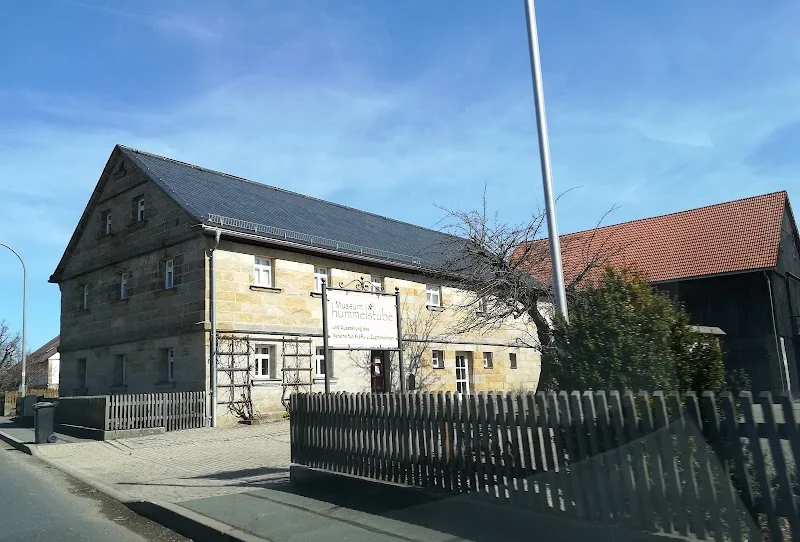
Hummeltal
Bayreuther Str. 42, 95503 Hummeltal, Deutschland
Museum Hummelstube | Opening Hours & Hummelgau
The Museum Hummelstube in Hummeltal is not a large, anonymous building, but a place with character, local roots, and surprisingly deep narrative depth. Those interested in Hummelgau, rural everyday culture, historical living forms, and regional memorial sites will find here a local museum that consciously thrives on detail. The address Bayreuther Straße 42 in 95503 Hummeltal marks not just a point on the map, but the access to a developed cultural site that has been associated with the work of Annemarie Leutzsch since the 1960s and is now supported by the Friends of Hummelstube e. V. Official and tourist sources describe the Hummelstube as a museum for Hummelgau, whose collection includes furniture, household goods, clothing, photographs, and written documents, and is particularly vivid with an original corner shop and a lovingly designed herb garden. Thus, the Hummelstube is an ideal destination for visitors who do not seek museum distance, but closeness to the region, its people, and its history. ([heimat-info.de](https://www.heimat-info.de/gemeinden/hummeltal/organisationen/museum-hummelstube))
Opening Hours, Dates, and Group Visits
For planning a visit, the opening hours of the Museum Hummelstube are particularly important, as the museum is not open daily throughout the year. According to official information, the Hummelstube opens from mid-March to the end of November on Wednesdays and Sundays from 2 PM to 5 PM. The museum is closed on holidays. At the same time, the Hummelstube is open for special cases: groups and school classes can also visit by arrangement outside of regular hours. This mix of clear opening hours and flexible scheduling makes the museum attractive for family outings, small club trips, or school excursions. The homepage of the official website also features current dates and a preview of the museum festival 2026, which shows that the Hummelstube engages its visitors not only with a permanent exhibition but also with recurring events. For SEO and real visitors, this provides a central benefit: those searching for museum hummelstube opening hours, hummelstube dates, or museum hummeltal receive concrete, seasonal guidance that is oriented to the actual museum work on site. ([hummelstube.de](https://www.hummelstube.de/files/09_Impressum/impressum.php?utm_source=openai))
The seasonal opening from mid-March to the end of November also emphasizes the character of the house as a lively cultural site with a close connection to the region and the annual cycle. In the warmer months, a visit to the museum can be well combined with a walk through Hummeltal or a trip to the Franconian Switzerland, while the group arrangement is particularly sensible for clubs, children's groups, and school classes. Those who wish to visit the Hummelstube not spontaneously but purposefully can use the available contact methods to arrange an appointment. This is sensible for a local museum that focuses on personal communication rather than mass operation in its presentation. From an SEO perspective, the search intentions around opening hours, dates, groups, and school classes are therefore particularly relevant. The Hummelstube answers these questions very clearly and in a way that provides potential guests with planning security. ([museen-in-bayern.de](https://museen-in-bayern.de/museen/detailseite-museum/museum-hummelstube))
The History of the Museum Hummelstube in Hummelgau
The history of the Museum Hummelstube does not begin in a modern museum building, but in a personal initiative with a strong local connection. Annemarie Leutzsch, known as Rettl from Hummelgau, established the Hummelstube in the 1960s in the former stable of her grandparents' house, the Ruckriegelhof in the Hummeltal district of Pittersdorf. This origin is more than a historical footnote, as it explains the special tone of the house: The Hummelstube was not created as an abstract collection but as a preserved piece of regional living environment. Sources also describe that the core of the collection comes from the Ruckriegelhof and was supplemented with items from Hummelgau, a region southwest of Bayreuth. Hummelgau itself is described as an area with its own character, where dialect, customs, furniture, and regional clothing have long been a specialty. The museum thus documents not just any general Upper Palatinate or Franconian history but a concrete cultural identity with local depth. ([heimat-info.de](https://www.heimat-info.de/gemeinden/hummeltal/organisationen/museum-hummelstube))
Another important step in the development of the house was the takeover by the municipality. The Neubürg site reports that the municipality purchased the stube in 2006 and transferred it to the newly renovated Zeckenhaus. This transformed a private or semi-internal collection point into a publicly accessible museum with municipal responsibility. This is crucial for the narrative of the Hummelstube, as it brings together continuity and professional safeguarding: the original commitment of Annemarie Leutzsch remains visible, while the cultural heritage is permanently protected. The Friends of Hummelstube e. V. continues to support the collection, preservation, and exploration of the testimonies of the history and culture of Hummelgau. It is precisely this connection of voluntary care, municipal takeover, and regional identity that makes the Hummelstube a credible and authentic local museum. Those searching for museum hummelstube history or ruckriegelhof hummeltal will find here a well-documented, comprehensible history of place, family, region, and public responsibility. ([neubuerg-fraenkische-schweiz.de](https://neubuerg-fraenkische-schweiz.de/die-region-entdecken/sehenswuerdigkeiten-gemeinde-hummeltal/))
Original Corner Shop, Furniture, and Everyday Culture
The most distinctive feature of the Museum Hummelstube is its strong focus on everyday history. The exhibitions showcase furniture, household goods, historical clothing, photographs, certificates, and other written records. These objects not only tell of the possessions of individual families but also of ways of life in the rural Hummelgau. Particularly impressive is the original preserved corner shop, which according to sources has furnishings from the late 19th century and provides an immediate impression of shopping in a typical village general store. This is where the charm of the Hummelstube lies: visitors see not only exhibits behind glass but a coherent milieu in which living, working, trading, and remembering are interconnected. Those searching for hummelstube exhibition or museum hummelgau will therefore find not just any collection but a well-thought-out concept that makes life in the region tangible through concrete objects. ([museen-in-bayern.de](https://museen-in-bayern.de/museen/detailseite-museum/museum-hummelstube))
The official thematic pages of the Hummelstube also show how the museum narratively explores its objects. Among the monthly themes are pieces like Mandelpäckla or Henkels Eier-Einlegemittel, things that are almost forgotten today but had a clear function in the everyday lives of earlier generations. Such examples make the collection particularly valuable, as they not only showcase beautiful or rare objects but also convey everyday knowledge about supply, trade, and nutrition. The Mandelpäckla tells of coffee substitutes and thriftiness, while the egg pickling agent speaks of preservation and stockpiling. These stories are at the core of the Hummelgau Museum, as they make visible the reality of life in an agriculturally shaped region. Those interested in historical clothing, household goods, or old shop culture receive not just a showcase but an understanding of social practices, material culture, and regional habits. Thus, the Hummelstube credibly answers search queries related to corner shop, historical clothing, and everyday culture. ([hummelstube.de](https://www.hummelstube.de/files/05_Thema_des_Monats/objektMonatSingleview.php?id=9&nav1=5&utm_source=openai))
Museum Grounds, Herb Garden, and Additional Collections
The Museum Hummelstube consists not only of an interior exhibition space but also of a small ensemble with further connections. The Neubürg site explicitly describes that the museum grounds also house the collection of the Museum Association for Power and Traction Machines e. V. Additionally, a farmer's garden has been established as an herb garden. This combination is particularly appealing to visitors as it broadens the theme of rural history: alongside living and shop culture, technical history, agricultural aesthetics, and gardening knowledge come into play. The museum site thus does not appear static but as a lively area where different forms of regional memory overlap. Those searching for hummeltal attractions or museum grounds will discover here more than just a building. The Hummelstube becomes a small learning space for history, agriculture, and regional identity, embedded in an environment that is also visually very accessible. ([neubuerg-fraenkische-schweiz.de](https://neubuerg-fraenkische-schweiz.de/die-region-entdecken/sehenswuerdigkeiten-gemeinde-hummeltal/))
Particularly the herb garden is a lovely detail for families, walkers, and culture-interested guests, as it extends the museum's interior world outward. A farmer's garden with herbs fits ideally with the Hummelstube, as it makes the everyday life of earlier times visible not only in furniture and writings but also in living plants and the practice of a kitchen garden. The fact that the collection of the Museum Association for Power and Traction Machines is also mentioned directly on the grounds shows the close interlinking of various local initiatives. Thus, thinking from the visitors' perspective, one gets several layers at once: a living history, a shop culture, a garden culture, and a technical history. This multi-layeredness is relevant for SEO, as search queries like herb garden hummeltal, museum courtyard, or power and traction machines in Pittersdorf can be well connected in content. At the same time, everything remains factually clean, as the available sources precisely document these elements. ([neubuerg-fraenkische-schweiz.de](https://neubuerg-fraenkische-schweiz.de/die-region-entdecken/sehenswuerdigkeiten-gemeinde-hummeltal/))
Directions to Hummeltal: Address, Contact, and Planning
For practical planning of a visit, the contact and address details of the Museum Hummelstube are clear. The address is Bayreuther Straße 42, 95503 Hummeltal. The official website lists the telephone number 09201 9186235 and the email address info@hummelstube.de. The museum page in Bavaria also refers to route planning, indicating that travel is actively supported. However, specific separate parking spaces are not mentioned in the verified sources. For a web text, this is important as it prevents speculation: those searching for hummelstube directions or museum hummeltal parking should use the available official information and inquire directly if necessary, rather than relying on assumptions. This keeps the information reliable and service-oriented. ([museen-in-bayern.de](https://museen-in-bayern.de/museen/detailseite-museum/museum-hummelstube))
From a regional perspective, the location is also attractive. Hummeltal is described on tourist pages as a place with several attractions, and the Hummelstube is explicitly recommended as a worthwhile visit. This makes the museum a good destination for day trips in Franconian Switzerland and the Bayreuth area. Thus, the journey is not just a matter of address but part of a larger discovery route that can be combined with hikes, regional attractions, and other cultural sites. For visitors who consciously plan their tour, the Hummelstube is particularly appreciated as it offers a compact destination with clear opening hours and a well-documented history. The search terms contact, directions, and address are answered here in a very concrete way, without artificially inflating or claiming unverified details like supposed parking areas. ([neubuerg-fraenkische-schweiz.de](https://neubuerg-fraenkische-schweiz.de/ueber-uns/mitglieder/gemeinde-hummeltal/?utm_source=openai))
Why a Visit is Worthwhile for Families, School Classes, and Culture Fans
The Museum Hummelstube is an ideal place for people who want to not only see the region but understand it. The fact that the Hummelstube appears in the category of children's and family cultural institutions fits well with the character of the house: the exhibits are vivid, the stories accessible, and the connection to the everyday lives of earlier generations is immediately tangible. Additionally, regional event and tourism collections show that the museum is repeatedly integrated into children's and holiday programs. There are indications of museum rallies for children and holiday programs that actively explore the site for young visitors. This results in a high added value for families and school classes: the museum is not just something to look at, but something to discover, ask questions about, and recognize again. Those searching for museum hummelstube children, family outing hummeltal, or museum rally will find a very fitting address. ([bbkult.net](https://www.bbkult.net/addresses-category/sonstige-kunsthandwerk/?utm_source=openai))
For culture-interested adults, the Hummelstube also has much to offer, as it conveys regional history not as distant material but as tangible reality. Hummelgau appears here as a landscape with its own language, its own furniture, its own habits, and a strong culture of remembrance. The combination of historical living room, corner shop, garden, technical reference, and monthly themes creates a museum image that goes far beyond a mere collection of old things. The house shows how everyday objects become narratives and how strong a place can be when people have cared for it with care over decades. Thus, those who do not just want to tick off attractions but want to experience genuine local identity will find in the Museum Hummelstube a compelling reason to visit. This is exactly why the Hummelstube is a strong destination for search queries related to museum hummelstube, hummelgau museum, local museum hummeltal, and historical everyday culture. ([museen-in-bayern.de](https://museen-in-bayern.de/museen/detailseite-museum/museum-hummelstube))
Sources:
Show moreShow less
Museum Hummelstube | Opening Hours & Hummelgau
The Museum Hummelstube in Hummeltal is not a large, anonymous building, but a place with character, local roots, and surprisingly deep narrative depth. Those interested in Hummelgau, rural everyday culture, historical living forms, and regional memorial sites will find here a local museum that consciously thrives on detail. The address Bayreuther Straße 42 in 95503 Hummeltal marks not just a point on the map, but the access to a developed cultural site that has been associated with the work of Annemarie Leutzsch since the 1960s and is now supported by the Friends of Hummelstube e. V. Official and tourist sources describe the Hummelstube as a museum for Hummelgau, whose collection includes furniture, household goods, clothing, photographs, and written documents, and is particularly vivid with an original corner shop and a lovingly designed herb garden. Thus, the Hummelstube is an ideal destination for visitors who do not seek museum distance, but closeness to the region, its people, and its history. ([heimat-info.de](https://www.heimat-info.de/gemeinden/hummeltal/organisationen/museum-hummelstube))
Opening Hours, Dates, and Group Visits
For planning a visit, the opening hours of the Museum Hummelstube are particularly important, as the museum is not open daily throughout the year. According to official information, the Hummelstube opens from mid-March to the end of November on Wednesdays and Sundays from 2 PM to 5 PM. The museum is closed on holidays. At the same time, the Hummelstube is open for special cases: groups and school classes can also visit by arrangement outside of regular hours. This mix of clear opening hours and flexible scheduling makes the museum attractive for family outings, small club trips, or school excursions. The homepage of the official website also features current dates and a preview of the museum festival 2026, which shows that the Hummelstube engages its visitors not only with a permanent exhibition but also with recurring events. For SEO and real visitors, this provides a central benefit: those searching for museum hummelstube opening hours, hummelstube dates, or museum hummeltal receive concrete, seasonal guidance that is oriented to the actual museum work on site. ([hummelstube.de](https://www.hummelstube.de/files/09_Impressum/impressum.php?utm_source=openai))
The seasonal opening from mid-March to the end of November also emphasizes the character of the house as a lively cultural site with a close connection to the region and the annual cycle. In the warmer months, a visit to the museum can be well combined with a walk through Hummeltal or a trip to the Franconian Switzerland, while the group arrangement is particularly sensible for clubs, children's groups, and school classes. Those who wish to visit the Hummelstube not spontaneously but purposefully can use the available contact methods to arrange an appointment. This is sensible for a local museum that focuses on personal communication rather than mass operation in its presentation. From an SEO perspective, the search intentions around opening hours, dates, groups, and school classes are therefore particularly relevant. The Hummelstube answers these questions very clearly and in a way that provides potential guests with planning security. ([museen-in-bayern.de](https://museen-in-bayern.de/museen/detailseite-museum/museum-hummelstube))
The History of the Museum Hummelstube in Hummelgau
The history of the Museum Hummelstube does not begin in a modern museum building, but in a personal initiative with a strong local connection. Annemarie Leutzsch, known as Rettl from Hummelgau, established the Hummelstube in the 1960s in the former stable of her grandparents' house, the Ruckriegelhof in the Hummeltal district of Pittersdorf. This origin is more than a historical footnote, as it explains the special tone of the house: The Hummelstube was not created as an abstract collection but as a preserved piece of regional living environment. Sources also describe that the core of the collection comes from the Ruckriegelhof and was supplemented with items from Hummelgau, a region southwest of Bayreuth. Hummelgau itself is described as an area with its own character, where dialect, customs, furniture, and regional clothing have long been a specialty. The museum thus documents not just any general Upper Palatinate or Franconian history but a concrete cultural identity with local depth. ([heimat-info.de](https://www.heimat-info.de/gemeinden/hummeltal/organisationen/museum-hummelstube))
Another important step in the development of the house was the takeover by the municipality. The Neubürg site reports that the municipality purchased the stube in 2006 and transferred it to the newly renovated Zeckenhaus. This transformed a private or semi-internal collection point into a publicly accessible museum with municipal responsibility. This is crucial for the narrative of the Hummelstube, as it brings together continuity and professional safeguarding: the original commitment of Annemarie Leutzsch remains visible, while the cultural heritage is permanently protected. The Friends of Hummelstube e. V. continues to support the collection, preservation, and exploration of the testimonies of the history and culture of Hummelgau. It is precisely this connection of voluntary care, municipal takeover, and regional identity that makes the Hummelstube a credible and authentic local museum. Those searching for museum hummelstube history or ruckriegelhof hummeltal will find here a well-documented, comprehensible history of place, family, region, and public responsibility. ([neubuerg-fraenkische-schweiz.de](https://neubuerg-fraenkische-schweiz.de/die-region-entdecken/sehenswuerdigkeiten-gemeinde-hummeltal/))
Original Corner Shop, Furniture, and Everyday Culture
The most distinctive feature of the Museum Hummelstube is its strong focus on everyday history. The exhibitions showcase furniture, household goods, historical clothing, photographs, certificates, and other written records. These objects not only tell of the possessions of individual families but also of ways of life in the rural Hummelgau. Particularly impressive is the original preserved corner shop, which according to sources has furnishings from the late 19th century and provides an immediate impression of shopping in a typical village general store. This is where the charm of the Hummelstube lies: visitors see not only exhibits behind glass but a coherent milieu in which living, working, trading, and remembering are interconnected. Those searching for hummelstube exhibition or museum hummelgau will therefore find not just any collection but a well-thought-out concept that makes life in the region tangible through concrete objects. ([museen-in-bayern.de](https://museen-in-bayern.de/museen/detailseite-museum/museum-hummelstube))
The official thematic pages of the Hummelstube also show how the museum narratively explores its objects. Among the monthly themes are pieces like Mandelpäckla or Henkels Eier-Einlegemittel, things that are almost forgotten today but had a clear function in the everyday lives of earlier generations. Such examples make the collection particularly valuable, as they not only showcase beautiful or rare objects but also convey everyday knowledge about supply, trade, and nutrition. The Mandelpäckla tells of coffee substitutes and thriftiness, while the egg pickling agent speaks of preservation and stockpiling. These stories are at the core of the Hummelgau Museum, as they make visible the reality of life in an agriculturally shaped region. Those interested in historical clothing, household goods, or old shop culture receive not just a showcase but an understanding of social practices, material culture, and regional habits. Thus, the Hummelstube credibly answers search queries related to corner shop, historical clothing, and everyday culture. ([hummelstube.de](https://www.hummelstube.de/files/05_Thema_des_Monats/objektMonatSingleview.php?id=9&nav1=5&utm_source=openai))
Museum Grounds, Herb Garden, and Additional Collections
The Museum Hummelstube consists not only of an interior exhibition space but also of a small ensemble with further connections. The Neubürg site explicitly describes that the museum grounds also house the collection of the Museum Association for Power and Traction Machines e. V. Additionally, a farmer's garden has been established as an herb garden. This combination is particularly appealing to visitors as it broadens the theme of rural history: alongside living and shop culture, technical history, agricultural aesthetics, and gardening knowledge come into play. The museum site thus does not appear static but as a lively area where different forms of regional memory overlap. Those searching for hummeltal attractions or museum grounds will discover here more than just a building. The Hummelstube becomes a small learning space for history, agriculture, and regional identity, embedded in an environment that is also visually very accessible. ([neubuerg-fraenkische-schweiz.de](https://neubuerg-fraenkische-schweiz.de/die-region-entdecken/sehenswuerdigkeiten-gemeinde-hummeltal/))
Particularly the herb garden is a lovely detail for families, walkers, and culture-interested guests, as it extends the museum's interior world outward. A farmer's garden with herbs fits ideally with the Hummelstube, as it makes the everyday life of earlier times visible not only in furniture and writings but also in living plants and the practice of a kitchen garden. The fact that the collection of the Museum Association for Power and Traction Machines is also mentioned directly on the grounds shows the close interlinking of various local initiatives. Thus, thinking from the visitors' perspective, one gets several layers at once: a living history, a shop culture, a garden culture, and a technical history. This multi-layeredness is relevant for SEO, as search queries like herb garden hummeltal, museum courtyard, or power and traction machines in Pittersdorf can be well connected in content. At the same time, everything remains factually clean, as the available sources precisely document these elements. ([neubuerg-fraenkische-schweiz.de](https://neubuerg-fraenkische-schweiz.de/die-region-entdecken/sehenswuerdigkeiten-gemeinde-hummeltal/))
Directions to Hummeltal: Address, Contact, and Planning
For practical planning of a visit, the contact and address details of the Museum Hummelstube are clear. The address is Bayreuther Straße 42, 95503 Hummeltal. The official website lists the telephone number 09201 9186235 and the email address info@hummelstube.de. The museum page in Bavaria also refers to route planning, indicating that travel is actively supported. However, specific separate parking spaces are not mentioned in the verified sources. For a web text, this is important as it prevents speculation: those searching for hummelstube directions or museum hummeltal parking should use the available official information and inquire directly if necessary, rather than relying on assumptions. This keeps the information reliable and service-oriented. ([museen-in-bayern.de](https://museen-in-bayern.de/museen/detailseite-museum/museum-hummelstube))
From a regional perspective, the location is also attractive. Hummeltal is described on tourist pages as a place with several attractions, and the Hummelstube is explicitly recommended as a worthwhile visit. This makes the museum a good destination for day trips in Franconian Switzerland and the Bayreuth area. Thus, the journey is not just a matter of address but part of a larger discovery route that can be combined with hikes, regional attractions, and other cultural sites. For visitors who consciously plan their tour, the Hummelstube is particularly appreciated as it offers a compact destination with clear opening hours and a well-documented history. The search terms contact, directions, and address are answered here in a very concrete way, without artificially inflating or claiming unverified details like supposed parking areas. ([neubuerg-fraenkische-schweiz.de](https://neubuerg-fraenkische-schweiz.de/ueber-uns/mitglieder/gemeinde-hummeltal/?utm_source=openai))
Why a Visit is Worthwhile for Families, School Classes, and Culture Fans
The Museum Hummelstube is an ideal place for people who want to not only see the region but understand it. The fact that the Hummelstube appears in the category of children's and family cultural institutions fits well with the character of the house: the exhibits are vivid, the stories accessible, and the connection to the everyday lives of earlier generations is immediately tangible. Additionally, regional event and tourism collections show that the museum is repeatedly integrated into children's and holiday programs. There are indications of museum rallies for children and holiday programs that actively explore the site for young visitors. This results in a high added value for families and school classes: the museum is not just something to look at, but something to discover, ask questions about, and recognize again. Those searching for museum hummelstube children, family outing hummeltal, or museum rally will find a very fitting address. ([bbkult.net](https://www.bbkult.net/addresses-category/sonstige-kunsthandwerk/?utm_source=openai))
For culture-interested adults, the Hummelstube also has much to offer, as it conveys regional history not as distant material but as tangible reality. Hummelgau appears here as a landscape with its own language, its own furniture, its own habits, and a strong culture of remembrance. The combination of historical living room, corner shop, garden, technical reference, and monthly themes creates a museum image that goes far beyond a mere collection of old things. The house shows how everyday objects become narratives and how strong a place can be when people have cared for it with care over decades. Thus, those who do not just want to tick off attractions but want to experience genuine local identity will find in the Museum Hummelstube a compelling reason to visit. This is exactly why the Hummelstube is a strong destination for search queries related to museum hummelstube, hummelgau museum, local museum hummeltal, and historical everyday culture. ([museen-in-bayern.de](https://museen-in-bayern.de/museen/detailseite-museum/museum-hummelstube))
Sources:
Museum Hummelstube | Opening Hours & Hummelgau
The Museum Hummelstube in Hummeltal is not a large, anonymous building, but a place with character, local roots, and surprisingly deep narrative depth. Those interested in Hummelgau, rural everyday culture, historical living forms, and regional memorial sites will find here a local museum that consciously thrives on detail. The address Bayreuther Straße 42 in 95503 Hummeltal marks not just a point on the map, but the access to a developed cultural site that has been associated with the work of Annemarie Leutzsch since the 1960s and is now supported by the Friends of Hummelstube e. V. Official and tourist sources describe the Hummelstube as a museum for Hummelgau, whose collection includes furniture, household goods, clothing, photographs, and written documents, and is particularly vivid with an original corner shop and a lovingly designed herb garden. Thus, the Hummelstube is an ideal destination for visitors who do not seek museum distance, but closeness to the region, its people, and its history. ([heimat-info.de](https://www.heimat-info.de/gemeinden/hummeltal/organisationen/museum-hummelstube))
Opening Hours, Dates, and Group Visits
For planning a visit, the opening hours of the Museum Hummelstube are particularly important, as the museum is not open daily throughout the year. According to official information, the Hummelstube opens from mid-March to the end of November on Wednesdays and Sundays from 2 PM to 5 PM. The museum is closed on holidays. At the same time, the Hummelstube is open for special cases: groups and school classes can also visit by arrangement outside of regular hours. This mix of clear opening hours and flexible scheduling makes the museum attractive for family outings, small club trips, or school excursions. The homepage of the official website also features current dates and a preview of the museum festival 2026, which shows that the Hummelstube engages its visitors not only with a permanent exhibition but also with recurring events. For SEO and real visitors, this provides a central benefit: those searching for museum hummelstube opening hours, hummelstube dates, or museum hummeltal receive concrete, seasonal guidance that is oriented to the actual museum work on site. ([hummelstube.de](https://www.hummelstube.de/files/09_Impressum/impressum.php?utm_source=openai))
The seasonal opening from mid-March to the end of November also emphasizes the character of the house as a lively cultural site with a close connection to the region and the annual cycle. In the warmer months, a visit to the museum can be well combined with a walk through Hummeltal or a trip to the Franconian Switzerland, while the group arrangement is particularly sensible for clubs, children's groups, and school classes. Those who wish to visit the Hummelstube not spontaneously but purposefully can use the available contact methods to arrange an appointment. This is sensible for a local museum that focuses on personal communication rather than mass operation in its presentation. From an SEO perspective, the search intentions around opening hours, dates, groups, and school classes are therefore particularly relevant. The Hummelstube answers these questions very clearly and in a way that provides potential guests with planning security. ([museen-in-bayern.de](https://museen-in-bayern.de/museen/detailseite-museum/museum-hummelstube))
The History of the Museum Hummelstube in Hummelgau
The history of the Museum Hummelstube does not begin in a modern museum building, but in a personal initiative with a strong local connection. Annemarie Leutzsch, known as Rettl from Hummelgau, established the Hummelstube in the 1960s in the former stable of her grandparents' house, the Ruckriegelhof in the Hummeltal district of Pittersdorf. This origin is more than a historical footnote, as it explains the special tone of the house: The Hummelstube was not created as an abstract collection but as a preserved piece of regional living environment. Sources also describe that the core of the collection comes from the Ruckriegelhof and was supplemented with items from Hummelgau, a region southwest of Bayreuth. Hummelgau itself is described as an area with its own character, where dialect, customs, furniture, and regional clothing have long been a specialty. The museum thus documents not just any general Upper Palatinate or Franconian history but a concrete cultural identity with local depth. ([heimat-info.de](https://www.heimat-info.de/gemeinden/hummeltal/organisationen/museum-hummelstube))
Another important step in the development of the house was the takeover by the municipality. The Neubürg site reports that the municipality purchased the stube in 2006 and transferred it to the newly renovated Zeckenhaus. This transformed a private or semi-internal collection point into a publicly accessible museum with municipal responsibility. This is crucial for the narrative of the Hummelstube, as it brings together continuity and professional safeguarding: the original commitment of Annemarie Leutzsch remains visible, while the cultural heritage is permanently protected. The Friends of Hummelstube e. V. continues to support the collection, preservation, and exploration of the testimonies of the history and culture of Hummelgau. It is precisely this connection of voluntary care, municipal takeover, and regional identity that makes the Hummelstube a credible and authentic local museum. Those searching for museum hummelstube history or ruckriegelhof hummeltal will find here a well-documented, comprehensible history of place, family, region, and public responsibility. ([neubuerg-fraenkische-schweiz.de](https://neubuerg-fraenkische-schweiz.de/die-region-entdecken/sehenswuerdigkeiten-gemeinde-hummeltal/))
Original Corner Shop, Furniture, and Everyday Culture
The most distinctive feature of the Museum Hummelstube is its strong focus on everyday history. The exhibitions showcase furniture, household goods, historical clothing, photographs, certificates, and other written records. These objects not only tell of the possessions of individual families but also of ways of life in the rural Hummelgau. Particularly impressive is the original preserved corner shop, which according to sources has furnishings from the late 19th century and provides an immediate impression of shopping in a typical village general store. This is where the charm of the Hummelstube lies: visitors see not only exhibits behind glass but a coherent milieu in which living, working, trading, and remembering are interconnected. Those searching for hummelstube exhibition or museum hummelgau will therefore find not just any collection but a well-thought-out concept that makes life in the region tangible through concrete objects. ([museen-in-bayern.de](https://museen-in-bayern.de/museen/detailseite-museum/museum-hummelstube))
The official thematic pages of the Hummelstube also show how the museum narratively explores its objects. Among the monthly themes are pieces like Mandelpäckla or Henkels Eier-Einlegemittel, things that are almost forgotten today but had a clear function in the everyday lives of earlier generations. Such examples make the collection particularly valuable, as they not only showcase beautiful or rare objects but also convey everyday knowledge about supply, trade, and nutrition. The Mandelpäckla tells of coffee substitutes and thriftiness, while the egg pickling agent speaks of preservation and stockpiling. These stories are at the core of the Hummelgau Museum, as they make visible the reality of life in an agriculturally shaped region. Those interested in historical clothing, household goods, or old shop culture receive not just a showcase but an understanding of social practices, material culture, and regional habits. Thus, the Hummelstube credibly answers search queries related to corner shop, historical clothing, and everyday culture. ([hummelstube.de](https://www.hummelstube.de/files/05_Thema_des_Monats/objektMonatSingleview.php?id=9&nav1=5&utm_source=openai))
Museum Grounds, Herb Garden, and Additional Collections
The Museum Hummelstube consists not only of an interior exhibition space but also of a small ensemble with further connections. The Neubürg site explicitly describes that the museum grounds also house the collection of the Museum Association for Power and Traction Machines e. V. Additionally, a farmer's garden has been established as an herb garden. This combination is particularly appealing to visitors as it broadens the theme of rural history: alongside living and shop culture, technical history, agricultural aesthetics, and gardening knowledge come into play. The museum site thus does not appear static but as a lively area where different forms of regional memory overlap. Those searching for hummeltal attractions or museum grounds will discover here more than just a building. The Hummelstube becomes a small learning space for history, agriculture, and regional identity, embedded in an environment that is also visually very accessible. ([neubuerg-fraenkische-schweiz.de](https://neubuerg-fraenkische-schweiz.de/die-region-entdecken/sehenswuerdigkeiten-gemeinde-hummeltal/))
Particularly the herb garden is a lovely detail for families, walkers, and culture-interested guests, as it extends the museum's interior world outward. A farmer's garden with herbs fits ideally with the Hummelstube, as it makes the everyday life of earlier times visible not only in furniture and writings but also in living plants and the practice of a kitchen garden. The fact that the collection of the Museum Association for Power and Traction Machines is also mentioned directly on the grounds shows the close interlinking of various local initiatives. Thus, thinking from the visitors' perspective, one gets several layers at once: a living history, a shop culture, a garden culture, and a technical history. This multi-layeredness is relevant for SEO, as search queries like herb garden hummeltal, museum courtyard, or power and traction machines in Pittersdorf can be well connected in content. At the same time, everything remains factually clean, as the available sources precisely document these elements. ([neubuerg-fraenkische-schweiz.de](https://neubuerg-fraenkische-schweiz.de/die-region-entdecken/sehenswuerdigkeiten-gemeinde-hummeltal/))
Directions to Hummeltal: Address, Contact, and Planning
For practical planning of a visit, the contact and address details of the Museum Hummelstube are clear. The address is Bayreuther Straße 42, 95503 Hummeltal. The official website lists the telephone number 09201 9186235 and the email address info@hummelstube.de. The museum page in Bavaria also refers to route planning, indicating that travel is actively supported. However, specific separate parking spaces are not mentioned in the verified sources. For a web text, this is important as it prevents speculation: those searching for hummelstube directions or museum hummeltal parking should use the available official information and inquire directly if necessary, rather than relying on assumptions. This keeps the information reliable and service-oriented. ([museen-in-bayern.de](https://museen-in-bayern.de/museen/detailseite-museum/museum-hummelstube))
From a regional perspective, the location is also attractive. Hummeltal is described on tourist pages as a place with several attractions, and the Hummelstube is explicitly recommended as a worthwhile visit. This makes the museum a good destination for day trips in Franconian Switzerland and the Bayreuth area. Thus, the journey is not just a matter of address but part of a larger discovery route that can be combined with hikes, regional attractions, and other cultural sites. For visitors who consciously plan their tour, the Hummelstube is particularly appreciated as it offers a compact destination with clear opening hours and a well-documented history. The search terms contact, directions, and address are answered here in a very concrete way, without artificially inflating or claiming unverified details like supposed parking areas. ([neubuerg-fraenkische-schweiz.de](https://neubuerg-fraenkische-schweiz.de/ueber-uns/mitglieder/gemeinde-hummeltal/?utm_source=openai))
Why a Visit is Worthwhile for Families, School Classes, and Culture Fans
The Museum Hummelstube is an ideal place for people who want to not only see the region but understand it. The fact that the Hummelstube appears in the category of children's and family cultural institutions fits well with the character of the house: the exhibits are vivid, the stories accessible, and the connection to the everyday lives of earlier generations is immediately tangible. Additionally, regional event and tourism collections show that the museum is repeatedly integrated into children's and holiday programs. There are indications of museum rallies for children and holiday programs that actively explore the site for young visitors. This results in a high added value for families and school classes: the museum is not just something to look at, but something to discover, ask questions about, and recognize again. Those searching for museum hummelstube children, family outing hummeltal, or museum rally will find a very fitting address. ([bbkult.net](https://www.bbkult.net/addresses-category/sonstige-kunsthandwerk/?utm_source=openai))
For culture-interested adults, the Hummelstube also has much to offer, as it conveys regional history not as distant material but as tangible reality. Hummelgau appears here as a landscape with its own language, its own furniture, its own habits, and a strong culture of remembrance. The combination of historical living room, corner shop, garden, technical reference, and monthly themes creates a museum image that goes far beyond a mere collection of old things. The house shows how everyday objects become narratives and how strong a place can be when people have cared for it with care over decades. Thus, those who do not just want to tick off attractions but want to experience genuine local identity will find in the Museum Hummelstube a compelling reason to visit. This is exactly why the Hummelstube is a strong destination for search queries related to museum hummelstube, hummelgau museum, local museum hummeltal, and historical everyday culture. ([museen-in-bayern.de](https://museen-in-bayern.de/museen/detailseite-museum/museum-hummelstube))
Sources:
Frequently Asked Questions
Reviews
Dawn Zimak-Straczowski
8. August 2019
Super cool place tucked away in Hummeltal, DE. Small and pristine in its cleanliness. Definitely a cute little place to enjoy some historic items from this local village. Don't forget to go in the barn!
Schorsch S.
23. July 2022
Super location
A. Lu
14. July 2022
Nice little museum, everything is described with great care. 2,-€ admission is very fair
Юлия Орёл
30. July 2024
Museum-house. A couple of rooms upstairs with typical decor from the last century, and a shop room on the first floor. There are no exhibits in the yard, no tractors or other equipment. Entrance 2.5€. And the smell of antiquity, I couldn't go into the rooms upstairs((( didn't spark any interest in the kids
Natalie G.
12. November 2022
We live near the museum. Our son has always been crazy about the agricultural machinery exhibition. So we visited it often before the lockdown. The museum itself is small, yet there's a lot inside. The digital guides through the exhibition were well made and easy to use. They offered plenty of interesting information about the exhibition. Our son was also very excited, even though he was quite small at the time of the visit.