
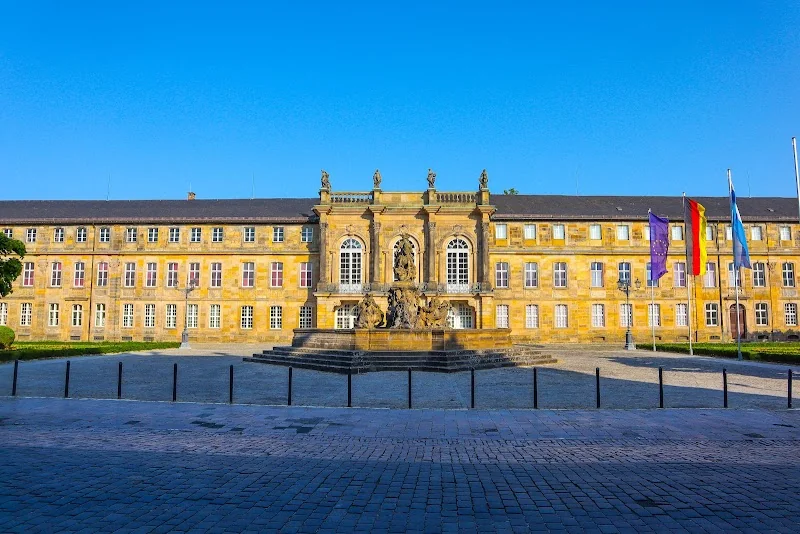
Ludwigstraße 21, Bayreuth
Ludwigstraße 21, 95444 Bayreuth, Germany
New Palace Bayreuth | Opening Hours & Tours
The New Palace Bayreuth is one of the most significant historical buildings in the city and a central point for all those who want to experience baroque residence culture, artistic interiors, and the palace garden in close proximity. Those looking for opening hours, tickets, tours, or the Italian Palace will find a place where architecture, courtly history, and museum visits are closely connected. The palace is located at Ludwigstraße 21 in Bayreuth and is part of the overarching experience world The World of Wilhelmine, which also includes other important palaces, gardens, and cultural sites from the margravial period. Particularly appealing is the combination of representative palace architecture, freely accessible palace garden, and the art-historically valuable collections inside. For visitors who want to discover Bayreuth in one day, the New Palace is an important focal point, as history, art, and walks in the green can be very well combined here. ([bayreuth-wilhelmine.de](https://www.bayreuth-wilhelmine.de/deutsch/tourist/oeffnung.htm))
Opening Hours, Admission, and Tickets at the New Palace Bayreuth
For planning a visit, the current opening hours are particularly important. According to official visitor information, the New Palace Bayreuth is open daily from April to September from 9 AM to 6 PM. From October to March, the daily opening hours are from 10 AM to 4 PM. The palace is generally closed on Mondays, with some holidays excluded: these include January 6, Easter Monday, May 1, Whit Monday, August 15, October 3, and November 1. Additionally, the palace is closed on January 1, Shrove Tuesday, and on December 24, 25, and 31. These fixed times make planning pleasantly transparent, as visitors do not have to expect changing daily openings. For all those incorporating the New Palace Bayreuth into a travel program, it is also important that the state rooms in the main wing can be visited without a guided tour. This makes a spontaneous visit significantly easier than is the case at many other residences. ([bayreuth-wilhelmine.de](https://www.bayreuth-wilhelmine.de/deutsch/tourist/oeffnung.htm))
The official information on admission prices is also clear. For 2026, the regular admission is 7 euros, and the reduced admission is 6 euros. In addition, there is a combination ticket for the New Palace and the Margravial Opera House, as well as a total ticket for the World of Wilhelmine, which allows several Bayreuth attractions to be connected. For families and younger guests, it is particularly attractive that children and teenagers up to the age of 18 have free admission. So, those traveling with multiple generations or planning Bayreuth as a cultural destination with children can calculate the visit financially well. The official site also refers to general information on opening hours and admission prices, which is helpful in case of changes or special regulations. Overall, the New Palace Bayreuth presents itself as a classic cultural site with easily understandable visiting conditions: clear time slots, a transparent ticket system, and the possibility to explore parts of the building without a pre-booked guided tour. ([schloesser.bayern.de](https://www.schloesser.bayern.de/deutsch/schloss/objekte/bay_ns.htm))
Guided Tours of State Rooms and the Italian Palace
A significant appeal of the New Palace Bayreuth lies in the guided tours. While the main wing of the palace can be visited independently, the true depth of the house is particularly well revealed through guided tours. For individual visitors, there are regular tours of the state rooms, taking place from Friday to Sunday at 11 AM. The tour lasts 60 minutes, is conducted only in German, and costs an additional 3 euros on top of the admission. The number of participants is limited, and registration is recommended. Private group tours are also possible upon request. This is interesting for travel groups, clubs, school classes, or small cultural trips, as the visit can be tailored to the respective group. The official visitor information also provides tour texts in several languages, including German, English, French, Italian, Polish, Russian, Spanish, and Czech. This makes the palace accessible to international guests as well. ([bayreuth-wilhelmine.de](https://www.bayreuth-wilhelmine.de/deutsch/tourist/oeffnung.htm))
Particularly striking is the Italian Palace, which can only be visited with a guided tour. The tours start from April to September at 9:15 AM and from October to March at 10:15 AM, each at 30-minute intervals. The duration is about 30 minutes, the group size is limited, and registration is recommended. The Italian Palace was built after the completion of the main palace for Sophie Caroline of Brunswick-Wolfenbüttel; it was later connected to the south wing. Thus, it is not just an extension but an integral part of the courtly living concept. The official presentation makes it clear that this part of the building met the private living requirements of the new wife and was based on a richly furnished apartment in the latest fashion. For visitors, this is important because it vividly illustrates the transition from representative palace architecture to a more intimate living culture. Therefore, anyone wishing to experience the New Palace Bayreuth intensively should definitely plan the tour of the Italian Palace. ([bayreuth-wilhelmine.de](https://www.bayreuth-wilhelmine.de/deutsch/tourist/oeffnung.htm))
The aspect of guided tours also plays a role in the currently published themed tours and family offerings. The official pages of the Bayreuth Palace Administration regularly announce themed tours in the city's buildings and surrounding areas, and the visitor information explicitly refers to offers for children and families. This means that for the search intent behind terms like events, children, or tours, the New Palace is not just a quiet museum, but part of a lively mediation program. Especially for those who want to learn about architecture, stories, courtly life, and art-historical contexts, these formats are beneficial. They do not present the palace as an isolated monument, but as a place where Bayreuth's margravines, margraves, collections, and garden facilities are interconnected. This gives the visit an additional layer that goes beyond a mere tour and makes the cultural context of the house understandable. ([bayreuth-tourismus.de](https://www.bayreuth-tourismus.de/entdecken/angebote-fuer-einzelreisende/welt-der-wilhelmine/))
Interiors, Collections, and Bayreuth Rococo
The interiors of the New Palace Bayreuth are among the outstanding examples of Bayreuth Rococo. Several rooms are explicitly highlighted on the official pages: the Mirror Shard Cabinet, the Salon with Gold Ceiling, the Japanese Room, and the Old Music Room. In the southern wing, there is also the Palm Room, which is described as the most significant spatial artwork of Bayreuth Rococo. This sequence of rooms makes it clear that the New Palace is not just a historical building, but an artistically staged sequence of interiors, whose effect still relies on materiality, colorfulness, and courtly symbolism. Particularly interesting is that Wilhelmine had a significant influence on the design of the rooms. The palace is therefore not simply a product of dry architectural history, but concretely reflects the aesthetic ideas of a margravial client. Those interested in interior design, Rococo, and courtly living culture will find a dense and well-documented collection of spatial impressions here. ([schloesser.bayern.de](https://www.schloesser.bayern.de/deutsch/schloss/objekte/bay_ns.htm))
In the New Palace, there are also several museum areas that enrich the visit. These include the Bayreuth Faience Collection – Collection Rummel, which according to the official description shows the most magnificent examples of the Bayreuth manufactory, the branch gallery of the Bavarian State Painting Collections with works from the late Baroque, and the miniature collection of Dr. Löer with gallant and erotic miniatures from the 18th century. This is complemented by the museum The Bayreuth of Margravine Wilhelmine, which provides a comprehensive view of the world of courtly Bayreuth in the 18th century. On the ground floor, the Collection Rummel, acquired in 1977, with Bayreuth faiences is also exhibited. This is particularly relevant from an SEO perspective for search queries related to museum, interiors, or images, as visitors can expect not only magnificent rooms but also clearly named collections and exhibition areas. The New Palace Bayreuth is therefore simultaneously a residence, museum, art location, and historical space. For many visitors, this is precisely where the special appeal lies: one does not merely enter a hall, but moves through an entire courtly narrative that remains visible in exhibitions, furniture, ceilings, wall coverings, and objects. ([schloesser.bayern.de](https://www.schloesser.bayern.de/deutsch/schloss/objekte/bay_ns.htm))
The museum The Bayreuth of Margravine Wilhelmine complements these rooms with a content level. The exhibition panels are, according to the official description, dedicated to the Hermitage, Sanspareil, the Margravial Opera House, and Schloss Fantaisie, among others. This opens the New Palace outward to a larger cultural-historical network, in which Bayreuth as a residence city and garden landscape becomes visible. Particularly impressive is that the presentation even picks up architectural drawings, classicist image worlds, and references to the unification of the former margraviate of Bayreuth with the Kingdom of Bavaria. The palace is thus closely embedded in the history of the region not only through its design but also through its museum mediation. Therefore, those searching inside will find not only beautiful ornamentation but a carefully curated representation of Bayreuth's courtly heritage. This makes the visit worthwhile for both art lovers and culturally historically interested guests. ([bayreuth-wilhelmine.de](https://www.bayreuth-wilhelmine.de/deutsch/n_schloss/wil-mus.htm))
History, Architecture, and the Palace Garden
The history of the New Palace Bayreuth begins with a turning point: the older palace no longer met the increased demands of baroque court life, and its fire in January 1753 accelerated the decision for a new building. Under Margrave Friedrich of Brandenburg-Bayreuth, the New Palace was built starting in 1753. The actual architectural construction comes from the Bayreuth court architect Joseph Saint-Pierre, who chose a site at the margravial pleasure garden. The buildings constructed there just under ten years earlier in an open row were incorporated into the new architecture, resulting in the characteristic elongated building form. This origin explains the special impression of the palace: it does not appear as a compact solitary structure, but as a courtly complex that integrates into the garden and city structure. For search queries related to Italian architecture, interiors, or Wikipedia logic, this is relevant because the building is composed of several construction and usage layers. ([schloesser.bayern.de](https://www.schloesser.bayern.de/deutsch/schloss/objekte/bay_ns.htm))
Wilhelmine, the wife of the margrave, significantly influenced the interiors. The official palace website emphasizes that she, as in the Old Palace of the Hermitage, had a great influence on the design of the rooms. Highlighted are the Mirror Shard Cabinet with a stucco representation of the margravine as a Chinese sage by Jean-Baptiste Pedrozzi, the salon with the gold ceiling, Wilhelmine's Japanese Room in the form of a garden trellis covered with exotic flowers, and the Old Music Room with pastel portraits of singers, actors, and dancers. In the southern wing, the margrave's apartment features the Palm Room with precious walnut paneling and gilded palms. These rooms show how closely representation, personal preferences, and artistic virtuosity were interconnected. The New Palace is therefore not only architecturally significant but also a key location for understanding courtly art of the 18th century in Bayreuth. ([bayreuth-wilhelmine.de](https://www.bayreuth-wilhelmine.de/deutsch/n_schloss/index.htm))
The history of the Italian Palace is also part of the palace's story. After the completion of the main palace, the margrave had the initially freestanding Italian Palace built starting in 1759 for his second wife Sophie Caroline of Brunswick-Wolfenbüttel. Shortly thereafter, it was connected to the south wing. The official explanation makes it clear that the private living spaces in the ladies' wing of the residence palace no longer met the demands for comfort and convenience. On the ground floor, a richly furnished apartment equipped in the latest fashion has been preserved, centered around the garden hall. To the north, the enfilade of private rooms extends, and to the south, the series of representative social rooms. This description is important because it shows how the New Palace was composed of various functional rooms, serving both representative and private needs. Therefore, those visiting the building today experience not just a single monument but a complex court organism with highly differentiated uses. ([bayreuth-wilhelmine.de](https://www.bayreuth-wilhelmine.de/deutsch/n_schloss/ital_schl.htm))
The palace garden itself also tells a long history. After the construction of the New Palace starting in 1753, the garden, which had already been in margravial possession since the end of the 16th century, was redesigned and expanded. The Mailbahn Avenue, planted in 1679, was incorporated into the new layout; south of it, the margrave couple had avenues, hedge quarters, arbors, and parterres created. The central axis was formed by a canal with four islands, and at the end of the 18th century, the layout was reshaped in the English style, so that today winding paths and free plantings connect with the basic features of the geometric garden. The parterre on the city side of the palace was restored according to plans by Carl Effner from 1864, and the parterre in front of the south wing was reconstructed in 1990. The palace garden is therefore not simply a surrounding green space, but a historically grown landscape space that complements the architecture of the palace while remaining independently readable. ([bayreuth-wilhelmine.de](https://www.bayreuth-wilhelmine.de/deutsch/hofg_ns/gesch.htm))
Access, Parking, and Practical Tips for Your Visit
The New Palace Bayreuth is very centrally located in the city center and is therefore easily accessible by both public transport and on foot. The official visitor information mentions Bayreuth Hbf as the train connection and the bus to Sternplatz as a practical option for arrival. For parking, the palace administration refers to the municipal parking options around Bayreuth city center, which can be accessed via the city website. The visitor information also mentions parking spaces for people with disabilities. Therefore, anyone wishing to combine their visit with a city tour, an opera house visit, or a walk through the palace garden should see the palace's central location as an advantage. Especially with limited time, it is pleasant that the area is not located far outside, but is directly embedded in the historical center. This allows for a cultural program to be planned without complicated transfers. ([schloesser.bayern.de](https://www.schloesser.bayern.de/deutsch/schloss/objekte/bay_ns.htm))
Some practical details are helpful for the stay itself. The Bayreuth Palace Garden is always accessible, making a walk worthwhile even outside of palace opening hours. This is particularly attractive if one arrives early in the morning or rounds off the visit in the evening. Additionally, the New Palace, according to the official site, offers free Wi-Fi, which can be useful for travel planning, navigation, or looking up further attractions. The information that the main wing can be visited without a guided tour also makes spontaneous visits easier. Visitors who prefer to explore on their own can therefore combine admission with free exploration, while those with more time can book the guided tour. The palace is thus suitable for both structured cultural trips and flexible day trips. For search queries related to parking, access, or opening hours, this mix is particularly important as it positions the New Palace Bayreuth as a well-planned destination in the heart of the city. ([schloesser.bayern.de](https://www.schloesser.bayern.de/deutsch/schloss/objekte/bay_ns.htm))
The integration into the larger Bayreuth cultural axis is also practically relevant. The official visitor world describes the New Palace as part of the World of Wilhelmine, which also includes the Margravial Opera House, the Hermitage, and other gardens and palaces. For travelers, this means: a visit to the New Palace can be very well combined with other attractions without long distances. The proximity to the palace garden, the city center location, and the connection to other margravial sites make the palace an ideal starting point for a Bayreuth tour. Those with only one to two hours can focus on the state rooms and then walk through the palace garden. Those with more time can complement the visit with the opera house or plan a whole Wilhelmine day. This flexibility makes the New Palace particularly attractive for spontaneous city visitors, families, and cultural travelers. ([bayreuth-tourismus.de](https://www.bayreuth-tourismus.de/entdecken/angebote-fuer-einzelreisende/welt-der-wilhelmine/))
Children, Families, and Other Attractions Around the New Palace
For families, the New Palace Bayreuth offers several good arguments. First, admission is free for children and teenagers up to 18 years, making the visit manageable and family-friendly. Additionally, the adjacent palace garden is always accessible and provides space for movement and relaxation for both children and adults. The official visitor information also refers to offers for children and families in the Bayreuth palaces and gardens. This makes it clear that the palace is not only intended as an art monument for adults but also consciously acts as a learning and experience place for younger guests. Therefore, those searching for attractions in Bayreuth with children can combine the palace, garden, and historical stories in a relaxed setting. Especially in connection with a guided tour or a short walk through the state rooms, a varied program emerges that does not feel overloaded yet offers substantial content. ([schloesser.bayern.de](https://www.schloesser.bayern.de/deutsch/schloss/objekte/bay_ns.htm))
There are also numerous other points around the New Palace that meaningfully complement the visit. The Margravial Opera House is just a few steps away and can be visited with a combination ticket. The Bayreuth marketing site explicitly describes the World of Wilhelmine as a journey through the Bayreuth of Margravine Wilhelmine, where the New Palace, the palace garden, and the opera house are experienced together. The Hermitage and Sanspareil are also mentioned as worthwhile additions. Those interested in photos, history, and different facets of the margravial era can thus put together a very coherent cultural package. The New Palace Bayreuth is therefore not just a single building, but the core of a whole historical network of places that explain each other. This connection is crucial for visitors searching for museum, events, or Hermitage, as it places the palace in a larger context and significantly enhances the stay in Bayreuth. ([bayreuth-tourismus.de](https://www.bayreuth-tourismus.de/entdecken/angebote-fuer-einzelreisende/welt-der-wilhelmine/))
Another interesting aspect is the Archaeological Museum of the Historical Association for Upper Franconia, which is housed in the Italian Palace and showcases finds from the Paleolithic to the Middle Ages. This gives the palace not only its courtly residential function but also a museum perspective. Visitors thus gain insight into both the 18th century and much older regional history within the same building complex. This broadens the content range of the visit and makes the New Palace Bayreuth even more attractive for culturally historically interested guests. Therefore, those expecting more than just a classic palace visit are indeed offered multiple layers here: architecture, courtly living culture, art collections, garden history, and archaeology. This mixture explains why the palace is one of the most frequently searched destinations in Bayreuth and why search queries for opening hours, tickets, tours, interiors, and museum are so closely linked. ([bayreuth-wilhelmine.de](https://www.bayreuth-wilhelmine.de/deutsch/tourist/weitere.htm))
Sources:
Show moreShow less
New Palace Bayreuth | Opening Hours & Tours
The New Palace Bayreuth is one of the most significant historical buildings in the city and a central point for all those who want to experience baroque residence culture, artistic interiors, and the palace garden in close proximity. Those looking for opening hours, tickets, tours, or the Italian Palace will find a place where architecture, courtly history, and museum visits are closely connected. The palace is located at Ludwigstraße 21 in Bayreuth and is part of the overarching experience world The World of Wilhelmine, which also includes other important palaces, gardens, and cultural sites from the margravial period. Particularly appealing is the combination of representative palace architecture, freely accessible palace garden, and the art-historically valuable collections inside. For visitors who want to discover Bayreuth in one day, the New Palace is an important focal point, as history, art, and walks in the green can be very well combined here. ([bayreuth-wilhelmine.de](https://www.bayreuth-wilhelmine.de/deutsch/tourist/oeffnung.htm))
Opening Hours, Admission, and Tickets at the New Palace Bayreuth
For planning a visit, the current opening hours are particularly important. According to official visitor information, the New Palace Bayreuth is open daily from April to September from 9 AM to 6 PM. From October to March, the daily opening hours are from 10 AM to 4 PM. The palace is generally closed on Mondays, with some holidays excluded: these include January 6, Easter Monday, May 1, Whit Monday, August 15, October 3, and November 1. Additionally, the palace is closed on January 1, Shrove Tuesday, and on December 24, 25, and 31. These fixed times make planning pleasantly transparent, as visitors do not have to expect changing daily openings. For all those incorporating the New Palace Bayreuth into a travel program, it is also important that the state rooms in the main wing can be visited without a guided tour. This makes a spontaneous visit significantly easier than is the case at many other residences. ([bayreuth-wilhelmine.de](https://www.bayreuth-wilhelmine.de/deutsch/tourist/oeffnung.htm))
The official information on admission prices is also clear. For 2026, the regular admission is 7 euros, and the reduced admission is 6 euros. In addition, there is a combination ticket for the New Palace and the Margravial Opera House, as well as a total ticket for the World of Wilhelmine, which allows several Bayreuth attractions to be connected. For families and younger guests, it is particularly attractive that children and teenagers up to the age of 18 have free admission. So, those traveling with multiple generations or planning Bayreuth as a cultural destination with children can calculate the visit financially well. The official site also refers to general information on opening hours and admission prices, which is helpful in case of changes or special regulations. Overall, the New Palace Bayreuth presents itself as a classic cultural site with easily understandable visiting conditions: clear time slots, a transparent ticket system, and the possibility to explore parts of the building without a pre-booked guided tour. ([schloesser.bayern.de](https://www.schloesser.bayern.de/deutsch/schloss/objekte/bay_ns.htm))
Guided Tours of State Rooms and the Italian Palace
A significant appeal of the New Palace Bayreuth lies in the guided tours. While the main wing of the palace can be visited independently, the true depth of the house is particularly well revealed through guided tours. For individual visitors, there are regular tours of the state rooms, taking place from Friday to Sunday at 11 AM. The tour lasts 60 minutes, is conducted only in German, and costs an additional 3 euros on top of the admission. The number of participants is limited, and registration is recommended. Private group tours are also possible upon request. This is interesting for travel groups, clubs, school classes, or small cultural trips, as the visit can be tailored to the respective group. The official visitor information also provides tour texts in several languages, including German, English, French, Italian, Polish, Russian, Spanish, and Czech. This makes the palace accessible to international guests as well. ([bayreuth-wilhelmine.de](https://www.bayreuth-wilhelmine.de/deutsch/tourist/oeffnung.htm))
Particularly striking is the Italian Palace, which can only be visited with a guided tour. The tours start from April to September at 9:15 AM and from October to March at 10:15 AM, each at 30-minute intervals. The duration is about 30 minutes, the group size is limited, and registration is recommended. The Italian Palace was built after the completion of the main palace for Sophie Caroline of Brunswick-Wolfenbüttel; it was later connected to the south wing. Thus, it is not just an extension but an integral part of the courtly living concept. The official presentation makes it clear that this part of the building met the private living requirements of the new wife and was based on a richly furnished apartment in the latest fashion. For visitors, this is important because it vividly illustrates the transition from representative palace architecture to a more intimate living culture. Therefore, anyone wishing to experience the New Palace Bayreuth intensively should definitely plan the tour of the Italian Palace. ([bayreuth-wilhelmine.de](https://www.bayreuth-wilhelmine.de/deutsch/tourist/oeffnung.htm))
The aspect of guided tours also plays a role in the currently published themed tours and family offerings. The official pages of the Bayreuth Palace Administration regularly announce themed tours in the city's buildings and surrounding areas, and the visitor information explicitly refers to offers for children and families. This means that for the search intent behind terms like events, children, or tours, the New Palace is not just a quiet museum, but part of a lively mediation program. Especially for those who want to learn about architecture, stories, courtly life, and art-historical contexts, these formats are beneficial. They do not present the palace as an isolated monument, but as a place where Bayreuth's margravines, margraves, collections, and garden facilities are interconnected. This gives the visit an additional layer that goes beyond a mere tour and makes the cultural context of the house understandable. ([bayreuth-tourismus.de](https://www.bayreuth-tourismus.de/entdecken/angebote-fuer-einzelreisende/welt-der-wilhelmine/))
Interiors, Collections, and Bayreuth Rococo
The interiors of the New Palace Bayreuth are among the outstanding examples of Bayreuth Rococo. Several rooms are explicitly highlighted on the official pages: the Mirror Shard Cabinet, the Salon with Gold Ceiling, the Japanese Room, and the Old Music Room. In the southern wing, there is also the Palm Room, which is described as the most significant spatial artwork of Bayreuth Rococo. This sequence of rooms makes it clear that the New Palace is not just a historical building, but an artistically staged sequence of interiors, whose effect still relies on materiality, colorfulness, and courtly symbolism. Particularly interesting is that Wilhelmine had a significant influence on the design of the rooms. The palace is therefore not simply a product of dry architectural history, but concretely reflects the aesthetic ideas of a margravial client. Those interested in interior design, Rococo, and courtly living culture will find a dense and well-documented collection of spatial impressions here. ([schloesser.bayern.de](https://www.schloesser.bayern.de/deutsch/schloss/objekte/bay_ns.htm))
In the New Palace, there are also several museum areas that enrich the visit. These include the Bayreuth Faience Collection – Collection Rummel, which according to the official description shows the most magnificent examples of the Bayreuth manufactory, the branch gallery of the Bavarian State Painting Collections with works from the late Baroque, and the miniature collection of Dr. Löer with gallant and erotic miniatures from the 18th century. This is complemented by the museum The Bayreuth of Margravine Wilhelmine, which provides a comprehensive view of the world of courtly Bayreuth in the 18th century. On the ground floor, the Collection Rummel, acquired in 1977, with Bayreuth faiences is also exhibited. This is particularly relevant from an SEO perspective for search queries related to museum, interiors, or images, as visitors can expect not only magnificent rooms but also clearly named collections and exhibition areas. The New Palace Bayreuth is therefore simultaneously a residence, museum, art location, and historical space. For many visitors, this is precisely where the special appeal lies: one does not merely enter a hall, but moves through an entire courtly narrative that remains visible in exhibitions, furniture, ceilings, wall coverings, and objects. ([schloesser.bayern.de](https://www.schloesser.bayern.de/deutsch/schloss/objekte/bay_ns.htm))
The museum The Bayreuth of Margravine Wilhelmine complements these rooms with a content level. The exhibition panels are, according to the official description, dedicated to the Hermitage, Sanspareil, the Margravial Opera House, and Schloss Fantaisie, among others. This opens the New Palace outward to a larger cultural-historical network, in which Bayreuth as a residence city and garden landscape becomes visible. Particularly impressive is that the presentation even picks up architectural drawings, classicist image worlds, and references to the unification of the former margraviate of Bayreuth with the Kingdom of Bavaria. The palace is thus closely embedded in the history of the region not only through its design but also through its museum mediation. Therefore, those searching inside will find not only beautiful ornamentation but a carefully curated representation of Bayreuth's courtly heritage. This makes the visit worthwhile for both art lovers and culturally historically interested guests. ([bayreuth-wilhelmine.de](https://www.bayreuth-wilhelmine.de/deutsch/n_schloss/wil-mus.htm))
History, Architecture, and the Palace Garden
The history of the New Palace Bayreuth begins with a turning point: the older palace no longer met the increased demands of baroque court life, and its fire in January 1753 accelerated the decision for a new building. Under Margrave Friedrich of Brandenburg-Bayreuth, the New Palace was built starting in 1753. The actual architectural construction comes from the Bayreuth court architect Joseph Saint-Pierre, who chose a site at the margravial pleasure garden. The buildings constructed there just under ten years earlier in an open row were incorporated into the new architecture, resulting in the characteristic elongated building form. This origin explains the special impression of the palace: it does not appear as a compact solitary structure, but as a courtly complex that integrates into the garden and city structure. For search queries related to Italian architecture, interiors, or Wikipedia logic, this is relevant because the building is composed of several construction and usage layers. ([schloesser.bayern.de](https://www.schloesser.bayern.de/deutsch/schloss/objekte/bay_ns.htm))
Wilhelmine, the wife of the margrave, significantly influenced the interiors. The official palace website emphasizes that she, as in the Old Palace of the Hermitage, had a great influence on the design of the rooms. Highlighted are the Mirror Shard Cabinet with a stucco representation of the margravine as a Chinese sage by Jean-Baptiste Pedrozzi, the salon with the gold ceiling, Wilhelmine's Japanese Room in the form of a garden trellis covered with exotic flowers, and the Old Music Room with pastel portraits of singers, actors, and dancers. In the southern wing, the margrave's apartment features the Palm Room with precious walnut paneling and gilded palms. These rooms show how closely representation, personal preferences, and artistic virtuosity were interconnected. The New Palace is therefore not only architecturally significant but also a key location for understanding courtly art of the 18th century in Bayreuth. ([bayreuth-wilhelmine.de](https://www.bayreuth-wilhelmine.de/deutsch/n_schloss/index.htm))
The history of the Italian Palace is also part of the palace's story. After the completion of the main palace, the margrave had the initially freestanding Italian Palace built starting in 1759 for his second wife Sophie Caroline of Brunswick-Wolfenbüttel. Shortly thereafter, it was connected to the south wing. The official explanation makes it clear that the private living spaces in the ladies' wing of the residence palace no longer met the demands for comfort and convenience. On the ground floor, a richly furnished apartment equipped in the latest fashion has been preserved, centered around the garden hall. To the north, the enfilade of private rooms extends, and to the south, the series of representative social rooms. This description is important because it shows how the New Palace was composed of various functional rooms, serving both representative and private needs. Therefore, those visiting the building today experience not just a single monument but a complex court organism with highly differentiated uses. ([bayreuth-wilhelmine.de](https://www.bayreuth-wilhelmine.de/deutsch/n_schloss/ital_schl.htm))
The palace garden itself also tells a long history. After the construction of the New Palace starting in 1753, the garden, which had already been in margravial possession since the end of the 16th century, was redesigned and expanded. The Mailbahn Avenue, planted in 1679, was incorporated into the new layout; south of it, the margrave couple had avenues, hedge quarters, arbors, and parterres created. The central axis was formed by a canal with four islands, and at the end of the 18th century, the layout was reshaped in the English style, so that today winding paths and free plantings connect with the basic features of the geometric garden. The parterre on the city side of the palace was restored according to plans by Carl Effner from 1864, and the parterre in front of the south wing was reconstructed in 1990. The palace garden is therefore not simply a surrounding green space, but a historically grown landscape space that complements the architecture of the palace while remaining independently readable. ([bayreuth-wilhelmine.de](https://www.bayreuth-wilhelmine.de/deutsch/hofg_ns/gesch.htm))
Access, Parking, and Practical Tips for Your Visit
The New Palace Bayreuth is very centrally located in the city center and is therefore easily accessible by both public transport and on foot. The official visitor information mentions Bayreuth Hbf as the train connection and the bus to Sternplatz as a practical option for arrival. For parking, the palace administration refers to the municipal parking options around Bayreuth city center, which can be accessed via the city website. The visitor information also mentions parking spaces for people with disabilities. Therefore, anyone wishing to combine their visit with a city tour, an opera house visit, or a walk through the palace garden should see the palace's central location as an advantage. Especially with limited time, it is pleasant that the area is not located far outside, but is directly embedded in the historical center. This allows for a cultural program to be planned without complicated transfers. ([schloesser.bayern.de](https://www.schloesser.bayern.de/deutsch/schloss/objekte/bay_ns.htm))
Some practical details are helpful for the stay itself. The Bayreuth Palace Garden is always accessible, making a walk worthwhile even outside of palace opening hours. This is particularly attractive if one arrives early in the morning or rounds off the visit in the evening. Additionally, the New Palace, according to the official site, offers free Wi-Fi, which can be useful for travel planning, navigation, or looking up further attractions. The information that the main wing can be visited without a guided tour also makes spontaneous visits easier. Visitors who prefer to explore on their own can therefore combine admission with free exploration, while those with more time can book the guided tour. The palace is thus suitable for both structured cultural trips and flexible day trips. For search queries related to parking, access, or opening hours, this mix is particularly important as it positions the New Palace Bayreuth as a well-planned destination in the heart of the city. ([schloesser.bayern.de](https://www.schloesser.bayern.de/deutsch/schloss/objekte/bay_ns.htm))
The integration into the larger Bayreuth cultural axis is also practically relevant. The official visitor world describes the New Palace as part of the World of Wilhelmine, which also includes the Margravial Opera House, the Hermitage, and other gardens and palaces. For travelers, this means: a visit to the New Palace can be very well combined with other attractions without long distances. The proximity to the palace garden, the city center location, and the connection to other margravial sites make the palace an ideal starting point for a Bayreuth tour. Those with only one to two hours can focus on the state rooms and then walk through the palace garden. Those with more time can complement the visit with the opera house or plan a whole Wilhelmine day. This flexibility makes the New Palace particularly attractive for spontaneous city visitors, families, and cultural travelers. ([bayreuth-tourismus.de](https://www.bayreuth-tourismus.de/entdecken/angebote-fuer-einzelreisende/welt-der-wilhelmine/))
Children, Families, and Other Attractions Around the New Palace
For families, the New Palace Bayreuth offers several good arguments. First, admission is free for children and teenagers up to 18 years, making the visit manageable and family-friendly. Additionally, the adjacent palace garden is always accessible and provides space for movement and relaxation for both children and adults. The official visitor information also refers to offers for children and families in the Bayreuth palaces and gardens. This makes it clear that the palace is not only intended as an art monument for adults but also consciously acts as a learning and experience place for younger guests. Therefore, those searching for attractions in Bayreuth with children can combine the palace, garden, and historical stories in a relaxed setting. Especially in connection with a guided tour or a short walk through the state rooms, a varied program emerges that does not feel overloaded yet offers substantial content. ([schloesser.bayern.de](https://www.schloesser.bayern.de/deutsch/schloss/objekte/bay_ns.htm))
There are also numerous other points around the New Palace that meaningfully complement the visit. The Margravial Opera House is just a few steps away and can be visited with a combination ticket. The Bayreuth marketing site explicitly describes the World of Wilhelmine as a journey through the Bayreuth of Margravine Wilhelmine, where the New Palace, the palace garden, and the opera house are experienced together. The Hermitage and Sanspareil are also mentioned as worthwhile additions. Those interested in photos, history, and different facets of the margravial era can thus put together a very coherent cultural package. The New Palace Bayreuth is therefore not just a single building, but the core of a whole historical network of places that explain each other. This connection is crucial for visitors searching for museum, events, or Hermitage, as it places the palace in a larger context and significantly enhances the stay in Bayreuth. ([bayreuth-tourismus.de](https://www.bayreuth-tourismus.de/entdecken/angebote-fuer-einzelreisende/welt-der-wilhelmine/))
Another interesting aspect is the Archaeological Museum of the Historical Association for Upper Franconia, which is housed in the Italian Palace and showcases finds from the Paleolithic to the Middle Ages. This gives the palace not only its courtly residential function but also a museum perspective. Visitors thus gain insight into both the 18th century and much older regional history within the same building complex. This broadens the content range of the visit and makes the New Palace Bayreuth even more attractive for culturally historically interested guests. Therefore, those expecting more than just a classic palace visit are indeed offered multiple layers here: architecture, courtly living culture, art collections, garden history, and archaeology. This mixture explains why the palace is one of the most frequently searched destinations in Bayreuth and why search queries for opening hours, tickets, tours, interiors, and museum are so closely linked. ([bayreuth-wilhelmine.de](https://www.bayreuth-wilhelmine.de/deutsch/tourist/weitere.htm))
Sources:
New Palace Bayreuth | Opening Hours & Tours
The New Palace Bayreuth is one of the most significant historical buildings in the city and a central point for all those who want to experience baroque residence culture, artistic interiors, and the palace garden in close proximity. Those looking for opening hours, tickets, tours, or the Italian Palace will find a place where architecture, courtly history, and museum visits are closely connected. The palace is located at Ludwigstraße 21 in Bayreuth and is part of the overarching experience world The World of Wilhelmine, which also includes other important palaces, gardens, and cultural sites from the margravial period. Particularly appealing is the combination of representative palace architecture, freely accessible palace garden, and the art-historically valuable collections inside. For visitors who want to discover Bayreuth in one day, the New Palace is an important focal point, as history, art, and walks in the green can be very well combined here. ([bayreuth-wilhelmine.de](https://www.bayreuth-wilhelmine.de/deutsch/tourist/oeffnung.htm))
Opening Hours, Admission, and Tickets at the New Palace Bayreuth
For planning a visit, the current opening hours are particularly important. According to official visitor information, the New Palace Bayreuth is open daily from April to September from 9 AM to 6 PM. From October to March, the daily opening hours are from 10 AM to 4 PM. The palace is generally closed on Mondays, with some holidays excluded: these include January 6, Easter Monday, May 1, Whit Monday, August 15, October 3, and November 1. Additionally, the palace is closed on January 1, Shrove Tuesday, and on December 24, 25, and 31. These fixed times make planning pleasantly transparent, as visitors do not have to expect changing daily openings. For all those incorporating the New Palace Bayreuth into a travel program, it is also important that the state rooms in the main wing can be visited without a guided tour. This makes a spontaneous visit significantly easier than is the case at many other residences. ([bayreuth-wilhelmine.de](https://www.bayreuth-wilhelmine.de/deutsch/tourist/oeffnung.htm))
The official information on admission prices is also clear. For 2026, the regular admission is 7 euros, and the reduced admission is 6 euros. In addition, there is a combination ticket for the New Palace and the Margravial Opera House, as well as a total ticket for the World of Wilhelmine, which allows several Bayreuth attractions to be connected. For families and younger guests, it is particularly attractive that children and teenagers up to the age of 18 have free admission. So, those traveling with multiple generations or planning Bayreuth as a cultural destination with children can calculate the visit financially well. The official site also refers to general information on opening hours and admission prices, which is helpful in case of changes or special regulations. Overall, the New Palace Bayreuth presents itself as a classic cultural site with easily understandable visiting conditions: clear time slots, a transparent ticket system, and the possibility to explore parts of the building without a pre-booked guided tour. ([schloesser.bayern.de](https://www.schloesser.bayern.de/deutsch/schloss/objekte/bay_ns.htm))
Guided Tours of State Rooms and the Italian Palace
A significant appeal of the New Palace Bayreuth lies in the guided tours. While the main wing of the palace can be visited independently, the true depth of the house is particularly well revealed through guided tours. For individual visitors, there are regular tours of the state rooms, taking place from Friday to Sunday at 11 AM. The tour lasts 60 minutes, is conducted only in German, and costs an additional 3 euros on top of the admission. The number of participants is limited, and registration is recommended. Private group tours are also possible upon request. This is interesting for travel groups, clubs, school classes, or small cultural trips, as the visit can be tailored to the respective group. The official visitor information also provides tour texts in several languages, including German, English, French, Italian, Polish, Russian, Spanish, and Czech. This makes the palace accessible to international guests as well. ([bayreuth-wilhelmine.de](https://www.bayreuth-wilhelmine.de/deutsch/tourist/oeffnung.htm))
Particularly striking is the Italian Palace, which can only be visited with a guided tour. The tours start from April to September at 9:15 AM and from October to March at 10:15 AM, each at 30-minute intervals. The duration is about 30 minutes, the group size is limited, and registration is recommended. The Italian Palace was built after the completion of the main palace for Sophie Caroline of Brunswick-Wolfenbüttel; it was later connected to the south wing. Thus, it is not just an extension but an integral part of the courtly living concept. The official presentation makes it clear that this part of the building met the private living requirements of the new wife and was based on a richly furnished apartment in the latest fashion. For visitors, this is important because it vividly illustrates the transition from representative palace architecture to a more intimate living culture. Therefore, anyone wishing to experience the New Palace Bayreuth intensively should definitely plan the tour of the Italian Palace. ([bayreuth-wilhelmine.de](https://www.bayreuth-wilhelmine.de/deutsch/tourist/oeffnung.htm))
The aspect of guided tours also plays a role in the currently published themed tours and family offerings. The official pages of the Bayreuth Palace Administration regularly announce themed tours in the city's buildings and surrounding areas, and the visitor information explicitly refers to offers for children and families. This means that for the search intent behind terms like events, children, or tours, the New Palace is not just a quiet museum, but part of a lively mediation program. Especially for those who want to learn about architecture, stories, courtly life, and art-historical contexts, these formats are beneficial. They do not present the palace as an isolated monument, but as a place where Bayreuth's margravines, margraves, collections, and garden facilities are interconnected. This gives the visit an additional layer that goes beyond a mere tour and makes the cultural context of the house understandable. ([bayreuth-tourismus.de](https://www.bayreuth-tourismus.de/entdecken/angebote-fuer-einzelreisende/welt-der-wilhelmine/))
Interiors, Collections, and Bayreuth Rococo
The interiors of the New Palace Bayreuth are among the outstanding examples of Bayreuth Rococo. Several rooms are explicitly highlighted on the official pages: the Mirror Shard Cabinet, the Salon with Gold Ceiling, the Japanese Room, and the Old Music Room. In the southern wing, there is also the Palm Room, which is described as the most significant spatial artwork of Bayreuth Rococo. This sequence of rooms makes it clear that the New Palace is not just a historical building, but an artistically staged sequence of interiors, whose effect still relies on materiality, colorfulness, and courtly symbolism. Particularly interesting is that Wilhelmine had a significant influence on the design of the rooms. The palace is therefore not simply a product of dry architectural history, but concretely reflects the aesthetic ideas of a margravial client. Those interested in interior design, Rococo, and courtly living culture will find a dense and well-documented collection of spatial impressions here. ([schloesser.bayern.de](https://www.schloesser.bayern.de/deutsch/schloss/objekte/bay_ns.htm))
In the New Palace, there are also several museum areas that enrich the visit. These include the Bayreuth Faience Collection – Collection Rummel, which according to the official description shows the most magnificent examples of the Bayreuth manufactory, the branch gallery of the Bavarian State Painting Collections with works from the late Baroque, and the miniature collection of Dr. Löer with gallant and erotic miniatures from the 18th century. This is complemented by the museum The Bayreuth of Margravine Wilhelmine, which provides a comprehensive view of the world of courtly Bayreuth in the 18th century. On the ground floor, the Collection Rummel, acquired in 1977, with Bayreuth faiences is also exhibited. This is particularly relevant from an SEO perspective for search queries related to museum, interiors, or images, as visitors can expect not only magnificent rooms but also clearly named collections and exhibition areas. The New Palace Bayreuth is therefore simultaneously a residence, museum, art location, and historical space. For many visitors, this is precisely where the special appeal lies: one does not merely enter a hall, but moves through an entire courtly narrative that remains visible in exhibitions, furniture, ceilings, wall coverings, and objects. ([schloesser.bayern.de](https://www.schloesser.bayern.de/deutsch/schloss/objekte/bay_ns.htm))
The museum The Bayreuth of Margravine Wilhelmine complements these rooms with a content level. The exhibition panels are, according to the official description, dedicated to the Hermitage, Sanspareil, the Margravial Opera House, and Schloss Fantaisie, among others. This opens the New Palace outward to a larger cultural-historical network, in which Bayreuth as a residence city and garden landscape becomes visible. Particularly impressive is that the presentation even picks up architectural drawings, classicist image worlds, and references to the unification of the former margraviate of Bayreuth with the Kingdom of Bavaria. The palace is thus closely embedded in the history of the region not only through its design but also through its museum mediation. Therefore, those searching inside will find not only beautiful ornamentation but a carefully curated representation of Bayreuth's courtly heritage. This makes the visit worthwhile for both art lovers and culturally historically interested guests. ([bayreuth-wilhelmine.de](https://www.bayreuth-wilhelmine.de/deutsch/n_schloss/wil-mus.htm))
History, Architecture, and the Palace Garden
The history of the New Palace Bayreuth begins with a turning point: the older palace no longer met the increased demands of baroque court life, and its fire in January 1753 accelerated the decision for a new building. Under Margrave Friedrich of Brandenburg-Bayreuth, the New Palace was built starting in 1753. The actual architectural construction comes from the Bayreuth court architect Joseph Saint-Pierre, who chose a site at the margravial pleasure garden. The buildings constructed there just under ten years earlier in an open row were incorporated into the new architecture, resulting in the characteristic elongated building form. This origin explains the special impression of the palace: it does not appear as a compact solitary structure, but as a courtly complex that integrates into the garden and city structure. For search queries related to Italian architecture, interiors, or Wikipedia logic, this is relevant because the building is composed of several construction and usage layers. ([schloesser.bayern.de](https://www.schloesser.bayern.de/deutsch/schloss/objekte/bay_ns.htm))
Wilhelmine, the wife of the margrave, significantly influenced the interiors. The official palace website emphasizes that she, as in the Old Palace of the Hermitage, had a great influence on the design of the rooms. Highlighted are the Mirror Shard Cabinet with a stucco representation of the margravine as a Chinese sage by Jean-Baptiste Pedrozzi, the salon with the gold ceiling, Wilhelmine's Japanese Room in the form of a garden trellis covered with exotic flowers, and the Old Music Room with pastel portraits of singers, actors, and dancers. In the southern wing, the margrave's apartment features the Palm Room with precious walnut paneling and gilded palms. These rooms show how closely representation, personal preferences, and artistic virtuosity were interconnected. The New Palace is therefore not only architecturally significant but also a key location for understanding courtly art of the 18th century in Bayreuth. ([bayreuth-wilhelmine.de](https://www.bayreuth-wilhelmine.de/deutsch/n_schloss/index.htm))
The history of the Italian Palace is also part of the palace's story. After the completion of the main palace, the margrave had the initially freestanding Italian Palace built starting in 1759 for his second wife Sophie Caroline of Brunswick-Wolfenbüttel. Shortly thereafter, it was connected to the south wing. The official explanation makes it clear that the private living spaces in the ladies' wing of the residence palace no longer met the demands for comfort and convenience. On the ground floor, a richly furnished apartment equipped in the latest fashion has been preserved, centered around the garden hall. To the north, the enfilade of private rooms extends, and to the south, the series of representative social rooms. This description is important because it shows how the New Palace was composed of various functional rooms, serving both representative and private needs. Therefore, those visiting the building today experience not just a single monument but a complex court organism with highly differentiated uses. ([bayreuth-wilhelmine.de](https://www.bayreuth-wilhelmine.de/deutsch/n_schloss/ital_schl.htm))
The palace garden itself also tells a long history. After the construction of the New Palace starting in 1753, the garden, which had already been in margravial possession since the end of the 16th century, was redesigned and expanded. The Mailbahn Avenue, planted in 1679, was incorporated into the new layout; south of it, the margrave couple had avenues, hedge quarters, arbors, and parterres created. The central axis was formed by a canal with four islands, and at the end of the 18th century, the layout was reshaped in the English style, so that today winding paths and free plantings connect with the basic features of the geometric garden. The parterre on the city side of the palace was restored according to plans by Carl Effner from 1864, and the parterre in front of the south wing was reconstructed in 1990. The palace garden is therefore not simply a surrounding green space, but a historically grown landscape space that complements the architecture of the palace while remaining independently readable. ([bayreuth-wilhelmine.de](https://www.bayreuth-wilhelmine.de/deutsch/hofg_ns/gesch.htm))
Access, Parking, and Practical Tips for Your Visit
The New Palace Bayreuth is very centrally located in the city center and is therefore easily accessible by both public transport and on foot. The official visitor information mentions Bayreuth Hbf as the train connection and the bus to Sternplatz as a practical option for arrival. For parking, the palace administration refers to the municipal parking options around Bayreuth city center, which can be accessed via the city website. The visitor information also mentions parking spaces for people with disabilities. Therefore, anyone wishing to combine their visit with a city tour, an opera house visit, or a walk through the palace garden should see the palace's central location as an advantage. Especially with limited time, it is pleasant that the area is not located far outside, but is directly embedded in the historical center. This allows for a cultural program to be planned without complicated transfers. ([schloesser.bayern.de](https://www.schloesser.bayern.de/deutsch/schloss/objekte/bay_ns.htm))
Some practical details are helpful for the stay itself. The Bayreuth Palace Garden is always accessible, making a walk worthwhile even outside of palace opening hours. This is particularly attractive if one arrives early in the morning or rounds off the visit in the evening. Additionally, the New Palace, according to the official site, offers free Wi-Fi, which can be useful for travel planning, navigation, or looking up further attractions. The information that the main wing can be visited without a guided tour also makes spontaneous visits easier. Visitors who prefer to explore on their own can therefore combine admission with free exploration, while those with more time can book the guided tour. The palace is thus suitable for both structured cultural trips and flexible day trips. For search queries related to parking, access, or opening hours, this mix is particularly important as it positions the New Palace Bayreuth as a well-planned destination in the heart of the city. ([schloesser.bayern.de](https://www.schloesser.bayern.de/deutsch/schloss/objekte/bay_ns.htm))
The integration into the larger Bayreuth cultural axis is also practically relevant. The official visitor world describes the New Palace as part of the World of Wilhelmine, which also includes the Margravial Opera House, the Hermitage, and other gardens and palaces. For travelers, this means: a visit to the New Palace can be very well combined with other attractions without long distances. The proximity to the palace garden, the city center location, and the connection to other margravial sites make the palace an ideal starting point for a Bayreuth tour. Those with only one to two hours can focus on the state rooms and then walk through the palace garden. Those with more time can complement the visit with the opera house or plan a whole Wilhelmine day. This flexibility makes the New Palace particularly attractive for spontaneous city visitors, families, and cultural travelers. ([bayreuth-tourismus.de](https://www.bayreuth-tourismus.de/entdecken/angebote-fuer-einzelreisende/welt-der-wilhelmine/))
Children, Families, and Other Attractions Around the New Palace
For families, the New Palace Bayreuth offers several good arguments. First, admission is free for children and teenagers up to 18 years, making the visit manageable and family-friendly. Additionally, the adjacent palace garden is always accessible and provides space for movement and relaxation for both children and adults. The official visitor information also refers to offers for children and families in the Bayreuth palaces and gardens. This makes it clear that the palace is not only intended as an art monument for adults but also consciously acts as a learning and experience place for younger guests. Therefore, those searching for attractions in Bayreuth with children can combine the palace, garden, and historical stories in a relaxed setting. Especially in connection with a guided tour or a short walk through the state rooms, a varied program emerges that does not feel overloaded yet offers substantial content. ([schloesser.bayern.de](https://www.schloesser.bayern.de/deutsch/schloss/objekte/bay_ns.htm))
There are also numerous other points around the New Palace that meaningfully complement the visit. The Margravial Opera House is just a few steps away and can be visited with a combination ticket. The Bayreuth marketing site explicitly describes the World of Wilhelmine as a journey through the Bayreuth of Margravine Wilhelmine, where the New Palace, the palace garden, and the opera house are experienced together. The Hermitage and Sanspareil are also mentioned as worthwhile additions. Those interested in photos, history, and different facets of the margravial era can thus put together a very coherent cultural package. The New Palace Bayreuth is therefore not just a single building, but the core of a whole historical network of places that explain each other. This connection is crucial for visitors searching for museum, events, or Hermitage, as it places the palace in a larger context and significantly enhances the stay in Bayreuth. ([bayreuth-tourismus.de](https://www.bayreuth-tourismus.de/entdecken/angebote-fuer-einzelreisende/welt-der-wilhelmine/))
Another interesting aspect is the Archaeological Museum of the Historical Association for Upper Franconia, which is housed in the Italian Palace and showcases finds from the Paleolithic to the Middle Ages. This gives the palace not only its courtly residential function but also a museum perspective. Visitors thus gain insight into both the 18th century and much older regional history within the same building complex. This broadens the content range of the visit and makes the New Palace Bayreuth even more attractive for culturally historically interested guests. Therefore, those expecting more than just a classic palace visit are indeed offered multiple layers here: architecture, courtly living culture, art collections, garden history, and archaeology. This mixture explains why the palace is one of the most frequently searched destinations in Bayreuth and why search queries for opening hours, tickets, tours, interiors, and museum are so closely linked. ([bayreuth-wilhelmine.de](https://www.bayreuth-wilhelmine.de/deutsch/tourist/weitere.htm))
Sources:
Frequently Asked Questions
Reviews
Krisztina Payne
4. January 2026
What a pretty place! We were greeted by Péter as we grabbed our tickets and our guide Jana showed us how the royals lived and their history, marriage and deaths and remarried life, how interesting, I could not get enough of the intertwined lives of the European royal houses that even touched on Bayreuth. The gardens are beautiful, relaxing shades under the old trees while you look onto the pond and flowers and people who strolled past.
Maryam Klidsar
6. January 2026
It is a stunning gem of history and art. The Italian palace section, with its refined yet vivid design and soft color palette, is absolutely breathtaking. The knowledgeable guide brought its history and artistic details to life with engaging storytelling, making the visit even more memorable. A must-see for anyone visiting Bayreuth!
Li Shen
16. May 2025
I really felt hospitality here at the Schloss today. I came by today because I liked my walk at sunset out at the Schlosspark last visit. Wasn’t expecting anything as I walked in and the gentleman at the Kasse was too warm and happy not to talk to. I got the ticket and was informed of a guided tour at the gallery. But the good vibe at the Kasse was only the beginning. We ran into a friendly staff who accompanied us to the restroom, and the guided tour lady was full of passion on the topic of the Schloss history. You see joy and spark in her eyes and she tells the stories. I had such an entertaining walk with all the details she gave. Luckily we were there in the early morning. So we ended up having an exclusive guided tour! I can probably also keep telling the story I learned today for quite a while among my friends. Recommend, you will have fun interacting with the people here and if time permits, visit the opera house too. To summarize, come early, no need to buy beforehand, interact, have a walk at the park at sunset. Park your car behind the opera house. In May this place is not crowded.
Lesly Huxley
3. April 2024
We visited on a cold, wet afternoon so didn't spend much time in the extensive gardens and grounds, but the interior was well worth the entrance fee. The rooms are beautifully decorated, it is easy to get around on both upper and lower floors, although there are some parts you can only visit on one of the regular guided tours. There is a small shop and museum, and a gallery of pictures on the ground floor.
p b
25. June 2023
A beautifully decorated building, the tour was in German but there was an information guide in English that gave a good overview of what was on display. The gardens and the adjacent park are good to visit too.