
Bayreuth
St. Georgen 50, 95448 Bayreuth, Deutschland
Order Church Bayreuth-St. Georgen | Photos & History
The Order Church in the Bayreuth district of St. Georgen is one of the most distinctive Baroque churches in Upper Franconia. It is part of a uniformly planned urban layout that began in 1702 as St. Georgen am See, and it combines representative architecture, court history, and Protestant community work in a compact space. The original name, Sophienkirche zur Heiligen Dreifaltigkeit, already indicates that this house of worship was intended to be more than just a regular parish church: it served as a family church, court church, and meeting place for the Order of Sincerity. Today, the Order Church is also a venue for services, music, church tours, and quiet visits, where the Baroque church space with its special lighting, images, and clear layout immediately makes an impact. Those interested in photos, history, or margravial culture will find here a destination that has preserved the atmosphere of an entire era. ([markgrafenkirchen.de](https://www.markgrafenkirchen.de/wp-content/uploads/2020/01/Flyer-BT-Ordenskirche-website.pdf))
Photos, Facades, and the Best Angles
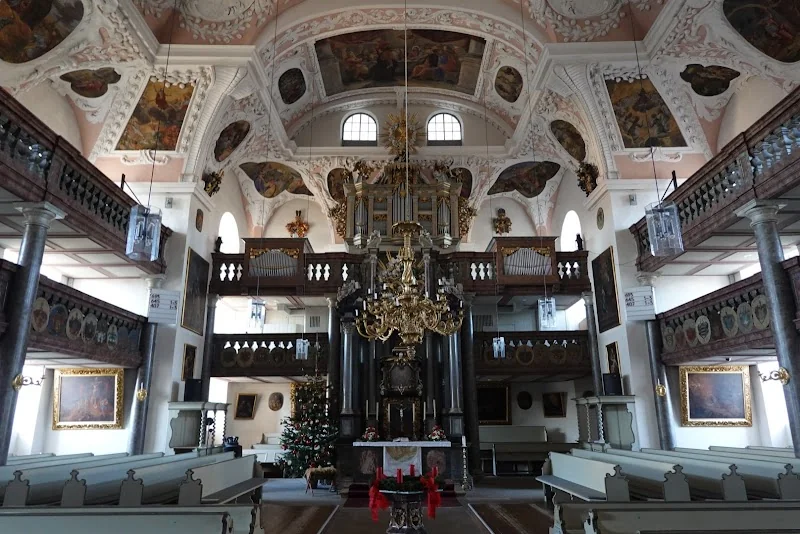
The Order Church is particularly exciting for photos because the exterior and interior differ significantly. From the outside, the building appears stately, with tall windows, decorative architectural details, and a powerful tower; inside, a nearly square space in the form of a Greek cross opens up, organizing itself towards the center from all sides. This allows for perspectives that are not found in many churches: the view from the western entrance into the bright space, the sight of the central baptismal font, and the axis towards the north-facing altar give each photo a clear structure. Thus, the Order Church is not a sober sacred building but a Baroque spatial artwork that can almost be read like a stage. The current impression is not coincidental but the result of very conscious planning that connects architecture and symbolism. ([markgrafenkirchen.de](https://www.markgrafenkirchen.de/wp-content/uploads/2020/01/Flyer-BT-Ordenskirche-website.pdf))
Especially photogenic are the details that one only notices upon closer inspection. The hexagonal baptismal font made of rose-veined marble is not placed in a corner but in the middle of the church space; above it lies an intricately carved lid depicting the baptism of Jesus. Above the altar, a second large ceiling painting shows the Last Supper, while surrounding scenes from the New Testament and Passion images under the gallery accompany the walls and walkways. Additionally, there is the Margrave's loge, the 83 coat of arms shields of the order members, and the light-colored stucco with floral and fruit motifs. Those looking for motifs for social media, travel reports, or family photos will find a wealth of clear image points and symmetries here; furthermore, the community even offers a 360-degree view of the interior on its website. ([ordenskirche.de](https://www.ordenskirche.de/seite/505294/ordenskirche.html))
From the Planned City of St. Georgen to the Baroque Order Church
The history of the Order Church begins with the Baroque urban project St. Georgen am See. The planned city was founded in 1702, construction of the church began in 1705, the consecration took place on St. George's Day in 1711, and the tower was completed in 1718. The architect responsible was Gottfried von Gedeler, while Johann David Räntz constructed the tower at the southern end of the building. It is crucial that the church was not planned in isolation: its floor plan and orientation follow the alignment of the Baroque urban layout towards the former order castle of the margrave. Thus, the building continues to connect religious use and urban representation in an unusually close manner. The church was understood from the beginning as part of an ideally conceived city, not as a later added individual monument. ([ordenskirche.de](https://www.ordenskirche.de/seite/505294/ordenskirche.html))
The builder was Margrave Georg Wilhelm, who had a church, a court church, and a spiritual meeting place created for his order in his new city. The original name Sophienkirche zur Heiligen Dreifaltigkeit recalls his mother Sophie Luise and the familial significance of the project, while the later name Order Church arose from the practice of order life. Georg Wilhelm stipulated that the knights of the Order of Sincerity should gather in the church every year on St. George's Day; at the same time, the members had to display their coat of arms shields. Thus, the house of worship became not only a place of faith but also a visible memory of the court society. The still-preserved abundance of coats of arms makes this historical connection particularly vivid, which is why the church is also so valuable for culturally interested visitors. ([ordenskirche.de](https://www.ordenskirche.de/seite/505294/ordenskirche.html))
Greek Cross, Pulpit Altar, and Ceiling Paintings
Architecturally, the Order Church is a model example of Baroque clarity and staging. The church space is accessed from the western main entrance, and the paths lead from several sides to the center. There stands the baptismal font made of rose-colored marble, whose intricately designed lid was created by Elias Räntz and bears the letters G W M Z B - a direct reference to Georg Wilhelm Margrave of Brandenburg. Above it lies one of the large ceiling paintings depicting the baptism of Jesus, so that the baptismal font and the image form a thematic pair. The church consciously works with axes, focal points, and symbols that guide the visitor step by step into the center of the faith space. Even the ceiling is not merely decoration but part of a narrative image order that theologically interprets the space. ([ordenskirche.de](https://www.ordenskirche.de/seite/505294/ordenskirche.html))
Equally defining is the pulpit altar, which is oriented to the north, thus deviating from the usual east orientation of many churches. The reason lies in the integration of the church into the course of the Baroque urban layout. The organ-pulpit altar, also from the master workshop of Elias Räntz, combines the proclamation of the word, music, and imagery in a single structure. Above the pulpit appear God the Father and God the Son before a golden radiance, below the dove as a symbol of the Holy Spirit. Even higher sits the organ with its Baroque prospect. This staging is complemented by the stucco from Bernardo Quadri, the ceiling paintings by Johann Martin Wild and Gabriel Schreyer, and the twelve Passion images under the first gallery, which are inspired by models from the Augsburg St. Anna Church. The bell system is also part of the history: of the early bells, the two smaller ones from 1714 have been preserved, and later new bells were added after the large knight's bell was damaged in 1986. ([ordenskirche.de](https://www.ordenskirche.de/seite/505294/ordenskirche.html))
Opening Hours, Access, Parking, and Directions
Those wishing to visit the Order Church will find it at St. Georgen 50 in 95448 Bayreuth. The Markgrafenkirchen website lists daily opening hours from 9:00 AM to 4:00 PM; from April to October, it is open until 6:00 PM. The parish office is located at St. Georgen 56 and is clearly named on the official pages of the community. For visitors, this means: the church is not only a historical monument but also a place that is regularly accessible and offers longer visiting hours during the summer months. Anyone planning a tour or a special appointment should always check the current community page, as services and events can change availability. The location in St. Georgen also makes the church well-suited as part of a city tour. ([markgrafenkirchen.de](https://www.markgrafenkirchen.de/en/margravechurches/the-church-of-the-order-bayreuth/))
The Order Church is also well-prepared for today's visitors regarding access. The Markgrafenkirchen website indicates barrier-free access, car parking, E-bike and E-car charging stations, as well as public transport connections. The community adds that visitors with mobility impairments can access the church via the side entrance behind the building and can use two disabled parking spaces there. This is practical for families, older guests, and anyone preferring a clear and simple arrival. Those traveling by bike or on foot will additionally benefit from the location in a historic district that can be easily combined with a walk or a small tour. Especially since St. Georgen has historically developed, the way to the church is worthwhile not only as a destination but also as part of a city experience. ([markgrafenkirchen.de](https://www.markgrafenkirchen.de/en/margravechurches/the-church-of-the-order-bayreuth/))
Services, Church Music, and a Vibrant Community
The Order Church is not only a building for quiet contemplation but a vibrant community space. The church community celebrates its main service every Sunday at 10 AM in the Order Church and consciously describes it as an open place for young and old. In addition, there are regular baptisms, communion services, baptismal services, and the children's loge for the youngest, while simultaneously about every two weeks a children's service takes place in the community house. So, those looking for the Order Church and service will find here not a museum object but an active Protestant community that continues to fill the space in the historic church building with life. The church space remains a place of listening, singing, and celebrating, not just of watching. ([ordenskirche.de](https://www.ordenskirche.de/seite/513204/termine.html))
Church music is also an important part of this profile. In St. Georgen, the choir rehearses weekly, the brass choir plays for services, festivals, and special occasions, and since 2024, band songs are regularly included in the Sunday service; this is complemented by a gospel choir and a permanently installed sound system with a projector. There are also church tours with organ music, for example, on the Day of Open Monuments, where history, symbolism, and sound come together directly. The community has also documented online services and invites to jubilee confirmations. All this shows: the Order Church is today a church for the dialogue between tradition and present, between Baroque heritage and modern community work. Those exploring the city center and the historic district of St. Georgen will also experience an environment with grown Baroque structure, striking historical buildings, and lively events such as St. Georgen swings or the Star Market. ([ordenskirche.de](https://www.ordenskirche.de/seite/505022/kirchenmusik.html))
The Order Church in Bayreuth-St. Georgen is thus much more than a beautiful church for a short stop. It is Baroque architecture, a courtly urban idea, a Protestant worship space, and a cultural memorial at the same time. Those looking for photos will find clear forms, strong axes, and rich details. Those seeking history will discover the planned city, Georg Wilhelm, and the Order of Sincerity. Those planning practically will benefit from fixed opening hours, good access, and the location in the St. Georgen district. And those simply wanting to experience a special place will find exactly that here: a space where art, faith, and urban history are remarkably interconnected. ([markgrafenkirchen.de](https://www.markgrafenkirchen.de/wp-content/uploads/2020/01/Flyer-BT-Ordenskirche-website.pdf))
Sources:
Show moreShow less
Order Church Bayreuth-St. Georgen | Photos & History
The Order Church in the Bayreuth district of St. Georgen is one of the most distinctive Baroque churches in Upper Franconia. It is part of a uniformly planned urban layout that began in 1702 as St. Georgen am See, and it combines representative architecture, court history, and Protestant community work in a compact space. The original name, Sophienkirche zur Heiligen Dreifaltigkeit, already indicates that this house of worship was intended to be more than just a regular parish church: it served as a family church, court church, and meeting place for the Order of Sincerity. Today, the Order Church is also a venue for services, music, church tours, and quiet visits, where the Baroque church space with its special lighting, images, and clear layout immediately makes an impact. Those interested in photos, history, or margravial culture will find here a destination that has preserved the atmosphere of an entire era. ([markgrafenkirchen.de](https://www.markgrafenkirchen.de/wp-content/uploads/2020/01/Flyer-BT-Ordenskirche-website.pdf))
Photos, Facades, and the Best Angles
The Order Church is particularly exciting for photos because the exterior and interior differ significantly. From the outside, the building appears stately, with tall windows, decorative architectural details, and a powerful tower; inside, a nearly square space in the form of a Greek cross opens up, organizing itself towards the center from all sides. This allows for perspectives that are not found in many churches: the view from the western entrance into the bright space, the sight of the central baptismal font, and the axis towards the north-facing altar give each photo a clear structure. Thus, the Order Church is not a sober sacred building but a Baroque spatial artwork that can almost be read like a stage. The current impression is not coincidental but the result of very conscious planning that connects architecture and symbolism. ([markgrafenkirchen.de](https://www.markgrafenkirchen.de/wp-content/uploads/2020/01/Flyer-BT-Ordenskirche-website.pdf))
Especially photogenic are the details that one only notices upon closer inspection. The hexagonal baptismal font made of rose-veined marble is not placed in a corner but in the middle of the church space; above it lies an intricately carved lid depicting the baptism of Jesus. Above the altar, a second large ceiling painting shows the Last Supper, while surrounding scenes from the New Testament and Passion images under the gallery accompany the walls and walkways. Additionally, there is the Margrave's loge, the 83 coat of arms shields of the order members, and the light-colored stucco with floral and fruit motifs. Those looking for motifs for social media, travel reports, or family photos will find a wealth of clear image points and symmetries here; furthermore, the community even offers a 360-degree view of the interior on its website. ([ordenskirche.de](https://www.ordenskirche.de/seite/505294/ordenskirche.html))
From the Planned City of St. Georgen to the Baroque Order Church
The history of the Order Church begins with the Baroque urban project St. Georgen am See. The planned city was founded in 1702, construction of the church began in 1705, the consecration took place on St. George's Day in 1711, and the tower was completed in 1718. The architect responsible was Gottfried von Gedeler, while Johann David Räntz constructed the tower at the southern end of the building. It is crucial that the church was not planned in isolation: its floor plan and orientation follow the alignment of the Baroque urban layout towards the former order castle of the margrave. Thus, the building continues to connect religious use and urban representation in an unusually close manner. The church was understood from the beginning as part of an ideally conceived city, not as a later added individual monument. ([ordenskirche.de](https://www.ordenskirche.de/seite/505294/ordenskirche.html))
The builder was Margrave Georg Wilhelm, who had a church, a court church, and a spiritual meeting place created for his order in his new city. The original name Sophienkirche zur Heiligen Dreifaltigkeit recalls his mother Sophie Luise and the familial significance of the project, while the later name Order Church arose from the practice of order life. Georg Wilhelm stipulated that the knights of the Order of Sincerity should gather in the church every year on St. George's Day; at the same time, the members had to display their coat of arms shields. Thus, the house of worship became not only a place of faith but also a visible memory of the court society. The still-preserved abundance of coats of arms makes this historical connection particularly vivid, which is why the church is also so valuable for culturally interested visitors. ([ordenskirche.de](https://www.ordenskirche.de/seite/505294/ordenskirche.html))
Greek Cross, Pulpit Altar, and Ceiling Paintings
Architecturally, the Order Church is a model example of Baroque clarity and staging. The church space is accessed from the western main entrance, and the paths lead from several sides to the center. There stands the baptismal font made of rose-colored marble, whose intricately designed lid was created by Elias Räntz and bears the letters G W M Z B - a direct reference to Georg Wilhelm Margrave of Brandenburg. Above it lies one of the large ceiling paintings depicting the baptism of Jesus, so that the baptismal font and the image form a thematic pair. The church consciously works with axes, focal points, and symbols that guide the visitor step by step into the center of the faith space. Even the ceiling is not merely decoration but part of a narrative image order that theologically interprets the space. ([ordenskirche.de](https://www.ordenskirche.de/seite/505294/ordenskirche.html))
Equally defining is the pulpit altar, which is oriented to the north, thus deviating from the usual east orientation of many churches. The reason lies in the integration of the church into the course of the Baroque urban layout. The organ-pulpit altar, also from the master workshop of Elias Räntz, combines the proclamation of the word, music, and imagery in a single structure. Above the pulpit appear God the Father and God the Son before a golden radiance, below the dove as a symbol of the Holy Spirit. Even higher sits the organ with its Baroque prospect. This staging is complemented by the stucco from Bernardo Quadri, the ceiling paintings by Johann Martin Wild and Gabriel Schreyer, and the twelve Passion images under the first gallery, which are inspired by models from the Augsburg St. Anna Church. The bell system is also part of the history: of the early bells, the two smaller ones from 1714 have been preserved, and later new bells were added after the large knight's bell was damaged in 1986. ([ordenskirche.de](https://www.ordenskirche.de/seite/505294/ordenskirche.html))
Opening Hours, Access, Parking, and Directions
Those wishing to visit the Order Church will find it at St. Georgen 50 in 95448 Bayreuth. The Markgrafenkirchen website lists daily opening hours from 9:00 AM to 4:00 PM; from April to October, it is open until 6:00 PM. The parish office is located at St. Georgen 56 and is clearly named on the official pages of the community. For visitors, this means: the church is not only a historical monument but also a place that is regularly accessible and offers longer visiting hours during the summer months. Anyone planning a tour or a special appointment should always check the current community page, as services and events can change availability. The location in St. Georgen also makes the church well-suited as part of a city tour. ([markgrafenkirchen.de](https://www.markgrafenkirchen.de/en/margravechurches/the-church-of-the-order-bayreuth/))
The Order Church is also well-prepared for today's visitors regarding access. The Markgrafenkirchen website indicates barrier-free access, car parking, E-bike and E-car charging stations, as well as public transport connections. The community adds that visitors with mobility impairments can access the church via the side entrance behind the building and can use two disabled parking spaces there. This is practical for families, older guests, and anyone preferring a clear and simple arrival. Those traveling by bike or on foot will additionally benefit from the location in a historic district that can be easily combined with a walk or a small tour. Especially since St. Georgen has historically developed, the way to the church is worthwhile not only as a destination but also as part of a city experience. ([markgrafenkirchen.de](https://www.markgrafenkirchen.de/en/margravechurches/the-church-of-the-order-bayreuth/))
Services, Church Music, and a Vibrant Community
The Order Church is not only a building for quiet contemplation but a vibrant community space. The church community celebrates its main service every Sunday at 10 AM in the Order Church and consciously describes it as an open place for young and old. In addition, there are regular baptisms, communion services, baptismal services, and the children's loge for the youngest, while simultaneously about every two weeks a children's service takes place in the community house. So, those looking for the Order Church and service will find here not a museum object but an active Protestant community that continues to fill the space in the historic church building with life. The church space remains a place of listening, singing, and celebrating, not just of watching. ([ordenskirche.de](https://www.ordenskirche.de/seite/513204/termine.html))
Church music is also an important part of this profile. In St. Georgen, the choir rehearses weekly, the brass choir plays for services, festivals, and special occasions, and since 2024, band songs are regularly included in the Sunday service; this is complemented by a gospel choir and a permanently installed sound system with a projector. There are also church tours with organ music, for example, on the Day of Open Monuments, where history, symbolism, and sound come together directly. The community has also documented online services and invites to jubilee confirmations. All this shows: the Order Church is today a church for the dialogue between tradition and present, between Baroque heritage and modern community work. Those exploring the city center and the historic district of St. Georgen will also experience an environment with grown Baroque structure, striking historical buildings, and lively events such as St. Georgen swings or the Star Market. ([ordenskirche.de](https://www.ordenskirche.de/seite/505022/kirchenmusik.html))
The Order Church in Bayreuth-St. Georgen is thus much more than a beautiful church for a short stop. It is Baroque architecture, a courtly urban idea, a Protestant worship space, and a cultural memorial at the same time. Those looking for photos will find clear forms, strong axes, and rich details. Those seeking history will discover the planned city, Georg Wilhelm, and the Order of Sincerity. Those planning practically will benefit from fixed opening hours, good access, and the location in the St. Georgen district. And those simply wanting to experience a special place will find exactly that here: a space where art, faith, and urban history are remarkably interconnected. ([markgrafenkirchen.de](https://www.markgrafenkirchen.de/wp-content/uploads/2020/01/Flyer-BT-Ordenskirche-website.pdf))
Sources:
Order Church Bayreuth-St. Georgen | Photos & History
The Order Church in the Bayreuth district of St. Georgen is one of the most distinctive Baroque churches in Upper Franconia. It is part of a uniformly planned urban layout that began in 1702 as St. Georgen am See, and it combines representative architecture, court history, and Protestant community work in a compact space. The original name, Sophienkirche zur Heiligen Dreifaltigkeit, already indicates that this house of worship was intended to be more than just a regular parish church: it served as a family church, court church, and meeting place for the Order of Sincerity. Today, the Order Church is also a venue for services, music, church tours, and quiet visits, where the Baroque church space with its special lighting, images, and clear layout immediately makes an impact. Those interested in photos, history, or margravial culture will find here a destination that has preserved the atmosphere of an entire era. ([markgrafenkirchen.de](https://www.markgrafenkirchen.de/wp-content/uploads/2020/01/Flyer-BT-Ordenskirche-website.pdf))
Photos, Facades, and the Best Angles
The Order Church is particularly exciting for photos because the exterior and interior differ significantly. From the outside, the building appears stately, with tall windows, decorative architectural details, and a powerful tower; inside, a nearly square space in the form of a Greek cross opens up, organizing itself towards the center from all sides. This allows for perspectives that are not found in many churches: the view from the western entrance into the bright space, the sight of the central baptismal font, and the axis towards the north-facing altar give each photo a clear structure. Thus, the Order Church is not a sober sacred building but a Baroque spatial artwork that can almost be read like a stage. The current impression is not coincidental but the result of very conscious planning that connects architecture and symbolism. ([markgrafenkirchen.de](https://www.markgrafenkirchen.de/wp-content/uploads/2020/01/Flyer-BT-Ordenskirche-website.pdf))
Especially photogenic are the details that one only notices upon closer inspection. The hexagonal baptismal font made of rose-veined marble is not placed in a corner but in the middle of the church space; above it lies an intricately carved lid depicting the baptism of Jesus. Above the altar, a second large ceiling painting shows the Last Supper, while surrounding scenes from the New Testament and Passion images under the gallery accompany the walls and walkways. Additionally, there is the Margrave's loge, the 83 coat of arms shields of the order members, and the light-colored stucco with floral and fruit motifs. Those looking for motifs for social media, travel reports, or family photos will find a wealth of clear image points and symmetries here; furthermore, the community even offers a 360-degree view of the interior on its website. ([ordenskirche.de](https://www.ordenskirche.de/seite/505294/ordenskirche.html))
From the Planned City of St. Georgen to the Baroque Order Church
The history of the Order Church begins with the Baroque urban project St. Georgen am See. The planned city was founded in 1702, construction of the church began in 1705, the consecration took place on St. George's Day in 1711, and the tower was completed in 1718. The architect responsible was Gottfried von Gedeler, while Johann David Räntz constructed the tower at the southern end of the building. It is crucial that the church was not planned in isolation: its floor plan and orientation follow the alignment of the Baroque urban layout towards the former order castle of the margrave. Thus, the building continues to connect religious use and urban representation in an unusually close manner. The church was understood from the beginning as part of an ideally conceived city, not as a later added individual monument. ([ordenskirche.de](https://www.ordenskirche.de/seite/505294/ordenskirche.html))
The builder was Margrave Georg Wilhelm, who had a church, a court church, and a spiritual meeting place created for his order in his new city. The original name Sophienkirche zur Heiligen Dreifaltigkeit recalls his mother Sophie Luise and the familial significance of the project, while the later name Order Church arose from the practice of order life. Georg Wilhelm stipulated that the knights of the Order of Sincerity should gather in the church every year on St. George's Day; at the same time, the members had to display their coat of arms shields. Thus, the house of worship became not only a place of faith but also a visible memory of the court society. The still-preserved abundance of coats of arms makes this historical connection particularly vivid, which is why the church is also so valuable for culturally interested visitors. ([ordenskirche.de](https://www.ordenskirche.de/seite/505294/ordenskirche.html))
Greek Cross, Pulpit Altar, and Ceiling Paintings
Architecturally, the Order Church is a model example of Baroque clarity and staging. The church space is accessed from the western main entrance, and the paths lead from several sides to the center. There stands the baptismal font made of rose-colored marble, whose intricately designed lid was created by Elias Räntz and bears the letters G W M Z B - a direct reference to Georg Wilhelm Margrave of Brandenburg. Above it lies one of the large ceiling paintings depicting the baptism of Jesus, so that the baptismal font and the image form a thematic pair. The church consciously works with axes, focal points, and symbols that guide the visitor step by step into the center of the faith space. Even the ceiling is not merely decoration but part of a narrative image order that theologically interprets the space. ([ordenskirche.de](https://www.ordenskirche.de/seite/505294/ordenskirche.html))
Equally defining is the pulpit altar, which is oriented to the north, thus deviating from the usual east orientation of many churches. The reason lies in the integration of the church into the course of the Baroque urban layout. The organ-pulpit altar, also from the master workshop of Elias Räntz, combines the proclamation of the word, music, and imagery in a single structure. Above the pulpit appear God the Father and God the Son before a golden radiance, below the dove as a symbol of the Holy Spirit. Even higher sits the organ with its Baroque prospect. This staging is complemented by the stucco from Bernardo Quadri, the ceiling paintings by Johann Martin Wild and Gabriel Schreyer, and the twelve Passion images under the first gallery, which are inspired by models from the Augsburg St. Anna Church. The bell system is also part of the history: of the early bells, the two smaller ones from 1714 have been preserved, and later new bells were added after the large knight's bell was damaged in 1986. ([ordenskirche.de](https://www.ordenskirche.de/seite/505294/ordenskirche.html))
Opening Hours, Access, Parking, and Directions
Those wishing to visit the Order Church will find it at St. Georgen 50 in 95448 Bayreuth. The Markgrafenkirchen website lists daily opening hours from 9:00 AM to 4:00 PM; from April to October, it is open until 6:00 PM. The parish office is located at St. Georgen 56 and is clearly named on the official pages of the community. For visitors, this means: the church is not only a historical monument but also a place that is regularly accessible and offers longer visiting hours during the summer months. Anyone planning a tour or a special appointment should always check the current community page, as services and events can change availability. The location in St. Georgen also makes the church well-suited as part of a city tour. ([markgrafenkirchen.de](https://www.markgrafenkirchen.de/en/margravechurches/the-church-of-the-order-bayreuth/))
The Order Church is also well-prepared for today's visitors regarding access. The Markgrafenkirchen website indicates barrier-free access, car parking, E-bike and E-car charging stations, as well as public transport connections. The community adds that visitors with mobility impairments can access the church via the side entrance behind the building and can use two disabled parking spaces there. This is practical for families, older guests, and anyone preferring a clear and simple arrival. Those traveling by bike or on foot will additionally benefit from the location in a historic district that can be easily combined with a walk or a small tour. Especially since St. Georgen has historically developed, the way to the church is worthwhile not only as a destination but also as part of a city experience. ([markgrafenkirchen.de](https://www.markgrafenkirchen.de/en/margravechurches/the-church-of-the-order-bayreuth/))
Services, Church Music, and a Vibrant Community
The Order Church is not only a building for quiet contemplation but a vibrant community space. The church community celebrates its main service every Sunday at 10 AM in the Order Church and consciously describes it as an open place for young and old. In addition, there are regular baptisms, communion services, baptismal services, and the children's loge for the youngest, while simultaneously about every two weeks a children's service takes place in the community house. So, those looking for the Order Church and service will find here not a museum object but an active Protestant community that continues to fill the space in the historic church building with life. The church space remains a place of listening, singing, and celebrating, not just of watching. ([ordenskirche.de](https://www.ordenskirche.de/seite/513204/termine.html))
Church music is also an important part of this profile. In St. Georgen, the choir rehearses weekly, the brass choir plays for services, festivals, and special occasions, and since 2024, band songs are regularly included in the Sunday service; this is complemented by a gospel choir and a permanently installed sound system with a projector. There are also church tours with organ music, for example, on the Day of Open Monuments, where history, symbolism, and sound come together directly. The community has also documented online services and invites to jubilee confirmations. All this shows: the Order Church is today a church for the dialogue between tradition and present, between Baroque heritage and modern community work. Those exploring the city center and the historic district of St. Georgen will also experience an environment with grown Baroque structure, striking historical buildings, and lively events such as St. Georgen swings or the Star Market. ([ordenskirche.de](https://www.ordenskirche.de/seite/505022/kirchenmusik.html))
The Order Church in Bayreuth-St. Georgen is thus much more than a beautiful church for a short stop. It is Baroque architecture, a courtly urban idea, a Protestant worship space, and a cultural memorial at the same time. Those looking for photos will find clear forms, strong axes, and rich details. Those seeking history will discover the planned city, Georg Wilhelm, and the Order of Sincerity. Those planning practically will benefit from fixed opening hours, good access, and the location in the St. Georgen district. And those simply wanting to experience a special place will find exactly that here: a space where art, faith, and urban history are remarkably interconnected. ([markgrafenkirchen.de](https://www.markgrafenkirchen.de/wp-content/uploads/2020/01/Flyer-BT-Ordenskirche-website.pdf))
Sources:

Frequently Asked Questions
Reviews
Matthias Rausch
8. November 2025
Beautiful church with a very interesting history. The name comes from the margraves and the assemblies of various orders that took place there. The coats of arms of the different orders can be seen in the church on the galleries.
Alex Schätz
29. May 2024
Beautiful church in the Bayreuth district of St. Georgen. Of course, it's free to visit.
Norbert Adler
11. March 2018
I was confirmed in the Order Church back in the day. I can only say it's a cool church.
Jens Flümer
17. July 2024
Small and fine. A wonderfully beautiful church. We were there for our son's wedding. A visit is definitely worth it if you're interested in discovering culturally impressive buildings. Parking is available right on site.
hhmyst hhmyst
16. July 2025
Nice church in this lovely neighborhood. I've always heard this at the Brandenburger and 8 PM.