
Weidenberg
St2181, 95485 Weidenberg, Deutschland
Parking Glaswanderweg | Directions & Hiking
The parking lot Glaswanderweg in Weidenberg is more than just a place to park your car. It is the practical entry point into a landscape where glass history, industrial culture, and nature experience are closely intertwined. Those who park here stand at the edge of one of the most well-known themed hiking trails in the Fichtelgebirge and begin their tour at a point where the traces of the regional glassmaking culture can be particularly well understood. The Glaswanderweg connects Weidenberg, Warmensteinach, Fichtelberg, and Bischofsgrün along a long, varied route. Official sources mention a total length of 42 km; including side routes and detours, the tour is even described as 47.7 km long. At the same time, the route is designed so that even partial sections are meaningful and attractive. This is exactly what makes the parking lot Glaswanderweg so interesting: it serves as a starting point for short walks as well as for longer hikes with a historical focus. The surroundings are characterized by the Steinach, old settlement and industrial sites, as well as a hiking trail that does not tell the glass history abstractly, but makes it visible directly in the landscape. ([glas-im-fichtelgebirge.de](https://glas-im-fichtelgebirge.de/fileadmin/Bilder/Korrektur/glaswegflyer_web.pdf))
Directions and Parking at the Parking Glaswanderweg
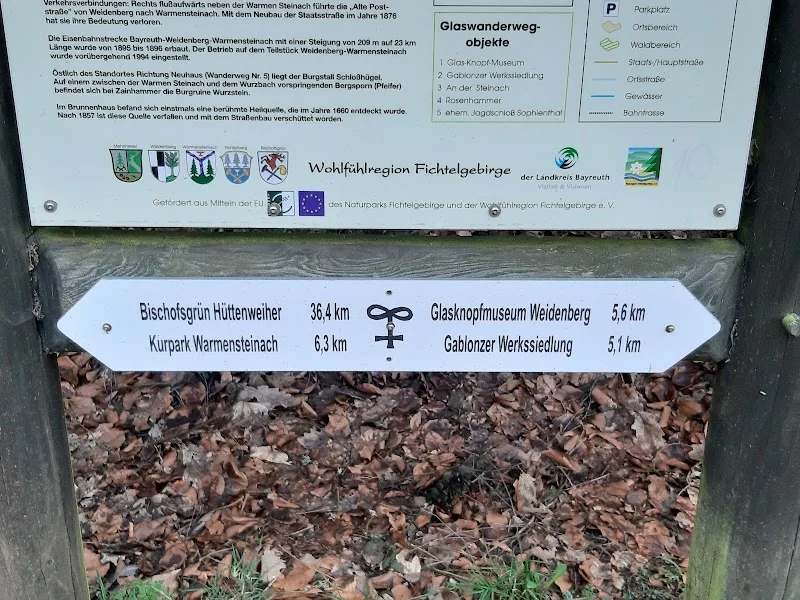
For many visitors, the most important question is quite practical: Where can you park well at the Glaswanderweg in Weidenberg? The official route documents help with this orientation, as they name several access points along the route. In the Weidenberg section, the path leads from the Glass Button Museum over the Gablonzer industrial settlement and further along the Steinach. After that, the area of Sophienthal with the Schwarze Bruck crossing and the state road is described as a prominent point of orientation. A flyer for the Glaswanderweg explicitly names the hiking parking lot “Schwarze Bruck” as the place from which it continues from Sophienthal towards Zainhammer and Warmensteinach. For the parking lot Glaswanderweg, this means: it is not just any random parking space, but is part of a path concept that is geared towards hikers and allows for several possible entries. The address at St2181 fits this because the road forms an important axis in the area of Weidenberg and Sophienthal. Therefore, those arriving by car should not look for a classic parking garage or an event parking lot, but rather for the entry point of a themed hiking trail. This very function makes the location so meaningful: arrive, get out, start walking. For a day hike, this is particularly pleasant because the route historically and scenically begins right at the point where glass production, industrial settlement, and transport routes were closely linked in the past. ([glas-im-fichtelgebirge.de](https://glas-im-fichtelgebirge.de/fileadmin/Bilder/Korrektur/glaswegflyer_web.pdf))
The classification as an event location is also important when considering search queries such as “tickets” or “events.” The parking lot Glaswanderweg is not a location with regular ticket sales, seating plans, or seats, but rather a public starting point for hikes. The official route entries refer to a themed hiking trail, hiking parking lots, circular paths, and historical stations, not to a ticket operation. Therefore, the appropriate expectation is more that of a freely accessible nature and culture starting point. Anyone planning a tour should therefore pay more attention to route duration, distance, signage, and connections to other places than to event tickets. This is relevant for SEO because many users initially search for tickets, but in reality mean a path, a route, or a convenient entry point. This is exactly where the parking lot Glaswanderweg fulfills its function best: it puts visitors in the right starting position for what truly makes the region strong, namely hiking with history. ([module.tourinfra.com](https://module.tourinfra.com/fichtelgebirge/details.php?id=70660&utm_source=openai))
The Glaswanderweg in Weidenberg: Starting Point, Length, and Course
The Glaswanderweg is one of the longest themed hiking trails in the Fichtelgebirge and was developed in collaboration with the municipalities of Weidenberg, Warmensteinach, Fichtelberg, and Bischofsgrün. The official flyer states a total length of 42 km and emphasizes that the path is intended as a cohesive experience. A tour description from the regional tourism portal lists it as 47.7 km including side routes and detours. Both figures are useful for visitors as they show that the Glaswanderweg can be understood as either a compact main route or an extensive themed path with additional loops, depending on the perspective. For the parking lot Glaswanderweg, this means: it is a realistic starting point for both short stages and longer day plans. The section in Weidenberg begins at the historical sites around the Glass Button Museum, leads through the Gablonzer industrial settlement, past the Steinach, over Rosenhammer, and to Sophienthal. From there, it continues over the Schwarze Bruck and the old postal road. Thus, the route is not only scenically attractive but also clearly structured. Those who do not wish to walk the entire distance can choose individual sections and still experience the character of the route: glass craftsmanship tradition, water-adjacent valley passages, old settlement sites, and information boards that make the history along the way understandable. This combination of a well-readable route and historical depth makes the Glaswanderweg so special. ([glas-im-fichtelgebirge.de](https://glas-im-fichtelgebirge.de/fileadmin/Bilder/Korrektur/glaswegflyer_web.pdf))
In the Weidenberg section, the path layout is particularly understandable because the stations are officially listed. This begins at the Glass Button Museum, continues to the Gablonzer industrial settlement, along the Steinach to the Scherzenmühle, and further to Rosenhammer and the former hunting lodge Sophienthal. This sequence is helpful for hikers because it not only facilitates orientation but also provides a narrative structure: from the museum entry through industrial and artisanal traces to scenic and historical transitions. The parking lot Glaswanderweg is thus located in close proximity to a part of the route that is particularly rich in stories. Those who start here do not enter just any forest path, but a thematic axis that consciously works with places, boards, and historical remnants. An official tour description also emphasizes that the path is well understandable due to extensive signage. This is particularly important for visitors who are walking the Glaswanderweg for the first time. They can focus on the route instead of having to plan for a long time or constantly check the map. This is a real advantage for families, beginners, and day guests. ([glas-im-fichtelgebirge.de](https://www.glas-im-fichtelgebirge.de/Weidenberg.64.0.html))
Those who only know the Glaswanderweg by name might expect mainly nature. In fact, however, the path connects nature and industrial culture so closely that both cannot be separated. The route does not simply follow a beautiful landscape but a historical narrative about glass processing, water, forest, raw materials, and settlement development. The data shows that the path leads through several places where glassmaking has been present for generations. This turns a hike into a kind of open history book. This is why the parking lot Glaswanderweg is not just any access point, but an entry into a theme that is deeply rooted in the region. Those who park their car there ideally start with the mindset of not just covering kilometers but also reading places: path signs, mills, former workshops, settlements, and river courses. This mixture is central to the added value of the route. ([glas-im-fichtelgebirge.de](https://glas-im-fichtelgebirge.de/fileadmin/Bilder/Korrektur/glaswegflyer_web.pdf))
Glass Button Museum, Gablonzer Industrial Settlement, and the History of Weidenberg
The historical depth of the Glaswanderweg begins in Weidenberg very concretely at the Glass Button Museum, which appears as a central reference point in the official descriptions. The museum page describes the house as a place for glass, glass buttons, chandeliers, Gablonzer jewelry, history, and integration. Particularly formative is the origin story after World War II: Displaced persons from the Sudetenland brought their knowledge of glass refinement to Weidenberg, and in the early 1950s, the Gablonzer industrial settlement emerged as a new district with the help of the Marshall Plan. This industrial settlement housed many glass workshops and later became an important memorial site of regional industrial and social history. This is exactly where it becomes clear why the parking lot Glaswanderweg is so valuable: it is located in an environment that visibly makes the connection between migration, work, craftsmanship, and home apparent in a small space. The museum was established between 1994 and 1997 in former production rooms and made the history of the people, resettlement, integration, and the glass industry tangible. Even if one only walks part of the way, this historical background carries the entire route. The starting point is therefore not only geographically sensible but also content-wise charged. ([glas-im-fichtelgebirge.de](https://www.glas-im-fichtelgebirge.de/Weidenberg-Museum.60.0.html))
The museum texts also make it clear how closely production was connected to everyday life. The GKM displayed the old production processes in an authentic environment because the layout, machines, and tools have largely been preserved. There, glass buttons, beads, bead chains, and other products of the Gablonzer glass and jewelry industry were manufactured. Particularly interesting is the note that visitors could follow the creation of an entry button on action days or get creative themselves at the bead winding station. This is important for the Glaswanderweg because the path does not just refer to boards but to real workplaces. The parking lot Glaswanderweg is thus located in a region where industrial history is not an anonymous number but a living memory of working worlds, production chains, and artisanal specialization. Those who take the historical perspective seriously will also discover the larger context here: glass was not only decoration in the Fichtelgebirge but also an economic factor, export product, and identity creator. The museum page describes the boom of the glass industry and its later decline due to cheap imports. This makes the place particularly credible because here not only success stories are told but also breaks. ([glas-im-fichtelgebirge.de](https://www.glas-im-fichtelgebirge.de/Weidenberg-Museum.60.0.html))
Additionally, there is a collection of historical glass objects that expands the view of the region's diversity. The official information mentions button pattern cards, goldsmith works, crystal chandeliers, hand-ground hollow glasses, and other artistically designed everyday objects. This shows how broad the production range was and how much Weidenberg fit into the network of glassmaking culture. For visitors to the parking lot Glaswanderweg, this means: even before walking the first meters, one has a content framework with which to read the landscape. The interplay of the industrial settlement, museum, and hiking trail makes the location particularly attractive for history enthusiasts. Those who embark on the route experience a place where the post-war period, craftsmanship tradition, and regional development intersect. This is exactly why the parking lot Glaswanderweg is not only practical but also thematically well chosen. ([glas-im-fichtelgebirge.de](https://www.glas-im-fichtelgebirge.de/Weidenberg-Museum.60.0.html))
Schwarze Bruck, Sophienthal, and the Stages Towards Warmensteinach
A particularly notable part of the route lies between Sophienthal and Warmensteinach. The official flyer explicitly names the hiking parking lot “Schwarze Bruck” and the old postal road as a connection to Zainhammer and Warmensteinach. This formulation is very useful for orientation at the parking lot Glaswanderweg because it shows how closely path guidance and historical infrastructure are connected. The Schwarze Bruck is therefore not just a bridge name but an important path sign in both a tourist and historical sense. The tour description for the Weidenberg glass route also confirms that the path leads over the Schwarze Bruck, the state road, and further through the historical glass towns. For hikers, this results in a clear sequence: Weidenberg as the entry point, Sophienthal as a historical junction, and then the transition into the Warmensteinach section. Those who use the parking lot Glaswanderweg are thus at a point where the route consciously condenses its narrative. It is about transitions, not just mere movement. The area shows how glass history was organized through postal roads, streams, workshops, and settlement axes. This spatial logic makes the Glaswanderweg particularly appealing for culture-interested hikers. ([glas-im-fichtelgebirge.de](https://glas-im-fichtelgebirge.de/fileadmin/Bilder/Korrektur/glaswegflyer_web.pdf))
The Warmensteinach section itself is described in the official information as just over 11 km long. It follows the Warmen Steinach for long stretches, contains more than 20 object boards, and thus tells more than 400 years of local glass history. This is remarkable because the route not only offers a nature experience but also has a thematic depth that one would otherwise expect more in museums. About halfway along, the Warmensteinach Glass Museum is located in the leisure house; furthermore, the path leads over Oberwarmensteinach and Fleckl to Grünstein. For visitors to the parking lot Glaswanderweg, this means that the entry in Weidenberg can be very well combined with a longer cultural walk that can extend to Warmensteinach or beyond. So, if you are looking for a place where you not only park but plan a whole hiking day, you are exactly right here. The route description connects historical glass production, town centers, and landscape sections so closely that you constantly discover new contexts while walking. Especially in conjunction with the boards along the way, a learning and experience path is created that goes far beyond a simple hiking route. ([glas-im-fichtelgebirge.de](https://glas-im-fichtelgebirge.de/fileadmin/Bilder/Korrektur/glaswegflyer_web.pdf))
The other places along the way are also important for orientation. The official overview of the Glaswanderweg names Weidenberg, Warmensteinach, Fichtelberg, and Bischofsgrün as the four defining sections of the overall path. This helps with tour planning because each part has its own focus: Weidenberg with the industrial settlement and starting history, Warmensteinach with the section along the Steinach, Fichtelberg with historical production sites, and Bischofsgrün with a dense sequence of stations and views. Therefore, those who start at the parking lot Glaswanderweg can decide how far the journey should go, depending on their daily condition and interest. The location is thus flexible: it is suitable for a short stage tracing the glass industry as well as for an ambitious multi-hour tour. This flexibility is a relevant SEO advantage because users often do not just search for a place but for a concrete decision-making aid: How do I get there, what do I see along the way, and how far do I have to walk? The parking lot Glaswanderweg answers exactly these questions by functioning as a gateway to an entire network of paths. ([glas-im-fichtelgebirge.de](https://glas-im-fichtelgebirge.de/Glaswanderweg.54.0.html))
Warmensteinach, Fichtelberg, and Bischofsgrün: The Route as a Cultural and Nature Experience
The further you follow the Glaswanderweg, the clearer it becomes that it was not conceived as an isolated round trip but as a regional connecting band between several places. The Warmensteinach section particularly shows how nature and industrial heritage come together: the route follows the Warmen Steinach, is equipped with many object boards, and can be described as an educational hike with moderate inclines. The official PDF emphasizes that the route tells the local glass history from the old craftsmanship of button and bead makers through mirror glass processing to industrial production after the war. Further towards Fichtelberg, the focus is even more on production sites and special stations. There, the path refers to Neugrün, the Thaddäus Chapel, the former glass harbor factory in Hennenlohe, and the information point “Waldglashütte Proterobas” in Neubau. These details also show that the parking lot Glaswanderweg is an entry into a much larger narrative network. Those who park here can consciously enter a route that connects over years, places, and production forms. This is particularly valuable in tourist communication because it creates emotional and historical depth beyond mere hiking. ([glas-im-fichtelgebirge.de](https://glas-im-fichtelgebirge.de/fileadmin/Bilder/Korrektur/glaswegflyer_web.pdf))
In the Bischofsgrün section, the path officially ends at the Hüttenweiher. Along the way, the path leads over Karches, along the White Main, to the Knopfhütte in Fröbershammer, and further to historical stations that deal with glassmaker families, Christmas ornaments, and regional glass companies. The flyer also describes that around 15 information boards tell interesting stories and that Bischofsgrün was once known for Ochsenkopf glasses and many other glass products. Particularly attractive is the detour to Birnstengel, which not only provides information but also offers beautiful views. For visitors to the parking lot Glaswanderweg, this means: those who combine the trip to Weidenberg with a longer tour will be rewarded not only with nature but with a route that functions like an open archive. Every place is part of an overarching narrative of raw materials, craftsmanship, families, innovation, and change. The scenic component is by no means a minor matter. It is precisely the combination of valley paths, river courses, forest sections, and historical town centers that makes the charm. This is also the reason why the Glaswanderweg works equally well for hikers, families, history enthusiasts, and day trippers. ([glas-im-fichtelgebirge.de](https://glas-im-fichtelgebirge.de/fileadmin/Bilder/Korrektur/glaswegflyer_web.pdf))
Another important aspect is the clear structure of the overall path. The official information not only names individual places but also gives the path an internal structure that is well suited for partial routes. This is particularly practical for the parking lot Glaswanderweg because visitors often do not want to walk the entire distance. Some are just looking for an easy entry, others want a half-day loop, and still others plan a multi-day connection from station to station. The themed path provides a good basis for this, as the path guidance remains understandable and historical information is directly at the path. Especially in the age of spontaneous leisure decisions, this is important: one can react flexibly on site without sacrificing experience quality. The parking lot Glaswanderweg is therefore not only a parking option but also a logistical advantage for a route that is among the strongest cultural-historical offerings in the region. Those who use it make the path a planable yet inspiring excursion. ([module.tourinfra.com](https://module.tourinfra.com/fichtelgebirge/details.php?id=70660&utm_source=openai))
Tickets, Events, and Practical Tips for the Visit
The search intent behind terms like “tickets” or “events” is to be understood differently for a location like the parking lot Glaswanderweg than for a concert hall or a trade fair site. Here, it is less about ticket sales than about the question of whether the path is freely accessible, how well one can park, and what offerings the surroundings have. The official information about the Glaswanderweg consistently refers to a themed hiking trail, hiking parking lots, stations, and museum or path sections. From this, it can be reasonably inferred that the parking lot itself is not a classic ticket location. This is an important classification because users sometimes search for admission, program, or box office, even though they actually mean a starting point for a hike. The parking lot Glaswanderweg fulfills exactly this expectation: it is an access to the landscape and history, not the event venue itself. Those looking for tickets should therefore check the respective museums along the way, such as the Glass Button Museum in Weidenberg or the Glass Museum in Warmensteinach, which is mentioned as a station in the route documents. For the hike itself, the planning of the route is crucial: How long do I want to be on the way, where do I want to start, and which stage fits my time budget? ([glas-im-fichtelgebirge.de](https://glas-im-fichtelgebirge.de/fileadmin/Bilder/Korrektur/glaswegflyer_web.pdf))
It is also practical that the Glaswanderweg has several well-described entry points. Those starting on the Weidenberg side can walk the section from the Glass Button Museum over the Gablonzer industrial settlement and further towards Sophienthal. Those who want to go further can connect to Warmensteinach via the Schwarze Bruck. In the further course, the path opens up to Fichtelberg and Bischofsgrün. For tour planning, this means: the parking lot Glaswanderweg is not an isolated single point but part of a hiking and memory space with several possible destinations. This is also attractive for families and less trained hikers because partial routes are meaningful and scenically rewarding. The official description speaks of easy, varied hikes on forest paths and trails, as well as of low to moderate inclines. Thus, the route is generally well suited if you want to combine nature and information without engaging in difficult alpine passages. For the visitor, this means: put on hiking shoes, bring water, plan time for information boards, and understand the path not just as a route but as a narrative. This is where the actual added value of the parking lot Glaswanderweg lies. ([visit.erlebnis-ochsenkopf.de](https://visit.erlebnis-ochsenkopf.de/de/warmensteinach/streaming/detail/Tour/geocoaching_tour_70660/glaswanderweg))
From an SEO perspective, one can also see why terms like directions, parking, hiking parking lot, Weidenberg, and Glaswanderweg fit together so well. Users in this region often do not search for an event but for a starting point where they can find orientation, history, and nature at the same time. The parking lot Glaswanderweg delivers exactly that. It is a useful hub for tours, not a noisy place, but a quiet beginning. Those who start here have the opportunity to experience the glass history of the Fichtelgebirge at their own pace and adjust the route according to their desires and fitness. This makes the location relevant and search-strong in the long term, even if there is no classic ticket logic. For visitors, in the end, the practical experience counts: good parking, good starting off, good understanding of what makes the region. And this is exactly what the Glaswanderweg in Weidenberg does particularly well. ([module.tourinfra.com](https://module.tourinfra.com/fichtelgebirge/details.php?id=70660&utm_source=openai))
Sources:
- Glass in the Fichtelgebirge - Glaswanderweg Fichtelgebirge ([glas-im-fichtelgebirge.de](https://www.glas-im-fichtelgebirge.de/Glaswanderweg.54.0.html))
- Glass in the Fichtelgebirge - Section Weidenberg ([glas-im-fichtelgebirge.de](https://www.glas-im-fichtelgebirge.de/Weidenberg.64.0.html))
- Glass in the Fichtelgebirge - Glaswegflyer PDF ([glas-im-fichtelgebirge.de](https://glas-im-fichtelgebirge.de/fileadmin/Bilder/Korrektur/glaswegflyer_web.pdf))
- Experience Ochsenkopf - Glaswanderweg ([visit.erlebnis-ochsenkopf.de](https://visit.erlebnis-ochsenkopf.de/de/warmensteinach/streaming/detail/Tour/geocoaching_tour_70660/glaswanderweg))
- Glass in the Fichtelgebirge - Glass Button Museum Weidenberg ([glas-im-fichtelgebirge.de](https://www.glas-im-fichtelgebirge.de/Weidenberg-Museum.60.0.html))
Show moreShow less
Parking Glaswanderweg | Directions & Hiking
The parking lot Glaswanderweg in Weidenberg is more than just a place to park your car. It is the practical entry point into a landscape where glass history, industrial culture, and nature experience are closely intertwined. Those who park here stand at the edge of one of the most well-known themed hiking trails in the Fichtelgebirge and begin their tour at a point where the traces of the regional glassmaking culture can be particularly well understood. The Glaswanderweg connects Weidenberg, Warmensteinach, Fichtelberg, and Bischofsgrün along a long, varied route. Official sources mention a total length of 42 km; including side routes and detours, the tour is even described as 47.7 km long. At the same time, the route is designed so that even partial sections are meaningful and attractive. This is exactly what makes the parking lot Glaswanderweg so interesting: it serves as a starting point for short walks as well as for longer hikes with a historical focus. The surroundings are characterized by the Steinach, old settlement and industrial sites, as well as a hiking trail that does not tell the glass history abstractly, but makes it visible directly in the landscape. ([glas-im-fichtelgebirge.de](https://glas-im-fichtelgebirge.de/fileadmin/Bilder/Korrektur/glaswegflyer_web.pdf))
Directions and Parking at the Parking Glaswanderweg
For many visitors, the most important question is quite practical: Where can you park well at the Glaswanderweg in Weidenberg? The official route documents help with this orientation, as they name several access points along the route. In the Weidenberg section, the path leads from the Glass Button Museum over the Gablonzer industrial settlement and further along the Steinach. After that, the area of Sophienthal with the Schwarze Bruck crossing and the state road is described as a prominent point of orientation. A flyer for the Glaswanderweg explicitly names the hiking parking lot “Schwarze Bruck” as the place from which it continues from Sophienthal towards Zainhammer and Warmensteinach. For the parking lot Glaswanderweg, this means: it is not just any random parking space, but is part of a path concept that is geared towards hikers and allows for several possible entries. The address at St2181 fits this because the road forms an important axis in the area of Weidenberg and Sophienthal. Therefore, those arriving by car should not look for a classic parking garage or an event parking lot, but rather for the entry point of a themed hiking trail. This very function makes the location so meaningful: arrive, get out, start walking. For a day hike, this is particularly pleasant because the route historically and scenically begins right at the point where glass production, industrial settlement, and transport routes were closely linked in the past. ([glas-im-fichtelgebirge.de](https://glas-im-fichtelgebirge.de/fileadmin/Bilder/Korrektur/glaswegflyer_web.pdf))
The classification as an event location is also important when considering search queries such as “tickets” or “events.” The parking lot Glaswanderweg is not a location with regular ticket sales, seating plans, or seats, but rather a public starting point for hikes. The official route entries refer to a themed hiking trail, hiking parking lots, circular paths, and historical stations, not to a ticket operation. Therefore, the appropriate expectation is more that of a freely accessible nature and culture starting point. Anyone planning a tour should therefore pay more attention to route duration, distance, signage, and connections to other places than to event tickets. This is relevant for SEO because many users initially search for tickets, but in reality mean a path, a route, or a convenient entry point. This is exactly where the parking lot Glaswanderweg fulfills its function best: it puts visitors in the right starting position for what truly makes the region strong, namely hiking with history. ([module.tourinfra.com](https://module.tourinfra.com/fichtelgebirge/details.php?id=70660&utm_source=openai))
The Glaswanderweg in Weidenberg: Starting Point, Length, and Course
The Glaswanderweg is one of the longest themed hiking trails in the Fichtelgebirge and was developed in collaboration with the municipalities of Weidenberg, Warmensteinach, Fichtelberg, and Bischofsgrün. The official flyer states a total length of 42 km and emphasizes that the path is intended as a cohesive experience. A tour description from the regional tourism portal lists it as 47.7 km including side routes and detours. Both figures are useful for visitors as they show that the Glaswanderweg can be understood as either a compact main route or an extensive themed path with additional loops, depending on the perspective. For the parking lot Glaswanderweg, this means: it is a realistic starting point for both short stages and longer day plans. The section in Weidenberg begins at the historical sites around the Glass Button Museum, leads through the Gablonzer industrial settlement, past the Steinach, over Rosenhammer, and to Sophienthal. From there, it continues over the Schwarze Bruck and the old postal road. Thus, the route is not only scenically attractive but also clearly structured. Those who do not wish to walk the entire distance can choose individual sections and still experience the character of the route: glass craftsmanship tradition, water-adjacent valley passages, old settlement sites, and information boards that make the history along the way understandable. This combination of a well-readable route and historical depth makes the Glaswanderweg so special. ([glas-im-fichtelgebirge.de](https://glas-im-fichtelgebirge.de/fileadmin/Bilder/Korrektur/glaswegflyer_web.pdf))
In the Weidenberg section, the path layout is particularly understandable because the stations are officially listed. This begins at the Glass Button Museum, continues to the Gablonzer industrial settlement, along the Steinach to the Scherzenmühle, and further to Rosenhammer and the former hunting lodge Sophienthal. This sequence is helpful for hikers because it not only facilitates orientation but also provides a narrative structure: from the museum entry through industrial and artisanal traces to scenic and historical transitions. The parking lot Glaswanderweg is thus located in close proximity to a part of the route that is particularly rich in stories. Those who start here do not enter just any forest path, but a thematic axis that consciously works with places, boards, and historical remnants. An official tour description also emphasizes that the path is well understandable due to extensive signage. This is particularly important for visitors who are walking the Glaswanderweg for the first time. They can focus on the route instead of having to plan for a long time or constantly check the map. This is a real advantage for families, beginners, and day guests. ([glas-im-fichtelgebirge.de](https://www.glas-im-fichtelgebirge.de/Weidenberg.64.0.html))
Those who only know the Glaswanderweg by name might expect mainly nature. In fact, however, the path connects nature and industrial culture so closely that both cannot be separated. The route does not simply follow a beautiful landscape but a historical narrative about glass processing, water, forest, raw materials, and settlement development. The data shows that the path leads through several places where glassmaking has been present for generations. This turns a hike into a kind of open history book. This is why the parking lot Glaswanderweg is not just any access point, but an entry into a theme that is deeply rooted in the region. Those who park their car there ideally start with the mindset of not just covering kilometers but also reading places: path signs, mills, former workshops, settlements, and river courses. This mixture is central to the added value of the route. ([glas-im-fichtelgebirge.de](https://glas-im-fichtelgebirge.de/fileadmin/Bilder/Korrektur/glaswegflyer_web.pdf))
Glass Button Museum, Gablonzer Industrial Settlement, and the History of Weidenberg
The historical depth of the Glaswanderweg begins in Weidenberg very concretely at the Glass Button Museum, which appears as a central reference point in the official descriptions. The museum page describes the house as a place for glass, glass buttons, chandeliers, Gablonzer jewelry, history, and integration. Particularly formative is the origin story after World War II: Displaced persons from the Sudetenland brought their knowledge of glass refinement to Weidenberg, and in the early 1950s, the Gablonzer industrial settlement emerged as a new district with the help of the Marshall Plan. This industrial settlement housed many glass workshops and later became an important memorial site of regional industrial and social history. This is exactly where it becomes clear why the parking lot Glaswanderweg is so valuable: it is located in an environment that visibly makes the connection between migration, work, craftsmanship, and home apparent in a small space. The museum was established between 1994 and 1997 in former production rooms and made the history of the people, resettlement, integration, and the glass industry tangible. Even if one only walks part of the way, this historical background carries the entire route. The starting point is therefore not only geographically sensible but also content-wise charged. ([glas-im-fichtelgebirge.de](https://www.glas-im-fichtelgebirge.de/Weidenberg-Museum.60.0.html))
The museum texts also make it clear how closely production was connected to everyday life. The GKM displayed the old production processes in an authentic environment because the layout, machines, and tools have largely been preserved. There, glass buttons, beads, bead chains, and other products of the Gablonzer glass and jewelry industry were manufactured. Particularly interesting is the note that visitors could follow the creation of an entry button on action days or get creative themselves at the bead winding station. This is important for the Glaswanderweg because the path does not just refer to boards but to real workplaces. The parking lot Glaswanderweg is thus located in a region where industrial history is not an anonymous number but a living memory of working worlds, production chains, and artisanal specialization. Those who take the historical perspective seriously will also discover the larger context here: glass was not only decoration in the Fichtelgebirge but also an economic factor, export product, and identity creator. The museum page describes the boom of the glass industry and its later decline due to cheap imports. This makes the place particularly credible because here not only success stories are told but also breaks. ([glas-im-fichtelgebirge.de](https://www.glas-im-fichtelgebirge.de/Weidenberg-Museum.60.0.html))
Additionally, there is a collection of historical glass objects that expands the view of the region's diversity. The official information mentions button pattern cards, goldsmith works, crystal chandeliers, hand-ground hollow glasses, and other artistically designed everyday objects. This shows how broad the production range was and how much Weidenberg fit into the network of glassmaking culture. For visitors to the parking lot Glaswanderweg, this means: even before walking the first meters, one has a content framework with which to read the landscape. The interplay of the industrial settlement, museum, and hiking trail makes the location particularly attractive for history enthusiasts. Those who embark on the route experience a place where the post-war period, craftsmanship tradition, and regional development intersect. This is exactly why the parking lot Glaswanderweg is not only practical but also thematically well chosen. ([glas-im-fichtelgebirge.de](https://www.glas-im-fichtelgebirge.de/Weidenberg-Museum.60.0.html))
Schwarze Bruck, Sophienthal, and the Stages Towards Warmensteinach
A particularly notable part of the route lies between Sophienthal and Warmensteinach. The official flyer explicitly names the hiking parking lot “Schwarze Bruck” and the old postal road as a connection to Zainhammer and Warmensteinach. This formulation is very useful for orientation at the parking lot Glaswanderweg because it shows how closely path guidance and historical infrastructure are connected. The Schwarze Bruck is therefore not just a bridge name but an important path sign in both a tourist and historical sense. The tour description for the Weidenberg glass route also confirms that the path leads over the Schwarze Bruck, the state road, and further through the historical glass towns. For hikers, this results in a clear sequence: Weidenberg as the entry point, Sophienthal as a historical junction, and then the transition into the Warmensteinach section. Those who use the parking lot Glaswanderweg are thus at a point where the route consciously condenses its narrative. It is about transitions, not just mere movement. The area shows how glass history was organized through postal roads, streams, workshops, and settlement axes. This spatial logic makes the Glaswanderweg particularly appealing for culture-interested hikers. ([glas-im-fichtelgebirge.de](https://glas-im-fichtelgebirge.de/fileadmin/Bilder/Korrektur/glaswegflyer_web.pdf))
The Warmensteinach section itself is described in the official information as just over 11 km long. It follows the Warmen Steinach for long stretches, contains more than 20 object boards, and thus tells more than 400 years of local glass history. This is remarkable because the route not only offers a nature experience but also has a thematic depth that one would otherwise expect more in museums. About halfway along, the Warmensteinach Glass Museum is located in the leisure house; furthermore, the path leads over Oberwarmensteinach and Fleckl to Grünstein. For visitors to the parking lot Glaswanderweg, this means that the entry in Weidenberg can be very well combined with a longer cultural walk that can extend to Warmensteinach or beyond. So, if you are looking for a place where you not only park but plan a whole hiking day, you are exactly right here. The route description connects historical glass production, town centers, and landscape sections so closely that you constantly discover new contexts while walking. Especially in conjunction with the boards along the way, a learning and experience path is created that goes far beyond a simple hiking route. ([glas-im-fichtelgebirge.de](https://glas-im-fichtelgebirge.de/fileadmin/Bilder/Korrektur/glaswegflyer_web.pdf))
The other places along the way are also important for orientation. The official overview of the Glaswanderweg names Weidenberg, Warmensteinach, Fichtelberg, and Bischofsgrün as the four defining sections of the overall path. This helps with tour planning because each part has its own focus: Weidenberg with the industrial settlement and starting history, Warmensteinach with the section along the Steinach, Fichtelberg with historical production sites, and Bischofsgrün with a dense sequence of stations and views. Therefore, those who start at the parking lot Glaswanderweg can decide how far the journey should go, depending on their daily condition and interest. The location is thus flexible: it is suitable for a short stage tracing the glass industry as well as for an ambitious multi-hour tour. This flexibility is a relevant SEO advantage because users often do not just search for a place but for a concrete decision-making aid: How do I get there, what do I see along the way, and how far do I have to walk? The parking lot Glaswanderweg answers exactly these questions by functioning as a gateway to an entire network of paths. ([glas-im-fichtelgebirge.de](https://glas-im-fichtelgebirge.de/Glaswanderweg.54.0.html))
Warmensteinach, Fichtelberg, and Bischofsgrün: The Route as a Cultural and Nature Experience
The further you follow the Glaswanderweg, the clearer it becomes that it was not conceived as an isolated round trip but as a regional connecting band between several places. The Warmensteinach section particularly shows how nature and industrial heritage come together: the route follows the Warmen Steinach, is equipped with many object boards, and can be described as an educational hike with moderate inclines. The official PDF emphasizes that the route tells the local glass history from the old craftsmanship of button and bead makers through mirror glass processing to industrial production after the war. Further towards Fichtelberg, the focus is even more on production sites and special stations. There, the path refers to Neugrün, the Thaddäus Chapel, the former glass harbor factory in Hennenlohe, and the information point “Waldglashütte Proterobas” in Neubau. These details also show that the parking lot Glaswanderweg is an entry into a much larger narrative network. Those who park here can consciously enter a route that connects over years, places, and production forms. This is particularly valuable in tourist communication because it creates emotional and historical depth beyond mere hiking. ([glas-im-fichtelgebirge.de](https://glas-im-fichtelgebirge.de/fileadmin/Bilder/Korrektur/glaswegflyer_web.pdf))
In the Bischofsgrün section, the path officially ends at the Hüttenweiher. Along the way, the path leads over Karches, along the White Main, to the Knopfhütte in Fröbershammer, and further to historical stations that deal with glassmaker families, Christmas ornaments, and regional glass companies. The flyer also describes that around 15 information boards tell interesting stories and that Bischofsgrün was once known for Ochsenkopf glasses and many other glass products. Particularly attractive is the detour to Birnstengel, which not only provides information but also offers beautiful views. For visitors to the parking lot Glaswanderweg, this means: those who combine the trip to Weidenberg with a longer tour will be rewarded not only with nature but with a route that functions like an open archive. Every place is part of an overarching narrative of raw materials, craftsmanship, families, innovation, and change. The scenic component is by no means a minor matter. It is precisely the combination of valley paths, river courses, forest sections, and historical town centers that makes the charm. This is also the reason why the Glaswanderweg works equally well for hikers, families, history enthusiasts, and day trippers. ([glas-im-fichtelgebirge.de](https://glas-im-fichtelgebirge.de/fileadmin/Bilder/Korrektur/glaswegflyer_web.pdf))
Another important aspect is the clear structure of the overall path. The official information not only names individual places but also gives the path an internal structure that is well suited for partial routes. This is particularly practical for the parking lot Glaswanderweg because visitors often do not want to walk the entire distance. Some are just looking for an easy entry, others want a half-day loop, and still others plan a multi-day connection from station to station. The themed path provides a good basis for this, as the path guidance remains understandable and historical information is directly at the path. Especially in the age of spontaneous leisure decisions, this is important: one can react flexibly on site without sacrificing experience quality. The parking lot Glaswanderweg is therefore not only a parking option but also a logistical advantage for a route that is among the strongest cultural-historical offerings in the region. Those who use it make the path a planable yet inspiring excursion. ([module.tourinfra.com](https://module.tourinfra.com/fichtelgebirge/details.php?id=70660&utm_source=openai))
Tickets, Events, and Practical Tips for the Visit
The search intent behind terms like “tickets” or “events” is to be understood differently for a location like the parking lot Glaswanderweg than for a concert hall or a trade fair site. Here, it is less about ticket sales than about the question of whether the path is freely accessible, how well one can park, and what offerings the surroundings have. The official information about the Glaswanderweg consistently refers to a themed hiking trail, hiking parking lots, stations, and museum or path sections. From this, it can be reasonably inferred that the parking lot itself is not a classic ticket location. This is an important classification because users sometimes search for admission, program, or box office, even though they actually mean a starting point for a hike. The parking lot Glaswanderweg fulfills exactly this expectation: it is an access to the landscape and history, not the event venue itself. Those looking for tickets should therefore check the respective museums along the way, such as the Glass Button Museum in Weidenberg or the Glass Museum in Warmensteinach, which is mentioned as a station in the route documents. For the hike itself, the planning of the route is crucial: How long do I want to be on the way, where do I want to start, and which stage fits my time budget? ([glas-im-fichtelgebirge.de](https://glas-im-fichtelgebirge.de/fileadmin/Bilder/Korrektur/glaswegflyer_web.pdf))
It is also practical that the Glaswanderweg has several well-described entry points. Those starting on the Weidenberg side can walk the section from the Glass Button Museum over the Gablonzer industrial settlement and further towards Sophienthal. Those who want to go further can connect to Warmensteinach via the Schwarze Bruck. In the further course, the path opens up to Fichtelberg and Bischofsgrün. For tour planning, this means: the parking lot Glaswanderweg is not an isolated single point but part of a hiking and memory space with several possible destinations. This is also attractive for families and less trained hikers because partial routes are meaningful and scenically rewarding. The official description speaks of easy, varied hikes on forest paths and trails, as well as of low to moderate inclines. Thus, the route is generally well suited if you want to combine nature and information without engaging in difficult alpine passages. For the visitor, this means: put on hiking shoes, bring water, plan time for information boards, and understand the path not just as a route but as a narrative. This is where the actual added value of the parking lot Glaswanderweg lies. ([visit.erlebnis-ochsenkopf.de](https://visit.erlebnis-ochsenkopf.de/de/warmensteinach/streaming/detail/Tour/geocoaching_tour_70660/glaswanderweg))
From an SEO perspective, one can also see why terms like directions, parking, hiking parking lot, Weidenberg, and Glaswanderweg fit together so well. Users in this region often do not search for an event but for a starting point where they can find orientation, history, and nature at the same time. The parking lot Glaswanderweg delivers exactly that. It is a useful hub for tours, not a noisy place, but a quiet beginning. Those who start here have the opportunity to experience the glass history of the Fichtelgebirge at their own pace and adjust the route according to their desires and fitness. This makes the location relevant and search-strong in the long term, even if there is no classic ticket logic. For visitors, in the end, the practical experience counts: good parking, good starting off, good understanding of what makes the region. And this is exactly what the Glaswanderweg in Weidenberg does particularly well. ([module.tourinfra.com](https://module.tourinfra.com/fichtelgebirge/details.php?id=70660&utm_source=openai))
Sources:
- Glass in the Fichtelgebirge - Glaswanderweg Fichtelgebirge ([glas-im-fichtelgebirge.de](https://www.glas-im-fichtelgebirge.de/Glaswanderweg.54.0.html))
- Glass in the Fichtelgebirge - Section Weidenberg ([glas-im-fichtelgebirge.de](https://www.glas-im-fichtelgebirge.de/Weidenberg.64.0.html))
- Glass in the Fichtelgebirge - Glaswegflyer PDF ([glas-im-fichtelgebirge.de](https://glas-im-fichtelgebirge.de/fileadmin/Bilder/Korrektur/glaswegflyer_web.pdf))
- Experience Ochsenkopf - Glaswanderweg ([visit.erlebnis-ochsenkopf.de](https://visit.erlebnis-ochsenkopf.de/de/warmensteinach/streaming/detail/Tour/geocoaching_tour_70660/glaswanderweg))
- Glass in the Fichtelgebirge - Glass Button Museum Weidenberg ([glas-im-fichtelgebirge.de](https://www.glas-im-fichtelgebirge.de/Weidenberg-Museum.60.0.html))
Parking Glaswanderweg | Directions & Hiking
The parking lot Glaswanderweg in Weidenberg is more than just a place to park your car. It is the practical entry point into a landscape where glass history, industrial culture, and nature experience are closely intertwined. Those who park here stand at the edge of one of the most well-known themed hiking trails in the Fichtelgebirge and begin their tour at a point where the traces of the regional glassmaking culture can be particularly well understood. The Glaswanderweg connects Weidenberg, Warmensteinach, Fichtelberg, and Bischofsgrün along a long, varied route. Official sources mention a total length of 42 km; including side routes and detours, the tour is even described as 47.7 km long. At the same time, the route is designed so that even partial sections are meaningful and attractive. This is exactly what makes the parking lot Glaswanderweg so interesting: it serves as a starting point for short walks as well as for longer hikes with a historical focus. The surroundings are characterized by the Steinach, old settlement and industrial sites, as well as a hiking trail that does not tell the glass history abstractly, but makes it visible directly in the landscape. ([glas-im-fichtelgebirge.de](https://glas-im-fichtelgebirge.de/fileadmin/Bilder/Korrektur/glaswegflyer_web.pdf))
Directions and Parking at the Parking Glaswanderweg
For many visitors, the most important question is quite practical: Where can you park well at the Glaswanderweg in Weidenberg? The official route documents help with this orientation, as they name several access points along the route. In the Weidenberg section, the path leads from the Glass Button Museum over the Gablonzer industrial settlement and further along the Steinach. After that, the area of Sophienthal with the Schwarze Bruck crossing and the state road is described as a prominent point of orientation. A flyer for the Glaswanderweg explicitly names the hiking parking lot “Schwarze Bruck” as the place from which it continues from Sophienthal towards Zainhammer and Warmensteinach. For the parking lot Glaswanderweg, this means: it is not just any random parking space, but is part of a path concept that is geared towards hikers and allows for several possible entries. The address at St2181 fits this because the road forms an important axis in the area of Weidenberg and Sophienthal. Therefore, those arriving by car should not look for a classic parking garage or an event parking lot, but rather for the entry point of a themed hiking trail. This very function makes the location so meaningful: arrive, get out, start walking. For a day hike, this is particularly pleasant because the route historically and scenically begins right at the point where glass production, industrial settlement, and transport routes were closely linked in the past. ([glas-im-fichtelgebirge.de](https://glas-im-fichtelgebirge.de/fileadmin/Bilder/Korrektur/glaswegflyer_web.pdf))
The classification as an event location is also important when considering search queries such as “tickets” or “events.” The parking lot Glaswanderweg is not a location with regular ticket sales, seating plans, or seats, but rather a public starting point for hikes. The official route entries refer to a themed hiking trail, hiking parking lots, circular paths, and historical stations, not to a ticket operation. Therefore, the appropriate expectation is more that of a freely accessible nature and culture starting point. Anyone planning a tour should therefore pay more attention to route duration, distance, signage, and connections to other places than to event tickets. This is relevant for SEO because many users initially search for tickets, but in reality mean a path, a route, or a convenient entry point. This is exactly where the parking lot Glaswanderweg fulfills its function best: it puts visitors in the right starting position for what truly makes the region strong, namely hiking with history. ([module.tourinfra.com](https://module.tourinfra.com/fichtelgebirge/details.php?id=70660&utm_source=openai))
The Glaswanderweg in Weidenberg: Starting Point, Length, and Course
The Glaswanderweg is one of the longest themed hiking trails in the Fichtelgebirge and was developed in collaboration with the municipalities of Weidenberg, Warmensteinach, Fichtelberg, and Bischofsgrün. The official flyer states a total length of 42 km and emphasizes that the path is intended as a cohesive experience. A tour description from the regional tourism portal lists it as 47.7 km including side routes and detours. Both figures are useful for visitors as they show that the Glaswanderweg can be understood as either a compact main route or an extensive themed path with additional loops, depending on the perspective. For the parking lot Glaswanderweg, this means: it is a realistic starting point for both short stages and longer day plans. The section in Weidenberg begins at the historical sites around the Glass Button Museum, leads through the Gablonzer industrial settlement, past the Steinach, over Rosenhammer, and to Sophienthal. From there, it continues over the Schwarze Bruck and the old postal road. Thus, the route is not only scenically attractive but also clearly structured. Those who do not wish to walk the entire distance can choose individual sections and still experience the character of the route: glass craftsmanship tradition, water-adjacent valley passages, old settlement sites, and information boards that make the history along the way understandable. This combination of a well-readable route and historical depth makes the Glaswanderweg so special. ([glas-im-fichtelgebirge.de](https://glas-im-fichtelgebirge.de/fileadmin/Bilder/Korrektur/glaswegflyer_web.pdf))
In the Weidenberg section, the path layout is particularly understandable because the stations are officially listed. This begins at the Glass Button Museum, continues to the Gablonzer industrial settlement, along the Steinach to the Scherzenmühle, and further to Rosenhammer and the former hunting lodge Sophienthal. This sequence is helpful for hikers because it not only facilitates orientation but also provides a narrative structure: from the museum entry through industrial and artisanal traces to scenic and historical transitions. The parking lot Glaswanderweg is thus located in close proximity to a part of the route that is particularly rich in stories. Those who start here do not enter just any forest path, but a thematic axis that consciously works with places, boards, and historical remnants. An official tour description also emphasizes that the path is well understandable due to extensive signage. This is particularly important for visitors who are walking the Glaswanderweg for the first time. They can focus on the route instead of having to plan for a long time or constantly check the map. This is a real advantage for families, beginners, and day guests. ([glas-im-fichtelgebirge.de](https://www.glas-im-fichtelgebirge.de/Weidenberg.64.0.html))
Those who only know the Glaswanderweg by name might expect mainly nature. In fact, however, the path connects nature and industrial culture so closely that both cannot be separated. The route does not simply follow a beautiful landscape but a historical narrative about glass processing, water, forest, raw materials, and settlement development. The data shows that the path leads through several places where glassmaking has been present for generations. This turns a hike into a kind of open history book. This is why the parking lot Glaswanderweg is not just any access point, but an entry into a theme that is deeply rooted in the region. Those who park their car there ideally start with the mindset of not just covering kilometers but also reading places: path signs, mills, former workshops, settlements, and river courses. This mixture is central to the added value of the route. ([glas-im-fichtelgebirge.de](https://glas-im-fichtelgebirge.de/fileadmin/Bilder/Korrektur/glaswegflyer_web.pdf))
Glass Button Museum, Gablonzer Industrial Settlement, and the History of Weidenberg
The historical depth of the Glaswanderweg begins in Weidenberg very concretely at the Glass Button Museum, which appears as a central reference point in the official descriptions. The museum page describes the house as a place for glass, glass buttons, chandeliers, Gablonzer jewelry, history, and integration. Particularly formative is the origin story after World War II: Displaced persons from the Sudetenland brought their knowledge of glass refinement to Weidenberg, and in the early 1950s, the Gablonzer industrial settlement emerged as a new district with the help of the Marshall Plan. This industrial settlement housed many glass workshops and later became an important memorial site of regional industrial and social history. This is exactly where it becomes clear why the parking lot Glaswanderweg is so valuable: it is located in an environment that visibly makes the connection between migration, work, craftsmanship, and home apparent in a small space. The museum was established between 1994 and 1997 in former production rooms and made the history of the people, resettlement, integration, and the glass industry tangible. Even if one only walks part of the way, this historical background carries the entire route. The starting point is therefore not only geographically sensible but also content-wise charged. ([glas-im-fichtelgebirge.de](https://www.glas-im-fichtelgebirge.de/Weidenberg-Museum.60.0.html))
The museum texts also make it clear how closely production was connected to everyday life. The GKM displayed the old production processes in an authentic environment because the layout, machines, and tools have largely been preserved. There, glass buttons, beads, bead chains, and other products of the Gablonzer glass and jewelry industry were manufactured. Particularly interesting is the note that visitors could follow the creation of an entry button on action days or get creative themselves at the bead winding station. This is important for the Glaswanderweg because the path does not just refer to boards but to real workplaces. The parking lot Glaswanderweg is thus located in a region where industrial history is not an anonymous number but a living memory of working worlds, production chains, and artisanal specialization. Those who take the historical perspective seriously will also discover the larger context here: glass was not only decoration in the Fichtelgebirge but also an economic factor, export product, and identity creator. The museum page describes the boom of the glass industry and its later decline due to cheap imports. This makes the place particularly credible because here not only success stories are told but also breaks. ([glas-im-fichtelgebirge.de](https://www.glas-im-fichtelgebirge.de/Weidenberg-Museum.60.0.html))
Additionally, there is a collection of historical glass objects that expands the view of the region's diversity. The official information mentions button pattern cards, goldsmith works, crystal chandeliers, hand-ground hollow glasses, and other artistically designed everyday objects. This shows how broad the production range was and how much Weidenberg fit into the network of glassmaking culture. For visitors to the parking lot Glaswanderweg, this means: even before walking the first meters, one has a content framework with which to read the landscape. The interplay of the industrial settlement, museum, and hiking trail makes the location particularly attractive for history enthusiasts. Those who embark on the route experience a place where the post-war period, craftsmanship tradition, and regional development intersect. This is exactly why the parking lot Glaswanderweg is not only practical but also thematically well chosen. ([glas-im-fichtelgebirge.de](https://www.glas-im-fichtelgebirge.de/Weidenberg-Museum.60.0.html))
Schwarze Bruck, Sophienthal, and the Stages Towards Warmensteinach
A particularly notable part of the route lies between Sophienthal and Warmensteinach. The official flyer explicitly names the hiking parking lot “Schwarze Bruck” and the old postal road as a connection to Zainhammer and Warmensteinach. This formulation is very useful for orientation at the parking lot Glaswanderweg because it shows how closely path guidance and historical infrastructure are connected. The Schwarze Bruck is therefore not just a bridge name but an important path sign in both a tourist and historical sense. The tour description for the Weidenberg glass route also confirms that the path leads over the Schwarze Bruck, the state road, and further through the historical glass towns. For hikers, this results in a clear sequence: Weidenberg as the entry point, Sophienthal as a historical junction, and then the transition into the Warmensteinach section. Those who use the parking lot Glaswanderweg are thus at a point where the route consciously condenses its narrative. It is about transitions, not just mere movement. The area shows how glass history was organized through postal roads, streams, workshops, and settlement axes. This spatial logic makes the Glaswanderweg particularly appealing for culture-interested hikers. ([glas-im-fichtelgebirge.de](https://glas-im-fichtelgebirge.de/fileadmin/Bilder/Korrektur/glaswegflyer_web.pdf))
The Warmensteinach section itself is described in the official information as just over 11 km long. It follows the Warmen Steinach for long stretches, contains more than 20 object boards, and thus tells more than 400 years of local glass history. This is remarkable because the route not only offers a nature experience but also has a thematic depth that one would otherwise expect more in museums. About halfway along, the Warmensteinach Glass Museum is located in the leisure house; furthermore, the path leads over Oberwarmensteinach and Fleckl to Grünstein. For visitors to the parking lot Glaswanderweg, this means that the entry in Weidenberg can be very well combined with a longer cultural walk that can extend to Warmensteinach or beyond. So, if you are looking for a place where you not only park but plan a whole hiking day, you are exactly right here. The route description connects historical glass production, town centers, and landscape sections so closely that you constantly discover new contexts while walking. Especially in conjunction with the boards along the way, a learning and experience path is created that goes far beyond a simple hiking route. ([glas-im-fichtelgebirge.de](https://glas-im-fichtelgebirge.de/fileadmin/Bilder/Korrektur/glaswegflyer_web.pdf))
The other places along the way are also important for orientation. The official overview of the Glaswanderweg names Weidenberg, Warmensteinach, Fichtelberg, and Bischofsgrün as the four defining sections of the overall path. This helps with tour planning because each part has its own focus: Weidenberg with the industrial settlement and starting history, Warmensteinach with the section along the Steinach, Fichtelberg with historical production sites, and Bischofsgrün with a dense sequence of stations and views. Therefore, those who start at the parking lot Glaswanderweg can decide how far the journey should go, depending on their daily condition and interest. The location is thus flexible: it is suitable for a short stage tracing the glass industry as well as for an ambitious multi-hour tour. This flexibility is a relevant SEO advantage because users often do not just search for a place but for a concrete decision-making aid: How do I get there, what do I see along the way, and how far do I have to walk? The parking lot Glaswanderweg answers exactly these questions by functioning as a gateway to an entire network of paths. ([glas-im-fichtelgebirge.de](https://glas-im-fichtelgebirge.de/Glaswanderweg.54.0.html))
Warmensteinach, Fichtelberg, and Bischofsgrün: The Route as a Cultural and Nature Experience
The further you follow the Glaswanderweg, the clearer it becomes that it was not conceived as an isolated round trip but as a regional connecting band between several places. The Warmensteinach section particularly shows how nature and industrial heritage come together: the route follows the Warmen Steinach, is equipped with many object boards, and can be described as an educational hike with moderate inclines. The official PDF emphasizes that the route tells the local glass history from the old craftsmanship of button and bead makers through mirror glass processing to industrial production after the war. Further towards Fichtelberg, the focus is even more on production sites and special stations. There, the path refers to Neugrün, the Thaddäus Chapel, the former glass harbor factory in Hennenlohe, and the information point “Waldglashütte Proterobas” in Neubau. These details also show that the parking lot Glaswanderweg is an entry into a much larger narrative network. Those who park here can consciously enter a route that connects over years, places, and production forms. This is particularly valuable in tourist communication because it creates emotional and historical depth beyond mere hiking. ([glas-im-fichtelgebirge.de](https://glas-im-fichtelgebirge.de/fileadmin/Bilder/Korrektur/glaswegflyer_web.pdf))
In the Bischofsgrün section, the path officially ends at the Hüttenweiher. Along the way, the path leads over Karches, along the White Main, to the Knopfhütte in Fröbershammer, and further to historical stations that deal with glassmaker families, Christmas ornaments, and regional glass companies. The flyer also describes that around 15 information boards tell interesting stories and that Bischofsgrün was once known for Ochsenkopf glasses and many other glass products. Particularly attractive is the detour to Birnstengel, which not only provides information but also offers beautiful views. For visitors to the parking lot Glaswanderweg, this means: those who combine the trip to Weidenberg with a longer tour will be rewarded not only with nature but with a route that functions like an open archive. Every place is part of an overarching narrative of raw materials, craftsmanship, families, innovation, and change. The scenic component is by no means a minor matter. It is precisely the combination of valley paths, river courses, forest sections, and historical town centers that makes the charm. This is also the reason why the Glaswanderweg works equally well for hikers, families, history enthusiasts, and day trippers. ([glas-im-fichtelgebirge.de](https://glas-im-fichtelgebirge.de/fileadmin/Bilder/Korrektur/glaswegflyer_web.pdf))
Another important aspect is the clear structure of the overall path. The official information not only names individual places but also gives the path an internal structure that is well suited for partial routes. This is particularly practical for the parking lot Glaswanderweg because visitors often do not want to walk the entire distance. Some are just looking for an easy entry, others want a half-day loop, and still others plan a multi-day connection from station to station. The themed path provides a good basis for this, as the path guidance remains understandable and historical information is directly at the path. Especially in the age of spontaneous leisure decisions, this is important: one can react flexibly on site without sacrificing experience quality. The parking lot Glaswanderweg is therefore not only a parking option but also a logistical advantage for a route that is among the strongest cultural-historical offerings in the region. Those who use it make the path a planable yet inspiring excursion. ([module.tourinfra.com](https://module.tourinfra.com/fichtelgebirge/details.php?id=70660&utm_source=openai))
Tickets, Events, and Practical Tips for the Visit
The search intent behind terms like “tickets” or “events” is to be understood differently for a location like the parking lot Glaswanderweg than for a concert hall or a trade fair site. Here, it is less about ticket sales than about the question of whether the path is freely accessible, how well one can park, and what offerings the surroundings have. The official information about the Glaswanderweg consistently refers to a themed hiking trail, hiking parking lots, stations, and museum or path sections. From this, it can be reasonably inferred that the parking lot itself is not a classic ticket location. This is an important classification because users sometimes search for admission, program, or box office, even though they actually mean a starting point for a hike. The parking lot Glaswanderweg fulfills exactly this expectation: it is an access to the landscape and history, not the event venue itself. Those looking for tickets should therefore check the respective museums along the way, such as the Glass Button Museum in Weidenberg or the Glass Museum in Warmensteinach, which is mentioned as a station in the route documents. For the hike itself, the planning of the route is crucial: How long do I want to be on the way, where do I want to start, and which stage fits my time budget? ([glas-im-fichtelgebirge.de](https://glas-im-fichtelgebirge.de/fileadmin/Bilder/Korrektur/glaswegflyer_web.pdf))
It is also practical that the Glaswanderweg has several well-described entry points. Those starting on the Weidenberg side can walk the section from the Glass Button Museum over the Gablonzer industrial settlement and further towards Sophienthal. Those who want to go further can connect to Warmensteinach via the Schwarze Bruck. In the further course, the path opens up to Fichtelberg and Bischofsgrün. For tour planning, this means: the parking lot Glaswanderweg is not an isolated single point but part of a hiking and memory space with several possible destinations. This is also attractive for families and less trained hikers because partial routes are meaningful and scenically rewarding. The official description speaks of easy, varied hikes on forest paths and trails, as well as of low to moderate inclines. Thus, the route is generally well suited if you want to combine nature and information without engaging in difficult alpine passages. For the visitor, this means: put on hiking shoes, bring water, plan time for information boards, and understand the path not just as a route but as a narrative. This is where the actual added value of the parking lot Glaswanderweg lies. ([visit.erlebnis-ochsenkopf.de](https://visit.erlebnis-ochsenkopf.de/de/warmensteinach/streaming/detail/Tour/geocoaching_tour_70660/glaswanderweg))
From an SEO perspective, one can also see why terms like directions, parking, hiking parking lot, Weidenberg, and Glaswanderweg fit together so well. Users in this region often do not search for an event but for a starting point where they can find orientation, history, and nature at the same time. The parking lot Glaswanderweg delivers exactly that. It is a useful hub for tours, not a noisy place, but a quiet beginning. Those who start here have the opportunity to experience the glass history of the Fichtelgebirge at their own pace and adjust the route according to their desires and fitness. This makes the location relevant and search-strong in the long term, even if there is no classic ticket logic. For visitors, in the end, the practical experience counts: good parking, good starting off, good understanding of what makes the region. And this is exactly what the Glaswanderweg in Weidenberg does particularly well. ([module.tourinfra.com](https://module.tourinfra.com/fichtelgebirge/details.php?id=70660&utm_source=openai))
Sources:
- Glass in the Fichtelgebirge - Glaswanderweg Fichtelgebirge ([glas-im-fichtelgebirge.de](https://www.glas-im-fichtelgebirge.de/Glaswanderweg.54.0.html))
- Glass in the Fichtelgebirge - Section Weidenberg ([glas-im-fichtelgebirge.de](https://www.glas-im-fichtelgebirge.de/Weidenberg.64.0.html))
- Glass in the Fichtelgebirge - Glaswegflyer PDF ([glas-im-fichtelgebirge.de](https://glas-im-fichtelgebirge.de/fileadmin/Bilder/Korrektur/glaswegflyer_web.pdf))
- Experience Ochsenkopf - Glaswanderweg ([visit.erlebnis-ochsenkopf.de](https://visit.erlebnis-ochsenkopf.de/de/warmensteinach/streaming/detail/Tour/geocoaching_tour_70660/glaswanderweg))
- Glass in the Fichtelgebirge - Glass Button Museum Weidenberg ([glas-im-fichtelgebirge.de](https://www.glas-im-fichtelgebirge.de/Weidenberg-Museum.60.0.html))
Frequently Asked Questions
Reviews
No reviews found