
Wiesentfels 40, Hollfeld
Wiesentfels 40, 96142 Hollfeld, Germany
Castle Burg Wiesentfels | Photos & Opening Hours
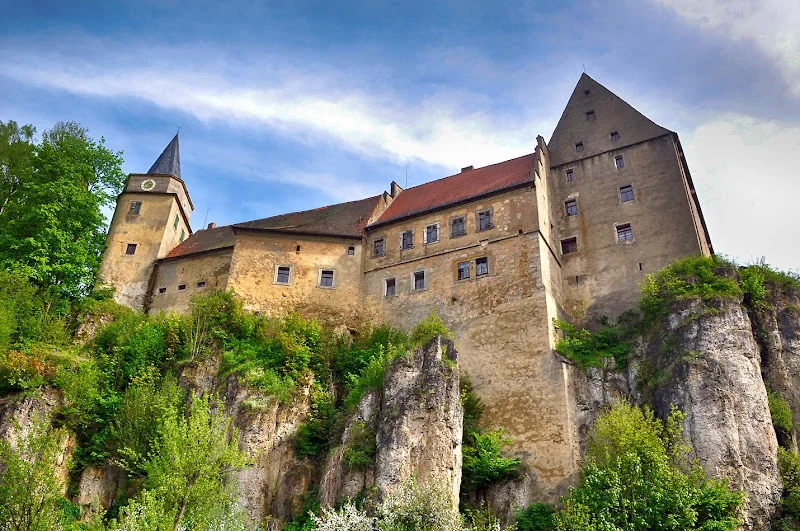
Castle Burg Wiesentfels is one of the most impressive rock formations in Franconian Switzerland and is already a striking sight from the valley. Above the village of Wiesentfels, the winding castle rises on a rock about 40 meters high, nestled between wooded slopes and the narrowing Wiesent valley. This location makes the site particularly special: on one hand, it appears defensible and shielded, while on the other hand, it reveals many historical details and a very characteristic local image upon closer inspection. The city of Hollfeld describes the castle complex as a noteworthy destination that immediately stands out in the valley and consciously maintains a distance from the classic museum castle due to its private use. Therefore, those searching for photos, reviews, or opening hours will end up at a place that remains interesting not only for its external appearance but also for its eventful history and current summer uses. Castle Wiesentfels is not a place for a quick visit, but for a detailed look at its location, history, and atmosphere. ([hollfeld.de](https://www.hollfeld.de/seite/710090/schl%25C3%25B6sser-und-burgen.html))
Current Opening Hours, Tours, and Visitor Status
For current visit planning, the most important point is that the city of Hollfeld explicitly notes that no tours are currently taking place. Thus, Castle Wiesentfels is not organized like a permanently open museum but remains a private property with restricted or event-based access. A tourist detail page of Northern Franconian Switzerland mentions previous seasonal tours from Pentecost to the end of September on Sunday afternoons, as well as group and special tours for ten or more people, but this information should be understood more as a historical or flexible guideline rather than a guaranteed current operation. Therefore, the most important orientation is always the current notice from the city. This also leads to the typical search intent behind terms like opening hours, tours, or currently: many visitors want to know whether they can spontaneously enter the castle or if it is only visible from the outside. According to the current status, it is valid that the castle can primarily be experienced as a historical landmark and as part of the local image, not as a regularly open visitor destination. ([hollfeld.de](https://www.hollfeld.de/seite/710090/schl%25C3%25B6sser-und-burgen.html))
Practically, this means: those planning an excursion should not only rely on older entries or general travel pages but should check the current status in advance. Especially with historical private properties, access, tours, and special dates can change without daily updates on opening hours being published. The tourism page of Northern Franconian Switzerland even lists Castle Wiesentfels with its own section for parking and access, but simultaneously states the status as closed. This is a good example that it is a destination with a special character, where information and reality are not always comparable to the classic opening hours of a leisure business. For travelers hoping for photos, this is still attractive: even from the outside, the prominent location can be very well perceived, and especially the contrast between the accessible valley and the shielded castle adds to the charm. However, Wiesentfels is currently not the right expectation for a spontaneous interior visit. ([noerdliche-fraenkische.de](https://www.noerdliche-fraenkische.de/detail/id%3D5f5773225f7f9b38066eefd5_325?utm_source=openai))
History from Construction to Private Present
The current castle complex dates back, according to the city of Hollfeld, to a new construction starting in 1476, initiated by Dietz and Otto von Giech. By 1493, Dietz von Giech was the sole owner before the complex was burned down in 1525 during the Peasants' War by farmers from Hollfeld. Thus, Wiesentfels exemplifies the tumultuous history of many Franconian noble and defensive seats: medieval origins, wartime destruction, reconstruction, and later transformation into a castle-like complex. The city chronicle makes it clear that the location on the rock not only appears romantic but originally also had a clear protective function. Between the valley, steep slope, and rock outcrop, a fortified site emerged that had to change repeatedly over the centuries. Therefore, those standing before the castle today do not simply see a pretty backdrop but the result of a long history of rule and construction, in which political upheavals, family changes, and regional conflicts have left their marks. ([hollfeld.de](https://www.hollfeld.de/seite/710090/schl%25C3%25B6sser-und-burgen.html))
In the 17th century, with the death of Hans Christoph von Giech, the Giech-Wiesentfels line ended, and in 1654 the castle came to the Thurnau line of the Giech after years of disputes. Later, the complex was repurposed and altered multiple times: in 1883, the administrative building built in 1773 in Peesten was demolished and rebuilt in Wiesentfels as a forestry house, in 1938 the last Count Franz Friedrich Carl Lothar von Giech died, and in 1943 the castle served as a goods and clothing depot for the Nuremberg police as well as a storage location for the Richard Wagner Museum. After the war, there was a brief occupation by American troops, and from 1946 to 1956, it served as a refugee camp for displaced persons from the Altvater Mountains and the Sudetenland. In 1969, the complex was sold to Dr. Elisabeth Bender-Fughe, in 2009 the Uhlmann family took over, and since May 2010, the castle chapel has been accessible for civil weddings. This sequence clearly shows how a noble seat has developed into a privately shaped cultural site over the centuries. ([hollfeld.de](https://www.hollfeld.de/seite/710090/schl%25C3%25B6sser-und-burgen.html))
Access, Parking, and Location in Wiesent Valley
Castle Burg Wiesentfels is located in a very narrow and thus particularly atmospheric valley shape. The city of Hollfeld describes that the Wiesent valley narrows here, that the village lies between wooded mountain slopes, and that the castle rises on a rock about 40 meters high. A road leads steeply up the mountain, and high walls shield the private property from curious eyes. This topographical situation also shapes the access: Wiesentfels is not a place where one simply drives up to a wide driveway or a huge parking lot like at a large event center. Instead, one moves in a village environment shaped by slopes and valleys. The tourism page provides a separate field for access and a separate field for parking for Castle Wiesentfels, which already shows that practical accessibility is indeed a topic, but in the scale of a small, sensitive place in Wiesent valley. For inquiries regarding access and parking, this is important information as it makes expectations realistic. ([hollfeld.de](https://www.hollfeld.de/seite/710090/schl%25C3%25B6sser-und-burgen.html))
For hikers and excursionists, the surroundings are particularly interesting because Castle Wiesentfels appears in several tourist routes. The city of Hollfeld describes on its hiking page the circular route Blue Dot as a tour from Hollfeld via Weiher, Freienfels, Wiesentfels, Krögelstein, and Kainach back to Hollfeld. It is also noted that the path passes steep rocks at Wiesentfels and that the castle is privately owned. For the route, a parking lot is mentioned at the starting point in Hollfeld, and the tourism page also points out parking for the location. Additionally, Northern Franconian Switzerland lists Wichtelallee in Wiesentfels as a direct connection to the castle. This mix of village road, hiking route, and specific parking hints is typical for a destination that is experienced more as part of an excursion, a hike, or a short visit from the outside rather than with classic city center logic. ([hollfeld.de](https://www.hollfeld.de/seite/709989/wandern-radfahren-nordic-walking-und-laufen.html))
Franconian Theater Summer and Cultural Use
One of the most exciting features of Castle Wiesentfels is its cultural secondary use. The city of Hollfeld explicitly states that performances of the Franconian Theater Summer take place between the castle walls in summer. This transforms the private historical site into a stage for theater, atmosphere, and architecture to interact directly. This form of use fits very well with the location of the castle: the shielded walls, the rock, and the valley floor create an almost natural stage space that is particularly appealing for drama and summer events. Cultural and tourism-related publications repeatedly list Wiesentfels as a venue or part of the program, which is important for visitors searching for events, programs, or seasons, as the castle is not only a monument but also a recurring site of cultural life in the Bayreuth district. This is exactly what distinguishes Wiesentfels from many other private castles that, while beautiful to look at, have no public cultural connection anymore. ([hollfeld.de](https://www.hollfeld.de/seite/710090/schl%25C3%25B6sser-und-burgen.html))
Castle Wiesentfels has also made a name for itself as a film set. The city of Hollfeld mentions the complex as a filming location for the youth film Five Friends in the Valley of the Dinosaurs from 2018. This underscores the visual character of the place: the combination of rock, tower, gable, outbuildings, and valley makes the castle very attractive for camera shots and exterior recordings. At the same time, the film use enhances the perception as a special place known beyond local history. For inquiries regarding photos, film sets, or special highlights, this is strong information as it shows that Wiesentfels is not only historically interesting but also culturally relevant in modern times. Therefore, those visiting the place experience multiple layers: the closed private complex, the summer stage of the theater summer, and the memory of a well-known children's and youth film. This multifaceted nature makes the SEO and excursion context so interesting. ([hollfeld.de](https://www.hollfeld.de/seite/710090/schl%25C3%25B6sser-und-burgen.html))
Photos, Perspectives, and the Special Rock Location
Those searching for photos of Castle Burg Wiesentfels are often actually looking for the special effect of the location. The castle does not sit flat in the village but is distinctly elevated on a rock, resulting in strong sightlines: below the valley with farms and houses, above the walls, the tower with a pointed roof, the main building, and the outbuildings. From the description of the city of Hollfeld, it is clear that the visual effect of the castle arises precisely from this layering. Additionally, the narrow valley shape, the wooded mountain slopes, and the steep access give the place an almost dramatic frame. A particularly beautiful detail is the Wichtelallee in Wiesentfels with linden trees up to 400 years old, which, according to the tourism page, leads directly to the castle. Such elements are worth their weight in gold for photo and excursion seekers because they make the way to the motif itself part of the experience. Instead of an isolated structure, one receives a whole scenery of path, tree, rock, and castle. ([hollfeld.de](https://www.hollfeld.de/seite/710090/schl%25C3%25B6sser-und-burgen.html))
From an SEO perspective, this combination of landscape and architecture is important because it explains the search intent behind terms like photos, reviews, and Castle Wiesentfels Hollfeld well. Visitors want to know not only the name of the castle but also what it looks like, from where it can be recognized, and why so many impressions of the place relate back to the location. The city of Hollfeld describes the rising tower with a pointed roof and the gable of the main building as distinctive elements, while the tourism page emphasizes the road leading up to the castle and the protective walls. This results in a clear photographic character: the place works particularly well in wide views from the valley, in detailed shots of the facades, and in atmospheric images along the access and hiking paths. Therefore, those searching for a photo motif in Franconian Switzerland will not find a smooth postcard image here but a place with depth, history, and distinct relief. ([hollfeld.de](https://www.hollfeld.de/seite/710090/schl%25C3%25B6sser-und-burgen.html))
Weddings, Castle Path, and Tips for the Excursion
A practical special aspect of Castle Wiesentfels is the use of the castle chapel for civil weddings. The city of Hollfeld notes that the chapel has been accessible for public weddings since May 2010. This makes the place interesting for couples looking for a historical backdrop for the official part of their wedding. At the same time, it remains important that this is a special use and not a sign of regular visitor openings in everyday life. For the excursion, this means: Wiesentfels is not a classic destination with permanent public operations but a place where cultural, private, and occasionally official functions coexist. Therefore, those planning a visit should adjust their expectations and rather consider it as a point for excursions, photos, or events rather than a day in a castle museum. In connection with private ownership, a very clear character emerges: present in the landscape but only open for certain forms of use in selected situations. ([hollfeld.de](https://www.hollfeld.de/seite/710090/schl%25C3%25B6sser-und-burgen.html))
For excursion planning, the surroundings of Wiesentfels offer plenty of room for exploration. The city of Hollfeld mentions the Castle Path Blue Dot with the route Hollfeld - Weiher - Freienfels - Wiesentfels - Krögelstein - Kainach - Hollfeld, and on this loop, the castle is highlighted as a prominent point in the hiking route. Therefore, even if one does not want or cannot enter the castle, there is still a very good reason to head to the place: as part of a scenically appealing castle and valley route. Additionally, further destinations can be combined in the region, such as Freienfels or the landscape-shaped sections around the Wiesent valley. The best excursion tip is therefore not to hope for a fixed opening time but to consciously take in the location, the views, and the paths around the castle. This way, a short stop becomes a coherent Franconian Switzerland day filled with history, nature, and a very distinctive local image. ([hollfeld.de](https://www.hollfeld.de/seite/709989/wandern-radfahren-nordic-walking-und-laufen.html))
Sources:
- City of Hollfeld - Castles and Fortresses
- City of Hollfeld - Hiking, Cycling, Nordic Walking, and Running
- Northern Franconian Switzerland - Castle Wiesentfels
- Franconian Switzerland - Along the Wiesent (VGN-PDF)
- Franconian Theater Summer - Official Website
- Echt Oberfranken - Wiesentfels
- Bayreuth Tourism - Festival-Free Time 2023
Show moreShow less
Castle Burg Wiesentfels | Photos & Opening Hours
Castle Burg Wiesentfels is one of the most impressive rock formations in Franconian Switzerland and is already a striking sight from the valley. Above the village of Wiesentfels, the winding castle rises on a rock about 40 meters high, nestled between wooded slopes and the narrowing Wiesent valley. This location makes the site particularly special: on one hand, it appears defensible and shielded, while on the other hand, it reveals many historical details and a very characteristic local image upon closer inspection. The city of Hollfeld describes the castle complex as a noteworthy destination that immediately stands out in the valley and consciously maintains a distance from the classic museum castle due to its private use. Therefore, those searching for photos, reviews, or opening hours will end up at a place that remains interesting not only for its external appearance but also for its eventful history and current summer uses. Castle Wiesentfels is not a place for a quick visit, but for a detailed look at its location, history, and atmosphere. ([hollfeld.de](https://www.hollfeld.de/seite/710090/schl%25C3%25B6sser-und-burgen.html))
Current Opening Hours, Tours, and Visitor Status
For current visit planning, the most important point is that the city of Hollfeld explicitly notes that no tours are currently taking place. Thus, Castle Wiesentfels is not organized like a permanently open museum but remains a private property with restricted or event-based access. A tourist detail page of Northern Franconian Switzerland mentions previous seasonal tours from Pentecost to the end of September on Sunday afternoons, as well as group and special tours for ten or more people, but this information should be understood more as a historical or flexible guideline rather than a guaranteed current operation. Therefore, the most important orientation is always the current notice from the city. This also leads to the typical search intent behind terms like opening hours, tours, or currently: many visitors want to know whether they can spontaneously enter the castle or if it is only visible from the outside. According to the current status, it is valid that the castle can primarily be experienced as a historical landmark and as part of the local image, not as a regularly open visitor destination. ([hollfeld.de](https://www.hollfeld.de/seite/710090/schl%25C3%25B6sser-und-burgen.html))
Practically, this means: those planning an excursion should not only rely on older entries or general travel pages but should check the current status in advance. Especially with historical private properties, access, tours, and special dates can change without daily updates on opening hours being published. The tourism page of Northern Franconian Switzerland even lists Castle Wiesentfels with its own section for parking and access, but simultaneously states the status as closed. This is a good example that it is a destination with a special character, where information and reality are not always comparable to the classic opening hours of a leisure business. For travelers hoping for photos, this is still attractive: even from the outside, the prominent location can be very well perceived, and especially the contrast between the accessible valley and the shielded castle adds to the charm. However, Wiesentfels is currently not the right expectation for a spontaneous interior visit. ([noerdliche-fraenkische.de](https://www.noerdliche-fraenkische.de/detail/id%3D5f5773225f7f9b38066eefd5_325?utm_source=openai))
History from Construction to Private Present
The current castle complex dates back, according to the city of Hollfeld, to a new construction starting in 1476, initiated by Dietz and Otto von Giech. By 1493, Dietz von Giech was the sole owner before the complex was burned down in 1525 during the Peasants' War by farmers from Hollfeld. Thus, Wiesentfels exemplifies the tumultuous history of many Franconian noble and defensive seats: medieval origins, wartime destruction, reconstruction, and later transformation into a castle-like complex. The city chronicle makes it clear that the location on the rock not only appears romantic but originally also had a clear protective function. Between the valley, steep slope, and rock outcrop, a fortified site emerged that had to change repeatedly over the centuries. Therefore, those standing before the castle today do not simply see a pretty backdrop but the result of a long history of rule and construction, in which political upheavals, family changes, and regional conflicts have left their marks. ([hollfeld.de](https://www.hollfeld.de/seite/710090/schl%25C3%25B6sser-und-burgen.html))
In the 17th century, with the death of Hans Christoph von Giech, the Giech-Wiesentfels line ended, and in 1654 the castle came to the Thurnau line of the Giech after years of disputes. Later, the complex was repurposed and altered multiple times: in 1883, the administrative building built in 1773 in Peesten was demolished and rebuilt in Wiesentfels as a forestry house, in 1938 the last Count Franz Friedrich Carl Lothar von Giech died, and in 1943 the castle served as a goods and clothing depot for the Nuremberg police as well as a storage location for the Richard Wagner Museum. After the war, there was a brief occupation by American troops, and from 1946 to 1956, it served as a refugee camp for displaced persons from the Altvater Mountains and the Sudetenland. In 1969, the complex was sold to Dr. Elisabeth Bender-Fughe, in 2009 the Uhlmann family took over, and since May 2010, the castle chapel has been accessible for civil weddings. This sequence clearly shows how a noble seat has developed into a privately shaped cultural site over the centuries. ([hollfeld.de](https://www.hollfeld.de/seite/710090/schl%25C3%25B6sser-und-burgen.html))
Access, Parking, and Location in Wiesent Valley
Castle Burg Wiesentfels is located in a very narrow and thus particularly atmospheric valley shape. The city of Hollfeld describes that the Wiesent valley narrows here, that the village lies between wooded mountain slopes, and that the castle rises on a rock about 40 meters high. A road leads steeply up the mountain, and high walls shield the private property from curious eyes. This topographical situation also shapes the access: Wiesentfels is not a place where one simply drives up to a wide driveway or a huge parking lot like at a large event center. Instead, one moves in a village environment shaped by slopes and valleys. The tourism page provides a separate field for access and a separate field for parking for Castle Wiesentfels, which already shows that practical accessibility is indeed a topic, but in the scale of a small, sensitive place in Wiesent valley. For inquiries regarding access and parking, this is important information as it makes expectations realistic. ([hollfeld.de](https://www.hollfeld.de/seite/710090/schl%25C3%25B6sser-und-burgen.html))
For hikers and excursionists, the surroundings are particularly interesting because Castle Wiesentfels appears in several tourist routes. The city of Hollfeld describes on its hiking page the circular route Blue Dot as a tour from Hollfeld via Weiher, Freienfels, Wiesentfels, Krögelstein, and Kainach back to Hollfeld. It is also noted that the path passes steep rocks at Wiesentfels and that the castle is privately owned. For the route, a parking lot is mentioned at the starting point in Hollfeld, and the tourism page also points out parking for the location. Additionally, Northern Franconian Switzerland lists Wichtelallee in Wiesentfels as a direct connection to the castle. This mix of village road, hiking route, and specific parking hints is typical for a destination that is experienced more as part of an excursion, a hike, or a short visit from the outside rather than with classic city center logic. ([hollfeld.de](https://www.hollfeld.de/seite/709989/wandern-radfahren-nordic-walking-und-laufen.html))
Franconian Theater Summer and Cultural Use
One of the most exciting features of Castle Wiesentfels is its cultural secondary use. The city of Hollfeld explicitly states that performances of the Franconian Theater Summer take place between the castle walls in summer. This transforms the private historical site into a stage for theater, atmosphere, and architecture to interact directly. This form of use fits very well with the location of the castle: the shielded walls, the rock, and the valley floor create an almost natural stage space that is particularly appealing for drama and summer events. Cultural and tourism-related publications repeatedly list Wiesentfels as a venue or part of the program, which is important for visitors searching for events, programs, or seasons, as the castle is not only a monument but also a recurring site of cultural life in the Bayreuth district. This is exactly what distinguishes Wiesentfels from many other private castles that, while beautiful to look at, have no public cultural connection anymore. ([hollfeld.de](https://www.hollfeld.de/seite/710090/schl%25C3%25B6sser-und-burgen.html))
Castle Wiesentfels has also made a name for itself as a film set. The city of Hollfeld mentions the complex as a filming location for the youth film Five Friends in the Valley of the Dinosaurs from 2018. This underscores the visual character of the place: the combination of rock, tower, gable, outbuildings, and valley makes the castle very attractive for camera shots and exterior recordings. At the same time, the film use enhances the perception as a special place known beyond local history. For inquiries regarding photos, film sets, or special highlights, this is strong information as it shows that Wiesentfels is not only historically interesting but also culturally relevant in modern times. Therefore, those visiting the place experience multiple layers: the closed private complex, the summer stage of the theater summer, and the memory of a well-known children's and youth film. This multifaceted nature makes the SEO and excursion context so interesting. ([hollfeld.de](https://www.hollfeld.de/seite/710090/schl%25C3%25B6sser-und-burgen.html))
Photos, Perspectives, and the Special Rock Location
Those searching for photos of Castle Burg Wiesentfels are often actually looking for the special effect of the location. The castle does not sit flat in the village but is distinctly elevated on a rock, resulting in strong sightlines: below the valley with farms and houses, above the walls, the tower with a pointed roof, the main building, and the outbuildings. From the description of the city of Hollfeld, it is clear that the visual effect of the castle arises precisely from this layering. Additionally, the narrow valley shape, the wooded mountain slopes, and the steep access give the place an almost dramatic frame. A particularly beautiful detail is the Wichtelallee in Wiesentfels with linden trees up to 400 years old, which, according to the tourism page, leads directly to the castle. Such elements are worth their weight in gold for photo and excursion seekers because they make the way to the motif itself part of the experience. Instead of an isolated structure, one receives a whole scenery of path, tree, rock, and castle. ([hollfeld.de](https://www.hollfeld.de/seite/710090/schl%25C3%25B6sser-und-burgen.html))
From an SEO perspective, this combination of landscape and architecture is important because it explains the search intent behind terms like photos, reviews, and Castle Wiesentfels Hollfeld well. Visitors want to know not only the name of the castle but also what it looks like, from where it can be recognized, and why so many impressions of the place relate back to the location. The city of Hollfeld describes the rising tower with a pointed roof and the gable of the main building as distinctive elements, while the tourism page emphasizes the road leading up to the castle and the protective walls. This results in a clear photographic character: the place works particularly well in wide views from the valley, in detailed shots of the facades, and in atmospheric images along the access and hiking paths. Therefore, those searching for a photo motif in Franconian Switzerland will not find a smooth postcard image here but a place with depth, history, and distinct relief. ([hollfeld.de](https://www.hollfeld.de/seite/710090/schl%25C3%25B6sser-und-burgen.html))
Weddings, Castle Path, and Tips for the Excursion
A practical special aspect of Castle Wiesentfels is the use of the castle chapel for civil weddings. The city of Hollfeld notes that the chapel has been accessible for public weddings since May 2010. This makes the place interesting for couples looking for a historical backdrop for the official part of their wedding. At the same time, it remains important that this is a special use and not a sign of regular visitor openings in everyday life. For the excursion, this means: Wiesentfels is not a classic destination with permanent public operations but a place where cultural, private, and occasionally official functions coexist. Therefore, those planning a visit should adjust their expectations and rather consider it as a point for excursions, photos, or events rather than a day in a castle museum. In connection with private ownership, a very clear character emerges: present in the landscape but only open for certain forms of use in selected situations. ([hollfeld.de](https://www.hollfeld.de/seite/710090/schl%25C3%25B6sser-und-burgen.html))
For excursion planning, the surroundings of Wiesentfels offer plenty of room for exploration. The city of Hollfeld mentions the Castle Path Blue Dot with the route Hollfeld - Weiher - Freienfels - Wiesentfels - Krögelstein - Kainach - Hollfeld, and on this loop, the castle is highlighted as a prominent point in the hiking route. Therefore, even if one does not want or cannot enter the castle, there is still a very good reason to head to the place: as part of a scenically appealing castle and valley route. Additionally, further destinations can be combined in the region, such as Freienfels or the landscape-shaped sections around the Wiesent valley. The best excursion tip is therefore not to hope for a fixed opening time but to consciously take in the location, the views, and the paths around the castle. This way, a short stop becomes a coherent Franconian Switzerland day filled with history, nature, and a very distinctive local image. ([hollfeld.de](https://www.hollfeld.de/seite/709989/wandern-radfahren-nordic-walking-und-laufen.html))
Sources:
- City of Hollfeld - Castles and Fortresses
- City of Hollfeld - Hiking, Cycling, Nordic Walking, and Running
- Northern Franconian Switzerland - Castle Wiesentfels
- Franconian Switzerland - Along the Wiesent (VGN-PDF)
- Franconian Theater Summer - Official Website
- Echt Oberfranken - Wiesentfels
- Bayreuth Tourism - Festival-Free Time 2023
Castle Burg Wiesentfels | Photos & Opening Hours
Castle Burg Wiesentfels is one of the most impressive rock formations in Franconian Switzerland and is already a striking sight from the valley. Above the village of Wiesentfels, the winding castle rises on a rock about 40 meters high, nestled between wooded slopes and the narrowing Wiesent valley. This location makes the site particularly special: on one hand, it appears defensible and shielded, while on the other hand, it reveals many historical details and a very characteristic local image upon closer inspection. The city of Hollfeld describes the castle complex as a noteworthy destination that immediately stands out in the valley and consciously maintains a distance from the classic museum castle due to its private use. Therefore, those searching for photos, reviews, or opening hours will end up at a place that remains interesting not only for its external appearance but also for its eventful history and current summer uses. Castle Wiesentfels is not a place for a quick visit, but for a detailed look at its location, history, and atmosphere. ([hollfeld.de](https://www.hollfeld.de/seite/710090/schl%25C3%25B6sser-und-burgen.html))
Current Opening Hours, Tours, and Visitor Status
For current visit planning, the most important point is that the city of Hollfeld explicitly notes that no tours are currently taking place. Thus, Castle Wiesentfels is not organized like a permanently open museum but remains a private property with restricted or event-based access. A tourist detail page of Northern Franconian Switzerland mentions previous seasonal tours from Pentecost to the end of September on Sunday afternoons, as well as group and special tours for ten or more people, but this information should be understood more as a historical or flexible guideline rather than a guaranteed current operation. Therefore, the most important orientation is always the current notice from the city. This also leads to the typical search intent behind terms like opening hours, tours, or currently: many visitors want to know whether they can spontaneously enter the castle or if it is only visible from the outside. According to the current status, it is valid that the castle can primarily be experienced as a historical landmark and as part of the local image, not as a regularly open visitor destination. ([hollfeld.de](https://www.hollfeld.de/seite/710090/schl%25C3%25B6sser-und-burgen.html))
Practically, this means: those planning an excursion should not only rely on older entries or general travel pages but should check the current status in advance. Especially with historical private properties, access, tours, and special dates can change without daily updates on opening hours being published. The tourism page of Northern Franconian Switzerland even lists Castle Wiesentfels with its own section for parking and access, but simultaneously states the status as closed. This is a good example that it is a destination with a special character, where information and reality are not always comparable to the classic opening hours of a leisure business. For travelers hoping for photos, this is still attractive: even from the outside, the prominent location can be very well perceived, and especially the contrast between the accessible valley and the shielded castle adds to the charm. However, Wiesentfels is currently not the right expectation for a spontaneous interior visit. ([noerdliche-fraenkische.de](https://www.noerdliche-fraenkische.de/detail/id%3D5f5773225f7f9b38066eefd5_325?utm_source=openai))
History from Construction to Private Present
The current castle complex dates back, according to the city of Hollfeld, to a new construction starting in 1476, initiated by Dietz and Otto von Giech. By 1493, Dietz von Giech was the sole owner before the complex was burned down in 1525 during the Peasants' War by farmers from Hollfeld. Thus, Wiesentfels exemplifies the tumultuous history of many Franconian noble and defensive seats: medieval origins, wartime destruction, reconstruction, and later transformation into a castle-like complex. The city chronicle makes it clear that the location on the rock not only appears romantic but originally also had a clear protective function. Between the valley, steep slope, and rock outcrop, a fortified site emerged that had to change repeatedly over the centuries. Therefore, those standing before the castle today do not simply see a pretty backdrop but the result of a long history of rule and construction, in which political upheavals, family changes, and regional conflicts have left their marks. ([hollfeld.de](https://www.hollfeld.de/seite/710090/schl%25C3%25B6sser-und-burgen.html))
In the 17th century, with the death of Hans Christoph von Giech, the Giech-Wiesentfels line ended, and in 1654 the castle came to the Thurnau line of the Giech after years of disputes. Later, the complex was repurposed and altered multiple times: in 1883, the administrative building built in 1773 in Peesten was demolished and rebuilt in Wiesentfels as a forestry house, in 1938 the last Count Franz Friedrich Carl Lothar von Giech died, and in 1943 the castle served as a goods and clothing depot for the Nuremberg police as well as a storage location for the Richard Wagner Museum. After the war, there was a brief occupation by American troops, and from 1946 to 1956, it served as a refugee camp for displaced persons from the Altvater Mountains and the Sudetenland. In 1969, the complex was sold to Dr. Elisabeth Bender-Fughe, in 2009 the Uhlmann family took over, and since May 2010, the castle chapel has been accessible for civil weddings. This sequence clearly shows how a noble seat has developed into a privately shaped cultural site over the centuries. ([hollfeld.de](https://www.hollfeld.de/seite/710090/schl%25C3%25B6sser-und-burgen.html))
Access, Parking, and Location in Wiesent Valley
Castle Burg Wiesentfels is located in a very narrow and thus particularly atmospheric valley shape. The city of Hollfeld describes that the Wiesent valley narrows here, that the village lies between wooded mountain slopes, and that the castle rises on a rock about 40 meters high. A road leads steeply up the mountain, and high walls shield the private property from curious eyes. This topographical situation also shapes the access: Wiesentfels is not a place where one simply drives up to a wide driveway or a huge parking lot like at a large event center. Instead, one moves in a village environment shaped by slopes and valleys. The tourism page provides a separate field for access and a separate field for parking for Castle Wiesentfels, which already shows that practical accessibility is indeed a topic, but in the scale of a small, sensitive place in Wiesent valley. For inquiries regarding access and parking, this is important information as it makes expectations realistic. ([hollfeld.de](https://www.hollfeld.de/seite/710090/schl%25C3%25B6sser-und-burgen.html))
For hikers and excursionists, the surroundings are particularly interesting because Castle Wiesentfels appears in several tourist routes. The city of Hollfeld describes on its hiking page the circular route Blue Dot as a tour from Hollfeld via Weiher, Freienfels, Wiesentfels, Krögelstein, and Kainach back to Hollfeld. It is also noted that the path passes steep rocks at Wiesentfels and that the castle is privately owned. For the route, a parking lot is mentioned at the starting point in Hollfeld, and the tourism page also points out parking for the location. Additionally, Northern Franconian Switzerland lists Wichtelallee in Wiesentfels as a direct connection to the castle. This mix of village road, hiking route, and specific parking hints is typical for a destination that is experienced more as part of an excursion, a hike, or a short visit from the outside rather than with classic city center logic. ([hollfeld.de](https://www.hollfeld.de/seite/709989/wandern-radfahren-nordic-walking-und-laufen.html))
Franconian Theater Summer and Cultural Use
One of the most exciting features of Castle Wiesentfels is its cultural secondary use. The city of Hollfeld explicitly states that performances of the Franconian Theater Summer take place between the castle walls in summer. This transforms the private historical site into a stage for theater, atmosphere, and architecture to interact directly. This form of use fits very well with the location of the castle: the shielded walls, the rock, and the valley floor create an almost natural stage space that is particularly appealing for drama and summer events. Cultural and tourism-related publications repeatedly list Wiesentfels as a venue or part of the program, which is important for visitors searching for events, programs, or seasons, as the castle is not only a monument but also a recurring site of cultural life in the Bayreuth district. This is exactly what distinguishes Wiesentfels from many other private castles that, while beautiful to look at, have no public cultural connection anymore. ([hollfeld.de](https://www.hollfeld.de/seite/710090/schl%25C3%25B6sser-und-burgen.html))
Castle Wiesentfels has also made a name for itself as a film set. The city of Hollfeld mentions the complex as a filming location for the youth film Five Friends in the Valley of the Dinosaurs from 2018. This underscores the visual character of the place: the combination of rock, tower, gable, outbuildings, and valley makes the castle very attractive for camera shots and exterior recordings. At the same time, the film use enhances the perception as a special place known beyond local history. For inquiries regarding photos, film sets, or special highlights, this is strong information as it shows that Wiesentfels is not only historically interesting but also culturally relevant in modern times. Therefore, those visiting the place experience multiple layers: the closed private complex, the summer stage of the theater summer, and the memory of a well-known children's and youth film. This multifaceted nature makes the SEO and excursion context so interesting. ([hollfeld.de](https://www.hollfeld.de/seite/710090/schl%25C3%25B6sser-und-burgen.html))
Photos, Perspectives, and the Special Rock Location
Those searching for photos of Castle Burg Wiesentfels are often actually looking for the special effect of the location. The castle does not sit flat in the village but is distinctly elevated on a rock, resulting in strong sightlines: below the valley with farms and houses, above the walls, the tower with a pointed roof, the main building, and the outbuildings. From the description of the city of Hollfeld, it is clear that the visual effect of the castle arises precisely from this layering. Additionally, the narrow valley shape, the wooded mountain slopes, and the steep access give the place an almost dramatic frame. A particularly beautiful detail is the Wichtelallee in Wiesentfels with linden trees up to 400 years old, which, according to the tourism page, leads directly to the castle. Such elements are worth their weight in gold for photo and excursion seekers because they make the way to the motif itself part of the experience. Instead of an isolated structure, one receives a whole scenery of path, tree, rock, and castle. ([hollfeld.de](https://www.hollfeld.de/seite/710090/schl%25C3%25B6sser-und-burgen.html))
From an SEO perspective, this combination of landscape and architecture is important because it explains the search intent behind terms like photos, reviews, and Castle Wiesentfels Hollfeld well. Visitors want to know not only the name of the castle but also what it looks like, from where it can be recognized, and why so many impressions of the place relate back to the location. The city of Hollfeld describes the rising tower with a pointed roof and the gable of the main building as distinctive elements, while the tourism page emphasizes the road leading up to the castle and the protective walls. This results in a clear photographic character: the place works particularly well in wide views from the valley, in detailed shots of the facades, and in atmospheric images along the access and hiking paths. Therefore, those searching for a photo motif in Franconian Switzerland will not find a smooth postcard image here but a place with depth, history, and distinct relief. ([hollfeld.de](https://www.hollfeld.de/seite/710090/schl%25C3%25B6sser-und-burgen.html))
Weddings, Castle Path, and Tips for the Excursion
A practical special aspect of Castle Wiesentfels is the use of the castle chapel for civil weddings. The city of Hollfeld notes that the chapel has been accessible for public weddings since May 2010. This makes the place interesting for couples looking for a historical backdrop for the official part of their wedding. At the same time, it remains important that this is a special use and not a sign of regular visitor openings in everyday life. For the excursion, this means: Wiesentfels is not a classic destination with permanent public operations but a place where cultural, private, and occasionally official functions coexist. Therefore, those planning a visit should adjust their expectations and rather consider it as a point for excursions, photos, or events rather than a day in a castle museum. In connection with private ownership, a very clear character emerges: present in the landscape but only open for certain forms of use in selected situations. ([hollfeld.de](https://www.hollfeld.de/seite/710090/schl%25C3%25B6sser-und-burgen.html))
For excursion planning, the surroundings of Wiesentfels offer plenty of room for exploration. The city of Hollfeld mentions the Castle Path Blue Dot with the route Hollfeld - Weiher - Freienfels - Wiesentfels - Krögelstein - Kainach - Hollfeld, and on this loop, the castle is highlighted as a prominent point in the hiking route. Therefore, even if one does not want or cannot enter the castle, there is still a very good reason to head to the place: as part of a scenically appealing castle and valley route. Additionally, further destinations can be combined in the region, such as Freienfels or the landscape-shaped sections around the Wiesent valley. The best excursion tip is therefore not to hope for a fixed opening time but to consciously take in the location, the views, and the paths around the castle. This way, a short stop becomes a coherent Franconian Switzerland day filled with history, nature, and a very distinctive local image. ([hollfeld.de](https://www.hollfeld.de/seite/709989/wandern-radfahren-nordic-walking-und-laufen.html))
Sources:
- City of Hollfeld - Castles and Fortresses
- City of Hollfeld - Hiking, Cycling, Nordic Walking, and Running
- Northern Franconian Switzerland - Castle Wiesentfels
- Franconian Switzerland - Along the Wiesent (VGN-PDF)
- Franconian Theater Summer - Official Website
- Echt Oberfranken - Wiesentfels
- Bayreuth Tourism - Festival-Free Time 2023

Frequently Asked Questions
Reviews
Bernhard Nerreter
11. August 2023
A beautiful little castle/palace. Unfortunately, guided tours have been suspended since the pandemic. However, it was possible to catch a glimpse of the grounds during the Franconian Theatre Summer festival.
Armin Dannhäußer
23. August 2024
Wiesentfels Castle is indeed an impressive structure. Unfortunately, it is privately owned and not open to the public.
Uwe Breitfelder
28. June 2025
Beautiful place. The castle stands majestically on the mountain.
Michl
28. June 2025
A very beautiful castle, though difficult to access. It's located on the Wiesent River in the small village of Wiesentfels-Hollfeld, in the "Franconian Switzerland" region of Upper Franconia, on the B22 highway. The castle is privately owned, but during the summer months, it was (and still is) open to visitors on Sundays. It's a beautiful subject for photography; I visit three or four times a year and always take a few photos. It's always lovely, with different seasons and new perspectives.
Nora Karittke
30. August 2025
We were there for the summer festival. It was very relaxed, with fair prices and a lovely atmosphere.