
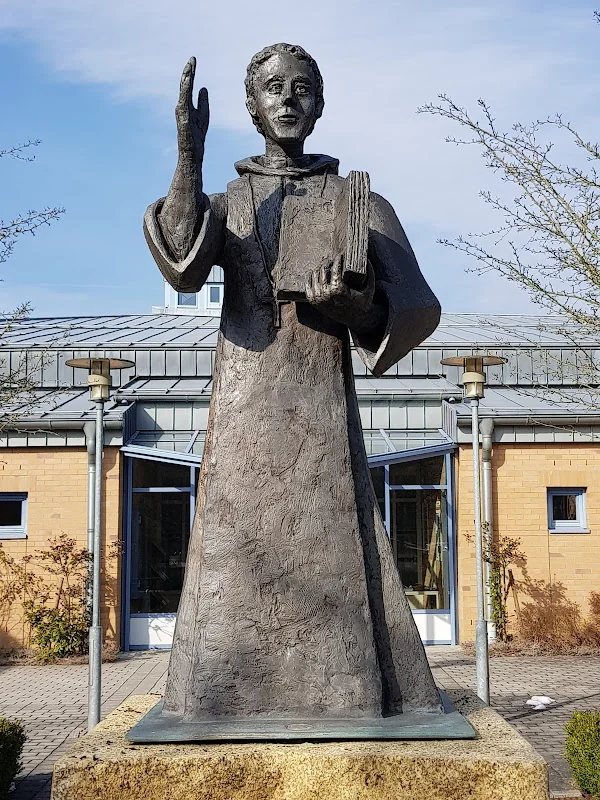
Bayreuth
Odenwaldstraße 6, 95448 Bayreuth-Aichig, Deutschland
St. Benedikt Bayreuth | Service Schedule & History
St. Benedikt Bayreuth is a Catholic branch church in the district of Aichig and at the same time a lively place of encounter. Those looking for a church with a clear spiritual identity, independent architecture, and an active community life will find here a location that is important not only for liturgy but also for education, senior work, family offerings, and spiritual orientation. The parish describes its church as a branch church with an office located at Odenwaldstraße 4-10; the website also provides current service information, news, and various areas for community life and pastoral care. Thus, St. Benedikt is not just a building but a church center for people from Bayreuth and the surrounding areas. ([st-benedikt-bayreuth.de](https://st-benedikt-bayreuth.de/kontakt/?utm_source=openai))
Service Schedule, Current Dates, and Regular Celebrations
The service schedule is one of the most important topics surrounding St. Benedikt Bayreuth, and for good reason: The community publishes its weekly dates online, keeping visitors informed. Current services such as Saturday evening masses, Word of God celebrations, and other liturgical offerings appear on the official page; recent entries also mention special forms such as a mass in Croatian. This is an important indication that St. Benedikt is not only open on Sundays but lives in a diverse, concrete pastoral practice. Anyone planning a visit should always check the current service schedule, as times and forms can change throughout the church year. ([st-benedikt-bayreuth.de](https://st-benedikt-bayreuth.de/gottesdienste/?utm_source=openai))
Moreover, the website shows how broad the liturgical and community spectrum at St. Benedikt is. In addition to the ongoing service schedule, there are dedicated areas for children's and family services, for the participation of young families, for altar servers, and for the various forms of church life. This makes the site not only an information source but a real service point for people who want to participate regularly or come for the first time. Those who want to experience the atmosphere of a community will get a good impression through this structure: worship here is not isolated but embedded in a vibrant community concept with recurring dates, special occasions, and a clear connection to the city of Bayreuth. ([st-benedikt-bayreuth.de](https://st-benedikt-bayreuth.de/gottesdienste/kindergottesdienste?utm_source=openai))
The History of St. Benedikt in Bayreuth
The emergence of St. Benedikt is well documented and begins with an initiative from the mother church, Our Lady, the Castle Church. On March 30, 1984, under the leadership of the founding pastor Siegbert Keiling, the application for the founding of the branch church was submitted. On December 14, 1987, with the approval of the Archiepiscopal Ordinariate, an architectural competition followed; the building was eventually constructed based on the design of the first-place winner, Dipl.-Ing. Thomas Holzmüller. On November 1, 1990, the foundation stone was laid, with stones from the Monks' Island in Ireland, from the holy mountain Athos, and from the founding monastery Monte Cassino being incorporated. This symbolic connection already points to the Benedictine idea of continuity, expansiveness, and spiritual rooting. ([st-benedikt-bayreuth.de](https://st-benedikt-bayreuth.de/ueber-uns/die-geschichte-von-st--benedikt))
The further stages of history show how closely the building, monastic life, and community have grown together. On July 22, 1991, the re-establishment of the convent of the Polish Sisters of the Order of St. Mary Magdalene of Penitence was the focus; on August 30, 1991, the topping-out ceremony took place, and Deacon Karl-Heinz Meyer moved in with his family together with the Magdalene Sisters into the new building. On July 11, 1992, Archbishop Dr. Elmar Maria Kredel consecrated the church to the patron Benedict. Later, further defining moments were added: in 1997, three new church bells were consecrated, in 2008 the community joined the parish association St. Benedikt - Castle Church - Holy Cross, in 2012 the Benedict fountain was inaugurated for the 20th anniversary of the church consecration, and since September 2019, St. Benedikt has been part of the pastoral area Bayreuth City. ([st-benedikt-bayreuth.de](https://st-benedikt-bayreuth.de/ueber-uns/die-geschichte-von-st--benedikt))
Architecture, Church Space, and the Special Form of Encounter
The architecture of St. Benedikt is one of the most distinctive features of this church. The official architectural text describes that the individual buildings are arranged in the form of a Benedictine monastery around the parish courtyard. These include the church building with its star-shaped floor plan, the residential building, the Magdalene convent, the bell tower, and the community center. This arrangement is not only functional but also carries a clear theological and communal message: the church is visible here as a place of togetherness, paths, and encounters. The sloping roofs inclined towards the church square strengthen the impression of a center that does not isolate but gathers. The warm, earthy visible masonry additionally ensures that the ensemble appears friendly, open, and at the same time clear. ([st-benedikt-bayreuth.de](https://st-benedikt-bayreuth.de/ueber-uns/kirche/architektur?utm_source=openai))
Especially in the connection of the main church, ancillary buildings, and parish courtyard, it becomes clear that St. Benedikt was not conceived as an isolated parish church but as a kind of spiritual campus in miniature. This fits well with the Benedictine name and the idea of a community that prays, works, receives, and organizes itself. The church space itself is also designed for this experience: the official website lists it as its own area along with architecture, window design, and the Benedict fountain. It becomes evident that not only liturgy but also spatial experience, sight guidance, and symbolism play a role. For visitors, this is particularly interesting because the building does not impress through size but through clarity, form, and substantive density. ([st-benedikt-bayreuth.de](https://st-benedikt-bayreuth.de/ueber-uns/kirche/?utm_source=openai))
Window Design, Light Art, and the Benedict Fountain
A prominent design element of the church is the window design. In a community portrait, it is described with the guiding thought The Human in the Light; the glass artist Raphael Seitz from Heilbronn is mentioned. The windows immerse the church space in a diverse play of color and light, and people are painted into the composition. Content-wise, it is not an abstract pattern that is in the foreground, but the human being as a being carried by God in the light. For the spiritual perception of a church, this is a strong motif because it not only beautifies but also provides theological interpretation. Light becomes an image for life, faith, and the presence of God, and the church space thus becomes a place where symbolism and atmosphere reinforce each other. ([xn--nchster-gottesdienst-bzb.de](https://xn--nchster-gottesdienst-bzb.de/123464063719d0e0/gemeindeprofil_stbenedikt_bayreuth?utm_source=openai))
The Benedict fountain is also one of the striking features of St. Benedikt. The official site explains the individual motifs: water stands for life and calm, the raven reminds of the Benedict story of salvation from poison, the stone refers to permanence, the grotto to the place of gathering, the book to the rule of St. Benedict, and the feather to vigilance and attentiveness. The inauguration of the fountain took place on July 15, 2012, for the 20th anniversary of the church consecration. Together with the windows, this creates an ensemble that makes religious content not didactic but sensually experienceable. Upon entering the church, one encounters not only architectural art but a consciously narrated world of faith in which water, light, stone, and color interact. ([st-benedikt-bayreuth.de](https://st-benedikt-bayreuth.de/ueber-uns/kirche/benediktbrunnen/wasser?utm_source=openai))
Community Life, Seniors, and Adult Education
St. Benedikt Bayreuth thrives not only on services but also on a broad community life. A very good example is the senior circle: it meets in the community hall every 14 days on Mondays from 2 PM to 4 PM, currently consists of about 70 people aged between 60 and 99 years, and is supported by around 18 volunteers as well as the two Magdalene Sisters. Participation is free, and those in need of support can even be picked up. This shows how socially and concretely the togetherness in this community is organized. The senior circle combines birthday celebrations, coffee and cake, conversations, and lectures on current topics and the church year. Thus, it is not only a leisure offering but genuine community work with a personal face. ([st-benedikt-bayreuth.de](https://st-benedikt-bayreuth.de/gemeindeleben/senioren-in-sankt-benedikt/?utm_source=openai))
Adult education is also firmly anchored in the profile of the community. According to the website, the events of the adult education program take place every Monday at 7:00 PM or 7:30 PM. In addition, there are further offerings for families, children, and youth, such as children's services, altar server work, communion preparation, confirmation preparation, and musical or creative formats. The navigation of the website also includes areas for choirs, liturgical helper teams, visitation services, and festivals and celebrations. This indicates a community that does not only see its members on Sundays but accompanies them through many contact points. For seekers, this is particularly relevant because behind the keyword community life lies not just a buzzword but a concrete, reliable structure. ([st-benedikt-bayreuth.de](https://st-benedikt-bayreuth.de/gemeindeleben/erwachsenenbildung?utm_source=openai))
Directions, Parish Office, and Parish District
The practical orientation at St. Benedikt is straightforward: The parish office of the Catholic branch church is located at Odenwaldstraße 4-10, 95448 Bayreuth. Office hours are Tuesdays from 3:00 PM to 5:00 PM and Thursdays from 9:30 AM to 11:30 AM; the parish office can be reached by phone at 0921-98837, and there is also an email address as well as the number of the convent. Those who want to arrive directly on site will also find an area for directions or a location map on the website. This shows that the location is well prepared for personal visits, inquiries, and pastoral conversations. ([st-benedikt-bayreuth.de](https://st-benedikt-bayreuth.de/kontakt/))
The church's catchment area is also clearly described. The parish district of St. Benedikt includes, among others, city and district parts east of the highway as well as Aichig, Bauernhöfen, Colmdorf, Herrmannshof, Lohe, Mooshügel, Obere Röth, and Untere Röth; communities and community parts from Emtmannsberg, Seybothenreuth, Speichersdorf, and Weidenberg are also mentioned. For travel by public transport, it is additionally relevant that Bayreuth's city bus network serves Aichig; in the municipal documents, lines 307 and 322 are listed for the Aichig area. The official site does not explicitly mention its own visitor parking information, so the most sensible planning is done via address, location plan, and city bus network. This is a practical tip for all who visit St. Benedikt for the first time. ([st-benedikt-bayreuth.de](https://st-benedikt-bayreuth.de/ueber-uns/pfarreisprengel?utm_source=openai))
St. Benedikt Bayreuth is thus a place where liturgical practice, architecture, community, and neighborhood anchoring come together. Those looking for a church that combines spiritual depth with concrete practicality will find much to explore: a clearly documented history, an independent building concept, strong art in the church space, vibrant offerings for different age groups, and reliable information on services and contact methods. This mixture makes the branch church in the east of Bayreuth a profile location that is exciting for both believers and culture-interested visitors. ([st-benedikt-bayreuth.de](https://st-benedikt-bayreuth.de/ueber-uns/die-geschichte-von-st--benedikt?utm_source=openai))
Sources:
- St. Benedikt Bayreuth - Official Website
- St. Benedikt Bayreuth - The History of St. Benedikt
- St. Benedikt Bayreuth - Architecture
- St. Benedikt Bayreuth - Our Church
- St. Benedikt Bayreuth - The Water
- St. Benedikt Bayreuth - Parish Office
- City of Bayreuth - Bus Schedule
- City of Bayreuth - Public Service Order
- Community Profile St. Benedikt Bayreuth - Light and Windows
Show moreShow less
St. Benedikt Bayreuth | Service Schedule & History
St. Benedikt Bayreuth is a Catholic branch church in the district of Aichig and at the same time a lively place of encounter. Those looking for a church with a clear spiritual identity, independent architecture, and an active community life will find here a location that is important not only for liturgy but also for education, senior work, family offerings, and spiritual orientation. The parish describes its church as a branch church with an office located at Odenwaldstraße 4-10; the website also provides current service information, news, and various areas for community life and pastoral care. Thus, St. Benedikt is not just a building but a church center for people from Bayreuth and the surrounding areas. ([st-benedikt-bayreuth.de](https://st-benedikt-bayreuth.de/kontakt/?utm_source=openai))
Service Schedule, Current Dates, and Regular Celebrations
The service schedule is one of the most important topics surrounding St. Benedikt Bayreuth, and for good reason: The community publishes its weekly dates online, keeping visitors informed. Current services such as Saturday evening masses, Word of God celebrations, and other liturgical offerings appear on the official page; recent entries also mention special forms such as a mass in Croatian. This is an important indication that St. Benedikt is not only open on Sundays but lives in a diverse, concrete pastoral practice. Anyone planning a visit should always check the current service schedule, as times and forms can change throughout the church year. ([st-benedikt-bayreuth.de](https://st-benedikt-bayreuth.de/gottesdienste/?utm_source=openai))
Moreover, the website shows how broad the liturgical and community spectrum at St. Benedikt is. In addition to the ongoing service schedule, there are dedicated areas for children's and family services, for the participation of young families, for altar servers, and for the various forms of church life. This makes the site not only an information source but a real service point for people who want to participate regularly or come for the first time. Those who want to experience the atmosphere of a community will get a good impression through this structure: worship here is not isolated but embedded in a vibrant community concept with recurring dates, special occasions, and a clear connection to the city of Bayreuth. ([st-benedikt-bayreuth.de](https://st-benedikt-bayreuth.de/gottesdienste/kindergottesdienste?utm_source=openai))
The History of St. Benedikt in Bayreuth
The emergence of St. Benedikt is well documented and begins with an initiative from the mother church, Our Lady, the Castle Church. On March 30, 1984, under the leadership of the founding pastor Siegbert Keiling, the application for the founding of the branch church was submitted. On December 14, 1987, with the approval of the Archiepiscopal Ordinariate, an architectural competition followed; the building was eventually constructed based on the design of the first-place winner, Dipl.-Ing. Thomas Holzmüller. On November 1, 1990, the foundation stone was laid, with stones from the Monks' Island in Ireland, from the holy mountain Athos, and from the founding monastery Monte Cassino being incorporated. This symbolic connection already points to the Benedictine idea of continuity, expansiveness, and spiritual rooting. ([st-benedikt-bayreuth.de](https://st-benedikt-bayreuth.de/ueber-uns/die-geschichte-von-st--benedikt))
The further stages of history show how closely the building, monastic life, and community have grown together. On July 22, 1991, the re-establishment of the convent of the Polish Sisters of the Order of St. Mary Magdalene of Penitence was the focus; on August 30, 1991, the topping-out ceremony took place, and Deacon Karl-Heinz Meyer moved in with his family together with the Magdalene Sisters into the new building. On July 11, 1992, Archbishop Dr. Elmar Maria Kredel consecrated the church to the patron Benedict. Later, further defining moments were added: in 1997, three new church bells were consecrated, in 2008 the community joined the parish association St. Benedikt - Castle Church - Holy Cross, in 2012 the Benedict fountain was inaugurated for the 20th anniversary of the church consecration, and since September 2019, St. Benedikt has been part of the pastoral area Bayreuth City. ([st-benedikt-bayreuth.de](https://st-benedikt-bayreuth.de/ueber-uns/die-geschichte-von-st--benedikt))
Architecture, Church Space, and the Special Form of Encounter
The architecture of St. Benedikt is one of the most distinctive features of this church. The official architectural text describes that the individual buildings are arranged in the form of a Benedictine monastery around the parish courtyard. These include the church building with its star-shaped floor plan, the residential building, the Magdalene convent, the bell tower, and the community center. This arrangement is not only functional but also carries a clear theological and communal message: the church is visible here as a place of togetherness, paths, and encounters. The sloping roofs inclined towards the church square strengthen the impression of a center that does not isolate but gathers. The warm, earthy visible masonry additionally ensures that the ensemble appears friendly, open, and at the same time clear. ([st-benedikt-bayreuth.de](https://st-benedikt-bayreuth.de/ueber-uns/kirche/architektur?utm_source=openai))
Especially in the connection of the main church, ancillary buildings, and parish courtyard, it becomes clear that St. Benedikt was not conceived as an isolated parish church but as a kind of spiritual campus in miniature. This fits well with the Benedictine name and the idea of a community that prays, works, receives, and organizes itself. The church space itself is also designed for this experience: the official website lists it as its own area along with architecture, window design, and the Benedict fountain. It becomes evident that not only liturgy but also spatial experience, sight guidance, and symbolism play a role. For visitors, this is particularly interesting because the building does not impress through size but through clarity, form, and substantive density. ([st-benedikt-bayreuth.de](https://st-benedikt-bayreuth.de/ueber-uns/kirche/?utm_source=openai))
Window Design, Light Art, and the Benedict Fountain
A prominent design element of the church is the window design. In a community portrait, it is described with the guiding thought The Human in the Light; the glass artist Raphael Seitz from Heilbronn is mentioned. The windows immerse the church space in a diverse play of color and light, and people are painted into the composition. Content-wise, it is not an abstract pattern that is in the foreground, but the human being as a being carried by God in the light. For the spiritual perception of a church, this is a strong motif because it not only beautifies but also provides theological interpretation. Light becomes an image for life, faith, and the presence of God, and the church space thus becomes a place where symbolism and atmosphere reinforce each other. ([xn--nchster-gottesdienst-bzb.de](https://xn--nchster-gottesdienst-bzb.de/123464063719d0e0/gemeindeprofil_stbenedikt_bayreuth?utm_source=openai))
The Benedict fountain is also one of the striking features of St. Benedikt. The official site explains the individual motifs: water stands for life and calm, the raven reminds of the Benedict story of salvation from poison, the stone refers to permanence, the grotto to the place of gathering, the book to the rule of St. Benedict, and the feather to vigilance and attentiveness. The inauguration of the fountain took place on July 15, 2012, for the 20th anniversary of the church consecration. Together with the windows, this creates an ensemble that makes religious content not didactic but sensually experienceable. Upon entering the church, one encounters not only architectural art but a consciously narrated world of faith in which water, light, stone, and color interact. ([st-benedikt-bayreuth.de](https://st-benedikt-bayreuth.de/ueber-uns/kirche/benediktbrunnen/wasser?utm_source=openai))
Community Life, Seniors, and Adult Education
St. Benedikt Bayreuth thrives not only on services but also on a broad community life. A very good example is the senior circle: it meets in the community hall every 14 days on Mondays from 2 PM to 4 PM, currently consists of about 70 people aged between 60 and 99 years, and is supported by around 18 volunteers as well as the two Magdalene Sisters. Participation is free, and those in need of support can even be picked up. This shows how socially and concretely the togetherness in this community is organized. The senior circle combines birthday celebrations, coffee and cake, conversations, and lectures on current topics and the church year. Thus, it is not only a leisure offering but genuine community work with a personal face. ([st-benedikt-bayreuth.de](https://st-benedikt-bayreuth.de/gemeindeleben/senioren-in-sankt-benedikt/?utm_source=openai))
Adult education is also firmly anchored in the profile of the community. According to the website, the events of the adult education program take place every Monday at 7:00 PM or 7:30 PM. In addition, there are further offerings for families, children, and youth, such as children's services, altar server work, communion preparation, confirmation preparation, and musical or creative formats. The navigation of the website also includes areas for choirs, liturgical helper teams, visitation services, and festivals and celebrations. This indicates a community that does not only see its members on Sundays but accompanies them through many contact points. For seekers, this is particularly relevant because behind the keyword community life lies not just a buzzword but a concrete, reliable structure. ([st-benedikt-bayreuth.de](https://st-benedikt-bayreuth.de/gemeindeleben/erwachsenenbildung?utm_source=openai))
Directions, Parish Office, and Parish District
The practical orientation at St. Benedikt is straightforward: The parish office of the Catholic branch church is located at Odenwaldstraße 4-10, 95448 Bayreuth. Office hours are Tuesdays from 3:00 PM to 5:00 PM and Thursdays from 9:30 AM to 11:30 AM; the parish office can be reached by phone at 0921-98837, and there is also an email address as well as the number of the convent. Those who want to arrive directly on site will also find an area for directions or a location map on the website. This shows that the location is well prepared for personal visits, inquiries, and pastoral conversations. ([st-benedikt-bayreuth.de](https://st-benedikt-bayreuth.de/kontakt/))
The church's catchment area is also clearly described. The parish district of St. Benedikt includes, among others, city and district parts east of the highway as well as Aichig, Bauernhöfen, Colmdorf, Herrmannshof, Lohe, Mooshügel, Obere Röth, and Untere Röth; communities and community parts from Emtmannsberg, Seybothenreuth, Speichersdorf, and Weidenberg are also mentioned. For travel by public transport, it is additionally relevant that Bayreuth's city bus network serves Aichig; in the municipal documents, lines 307 and 322 are listed for the Aichig area. The official site does not explicitly mention its own visitor parking information, so the most sensible planning is done via address, location plan, and city bus network. This is a practical tip for all who visit St. Benedikt for the first time. ([st-benedikt-bayreuth.de](https://st-benedikt-bayreuth.de/ueber-uns/pfarreisprengel?utm_source=openai))
St. Benedikt Bayreuth is thus a place where liturgical practice, architecture, community, and neighborhood anchoring come together. Those looking for a church that combines spiritual depth with concrete practicality will find much to explore: a clearly documented history, an independent building concept, strong art in the church space, vibrant offerings for different age groups, and reliable information on services and contact methods. This mixture makes the branch church in the east of Bayreuth a profile location that is exciting for both believers and culture-interested visitors. ([st-benedikt-bayreuth.de](https://st-benedikt-bayreuth.de/ueber-uns/die-geschichte-von-st--benedikt?utm_source=openai))
Sources:
- St. Benedikt Bayreuth - Official Website
- St. Benedikt Bayreuth - The History of St. Benedikt
- St. Benedikt Bayreuth - Architecture
- St. Benedikt Bayreuth - Our Church
- St. Benedikt Bayreuth - The Water
- St. Benedikt Bayreuth - Parish Office
- City of Bayreuth - Bus Schedule
- City of Bayreuth - Public Service Order
- Community Profile St. Benedikt Bayreuth - Light and Windows
St. Benedikt Bayreuth | Service Schedule & History
St. Benedikt Bayreuth is a Catholic branch church in the district of Aichig and at the same time a lively place of encounter. Those looking for a church with a clear spiritual identity, independent architecture, and an active community life will find here a location that is important not only for liturgy but also for education, senior work, family offerings, and spiritual orientation. The parish describes its church as a branch church with an office located at Odenwaldstraße 4-10; the website also provides current service information, news, and various areas for community life and pastoral care. Thus, St. Benedikt is not just a building but a church center for people from Bayreuth and the surrounding areas. ([st-benedikt-bayreuth.de](https://st-benedikt-bayreuth.de/kontakt/?utm_source=openai))
Service Schedule, Current Dates, and Regular Celebrations
The service schedule is one of the most important topics surrounding St. Benedikt Bayreuth, and for good reason: The community publishes its weekly dates online, keeping visitors informed. Current services such as Saturday evening masses, Word of God celebrations, and other liturgical offerings appear on the official page; recent entries also mention special forms such as a mass in Croatian. This is an important indication that St. Benedikt is not only open on Sundays but lives in a diverse, concrete pastoral practice. Anyone planning a visit should always check the current service schedule, as times and forms can change throughout the church year. ([st-benedikt-bayreuth.de](https://st-benedikt-bayreuth.de/gottesdienste/?utm_source=openai))
Moreover, the website shows how broad the liturgical and community spectrum at St. Benedikt is. In addition to the ongoing service schedule, there are dedicated areas for children's and family services, for the participation of young families, for altar servers, and for the various forms of church life. This makes the site not only an information source but a real service point for people who want to participate regularly or come for the first time. Those who want to experience the atmosphere of a community will get a good impression through this structure: worship here is not isolated but embedded in a vibrant community concept with recurring dates, special occasions, and a clear connection to the city of Bayreuth. ([st-benedikt-bayreuth.de](https://st-benedikt-bayreuth.de/gottesdienste/kindergottesdienste?utm_source=openai))
The History of St. Benedikt in Bayreuth
The emergence of St. Benedikt is well documented and begins with an initiative from the mother church, Our Lady, the Castle Church. On March 30, 1984, under the leadership of the founding pastor Siegbert Keiling, the application for the founding of the branch church was submitted. On December 14, 1987, with the approval of the Archiepiscopal Ordinariate, an architectural competition followed; the building was eventually constructed based on the design of the first-place winner, Dipl.-Ing. Thomas Holzmüller. On November 1, 1990, the foundation stone was laid, with stones from the Monks' Island in Ireland, from the holy mountain Athos, and from the founding monastery Monte Cassino being incorporated. This symbolic connection already points to the Benedictine idea of continuity, expansiveness, and spiritual rooting. ([st-benedikt-bayreuth.de](https://st-benedikt-bayreuth.de/ueber-uns/die-geschichte-von-st--benedikt))
The further stages of history show how closely the building, monastic life, and community have grown together. On July 22, 1991, the re-establishment of the convent of the Polish Sisters of the Order of St. Mary Magdalene of Penitence was the focus; on August 30, 1991, the topping-out ceremony took place, and Deacon Karl-Heinz Meyer moved in with his family together with the Magdalene Sisters into the new building. On July 11, 1992, Archbishop Dr. Elmar Maria Kredel consecrated the church to the patron Benedict. Later, further defining moments were added: in 1997, three new church bells were consecrated, in 2008 the community joined the parish association St. Benedikt - Castle Church - Holy Cross, in 2012 the Benedict fountain was inaugurated for the 20th anniversary of the church consecration, and since September 2019, St. Benedikt has been part of the pastoral area Bayreuth City. ([st-benedikt-bayreuth.de](https://st-benedikt-bayreuth.de/ueber-uns/die-geschichte-von-st--benedikt))
Architecture, Church Space, and the Special Form of Encounter
The architecture of St. Benedikt is one of the most distinctive features of this church. The official architectural text describes that the individual buildings are arranged in the form of a Benedictine monastery around the parish courtyard. These include the church building with its star-shaped floor plan, the residential building, the Magdalene convent, the bell tower, and the community center. This arrangement is not only functional but also carries a clear theological and communal message: the church is visible here as a place of togetherness, paths, and encounters. The sloping roofs inclined towards the church square strengthen the impression of a center that does not isolate but gathers. The warm, earthy visible masonry additionally ensures that the ensemble appears friendly, open, and at the same time clear. ([st-benedikt-bayreuth.de](https://st-benedikt-bayreuth.de/ueber-uns/kirche/architektur?utm_source=openai))
Especially in the connection of the main church, ancillary buildings, and parish courtyard, it becomes clear that St. Benedikt was not conceived as an isolated parish church but as a kind of spiritual campus in miniature. This fits well with the Benedictine name and the idea of a community that prays, works, receives, and organizes itself. The church space itself is also designed for this experience: the official website lists it as its own area along with architecture, window design, and the Benedict fountain. It becomes evident that not only liturgy but also spatial experience, sight guidance, and symbolism play a role. For visitors, this is particularly interesting because the building does not impress through size but through clarity, form, and substantive density. ([st-benedikt-bayreuth.de](https://st-benedikt-bayreuth.de/ueber-uns/kirche/?utm_source=openai))
Window Design, Light Art, and the Benedict Fountain
A prominent design element of the church is the window design. In a community portrait, it is described with the guiding thought The Human in the Light; the glass artist Raphael Seitz from Heilbronn is mentioned. The windows immerse the church space in a diverse play of color and light, and people are painted into the composition. Content-wise, it is not an abstract pattern that is in the foreground, but the human being as a being carried by God in the light. For the spiritual perception of a church, this is a strong motif because it not only beautifies but also provides theological interpretation. Light becomes an image for life, faith, and the presence of God, and the church space thus becomes a place where symbolism and atmosphere reinforce each other. ([xn--nchster-gottesdienst-bzb.de](https://xn--nchster-gottesdienst-bzb.de/123464063719d0e0/gemeindeprofil_stbenedikt_bayreuth?utm_source=openai))
The Benedict fountain is also one of the striking features of St. Benedikt. The official site explains the individual motifs: water stands for life and calm, the raven reminds of the Benedict story of salvation from poison, the stone refers to permanence, the grotto to the place of gathering, the book to the rule of St. Benedict, and the feather to vigilance and attentiveness. The inauguration of the fountain took place on July 15, 2012, for the 20th anniversary of the church consecration. Together with the windows, this creates an ensemble that makes religious content not didactic but sensually experienceable. Upon entering the church, one encounters not only architectural art but a consciously narrated world of faith in which water, light, stone, and color interact. ([st-benedikt-bayreuth.de](https://st-benedikt-bayreuth.de/ueber-uns/kirche/benediktbrunnen/wasser?utm_source=openai))
Community Life, Seniors, and Adult Education
St. Benedikt Bayreuth thrives not only on services but also on a broad community life. A very good example is the senior circle: it meets in the community hall every 14 days on Mondays from 2 PM to 4 PM, currently consists of about 70 people aged between 60 and 99 years, and is supported by around 18 volunteers as well as the two Magdalene Sisters. Participation is free, and those in need of support can even be picked up. This shows how socially and concretely the togetherness in this community is organized. The senior circle combines birthday celebrations, coffee and cake, conversations, and lectures on current topics and the church year. Thus, it is not only a leisure offering but genuine community work with a personal face. ([st-benedikt-bayreuth.de](https://st-benedikt-bayreuth.de/gemeindeleben/senioren-in-sankt-benedikt/?utm_source=openai))
Adult education is also firmly anchored in the profile of the community. According to the website, the events of the adult education program take place every Monday at 7:00 PM or 7:30 PM. In addition, there are further offerings for families, children, and youth, such as children's services, altar server work, communion preparation, confirmation preparation, and musical or creative formats. The navigation of the website also includes areas for choirs, liturgical helper teams, visitation services, and festivals and celebrations. This indicates a community that does not only see its members on Sundays but accompanies them through many contact points. For seekers, this is particularly relevant because behind the keyword community life lies not just a buzzword but a concrete, reliable structure. ([st-benedikt-bayreuth.de](https://st-benedikt-bayreuth.de/gemeindeleben/erwachsenenbildung?utm_source=openai))
Directions, Parish Office, and Parish District
The practical orientation at St. Benedikt is straightforward: The parish office of the Catholic branch church is located at Odenwaldstraße 4-10, 95448 Bayreuth. Office hours are Tuesdays from 3:00 PM to 5:00 PM and Thursdays from 9:30 AM to 11:30 AM; the parish office can be reached by phone at 0921-98837, and there is also an email address as well as the number of the convent. Those who want to arrive directly on site will also find an area for directions or a location map on the website. This shows that the location is well prepared for personal visits, inquiries, and pastoral conversations. ([st-benedikt-bayreuth.de](https://st-benedikt-bayreuth.de/kontakt/))
The church's catchment area is also clearly described. The parish district of St. Benedikt includes, among others, city and district parts east of the highway as well as Aichig, Bauernhöfen, Colmdorf, Herrmannshof, Lohe, Mooshügel, Obere Röth, and Untere Röth; communities and community parts from Emtmannsberg, Seybothenreuth, Speichersdorf, and Weidenberg are also mentioned. For travel by public transport, it is additionally relevant that Bayreuth's city bus network serves Aichig; in the municipal documents, lines 307 and 322 are listed for the Aichig area. The official site does not explicitly mention its own visitor parking information, so the most sensible planning is done via address, location plan, and city bus network. This is a practical tip for all who visit St. Benedikt for the first time. ([st-benedikt-bayreuth.de](https://st-benedikt-bayreuth.de/ueber-uns/pfarreisprengel?utm_source=openai))
St. Benedikt Bayreuth is thus a place where liturgical practice, architecture, community, and neighborhood anchoring come together. Those looking for a church that combines spiritual depth with concrete practicality will find much to explore: a clearly documented history, an independent building concept, strong art in the church space, vibrant offerings for different age groups, and reliable information on services and contact methods. This mixture makes the branch church in the east of Bayreuth a profile location that is exciting for both believers and culture-interested visitors. ([st-benedikt-bayreuth.de](https://st-benedikt-bayreuth.de/ueber-uns/die-geschichte-von-st--benedikt?utm_source=openai))
Sources:
- St. Benedikt Bayreuth - Official Website
- St. Benedikt Bayreuth - The History of St. Benedikt
- St. Benedikt Bayreuth - Architecture
- St. Benedikt Bayreuth - Our Church
- St. Benedikt Bayreuth - The Water
- St. Benedikt Bayreuth - Parish Office
- City of Bayreuth - Bus Schedule
- City of Bayreuth - Public Service Order
- Community Profile St. Benedikt Bayreuth - Light and Windows
Frequently Asked Questions
Reviews
No reviews found