
Bayreuth
Schwindstraße 14A, 95447 Bayreuth, Deutschland
St. Hedwig Bayreuth | Services & Directions
St. Hedwig in Bayreuth is much more than just a Catholic parish church at a well-known address. The place combines liturgical life, remarkable post-war architecture, a functioning parish center, and a courtyard that makes many visitors think more of a monastic retreat than a classic church building. The official parish describes the Hedwig Church as one of the most beautiful post-war sacred buildings in the Archdiocese, and it is precisely this tension that makes it appealing: simple materials, clear forms, plenty of light, and a surprisingly dense atmosphere. Therefore, those searching for St. Hedwig Bayreuth often mean not just the address, but also services, directions, parking, barrier-free access, parish center, organ, and the special history of the site. For visitors looking for a place with a calm aura and simultaneously vibrant community life, St. Hedwig is a precise, credible, and versatile destination. ([sthedwig-bayreuth.kirche-bamberg.de](https://sthedwig-bayreuth.kirche-bamberg.de/kirchen/st--hedwig/kirchengeschichte/kurzfassung))
Services and Current Dates at St. Hedwig Bayreuth
The strongest keyword signal around St. Hedwig Bayreuth clearly lies in the area of services, dates, and regular spiritual offerings. The official service page mentions a clear weekly structure: Saturday at 5:15 PM the evening mass, Sunday at 8:00 AM and 10:00 AM Eucharistic celebrations, as well as additionally Tuesday and Friday at 8:00 AM and Wednesday at 7:00 PM. This is important for seekers because the information directly refers to the concrete use of the place and not just to the name of the church. Therefore, anyone looking for a reliable place for mass, devotion, or a quiet visit will find a structured, regularly maintained overview here. At the same time, the parish points out that times may change on special occasions, so the current service schedule should always be considered. This combination of reliability and flexibility is typical for vibrant parish locations and is precisely why it is so relevant for search queries about St. Hedwig Bayreuth services. ([sthedwig-bayreuth.kirche-bamberg.de](https://sthedwig-bayreuth.kirche-bamberg.de/gottesdienste/regulaere-gottesdienste))
Additionally, the official homepage not only shows services but also an active community life. The homepage announced or documented events for 2026, including the parish festival, the festive first communion, a parish family festival, the camp, a family way of the cross, the Easter vigil, and a cross meditation on Good Friday. Furthermore, a faith discussion was listed for June 29, 2026, in the parish hall meeting room. Such hints are particularly valuable for content research because they show that St. Hedwig exists not only as a sacred space but as a place of continuous community practice. Therefore, those searching for St. Hedwig Bayreuth events, dates, or opening hours often mean the interplay of liturgical celebrations, group offerings, and seasonal festivals. This is precisely where the strength of this location lies: it is both a spiritual center and a social meeting point. ([st-hedwig-bayreuth.de](https://st-hedwig-bayreuth.de/index.html?utm_source=openai))
Address, Directions, and Barrier-Free Access via Schwindstraße
The address is clear and particularly relevant for local searches: Catholic Parish Church St. Hedwig, Schwindstr. 14a, 95447 Bayreuth. The same address is also listed as the administrative seat of the parish. This is important for orientation because search queries for St. Hedwig Bayreuth address or contact usually lead directly to this point. The Bayreuth event overview additionally emphasizes that barrier-free access is via Schwindstraße. This is a strong practical detail, as it directly answers the question of where the best and most accessible entrance is located. Especially for churches with a courtyard character, this information is often more crucial than a mere postal address, as visitors want to know how to get into the church area or the parish center without detours. This clarity is a real advantage for people with limited mobility, families with strollers, or guests with little local knowledge. ([sthedwig-bayreuth.kirche-bamberg.de](https://sthedwig-bayreuth.kirche-bamberg.de/gottesdienste/regulaere-gottesdienste))
Regarding parking, the official church does not provide its own visitor garage, but the city of Bayreuth gives general advice for the city center: There are parking garages, street-side parking options, and mobile parking via app through EasyPark. In practice, this means that those visiting St. Hedwig are best oriented towards the available parking options in the city center and use the digital or classic parking service provided in Bayreuth. The city explicitly describes the city center as an area with attractive parking garages and affordable parking options, which facilitates arriving by car in the urban context. At the same time, the note about the barrier-free entrance via Schwindstraße is important because it shows that the facility is designed not only architecturally but also functionally for visitor-friendliness. This combination of a clear address, easily identifiable access, and urban parking infrastructure makes St. Hedwig Bayreuth particularly relevant for many search queries regarding directions and parking. ([bayreuth.de](https://www.bayreuth.de/rathaus-buergerservice/verkehr-oepnv/?utm_source=openai))
Architecture, Construction History, and the Signature of Emil Steffann
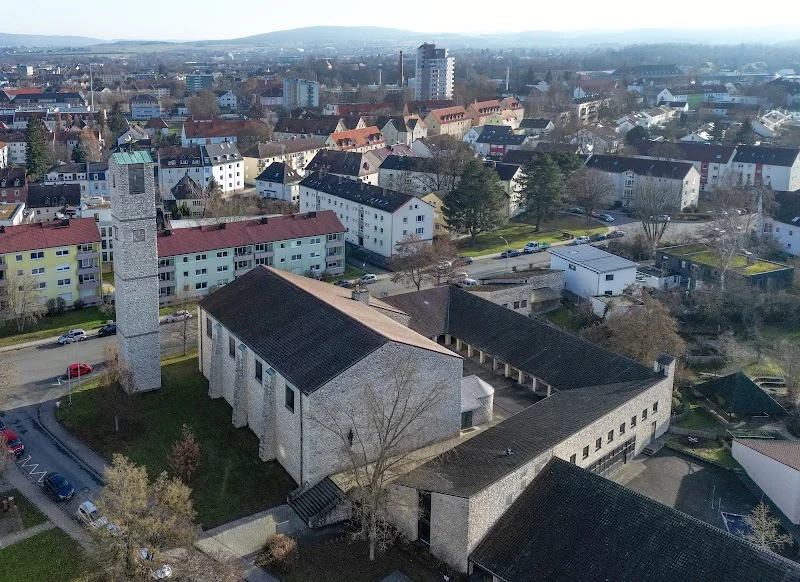
The history of St. Hedwig Bayreuth begins in the spring and summer of 1959 with a construction project that quickly grew beyond its original purpose. According to the official summary, the foundation stone was laid on August 23, 1959, and the consecration took place on September 18, 1960, by Archbishop Dr. Josef Schneider. The architect of the center was Emil Steffann from Mehlem near Bonn, while Walter Schilling was responsible for the construction execution. In 1963, the campanile was added, in 1965 four bells were consecrated, and in 1966 St. Hedwig became an independent parish. This chronology is crucial for the construction history because it makes visible the transition from the establishment of a facility to the development of an independent community center. St. Hedwig is thus not only a church building but an urban and pastoral ensemble whose development can be traced over the years. ([sthedwig-bayreuth.kirche-bamberg.de](https://sthedwig-bayreuth.kirche-bamberg.de/kirchen/st--hedwig/kirchengeschichte/kurzfassung))
Architecturally, this claim becomes particularly clear in the official construction history. There, the church is described as a longitudinal church building completely made of limestone, with an apse, flat gable roof, attached side and baptismal chapel, and campanile. The courtyard is framed by the connected building bodies in such a way that a kind of cloister is created. This monastic atmosphere makes the place extraordinary: the pathways are not spectacular but deliberately calm, almost meditative. The campanile reaches a height of 35 meters and is constructed as a concrete framework with limestone infill for static reasons. The length of the nave is approximately 32 meters, the width 18 meters, and the height 9 meters. Additionally, there are bronze portal reliefs with Old Testament and New Testament imagery. All of this shows that St. Hedwig Bayreuth is not just any post-war building but a carefully composed sacred space, whose architecture relates faith, material, and light. ([sthedwig-bayreuth.kirche-bamberg.de](https://sthedwig-bayreuth.kirche-bamberg.de/kirchen/st--hedwig/kirchengeschichte/baugeschichte))
Parish Center, Rooms, and Use for Events
Those searching for St. Hedwig Bayreuth parish center or St. Hedwig Bayreuth events encounter an ensemble that is not limited to liturgy. The Bayreuth event overview explicitly lists the parish center as barrier-free. Two usable areas are noted there: a room for 170 people with or without tables, equipped with a projector, speakers, and kitchen, as well as another room for 45 people with a projector. This is extremely practical for parish work, lectures, discussion rounds, group evenings, and small celebrations. Especially in a church that is primarily reserved for spiritual concerts, the parish center gains significance as a flexible place for encounter and organization. It thus fulfills exactly the function that many modern parish facilities seek: the actual church remains sacred and focused, while the meeting and working spaces support the everyday life of the community. ([bayreuth.de](https://www.bayreuth.de/wp-content/uploads/2026/03/Veranstaltungsorte-Bayreuth_2026.pdf))
Particularly interesting is the clear separation between sacred space and event use. The Bayreuth list notes that the church is only available for spiritual concerts and upon request. For seekers, this is an important detail because it clarifies the expectations of the place: here one does not find a general multipurpose hall, but a church with specifically regulated use. At the same time, the official homepage shows that the parish center and the outdoor areas are indeed used for diverse community life, such as during the family service for the parish family festival or during meetings in the parish hall. The 2014 renovated parish hall is also mentioned in the summary; there, toilets were renovated, media technology with ceiling projector and speaker system was renewed, and floor and wall coverings were modernized. This mix of functional equipment and pastoral everyday suitability makes St. Hedwig Bayreuth a place that is not only visited but actively used. ([bayreuth.de](https://www.bayreuth.de/wp-content/uploads/2026/03/Veranstaltungsorte-Bayreuth_2026.pdf))
Organ, Stations of the Cross, and Artistic Furnishings
The interior furnishings of St. Hedwig Bayreuth are an essential part of its identity. Already on the homepage of the parish, the Sandtner organ, the altar cross, the apse, the icon of Saint Hedwig, and various figures are prominently highlighted. The construction history mentions the large Sandtner organ on the western end wall of the nave, as well as the figure of Mary with child, the Stations of the Cross, the holy water basin made of Jura dolomite, and a South Sea shell as another basin in the side chapel. These details are not mere decoration but expressions of a consciously composed liturgical aesthetic. The space does not distract but focuses. The imagery and material language return to the essentials, allowing light, stone, and selected artworks to interact. This is precisely why many visitors perceive the interior as calm, clear, and simultaneously impressive. ([st-hedwig-bayreuth.de](https://st-hedwig-bayreuth.de/?utm_source=openai))
The external impact is also strongly shaped by art. The official summary refers to the western portal with Old Testament imagery, the eastern portal with New Testament references, the Jonah fountain facility in the courtyard from 1989, and the portal images added in 1994. In the courtyard stands the more than two-meter-high bronze figure of Saint Hedwig on a stone console, and access to the church deliberately leads through this cloister-like courtyard. The construction history also describes the high presence of the patroness and the logical pathway from the courtyard through the portals into the church space. For the keyword spectrum St. Hedwig Bayreuth organ, Stations of the Cross, and art, this is ideal because the place offers several levels: musical equipment, pictorial theology, and architectural tranquility. The sum of these elements makes St. Hedwig not only a place of worship but a designed spiritual landscape in which every detail plays a role. ([sthedwig-bayreuth.kirche-bamberg.de](https://sthedwig-bayreuth.kirche-bamberg.de/kirchen/st--hedwig/kirchengeschichte/kurzfassung))
Community Life, Family Festivals, and Special Offers
A look at the current announcements shows that St. Hedwig Bayreuth wants to be perceived as a lively community. On the homepage of the parish, there are hints for 2026 about the parish festival, the festive first communion, the parish family festival, the camp, family way of the cross, Easter vigil, and cross meditation. For search queries like St. Hedwig Bayreuth events or St. Hedwig Bayreuth opening hours, this is important because the church does not function in isolation but is embedded in a real community life. Additionally, the children's and youth structures of the parish, which are also visible on the homepage, such as the kindergartens Kiga St. Hedwig, Kiga St. Nikolaus, Kiga/Kiho Jakobshof, and Kiga Storchennest, explain why St. Hedwig in Bayreuth is relevant not only for Sunday visits but also for families, groups, volunteers, and people looking for a reliable church meeting point. ([st-hedwig-bayreuth.de](https://st-hedwig-bayreuth.de/index.html?utm_source=openai))
The official summary also historically emphasizes this community logic. Already with the establishment of the facility, the parish residence, chaplaincy, sacristan's apartment, rooms for youth, parish hall, and kindergarten were considered. This means that the spatial order of St. Hedwig has been oriented towards encounter, education, and everyday life from the very beginning. This explains the current relevance of the search for St. Hedwig Bayreuth contact, parish center, or events: people are not only looking for the service but a place where they can find orientation, community, and structure. That the parish hall was renovated in 2014, the LED lighting was renewed in 2018, and the wastewater pipes in the courtyard along with the floor tiles were renovated in 2020 additionally shows that the facility is maintained and further developed. In sum, this creates a place that does not conserve tradition but keeps it alive. St. Hedwig Bayreuth thus remains a church and community complex that is visible, functional, and spiritually significant in the city. ([sthedwig-bayreuth.kirche-bamberg.de](https://sthedwig-bayreuth.kirche-bamberg.de/kirchen/st--hedwig/kirchengeschichte/kurzfassung))
Why St. Hedwig Bayreuth is Special for Visitors
The unique strength of St. Hedwig Bayreuth lies in the combination of clear function and independent atmosphere. Those visiting the church experience a facility that remains consistent in its materiality, appears calm in its spatial layout, and is surprisingly rich in details. The cloister-like courtyard, the limestone architecture, the tall campanile, the carefully placed portals, the Sandtner organ, and the patroness in the outdoor area together create an image that appears distinctive in the cityscape of Bayreuth. This is not a spectacular event building but a place that convinces through its presence. Precisely for this reason, it is interesting for seekers who expect not just an address but an experience with substance when looking for St. Hedwig Bayreuth. In a time when many places seem interchangeable, St. Hedwig offers a rare mix of liturgical clarity, architectural tranquility, and reliable community life. ([sthedwig-bayreuth.kirche-bamberg.de](https://sthedwig-bayreuth.kirche-bamberg.de/kirchen/st--hedwig/baukultur))
From an SEO perspective, this place is also advantageous because the search intentions are very concrete: people search for services, directions, parking, barrier-free access, parish center, organ, Stations of the Cross, history, and current dates. St. Hedwig Bayreuth provides solid answers to all these questions, coming from official sources and easily translated into structured content. The regular services give the place rhythm, the historical dates give it depth, the event spaces give it utility, and the architecture gives it recognizability. Therefore, St. Hedwig Bayreuth is particularly well-suited for a content level that aims not only to inform but also to build trust. Those who land here often seek a quiet, reliable, and simultaneously vibrant place in Bayreuth. This promise is fulfilled by St. Hedwig. ([sthedwig-bayreuth.kirche-bamberg.de](https://sthedwig-bayreuth.kirche-bamberg.de/gottesdienste/regulaere-gottesdienste))
Sources:
Show moreShow less
St. Hedwig Bayreuth | Services & Directions
St. Hedwig in Bayreuth is much more than just a Catholic parish church at a well-known address. The place combines liturgical life, remarkable post-war architecture, a functioning parish center, and a courtyard that makes many visitors think more of a monastic retreat than a classic church building. The official parish describes the Hedwig Church as one of the most beautiful post-war sacred buildings in the Archdiocese, and it is precisely this tension that makes it appealing: simple materials, clear forms, plenty of light, and a surprisingly dense atmosphere. Therefore, those searching for St. Hedwig Bayreuth often mean not just the address, but also services, directions, parking, barrier-free access, parish center, organ, and the special history of the site. For visitors looking for a place with a calm aura and simultaneously vibrant community life, St. Hedwig is a precise, credible, and versatile destination. ([sthedwig-bayreuth.kirche-bamberg.de](https://sthedwig-bayreuth.kirche-bamberg.de/kirchen/st--hedwig/kirchengeschichte/kurzfassung))
Services and Current Dates at St. Hedwig Bayreuth
The strongest keyword signal around St. Hedwig Bayreuth clearly lies in the area of services, dates, and regular spiritual offerings. The official service page mentions a clear weekly structure: Saturday at 5:15 PM the evening mass, Sunday at 8:00 AM and 10:00 AM Eucharistic celebrations, as well as additionally Tuesday and Friday at 8:00 AM and Wednesday at 7:00 PM. This is important for seekers because the information directly refers to the concrete use of the place and not just to the name of the church. Therefore, anyone looking for a reliable place for mass, devotion, or a quiet visit will find a structured, regularly maintained overview here. At the same time, the parish points out that times may change on special occasions, so the current service schedule should always be considered. This combination of reliability and flexibility is typical for vibrant parish locations and is precisely why it is so relevant for search queries about St. Hedwig Bayreuth services. ([sthedwig-bayreuth.kirche-bamberg.de](https://sthedwig-bayreuth.kirche-bamberg.de/gottesdienste/regulaere-gottesdienste))
Additionally, the official homepage not only shows services but also an active community life. The homepage announced or documented events for 2026, including the parish festival, the festive first communion, a parish family festival, the camp, a family way of the cross, the Easter vigil, and a cross meditation on Good Friday. Furthermore, a faith discussion was listed for June 29, 2026, in the parish hall meeting room. Such hints are particularly valuable for content research because they show that St. Hedwig exists not only as a sacred space but as a place of continuous community practice. Therefore, those searching for St. Hedwig Bayreuth events, dates, or opening hours often mean the interplay of liturgical celebrations, group offerings, and seasonal festivals. This is precisely where the strength of this location lies: it is both a spiritual center and a social meeting point. ([st-hedwig-bayreuth.de](https://st-hedwig-bayreuth.de/index.html?utm_source=openai))
Address, Directions, and Barrier-Free Access via Schwindstraße
The address is clear and particularly relevant for local searches: Catholic Parish Church St. Hedwig, Schwindstr. 14a, 95447 Bayreuth. The same address is also listed as the administrative seat of the parish. This is important for orientation because search queries for St. Hedwig Bayreuth address or contact usually lead directly to this point. The Bayreuth event overview additionally emphasizes that barrier-free access is via Schwindstraße. This is a strong practical detail, as it directly answers the question of where the best and most accessible entrance is located. Especially for churches with a courtyard character, this information is often more crucial than a mere postal address, as visitors want to know how to get into the church area or the parish center without detours. This clarity is a real advantage for people with limited mobility, families with strollers, or guests with little local knowledge. ([sthedwig-bayreuth.kirche-bamberg.de](https://sthedwig-bayreuth.kirche-bamberg.de/gottesdienste/regulaere-gottesdienste))
Regarding parking, the official church does not provide its own visitor garage, but the city of Bayreuth gives general advice for the city center: There are parking garages, street-side parking options, and mobile parking via app through EasyPark. In practice, this means that those visiting St. Hedwig are best oriented towards the available parking options in the city center and use the digital or classic parking service provided in Bayreuth. The city explicitly describes the city center as an area with attractive parking garages and affordable parking options, which facilitates arriving by car in the urban context. At the same time, the note about the barrier-free entrance via Schwindstraße is important because it shows that the facility is designed not only architecturally but also functionally for visitor-friendliness. This combination of a clear address, easily identifiable access, and urban parking infrastructure makes St. Hedwig Bayreuth particularly relevant for many search queries regarding directions and parking. ([bayreuth.de](https://www.bayreuth.de/rathaus-buergerservice/verkehr-oepnv/?utm_source=openai))
Architecture, Construction History, and the Signature of Emil Steffann
The history of St. Hedwig Bayreuth begins in the spring and summer of 1959 with a construction project that quickly grew beyond its original purpose. According to the official summary, the foundation stone was laid on August 23, 1959, and the consecration took place on September 18, 1960, by Archbishop Dr. Josef Schneider. The architect of the center was Emil Steffann from Mehlem near Bonn, while Walter Schilling was responsible for the construction execution. In 1963, the campanile was added, in 1965 four bells were consecrated, and in 1966 St. Hedwig became an independent parish. This chronology is crucial for the construction history because it makes visible the transition from the establishment of a facility to the development of an independent community center. St. Hedwig is thus not only a church building but an urban and pastoral ensemble whose development can be traced over the years. ([sthedwig-bayreuth.kirche-bamberg.de](https://sthedwig-bayreuth.kirche-bamberg.de/kirchen/st--hedwig/kirchengeschichte/kurzfassung))
Architecturally, this claim becomes particularly clear in the official construction history. There, the church is described as a longitudinal church building completely made of limestone, with an apse, flat gable roof, attached side and baptismal chapel, and campanile. The courtyard is framed by the connected building bodies in such a way that a kind of cloister is created. This monastic atmosphere makes the place extraordinary: the pathways are not spectacular but deliberately calm, almost meditative. The campanile reaches a height of 35 meters and is constructed as a concrete framework with limestone infill for static reasons. The length of the nave is approximately 32 meters, the width 18 meters, and the height 9 meters. Additionally, there are bronze portal reliefs with Old Testament and New Testament imagery. All of this shows that St. Hedwig Bayreuth is not just any post-war building but a carefully composed sacred space, whose architecture relates faith, material, and light. ([sthedwig-bayreuth.kirche-bamberg.de](https://sthedwig-bayreuth.kirche-bamberg.de/kirchen/st--hedwig/kirchengeschichte/baugeschichte))
Parish Center, Rooms, and Use for Events
Those searching for St. Hedwig Bayreuth parish center or St. Hedwig Bayreuth events encounter an ensemble that is not limited to liturgy. The Bayreuth event overview explicitly lists the parish center as barrier-free. Two usable areas are noted there: a room for 170 people with or without tables, equipped with a projector, speakers, and kitchen, as well as another room for 45 people with a projector. This is extremely practical for parish work, lectures, discussion rounds, group evenings, and small celebrations. Especially in a church that is primarily reserved for spiritual concerts, the parish center gains significance as a flexible place for encounter and organization. It thus fulfills exactly the function that many modern parish facilities seek: the actual church remains sacred and focused, while the meeting and working spaces support the everyday life of the community. ([bayreuth.de](https://www.bayreuth.de/wp-content/uploads/2026/03/Veranstaltungsorte-Bayreuth_2026.pdf))
Particularly interesting is the clear separation between sacred space and event use. The Bayreuth list notes that the church is only available for spiritual concerts and upon request. For seekers, this is an important detail because it clarifies the expectations of the place: here one does not find a general multipurpose hall, but a church with specifically regulated use. At the same time, the official homepage shows that the parish center and the outdoor areas are indeed used for diverse community life, such as during the family service for the parish family festival or during meetings in the parish hall. The 2014 renovated parish hall is also mentioned in the summary; there, toilets were renovated, media technology with ceiling projector and speaker system was renewed, and floor and wall coverings were modernized. This mix of functional equipment and pastoral everyday suitability makes St. Hedwig Bayreuth a place that is not only visited but actively used. ([bayreuth.de](https://www.bayreuth.de/wp-content/uploads/2026/03/Veranstaltungsorte-Bayreuth_2026.pdf))
Organ, Stations of the Cross, and Artistic Furnishings
The interior furnishings of St. Hedwig Bayreuth are an essential part of its identity. Already on the homepage of the parish, the Sandtner organ, the altar cross, the apse, the icon of Saint Hedwig, and various figures are prominently highlighted. The construction history mentions the large Sandtner organ on the western end wall of the nave, as well as the figure of Mary with child, the Stations of the Cross, the holy water basin made of Jura dolomite, and a South Sea shell as another basin in the side chapel. These details are not mere decoration but expressions of a consciously composed liturgical aesthetic. The space does not distract but focuses. The imagery and material language return to the essentials, allowing light, stone, and selected artworks to interact. This is precisely why many visitors perceive the interior as calm, clear, and simultaneously impressive. ([st-hedwig-bayreuth.de](https://st-hedwig-bayreuth.de/?utm_source=openai))
The external impact is also strongly shaped by art. The official summary refers to the western portal with Old Testament imagery, the eastern portal with New Testament references, the Jonah fountain facility in the courtyard from 1989, and the portal images added in 1994. In the courtyard stands the more than two-meter-high bronze figure of Saint Hedwig on a stone console, and access to the church deliberately leads through this cloister-like courtyard. The construction history also describes the high presence of the patroness and the logical pathway from the courtyard through the portals into the church space. For the keyword spectrum St. Hedwig Bayreuth organ, Stations of the Cross, and art, this is ideal because the place offers several levels: musical equipment, pictorial theology, and architectural tranquility. The sum of these elements makes St. Hedwig not only a place of worship but a designed spiritual landscape in which every detail plays a role. ([sthedwig-bayreuth.kirche-bamberg.de](https://sthedwig-bayreuth.kirche-bamberg.de/kirchen/st--hedwig/kirchengeschichte/kurzfassung))
Community Life, Family Festivals, and Special Offers
A look at the current announcements shows that St. Hedwig Bayreuth wants to be perceived as a lively community. On the homepage of the parish, there are hints for 2026 about the parish festival, the festive first communion, the parish family festival, the camp, family way of the cross, Easter vigil, and cross meditation. For search queries like St. Hedwig Bayreuth events or St. Hedwig Bayreuth opening hours, this is important because the church does not function in isolation but is embedded in a real community life. Additionally, the children's and youth structures of the parish, which are also visible on the homepage, such as the kindergartens Kiga St. Hedwig, Kiga St. Nikolaus, Kiga/Kiho Jakobshof, and Kiga Storchennest, explain why St. Hedwig in Bayreuth is relevant not only for Sunday visits but also for families, groups, volunteers, and people looking for a reliable church meeting point. ([st-hedwig-bayreuth.de](https://st-hedwig-bayreuth.de/index.html?utm_source=openai))
The official summary also historically emphasizes this community logic. Already with the establishment of the facility, the parish residence, chaplaincy, sacristan's apartment, rooms for youth, parish hall, and kindergarten were considered. This means that the spatial order of St. Hedwig has been oriented towards encounter, education, and everyday life from the very beginning. This explains the current relevance of the search for St. Hedwig Bayreuth contact, parish center, or events: people are not only looking for the service but a place where they can find orientation, community, and structure. That the parish hall was renovated in 2014, the LED lighting was renewed in 2018, and the wastewater pipes in the courtyard along with the floor tiles were renovated in 2020 additionally shows that the facility is maintained and further developed. In sum, this creates a place that does not conserve tradition but keeps it alive. St. Hedwig Bayreuth thus remains a church and community complex that is visible, functional, and spiritually significant in the city. ([sthedwig-bayreuth.kirche-bamberg.de](https://sthedwig-bayreuth.kirche-bamberg.de/kirchen/st--hedwig/kirchengeschichte/kurzfassung))
Why St. Hedwig Bayreuth is Special for Visitors
The unique strength of St. Hedwig Bayreuth lies in the combination of clear function and independent atmosphere. Those visiting the church experience a facility that remains consistent in its materiality, appears calm in its spatial layout, and is surprisingly rich in details. The cloister-like courtyard, the limestone architecture, the tall campanile, the carefully placed portals, the Sandtner organ, and the patroness in the outdoor area together create an image that appears distinctive in the cityscape of Bayreuth. This is not a spectacular event building but a place that convinces through its presence. Precisely for this reason, it is interesting for seekers who expect not just an address but an experience with substance when looking for St. Hedwig Bayreuth. In a time when many places seem interchangeable, St. Hedwig offers a rare mix of liturgical clarity, architectural tranquility, and reliable community life. ([sthedwig-bayreuth.kirche-bamberg.de](https://sthedwig-bayreuth.kirche-bamberg.de/kirchen/st--hedwig/baukultur))
From an SEO perspective, this place is also advantageous because the search intentions are very concrete: people search for services, directions, parking, barrier-free access, parish center, organ, Stations of the Cross, history, and current dates. St. Hedwig Bayreuth provides solid answers to all these questions, coming from official sources and easily translated into structured content. The regular services give the place rhythm, the historical dates give it depth, the event spaces give it utility, and the architecture gives it recognizability. Therefore, St. Hedwig Bayreuth is particularly well-suited for a content level that aims not only to inform but also to build trust. Those who land here often seek a quiet, reliable, and simultaneously vibrant place in Bayreuth. This promise is fulfilled by St. Hedwig. ([sthedwig-bayreuth.kirche-bamberg.de](https://sthedwig-bayreuth.kirche-bamberg.de/gottesdienste/regulaere-gottesdienste))
Sources:
St. Hedwig Bayreuth | Services & Directions
St. Hedwig in Bayreuth is much more than just a Catholic parish church at a well-known address. The place combines liturgical life, remarkable post-war architecture, a functioning parish center, and a courtyard that makes many visitors think more of a monastic retreat than a classic church building. The official parish describes the Hedwig Church as one of the most beautiful post-war sacred buildings in the Archdiocese, and it is precisely this tension that makes it appealing: simple materials, clear forms, plenty of light, and a surprisingly dense atmosphere. Therefore, those searching for St. Hedwig Bayreuth often mean not just the address, but also services, directions, parking, barrier-free access, parish center, organ, and the special history of the site. For visitors looking for a place with a calm aura and simultaneously vibrant community life, St. Hedwig is a precise, credible, and versatile destination. ([sthedwig-bayreuth.kirche-bamberg.de](https://sthedwig-bayreuth.kirche-bamberg.de/kirchen/st--hedwig/kirchengeschichte/kurzfassung))
Services and Current Dates at St. Hedwig Bayreuth
The strongest keyword signal around St. Hedwig Bayreuth clearly lies in the area of services, dates, and regular spiritual offerings. The official service page mentions a clear weekly structure: Saturday at 5:15 PM the evening mass, Sunday at 8:00 AM and 10:00 AM Eucharistic celebrations, as well as additionally Tuesday and Friday at 8:00 AM and Wednesday at 7:00 PM. This is important for seekers because the information directly refers to the concrete use of the place and not just to the name of the church. Therefore, anyone looking for a reliable place for mass, devotion, or a quiet visit will find a structured, regularly maintained overview here. At the same time, the parish points out that times may change on special occasions, so the current service schedule should always be considered. This combination of reliability and flexibility is typical for vibrant parish locations and is precisely why it is so relevant for search queries about St. Hedwig Bayreuth services. ([sthedwig-bayreuth.kirche-bamberg.de](https://sthedwig-bayreuth.kirche-bamberg.de/gottesdienste/regulaere-gottesdienste))
Additionally, the official homepage not only shows services but also an active community life. The homepage announced or documented events for 2026, including the parish festival, the festive first communion, a parish family festival, the camp, a family way of the cross, the Easter vigil, and a cross meditation on Good Friday. Furthermore, a faith discussion was listed for June 29, 2026, in the parish hall meeting room. Such hints are particularly valuable for content research because they show that St. Hedwig exists not only as a sacred space but as a place of continuous community practice. Therefore, those searching for St. Hedwig Bayreuth events, dates, or opening hours often mean the interplay of liturgical celebrations, group offerings, and seasonal festivals. This is precisely where the strength of this location lies: it is both a spiritual center and a social meeting point. ([st-hedwig-bayreuth.de](https://st-hedwig-bayreuth.de/index.html?utm_source=openai))
Address, Directions, and Barrier-Free Access via Schwindstraße
The address is clear and particularly relevant for local searches: Catholic Parish Church St. Hedwig, Schwindstr. 14a, 95447 Bayreuth. The same address is also listed as the administrative seat of the parish. This is important for orientation because search queries for St. Hedwig Bayreuth address or contact usually lead directly to this point. The Bayreuth event overview additionally emphasizes that barrier-free access is via Schwindstraße. This is a strong practical detail, as it directly answers the question of where the best and most accessible entrance is located. Especially for churches with a courtyard character, this information is often more crucial than a mere postal address, as visitors want to know how to get into the church area or the parish center without detours. This clarity is a real advantage for people with limited mobility, families with strollers, or guests with little local knowledge. ([sthedwig-bayreuth.kirche-bamberg.de](https://sthedwig-bayreuth.kirche-bamberg.de/gottesdienste/regulaere-gottesdienste))
Regarding parking, the official church does not provide its own visitor garage, but the city of Bayreuth gives general advice for the city center: There are parking garages, street-side parking options, and mobile parking via app through EasyPark. In practice, this means that those visiting St. Hedwig are best oriented towards the available parking options in the city center and use the digital or classic parking service provided in Bayreuth. The city explicitly describes the city center as an area with attractive parking garages and affordable parking options, which facilitates arriving by car in the urban context. At the same time, the note about the barrier-free entrance via Schwindstraße is important because it shows that the facility is designed not only architecturally but also functionally for visitor-friendliness. This combination of a clear address, easily identifiable access, and urban parking infrastructure makes St. Hedwig Bayreuth particularly relevant for many search queries regarding directions and parking. ([bayreuth.de](https://www.bayreuth.de/rathaus-buergerservice/verkehr-oepnv/?utm_source=openai))
Architecture, Construction History, and the Signature of Emil Steffann
The history of St. Hedwig Bayreuth begins in the spring and summer of 1959 with a construction project that quickly grew beyond its original purpose. According to the official summary, the foundation stone was laid on August 23, 1959, and the consecration took place on September 18, 1960, by Archbishop Dr. Josef Schneider. The architect of the center was Emil Steffann from Mehlem near Bonn, while Walter Schilling was responsible for the construction execution. In 1963, the campanile was added, in 1965 four bells were consecrated, and in 1966 St. Hedwig became an independent parish. This chronology is crucial for the construction history because it makes visible the transition from the establishment of a facility to the development of an independent community center. St. Hedwig is thus not only a church building but an urban and pastoral ensemble whose development can be traced over the years. ([sthedwig-bayreuth.kirche-bamberg.de](https://sthedwig-bayreuth.kirche-bamberg.de/kirchen/st--hedwig/kirchengeschichte/kurzfassung))
Architecturally, this claim becomes particularly clear in the official construction history. There, the church is described as a longitudinal church building completely made of limestone, with an apse, flat gable roof, attached side and baptismal chapel, and campanile. The courtyard is framed by the connected building bodies in such a way that a kind of cloister is created. This monastic atmosphere makes the place extraordinary: the pathways are not spectacular but deliberately calm, almost meditative. The campanile reaches a height of 35 meters and is constructed as a concrete framework with limestone infill for static reasons. The length of the nave is approximately 32 meters, the width 18 meters, and the height 9 meters. Additionally, there are bronze portal reliefs with Old Testament and New Testament imagery. All of this shows that St. Hedwig Bayreuth is not just any post-war building but a carefully composed sacred space, whose architecture relates faith, material, and light. ([sthedwig-bayreuth.kirche-bamberg.de](https://sthedwig-bayreuth.kirche-bamberg.de/kirchen/st--hedwig/kirchengeschichte/baugeschichte))
Parish Center, Rooms, and Use for Events
Those searching for St. Hedwig Bayreuth parish center or St. Hedwig Bayreuth events encounter an ensemble that is not limited to liturgy. The Bayreuth event overview explicitly lists the parish center as barrier-free. Two usable areas are noted there: a room for 170 people with or without tables, equipped with a projector, speakers, and kitchen, as well as another room for 45 people with a projector. This is extremely practical for parish work, lectures, discussion rounds, group evenings, and small celebrations. Especially in a church that is primarily reserved for spiritual concerts, the parish center gains significance as a flexible place for encounter and organization. It thus fulfills exactly the function that many modern parish facilities seek: the actual church remains sacred and focused, while the meeting and working spaces support the everyday life of the community. ([bayreuth.de](https://www.bayreuth.de/wp-content/uploads/2026/03/Veranstaltungsorte-Bayreuth_2026.pdf))
Particularly interesting is the clear separation between sacred space and event use. The Bayreuth list notes that the church is only available for spiritual concerts and upon request. For seekers, this is an important detail because it clarifies the expectations of the place: here one does not find a general multipurpose hall, but a church with specifically regulated use. At the same time, the official homepage shows that the parish center and the outdoor areas are indeed used for diverse community life, such as during the family service for the parish family festival or during meetings in the parish hall. The 2014 renovated parish hall is also mentioned in the summary; there, toilets were renovated, media technology with ceiling projector and speaker system was renewed, and floor and wall coverings were modernized. This mix of functional equipment and pastoral everyday suitability makes St. Hedwig Bayreuth a place that is not only visited but actively used. ([bayreuth.de](https://www.bayreuth.de/wp-content/uploads/2026/03/Veranstaltungsorte-Bayreuth_2026.pdf))
Organ, Stations of the Cross, and Artistic Furnishings
The interior furnishings of St. Hedwig Bayreuth are an essential part of its identity. Already on the homepage of the parish, the Sandtner organ, the altar cross, the apse, the icon of Saint Hedwig, and various figures are prominently highlighted. The construction history mentions the large Sandtner organ on the western end wall of the nave, as well as the figure of Mary with child, the Stations of the Cross, the holy water basin made of Jura dolomite, and a South Sea shell as another basin in the side chapel. These details are not mere decoration but expressions of a consciously composed liturgical aesthetic. The space does not distract but focuses. The imagery and material language return to the essentials, allowing light, stone, and selected artworks to interact. This is precisely why many visitors perceive the interior as calm, clear, and simultaneously impressive. ([st-hedwig-bayreuth.de](https://st-hedwig-bayreuth.de/?utm_source=openai))
The external impact is also strongly shaped by art. The official summary refers to the western portal with Old Testament imagery, the eastern portal with New Testament references, the Jonah fountain facility in the courtyard from 1989, and the portal images added in 1994. In the courtyard stands the more than two-meter-high bronze figure of Saint Hedwig on a stone console, and access to the church deliberately leads through this cloister-like courtyard. The construction history also describes the high presence of the patroness and the logical pathway from the courtyard through the portals into the church space. For the keyword spectrum St. Hedwig Bayreuth organ, Stations of the Cross, and art, this is ideal because the place offers several levels: musical equipment, pictorial theology, and architectural tranquility. The sum of these elements makes St. Hedwig not only a place of worship but a designed spiritual landscape in which every detail plays a role. ([sthedwig-bayreuth.kirche-bamberg.de](https://sthedwig-bayreuth.kirche-bamberg.de/kirchen/st--hedwig/kirchengeschichte/kurzfassung))
Community Life, Family Festivals, and Special Offers
A look at the current announcements shows that St. Hedwig Bayreuth wants to be perceived as a lively community. On the homepage of the parish, there are hints for 2026 about the parish festival, the festive first communion, the parish family festival, the camp, family way of the cross, Easter vigil, and cross meditation. For search queries like St. Hedwig Bayreuth events or St. Hedwig Bayreuth opening hours, this is important because the church does not function in isolation but is embedded in a real community life. Additionally, the children's and youth structures of the parish, which are also visible on the homepage, such as the kindergartens Kiga St. Hedwig, Kiga St. Nikolaus, Kiga/Kiho Jakobshof, and Kiga Storchennest, explain why St. Hedwig in Bayreuth is relevant not only for Sunday visits but also for families, groups, volunteers, and people looking for a reliable church meeting point. ([st-hedwig-bayreuth.de](https://st-hedwig-bayreuth.de/index.html?utm_source=openai))
The official summary also historically emphasizes this community logic. Already with the establishment of the facility, the parish residence, chaplaincy, sacristan's apartment, rooms for youth, parish hall, and kindergarten were considered. This means that the spatial order of St. Hedwig has been oriented towards encounter, education, and everyday life from the very beginning. This explains the current relevance of the search for St. Hedwig Bayreuth contact, parish center, or events: people are not only looking for the service but a place where they can find orientation, community, and structure. That the parish hall was renovated in 2014, the LED lighting was renewed in 2018, and the wastewater pipes in the courtyard along with the floor tiles were renovated in 2020 additionally shows that the facility is maintained and further developed. In sum, this creates a place that does not conserve tradition but keeps it alive. St. Hedwig Bayreuth thus remains a church and community complex that is visible, functional, and spiritually significant in the city. ([sthedwig-bayreuth.kirche-bamberg.de](https://sthedwig-bayreuth.kirche-bamberg.de/kirchen/st--hedwig/kirchengeschichte/kurzfassung))
Why St. Hedwig Bayreuth is Special for Visitors
The unique strength of St. Hedwig Bayreuth lies in the combination of clear function and independent atmosphere. Those visiting the church experience a facility that remains consistent in its materiality, appears calm in its spatial layout, and is surprisingly rich in details. The cloister-like courtyard, the limestone architecture, the tall campanile, the carefully placed portals, the Sandtner organ, and the patroness in the outdoor area together create an image that appears distinctive in the cityscape of Bayreuth. This is not a spectacular event building but a place that convinces through its presence. Precisely for this reason, it is interesting for seekers who expect not just an address but an experience with substance when looking for St. Hedwig Bayreuth. In a time when many places seem interchangeable, St. Hedwig offers a rare mix of liturgical clarity, architectural tranquility, and reliable community life. ([sthedwig-bayreuth.kirche-bamberg.de](https://sthedwig-bayreuth.kirche-bamberg.de/kirchen/st--hedwig/baukultur))
From an SEO perspective, this place is also advantageous because the search intentions are very concrete: people search for services, directions, parking, barrier-free access, parish center, organ, Stations of the Cross, history, and current dates. St. Hedwig Bayreuth provides solid answers to all these questions, coming from official sources and easily translated into structured content. The regular services give the place rhythm, the historical dates give it depth, the event spaces give it utility, and the architecture gives it recognizability. Therefore, St. Hedwig Bayreuth is particularly well-suited for a content level that aims not only to inform but also to build trust. Those who land here often seek a quiet, reliable, and simultaneously vibrant place in Bayreuth. This promise is fulfilled by St. Hedwig. ([sthedwig-bayreuth.kirche-bamberg.de](https://sthedwig-bayreuth.kirche-bamberg.de/gottesdienste/regulaere-gottesdienste))
Sources:
Upcoming Events
No events found
Frequently Asked Questions
Reviews
Damian Mierzwiński
23. April 2022
Beautiful church. Wide and open. Medieval style.
1 1
14. April 2016
I was baptized here. :)
Wolfgang Roth
10. February 2026
World Day of Prayer for Women, ecumenical service followed by a snack. Very well done and beautifully organized. Thanks to the participants and the hosting community.
Leon
7. July 2025
Beautiful church, but the bell ringing should be adjusted to modern times. No need to be woken up at 7 AM every day, including Saturday and Sunday. This applies to all churches.
BTabove&beyond
16. August 2020
A nuisance for the whole neighborhood. Why do free people need to be reminded of the time by bell chimes, or why do bell concerts need to remind the "believers" (the Catholic Church is more of a sect) to pray? These people don't even know.