
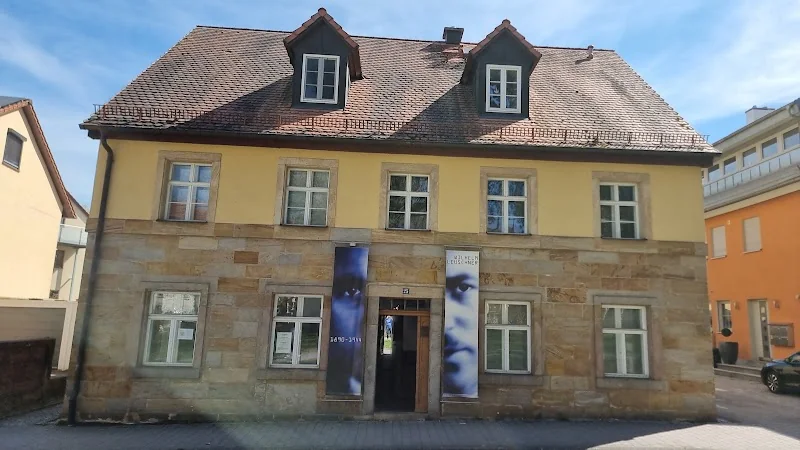
Moritzhöfen 25, Bayreuth
Moritzhöfen 25, 95447 Bayreuth, Germany
Wilhelm-Leuschner-Memorial | Bayreuth & Opening Hours
The Wilhelm-Leuschner-Memorial in Bayreuth is not a loud excursion spot, but a clear, concentrated space of remembrance with a distinct historical and political message. Anyone interested in the history of the city of Bayreuth, the labor movement, the resistance against National Socialism, or the person Wilhelm Leuschner will find a place here that connects biography, memory, and political education. The city of Bayreuth established the memorial in 2003 in the birthplace of Leuschner in Moritzhöfen; the Wilhelm-Leuschner-Foundation sees the site as a learning place for future generations and as a starting point for educational work with visitor groups. ([bayreuth-tourismus.de](https://www.bayreuth-tourismus.de/sehenswertes/museen/wilhelm-leuschner-gedenkstaette/))
Especially for visitors who come from search queries like memorial, Bayreuth, opening hours, free admission, or birthplace, the place is quickly explainable: It is a historic house that makes visible the life stages of a Bayreuth resistance fighter and consciously focuses on a calm, informative presentation. This makes the memorial a place to visit for all who want to experience history not just by reading, but in a specific building and at a specific location. ([bayreuth-tourismus.de](https://www.bayreuth-tourismus.de/sehenswertes/museen/wilhelm-leuschner-gedenkstaette/))
Opening Hours, Admission, and Visit Planning
For planning the visit, the opening hours are particularly important, as the Wilhelm-Leuschner-Memorial does not have continuous daily hours. According to the Historical Museum and Bayreuth Tourism, it is open Tuesday to Friday from 10 AM to 2 PM, Saturday and Sunday from 1 PM to 4 PM, and on public holidays from 10 AM to 2 PM. Additionally, the memorial is closed every year from December 15 to January 6. Admission is free. ([historisches-museum-bayreuth.de](https://www.historisches-museum-bayreuth.de/museum/leuschner-gedenkstaette/))
These times also show how the place is used: rather as a targeted memorial site than as a large museum with long evening hours. Anyone planning a short city tour can easily combine the visit with other historical destinations in Bayreuth, but should plan for the limited opening hours in advance. Especially in the search intent around opening hours and free admission, the most important message is therefore simple and clear: The memorial is freely accessible, but only open during fixed time slots. This makes a short preparation sensible, especially on weekends and public holidays. ([historisches-museum-bayreuth.de](https://www.historisches-museum-bayreuth.de/museum/leuschner-gedenkstaette/))
The size of the place is also important for planning. It is not an extensive exhibition house with many halls, but rather a small, focused memorial site in the former birthplace. This benefits the visit because the exhibition is compact and content-rich. Ideally, those who consciously visit the place take their time to quietly follow the stages of Leuschner's life and not just superficially go through the documentary presentation. This is where one of the special charms of this house lies. ([bayreuth-tourismus.de](https://www.bayreuth-tourismus.de/sehenswertes/museen/wilhelm-leuschner-gedenkstaette/))
Wilhelm Leuschner: Bayreuth Birthplace and Biography
Wilhelm Leuschner was born in 1890 in Bayreuth and grew up here. The tourism site describes him as the son of a stove builder; he attended school in Bayreuth and completed his apprenticeship there. In 1907, he left the city. The biography of the memorial makes it clear that Bayreuth is not only a place of birth but also the starting point of a later political career that had an impact far beyond the city. ([bayreuth-tourismus.de](https://www.bayreuth-tourismus.de/sehenswertes/museen/wilhelm-leuschner-gedenkstaette/))
Later, Leuschner became a prominent figure in the labor movement in Darmstadt. The official pages describe him as a trade unionist and social democratic politician; between 1928 and 1933, he was the Hessian Minister of the Interior. After 1933, he lived in Berlin and was part of the resistance against National Socialism. After the failed assassination attempt on July 20, 1944, he was arrested and sentenced to death by the People's Court. He was executed on September 29, 1944, in Berlin-Plötzensee. ([bayreuth-tourismus.de](https://www.bayreuth-tourismus.de/sehenswertes/museen/wilhelm-leuschner-gedenkstaette/))
The memorial organizes these life stages not only chronologically but also politically. Wilhelm Leuschner represents a biography in which trade union work, democratic conviction, and anti-fascist resistance belong together. This is the essence of the place: not only remembering a well-known person but making visible a life that began in Bayreuth and played an important role in the German history of the 20th century. Therefore, those who visit the memorial encounter not just a name but a condensed historical experience. ([bayreuth-tourismus.de](https://www.bayreuth-tourismus.de/sehenswertes/museen/wilhelm-leuschner-gedenkstaette/))
The Exhibition in the Birthplace and the Rooms of the Memorial
The memorial is located in the birthplace of Wilhelm Leuschner in Moritzhöfen. The tourism site describes the exhibition as an establishment in three rooms that represent the stages of his life. The foundation adds that a memorial exhibition has been set up on approximately 95 square meters on the ground floor of the building and that the house also houses administrative rooms, an archive, and a library. For visitors, this creates the image of a small but content-rich memorial site with a clear structure. ([bayreuth-tourismus.de](https://www.bayreuth-tourismus.de/sehenswertes/museen/wilhelm-leuschner-gedenkstaette/))
The form of presentation is appropriate to the theme. Since the place is not a classic large museum, the focus is on concentrated communication and the historical space itself. The house carries the history not only through panels, texts, and objects but also through its function as a birthplace and through its conscious repurposing as a memorial site. This is exactly what makes the memorial so impressive for visitors: You stand in a building that is biographically connected to Leuschner and trace the essential stages of his life from the Bayreuth beginning through the political career to the resistance. ([bayreuth-tourismus.de](https://www.bayreuth-tourismus.de/sehenswertes/museen/wilhelm-leuschner-gedenkstaette/))
According to the foundation, the exhibition also includes an educational workshop that has been set up in the former carpenter's workshop in the rear building. There, seminar operations for memorial work began in 2004. This shows that the memorial is not only a place of quiet contemplation but also a place of learning, discussion, and historical contextualization. Therefore, those interested in political education will find here not only a museum presentation but also a pedagogical concept that deepens the visit and goes beyond mere sightseeing. ([wilhelm-leuschner-stiftung.de](https://wilhelm-leuschner-stiftung.de/index.php/de/ort-der-erinnerung/geburtshaus))
Guided Tours, Educational Work, and the Wilhelm-Leuschner-Foundation
The Wilhelm-Leuschner-Foundation plays a central role in the operation and communication of the memorial. According to the foundation, it has been coordinating the memorial work since 2002 and conducting educational work for visitor groups. The Bayreuth Tourism site adds that guided tours of the memorial and other educational events are offered by the foundation. For groups, schools, and historically interested visitors, this is an important note, as the place is not only intended for free individual visits but also for guided formats. ([wilhelm-leuschner-stiftung.de](https://www.wilhelm-leuschner-stiftung.de/index.php/de/home))
The foundation itself is now located at Herderstraße 29 and has established the Wilhelm-Leuschner-Center there since 2012. According to the foundation, the estate of Wilhelm Leuschner is preserved in its original form, scientifically processed, and made digitally accessible. This shift of the archival and scientific focus into its own center shows that the memorial work in Bayreuth is organized on two levels: The birthplace in Moritzhöfen remains the visible place of remembrance, while the center carries the professional and documentary deepening. ([wilhelm-leuschner-stiftung.de](https://www.wilhelm-leuschner-stiftung.de/index.php/de/home))
For search queries regarding guided tours, educational work, or the foundation, this connection is important. Those planning a visit benefit from the combination of a historical site, pedagogical support, and in-depth research. This is particularly valuable for school classes, project groups, and all those who want to understand National Socialism not abstractly but through a concrete biography and a specific place. In this function, the Wilhelm-Leuschner-Memorial is much more than a local monument: It is a place of democratic remembrance and active communication. ([bayreuth-tourismus.de](https://www.bayreuth-tourismus.de/sehenswertes/museen/wilhelm-leuschner-gedenkstaette/))
Address, Location, and Orientation in Moritzhöfen
The most reliable orientation for the visit is the address Moritzhöfen 25 in Bayreuth. The city of Bayreuth lists the memorial among the municipal museums, the tourism site locates it in the district of Moritzhöfen, and the foundation confirms the birthplace at exactly this location. Thus, it is clear: Those looking for the memorial are not searching for a large event address but for a specific historic house in a district with its own local history. ([bayreuth.de](https://www.bayreuth.de/rathaus-buergerservice/stadtverwaltung/referate-aemter/aemter-a-z/staedtische-museen/))
It is also important for the classification that the house, according to the tourism site, is privately owned. Nevertheless, the city has established a memorial there, which shows how closely civic engagement, foundation activities, and municipal cultural work are intertwined in Bayreuth. For visitors, this means primarily: The place is operated as a publicly accessible memorial, even though the ownership relations are private. This is a typical example of how historical remembrance can be organizationally supported in a city. ([bayreuth.de](https://www.bayreuth.de/sehenswertes/museen/wilhelm-leuschner-gedenkstaette/))
Orientation also includes looking at the municipal structure. Bayreuth Tourism includes the memorial within the museum context of the city, while the city administration lists it directly among the municipal museums. This underscores that the Wilhelm-Leuschner-Memorial is not an isolated special case but part of a larger cultural network of museums, memorial sites, and educational offerings in Bayreuth. Therefore, anyone planning a tour of the city can easily integrate the place into a historical walk. ([bayreuth.de](https://www.bayreuth.de/rathaus-buergerservice/stadtverwaltung/referate-aemter/aemter-a-z/staedtische-museen/))
Why the Wilhelm-Leuschner-Memorial is Important for Bayreuth
The memorial is so important for Bayreuth because it makes another side of the city's history visible. In the memorial book of the city of Bayreuth, Wilhelm Leuschner is explicitly remembered as a trade union leader and resistance fighter against National Socialism. It also states that the city dedicated a memorial plaque to him in 1984, on the 50th anniversary of his execution. This makes it clear that the memory of Leuschner in Bayreuth did not begin with the memorial of 2003 but was already publicly maintained earlier. ([gedenkbuch.bayreuth.de](https://gedenkbuch.bayreuth.de/gedenktafel/ns-regime-opfer/))
The historical significance also lies in the fact that Leuschner stands for democratic, trade union, and anti-fascist traditions. Therefore, the memorial tells not only about a person but also about an attitude. It makes visible that Bayreuth is not exclusively defined by well-known cultural or representative places but also by the memory of people who stood up against dictatorship and injustice. This is precisely why the place has a special impact: It connects local origins with national history and personal fate. ([bayreuth-tourismus.de](https://www.bayreuth-tourismus.de/sehenswertes/museen/wilhelm-leuschner-gedenkstaette/))
For today's visitors, this results in a particularly valuable access to the city. The memorial offers a quiet, serious, and at the same time accessible framework to reflect on resistance, democracy, and political responsibility. Anyone who wants to get to know Bayreuth not only as a cultural city but also as a city of remembrance should plan to visit this place. This is where the lasting value of the Wilhelm-Leuschner-Memorial lies: It keeps a local biography alive that has significance far beyond Bayreuth. ([bayreuth-tourismus.de](https://www.bayreuth-tourismus.de/sehenswertes/museen/wilhelm-leuschner-gedenkstaette/))
Sources:
Show moreShow less
Wilhelm-Leuschner-Memorial | Bayreuth & Opening Hours
The Wilhelm-Leuschner-Memorial in Bayreuth is not a loud excursion spot, but a clear, concentrated space of remembrance with a distinct historical and political message. Anyone interested in the history of the city of Bayreuth, the labor movement, the resistance against National Socialism, or the person Wilhelm Leuschner will find a place here that connects biography, memory, and political education. The city of Bayreuth established the memorial in 2003 in the birthplace of Leuschner in Moritzhöfen; the Wilhelm-Leuschner-Foundation sees the site as a learning place for future generations and as a starting point for educational work with visitor groups. ([bayreuth-tourismus.de](https://www.bayreuth-tourismus.de/sehenswertes/museen/wilhelm-leuschner-gedenkstaette/))
Especially for visitors who come from search queries like memorial, Bayreuth, opening hours, free admission, or birthplace, the place is quickly explainable: It is a historic house that makes visible the life stages of a Bayreuth resistance fighter and consciously focuses on a calm, informative presentation. This makes the memorial a place to visit for all who want to experience history not just by reading, but in a specific building and at a specific location. ([bayreuth-tourismus.de](https://www.bayreuth-tourismus.de/sehenswertes/museen/wilhelm-leuschner-gedenkstaette/))
Opening Hours, Admission, and Visit Planning
For planning the visit, the opening hours are particularly important, as the Wilhelm-Leuschner-Memorial does not have continuous daily hours. According to the Historical Museum and Bayreuth Tourism, it is open Tuesday to Friday from 10 AM to 2 PM, Saturday and Sunday from 1 PM to 4 PM, and on public holidays from 10 AM to 2 PM. Additionally, the memorial is closed every year from December 15 to January 6. Admission is free. ([historisches-museum-bayreuth.de](https://www.historisches-museum-bayreuth.de/museum/leuschner-gedenkstaette/))
These times also show how the place is used: rather as a targeted memorial site than as a large museum with long evening hours. Anyone planning a short city tour can easily combine the visit with other historical destinations in Bayreuth, but should plan for the limited opening hours in advance. Especially in the search intent around opening hours and free admission, the most important message is therefore simple and clear: The memorial is freely accessible, but only open during fixed time slots. This makes a short preparation sensible, especially on weekends and public holidays. ([historisches-museum-bayreuth.de](https://www.historisches-museum-bayreuth.de/museum/leuschner-gedenkstaette/))
The size of the place is also important for planning. It is not an extensive exhibition house with many halls, but rather a small, focused memorial site in the former birthplace. This benefits the visit because the exhibition is compact and content-rich. Ideally, those who consciously visit the place take their time to quietly follow the stages of Leuschner's life and not just superficially go through the documentary presentation. This is where one of the special charms of this house lies. ([bayreuth-tourismus.de](https://www.bayreuth-tourismus.de/sehenswertes/museen/wilhelm-leuschner-gedenkstaette/))
Wilhelm Leuschner: Bayreuth Birthplace and Biography
Wilhelm Leuschner was born in 1890 in Bayreuth and grew up here. The tourism site describes him as the son of a stove builder; he attended school in Bayreuth and completed his apprenticeship there. In 1907, he left the city. The biography of the memorial makes it clear that Bayreuth is not only a place of birth but also the starting point of a later political career that had an impact far beyond the city. ([bayreuth-tourismus.de](https://www.bayreuth-tourismus.de/sehenswertes/museen/wilhelm-leuschner-gedenkstaette/))
Later, Leuschner became a prominent figure in the labor movement in Darmstadt. The official pages describe him as a trade unionist and social democratic politician; between 1928 and 1933, he was the Hessian Minister of the Interior. After 1933, he lived in Berlin and was part of the resistance against National Socialism. After the failed assassination attempt on July 20, 1944, he was arrested and sentenced to death by the People's Court. He was executed on September 29, 1944, in Berlin-Plötzensee. ([bayreuth-tourismus.de](https://www.bayreuth-tourismus.de/sehenswertes/museen/wilhelm-leuschner-gedenkstaette/))
The memorial organizes these life stages not only chronologically but also politically. Wilhelm Leuschner represents a biography in which trade union work, democratic conviction, and anti-fascist resistance belong together. This is the essence of the place: not only remembering a well-known person but making visible a life that began in Bayreuth and played an important role in the German history of the 20th century. Therefore, those who visit the memorial encounter not just a name but a condensed historical experience. ([bayreuth-tourismus.de](https://www.bayreuth-tourismus.de/sehenswertes/museen/wilhelm-leuschner-gedenkstaette/))
The Exhibition in the Birthplace and the Rooms of the Memorial
The memorial is located in the birthplace of Wilhelm Leuschner in Moritzhöfen. The tourism site describes the exhibition as an establishment in three rooms that represent the stages of his life. The foundation adds that a memorial exhibition has been set up on approximately 95 square meters on the ground floor of the building and that the house also houses administrative rooms, an archive, and a library. For visitors, this creates the image of a small but content-rich memorial site with a clear structure. ([bayreuth-tourismus.de](https://www.bayreuth-tourismus.de/sehenswertes/museen/wilhelm-leuschner-gedenkstaette/))
The form of presentation is appropriate to the theme. Since the place is not a classic large museum, the focus is on concentrated communication and the historical space itself. The house carries the history not only through panels, texts, and objects but also through its function as a birthplace and through its conscious repurposing as a memorial site. This is exactly what makes the memorial so impressive for visitors: You stand in a building that is biographically connected to Leuschner and trace the essential stages of his life from the Bayreuth beginning through the political career to the resistance. ([bayreuth-tourismus.de](https://www.bayreuth-tourismus.de/sehenswertes/museen/wilhelm-leuschner-gedenkstaette/))
According to the foundation, the exhibition also includes an educational workshop that has been set up in the former carpenter's workshop in the rear building. There, seminar operations for memorial work began in 2004. This shows that the memorial is not only a place of quiet contemplation but also a place of learning, discussion, and historical contextualization. Therefore, those interested in political education will find here not only a museum presentation but also a pedagogical concept that deepens the visit and goes beyond mere sightseeing. ([wilhelm-leuschner-stiftung.de](https://wilhelm-leuschner-stiftung.de/index.php/de/ort-der-erinnerung/geburtshaus))
Guided Tours, Educational Work, and the Wilhelm-Leuschner-Foundation
The Wilhelm-Leuschner-Foundation plays a central role in the operation and communication of the memorial. According to the foundation, it has been coordinating the memorial work since 2002 and conducting educational work for visitor groups. The Bayreuth Tourism site adds that guided tours of the memorial and other educational events are offered by the foundation. For groups, schools, and historically interested visitors, this is an important note, as the place is not only intended for free individual visits but also for guided formats. ([wilhelm-leuschner-stiftung.de](https://www.wilhelm-leuschner-stiftung.de/index.php/de/home))
The foundation itself is now located at Herderstraße 29 and has established the Wilhelm-Leuschner-Center there since 2012. According to the foundation, the estate of Wilhelm Leuschner is preserved in its original form, scientifically processed, and made digitally accessible. This shift of the archival and scientific focus into its own center shows that the memorial work in Bayreuth is organized on two levels: The birthplace in Moritzhöfen remains the visible place of remembrance, while the center carries the professional and documentary deepening. ([wilhelm-leuschner-stiftung.de](https://www.wilhelm-leuschner-stiftung.de/index.php/de/home))
For search queries regarding guided tours, educational work, or the foundation, this connection is important. Those planning a visit benefit from the combination of a historical site, pedagogical support, and in-depth research. This is particularly valuable for school classes, project groups, and all those who want to understand National Socialism not abstractly but through a concrete biography and a specific place. In this function, the Wilhelm-Leuschner-Memorial is much more than a local monument: It is a place of democratic remembrance and active communication. ([bayreuth-tourismus.de](https://www.bayreuth-tourismus.de/sehenswertes/museen/wilhelm-leuschner-gedenkstaette/))
Address, Location, and Orientation in Moritzhöfen
The most reliable orientation for the visit is the address Moritzhöfen 25 in Bayreuth. The city of Bayreuth lists the memorial among the municipal museums, the tourism site locates it in the district of Moritzhöfen, and the foundation confirms the birthplace at exactly this location. Thus, it is clear: Those looking for the memorial are not searching for a large event address but for a specific historic house in a district with its own local history. ([bayreuth.de](https://www.bayreuth.de/rathaus-buergerservice/stadtverwaltung/referate-aemter/aemter-a-z/staedtische-museen/))
It is also important for the classification that the house, according to the tourism site, is privately owned. Nevertheless, the city has established a memorial there, which shows how closely civic engagement, foundation activities, and municipal cultural work are intertwined in Bayreuth. For visitors, this means primarily: The place is operated as a publicly accessible memorial, even though the ownership relations are private. This is a typical example of how historical remembrance can be organizationally supported in a city. ([bayreuth.de](https://www.bayreuth.de/sehenswertes/museen/wilhelm-leuschner-gedenkstaette/))
Orientation also includes looking at the municipal structure. Bayreuth Tourism includes the memorial within the museum context of the city, while the city administration lists it directly among the municipal museums. This underscores that the Wilhelm-Leuschner-Memorial is not an isolated special case but part of a larger cultural network of museums, memorial sites, and educational offerings in Bayreuth. Therefore, anyone planning a tour of the city can easily integrate the place into a historical walk. ([bayreuth.de](https://www.bayreuth.de/rathaus-buergerservice/stadtverwaltung/referate-aemter/aemter-a-z/staedtische-museen/))
Why the Wilhelm-Leuschner-Memorial is Important for Bayreuth
The memorial is so important for Bayreuth because it makes another side of the city's history visible. In the memorial book of the city of Bayreuth, Wilhelm Leuschner is explicitly remembered as a trade union leader and resistance fighter against National Socialism. It also states that the city dedicated a memorial plaque to him in 1984, on the 50th anniversary of his execution. This makes it clear that the memory of Leuschner in Bayreuth did not begin with the memorial of 2003 but was already publicly maintained earlier. ([gedenkbuch.bayreuth.de](https://gedenkbuch.bayreuth.de/gedenktafel/ns-regime-opfer/))
The historical significance also lies in the fact that Leuschner stands for democratic, trade union, and anti-fascist traditions. Therefore, the memorial tells not only about a person but also about an attitude. It makes visible that Bayreuth is not exclusively defined by well-known cultural or representative places but also by the memory of people who stood up against dictatorship and injustice. This is precisely why the place has a special impact: It connects local origins with national history and personal fate. ([bayreuth-tourismus.de](https://www.bayreuth-tourismus.de/sehenswertes/museen/wilhelm-leuschner-gedenkstaette/))
For today's visitors, this results in a particularly valuable access to the city. The memorial offers a quiet, serious, and at the same time accessible framework to reflect on resistance, democracy, and political responsibility. Anyone who wants to get to know Bayreuth not only as a cultural city but also as a city of remembrance should plan to visit this place. This is where the lasting value of the Wilhelm-Leuschner-Memorial lies: It keeps a local biography alive that has significance far beyond Bayreuth. ([bayreuth-tourismus.de](https://www.bayreuth-tourismus.de/sehenswertes/museen/wilhelm-leuschner-gedenkstaette/))
Sources:
Wilhelm-Leuschner-Memorial | Bayreuth & Opening Hours
The Wilhelm-Leuschner-Memorial in Bayreuth is not a loud excursion spot, but a clear, concentrated space of remembrance with a distinct historical and political message. Anyone interested in the history of the city of Bayreuth, the labor movement, the resistance against National Socialism, or the person Wilhelm Leuschner will find a place here that connects biography, memory, and political education. The city of Bayreuth established the memorial in 2003 in the birthplace of Leuschner in Moritzhöfen; the Wilhelm-Leuschner-Foundation sees the site as a learning place for future generations and as a starting point for educational work with visitor groups. ([bayreuth-tourismus.de](https://www.bayreuth-tourismus.de/sehenswertes/museen/wilhelm-leuschner-gedenkstaette/))
Especially for visitors who come from search queries like memorial, Bayreuth, opening hours, free admission, or birthplace, the place is quickly explainable: It is a historic house that makes visible the life stages of a Bayreuth resistance fighter and consciously focuses on a calm, informative presentation. This makes the memorial a place to visit for all who want to experience history not just by reading, but in a specific building and at a specific location. ([bayreuth-tourismus.de](https://www.bayreuth-tourismus.de/sehenswertes/museen/wilhelm-leuschner-gedenkstaette/))
Opening Hours, Admission, and Visit Planning
For planning the visit, the opening hours are particularly important, as the Wilhelm-Leuschner-Memorial does not have continuous daily hours. According to the Historical Museum and Bayreuth Tourism, it is open Tuesday to Friday from 10 AM to 2 PM, Saturday and Sunday from 1 PM to 4 PM, and on public holidays from 10 AM to 2 PM. Additionally, the memorial is closed every year from December 15 to January 6. Admission is free. ([historisches-museum-bayreuth.de](https://www.historisches-museum-bayreuth.de/museum/leuschner-gedenkstaette/))
These times also show how the place is used: rather as a targeted memorial site than as a large museum with long evening hours. Anyone planning a short city tour can easily combine the visit with other historical destinations in Bayreuth, but should plan for the limited opening hours in advance. Especially in the search intent around opening hours and free admission, the most important message is therefore simple and clear: The memorial is freely accessible, but only open during fixed time slots. This makes a short preparation sensible, especially on weekends and public holidays. ([historisches-museum-bayreuth.de](https://www.historisches-museum-bayreuth.de/museum/leuschner-gedenkstaette/))
The size of the place is also important for planning. It is not an extensive exhibition house with many halls, but rather a small, focused memorial site in the former birthplace. This benefits the visit because the exhibition is compact and content-rich. Ideally, those who consciously visit the place take their time to quietly follow the stages of Leuschner's life and not just superficially go through the documentary presentation. This is where one of the special charms of this house lies. ([bayreuth-tourismus.de](https://www.bayreuth-tourismus.de/sehenswertes/museen/wilhelm-leuschner-gedenkstaette/))
Wilhelm Leuschner: Bayreuth Birthplace and Biography
Wilhelm Leuschner was born in 1890 in Bayreuth and grew up here. The tourism site describes him as the son of a stove builder; he attended school in Bayreuth and completed his apprenticeship there. In 1907, he left the city. The biography of the memorial makes it clear that Bayreuth is not only a place of birth but also the starting point of a later political career that had an impact far beyond the city. ([bayreuth-tourismus.de](https://www.bayreuth-tourismus.de/sehenswertes/museen/wilhelm-leuschner-gedenkstaette/))
Later, Leuschner became a prominent figure in the labor movement in Darmstadt. The official pages describe him as a trade unionist and social democratic politician; between 1928 and 1933, he was the Hessian Minister of the Interior. After 1933, he lived in Berlin and was part of the resistance against National Socialism. After the failed assassination attempt on July 20, 1944, he was arrested and sentenced to death by the People's Court. He was executed on September 29, 1944, in Berlin-Plötzensee. ([bayreuth-tourismus.de](https://www.bayreuth-tourismus.de/sehenswertes/museen/wilhelm-leuschner-gedenkstaette/))
The memorial organizes these life stages not only chronologically but also politically. Wilhelm Leuschner represents a biography in which trade union work, democratic conviction, and anti-fascist resistance belong together. This is the essence of the place: not only remembering a well-known person but making visible a life that began in Bayreuth and played an important role in the German history of the 20th century. Therefore, those who visit the memorial encounter not just a name but a condensed historical experience. ([bayreuth-tourismus.de](https://www.bayreuth-tourismus.de/sehenswertes/museen/wilhelm-leuschner-gedenkstaette/))
The Exhibition in the Birthplace and the Rooms of the Memorial
The memorial is located in the birthplace of Wilhelm Leuschner in Moritzhöfen. The tourism site describes the exhibition as an establishment in three rooms that represent the stages of his life. The foundation adds that a memorial exhibition has been set up on approximately 95 square meters on the ground floor of the building and that the house also houses administrative rooms, an archive, and a library. For visitors, this creates the image of a small but content-rich memorial site with a clear structure. ([bayreuth-tourismus.de](https://www.bayreuth-tourismus.de/sehenswertes/museen/wilhelm-leuschner-gedenkstaette/))
The form of presentation is appropriate to the theme. Since the place is not a classic large museum, the focus is on concentrated communication and the historical space itself. The house carries the history not only through panels, texts, and objects but also through its function as a birthplace and through its conscious repurposing as a memorial site. This is exactly what makes the memorial so impressive for visitors: You stand in a building that is biographically connected to Leuschner and trace the essential stages of his life from the Bayreuth beginning through the political career to the resistance. ([bayreuth-tourismus.de](https://www.bayreuth-tourismus.de/sehenswertes/museen/wilhelm-leuschner-gedenkstaette/))
According to the foundation, the exhibition also includes an educational workshop that has been set up in the former carpenter's workshop in the rear building. There, seminar operations for memorial work began in 2004. This shows that the memorial is not only a place of quiet contemplation but also a place of learning, discussion, and historical contextualization. Therefore, those interested in political education will find here not only a museum presentation but also a pedagogical concept that deepens the visit and goes beyond mere sightseeing. ([wilhelm-leuschner-stiftung.de](https://wilhelm-leuschner-stiftung.de/index.php/de/ort-der-erinnerung/geburtshaus))
Guided Tours, Educational Work, and the Wilhelm-Leuschner-Foundation
The Wilhelm-Leuschner-Foundation plays a central role in the operation and communication of the memorial. According to the foundation, it has been coordinating the memorial work since 2002 and conducting educational work for visitor groups. The Bayreuth Tourism site adds that guided tours of the memorial and other educational events are offered by the foundation. For groups, schools, and historically interested visitors, this is an important note, as the place is not only intended for free individual visits but also for guided formats. ([wilhelm-leuschner-stiftung.de](https://www.wilhelm-leuschner-stiftung.de/index.php/de/home))
The foundation itself is now located at Herderstraße 29 and has established the Wilhelm-Leuschner-Center there since 2012. According to the foundation, the estate of Wilhelm Leuschner is preserved in its original form, scientifically processed, and made digitally accessible. This shift of the archival and scientific focus into its own center shows that the memorial work in Bayreuth is organized on two levels: The birthplace in Moritzhöfen remains the visible place of remembrance, while the center carries the professional and documentary deepening. ([wilhelm-leuschner-stiftung.de](https://www.wilhelm-leuschner-stiftung.de/index.php/de/home))
For search queries regarding guided tours, educational work, or the foundation, this connection is important. Those planning a visit benefit from the combination of a historical site, pedagogical support, and in-depth research. This is particularly valuable for school classes, project groups, and all those who want to understand National Socialism not abstractly but through a concrete biography and a specific place. In this function, the Wilhelm-Leuschner-Memorial is much more than a local monument: It is a place of democratic remembrance and active communication. ([bayreuth-tourismus.de](https://www.bayreuth-tourismus.de/sehenswertes/museen/wilhelm-leuschner-gedenkstaette/))
Address, Location, and Orientation in Moritzhöfen
The most reliable orientation for the visit is the address Moritzhöfen 25 in Bayreuth. The city of Bayreuth lists the memorial among the municipal museums, the tourism site locates it in the district of Moritzhöfen, and the foundation confirms the birthplace at exactly this location. Thus, it is clear: Those looking for the memorial are not searching for a large event address but for a specific historic house in a district with its own local history. ([bayreuth.de](https://www.bayreuth.de/rathaus-buergerservice/stadtverwaltung/referate-aemter/aemter-a-z/staedtische-museen/))
It is also important for the classification that the house, according to the tourism site, is privately owned. Nevertheless, the city has established a memorial there, which shows how closely civic engagement, foundation activities, and municipal cultural work are intertwined in Bayreuth. For visitors, this means primarily: The place is operated as a publicly accessible memorial, even though the ownership relations are private. This is a typical example of how historical remembrance can be organizationally supported in a city. ([bayreuth.de](https://www.bayreuth.de/sehenswertes/museen/wilhelm-leuschner-gedenkstaette/))
Orientation also includes looking at the municipal structure. Bayreuth Tourism includes the memorial within the museum context of the city, while the city administration lists it directly among the municipal museums. This underscores that the Wilhelm-Leuschner-Memorial is not an isolated special case but part of a larger cultural network of museums, memorial sites, and educational offerings in Bayreuth. Therefore, anyone planning a tour of the city can easily integrate the place into a historical walk. ([bayreuth.de](https://www.bayreuth.de/rathaus-buergerservice/stadtverwaltung/referate-aemter/aemter-a-z/staedtische-museen/))
Why the Wilhelm-Leuschner-Memorial is Important for Bayreuth
The memorial is so important for Bayreuth because it makes another side of the city's history visible. In the memorial book of the city of Bayreuth, Wilhelm Leuschner is explicitly remembered as a trade union leader and resistance fighter against National Socialism. It also states that the city dedicated a memorial plaque to him in 1984, on the 50th anniversary of his execution. This makes it clear that the memory of Leuschner in Bayreuth did not begin with the memorial of 2003 but was already publicly maintained earlier. ([gedenkbuch.bayreuth.de](https://gedenkbuch.bayreuth.de/gedenktafel/ns-regime-opfer/))
The historical significance also lies in the fact that Leuschner stands for democratic, trade union, and anti-fascist traditions. Therefore, the memorial tells not only about a person but also about an attitude. It makes visible that Bayreuth is not exclusively defined by well-known cultural or representative places but also by the memory of people who stood up against dictatorship and injustice. This is precisely why the place has a special impact: It connects local origins with national history and personal fate. ([bayreuth-tourismus.de](https://www.bayreuth-tourismus.de/sehenswertes/museen/wilhelm-leuschner-gedenkstaette/))
For today's visitors, this results in a particularly valuable access to the city. The memorial offers a quiet, serious, and at the same time accessible framework to reflect on resistance, democracy, and political responsibility. Anyone who wants to get to know Bayreuth not only as a cultural city but also as a city of remembrance should plan to visit this place. This is where the lasting value of the Wilhelm-Leuschner-Memorial lies: It keeps a local biography alive that has significance far beyond Bayreuth. ([bayreuth-tourismus.de](https://www.bayreuth-tourismus.de/sehenswertes/museen/wilhelm-leuschner-gedenkstaette/))
Sources:
Upcoming Events

A Life for Democracy - Tour in the Wilhelm Leuschner Memorial
An emotional look at Bayreuth's history of democracy: Tour in the Wilhelm Leuschner Memorial with historical depth and atmosphere. #Bayreuth #History

Bayreuth on the Path to National Socialism
An impressive city walk in Bayreuth leads to places of NS history and opens the view for culture of remembrance and historical responsibility. 01.08.2026, 14:00, 1 Euro. Mark your calendar now. #Bayreuth #History
Frequently Asked Questions
Reviews
Dogan Ceren
19. April 2025
In my opinion, the Wilhelm Leuschner Memorial is one of the places you absolutely must see in Bayreuth. This is the house where Wilhelm Leuschner, a Social Democrat, trade unionist, and respected figure who organized resistance against National Socialism, was born, and which has been transformed into a museum in his memory. Wilhelm Leuschner was repeatedly arrested by the Nazis, persecuted in concentration camps, and murdered in 1944. On April 12, 2025, my dear wife Emine and I visited his museum and paid tribute to this valuable anti-fascist figure. The Wilhelm Leuschner Memorial is a must-see in Bayreuth, Germany. This is the house that has been turned into a museum in memory of Wilhelm Leuschner, a Social Democrat, trade unionist, and respected person who organized resistance against National Socialism. Wilhelm Leuschner was repeatedly arrested by the Nazis, persecuted in concentration camps, and murdered in 1944. On April 12, 2025, I visited his museum with my dear wife Emine and honored this valuable anti-fascist figure.
Anja Walther
10. July 2021
The free memorial is located in the birthplace of W. Leuschner, a resistance fighter during World War II. It depicts Leuschner's life and work up until his execution on September 29, 1944, in Berlin-Plötzensee. The exhibition concludes with an immersive film screening.
P. T.
12. March 2023
A very important place for Bayreuth! An important memorial to the resistance against Nazism! There were voices in this city other than the Wagner family's Hitler sympathizers! Never again fascism.
Thomas
1. October 2023
A memorial – OK! The same exhibition has been there for 20 years. It could use a refresh. At least it's free, and probably important, otherwise there would be complaints about the emptiness.
Сергій Високоморний
15. July 2025