
Bayreuth
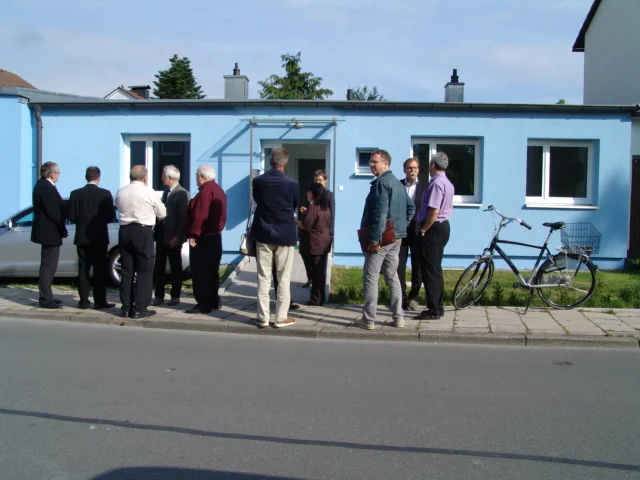
Herderstraße 29, 95447 Bayreuth, Deutschland
Wilhelm-Leuschner-Stiftung Bayreuth | Memorial & Directions
The Wilhelm-Leuschner-Stiftung is not a classic venue for concerts or shows in Bayreuth, but a historically shaped memorial and educational site. Today, those searching for Wilhelm Leuschner often encounter the interplay between the foundation, the Wilhelm-Leuschner-Center, and the municipal memorial at the birthplace of the resistance fighter. Even though some search queries may sound like they are looking for a home or senior center, the researched sources clearly indicate: It refers to a foundation with an archive, library, exhibition, educational work, and a firm place in Bayreuth's culture of remembrance. This connection makes the location on Herderstraße and in Moritzhöfen particularly interesting, as historical research and public communication come together closely. ([wilhelm-leuschner-stiftung.de](https://www.wilhelm-leuschner-stiftung.de/index.php/de/home))
At the center is Wilhelm Leuschner as a trade unionist, social democrat, and resistance fighter. The foundation works not only with historical documents but also with project days, exhibitions, lectures, and digital materials aimed at school classes, clubs, and interested visitors. This makes the location particularly relevant for search intentions around “foundation,” “memorial,” “center,” “exhibition,” “tours,” “directions,” and “opening hours.” Those who want to connect Bayreuth with political history, resistance culture, and local biography will find a place here that does not let the past become museum-like but keeps it alive as a space for learning and encounters. ([wilhelm-leuschner-stiftung.de](https://www.wilhelm-leuschner-stiftung.de/index.php/de/home))
History of the Wilhelm-Leuschner-Stiftung in Bayreuth
The history of the Wilhelm-Leuschner-Stiftung begins with civic engagement and the attempt to preserve an important building and the memory of an important biography. Since the 1990s, the Bayreuth Association for Social and Cultural History has been committed to preserving the birthplace of Wilhelm Leuschner. In 1997, the city placed the house under monument protection, and in 2000, a demolition application from the then-owners triggered a broad public mobilization. The association consolidated its activities, wrote to prominent supporters such as Richard von Weizsäcker and Hans-Jochen Vogel, and launched the campaign “Building Blocks for the Leuschner House.” Thus, a politically and culturally charged rescue project emerged, which made the later memorial possible. ([wilhelm-leuschner-stiftung.de](https://www.wilhelm-leuschner-stiftung.de/index.php/de/stiftung/geschichte))
The official history of the foundation shows very concretely how this initiative became a permanent structure. After negotiations with the city, a private owner, and other partners, the renovation of the house began in 2001. In the summer of 2002, the work was completed, and the city of Bayreuth rented rooms on the ground floor for the memorial. In March 2002, the Hasibether and Höhn families, with the support of the association, founded the Wilhelm-Leuschner-Stiftung with a foundation capital of 50,000 euros and material assets from the archive and office equipment. On April 5, 2002, the foundation was recognized by the government of Upper Franconia, and on July 1, 2002, it moved into its rooms in the attic of the birthplace. Since July 2012, it has been operating at Herderstraße 29 in the current Wilhelm-Leuschner-Center, where the estate, archive, and library have been permanently brought together. This development makes the foundation a grown institution, not a short-term project. ([wilhelm-leuschner-stiftung.de](https://www.wilhelm-leuschner-stiftung.de/index.php/de/stiftung/geschichte))
Wilhelm-Leuschner-Memorial at the Birthplace in Moritzhöfen
The Wilhelm-Leuschner-Memorial of the city of Bayreuth is located in the birthplace of Leuschner, born in 1890, at Moritzhöfen 25. According to official representation, the memorial was established in 2003 and showcases the life path of the Weimar politician and resistance fighter in four rooms with five thematic sections. The house itself is privately owned, but the content development is carried out in close cooperation with the foundation. The exhibition combines image panels, exhibits, and a biographical narrative that spans from Bayreuth to Darmstadt to Berlin. Those who enter these rooms see not only local history but also the intertwining of craftsmanship, the labor movement, the Weimar Republic, Nazi persecution, and resistance. ([wilhelm-leuschner-stiftung.de](https://www.wilhelm-leuschner-stiftung.de/index.php/de/ort-der-erinnerung/gedenkstaette))
The stations of the exhibition are carefully aligned with Leuschner's life path. In Bayreuth, he spent his childhood, youth, and training; he became active in the trade union early on and joined the union in the city in 1907. In 1913, he joined the SPD, and in 1919, he was elected full-time chairman of the trade unions in Darmstadt and elected to the city council. In 1924, he entered the Hessian state parliament, and in 1928, he became the interior minister. The exhibition also addresses his conflict with the NSDAP, the publication of the so-called Boxheimer documents in 1931, his international significance as a trade union leader, his arrest in 1933, and his imprisonment in Börgermoor and Lichtenburg. The memorial is thus not just a space of remembrance but a condensed history book that makes Leuschner's political biography comprehensible and vivid. ([wilhelm-leuschner-stiftung.de](https://www.wilhelm-leuschner-stiftung.de/index.php/de/ort-der-erinnerung/gedenkstaette))
Herderstraße 29, Moritzhöfen 25 and Practical Visitor Information
For practical orientation, the distinction between the foundation and the memorial is important. The Wilhelm-Leuschner-Stiftung is located at Herderstraße 29, 95447 Bayreuth, and can be reached at phone number 0921 1507269. The municipal memorial is located at the birthplace in Moritzhöfen 25, 95444 Bayreuth, with the contact numbers provided by Bayreuth Tourism. This distinction is particularly helpful for search queries such as “directions,” “contact,” “opening hours,” or “where exactly is the foundation.” Therefore, those looking for the foundation's address will end up at the Wilhelm-Leuschner-Center; those wishing to visit the historical exhibition house will go to Moritzhöfen. ([wilhelm-leuschner-stiftung.de](https://www.wilhelm-leuschner-stiftung.de/index.php/de/kontakt))
The publicly stated visiting hours refer to the memorial: Tuesday to Friday from 10 AM to 2 PM, Saturday and Sunday from 1 PM to 4 PM, closed from December 15 to January 6. Admission is free. This is particularly helpful for visitors, as the memorial is clearly positioned as a freely accessible place of remembrance, while the foundation's center functions more as a working, archive, and educational site. The foundation's website also points out that access to the digital estate is set up upon request by the administrator. Therefore, those who wish to not only look but also research deeper should contact the foundation in advance. For the search intention “Wilhelm Leuschner directions,” the most important, reliable core statement is: check the address, distinguish the functions of the two places, and note the opening hours of the memorial. ([bayreuth-tourismus.de](https://www.bayreuth-tourismus.de/sehenswertes/museen/wilhelm-leuschner-gedenkstaette/))
Archive, Library, and Digital Educational Work at the Leuschner Center
The Wilhelm-Leuschner-Center at Herderstraße 29 is more than an administrative address. The official description makes clear that the estate of Wilhelm Leuschner is preserved there in its original form, scientifically processed, and made available digitally online. This includes an archive, library, and a seminar room, which have formed the basis for scientific work since moving in 2002 in the attic of the birthplace and since the move in 2012 in its own center. It is particularly important that digital access is not open and arbitrary but is set up upon request by the administrator. This demonstrates both the archival claim and the careful handling of historical material. ([wilhelm-leuschner-stiftung.de](https://www.wilhelm-leuschner-stiftung.de/index.php/de/home))
The educational work also includes a concrete spatial concept. In December 2003, the Wilhelm Leuschner Educational Workshop was established in the former carpenter's workshop in the rear building; in February 2004, seminar operations for memorial work began there. This educational workshop is central to the mediation for school classes and groups, as it brings together visits, seminars, and political education. Additionally, there is the foundation exhibition, which was first conceived in 2014 for the Wilhelm-Leuschner-Center and prepares Leuschner's biography with archive images and explanatory texts. Since 2026, an online version of the exhibition has also been available, along with a small brochure about Leuschner's life and work, which the foundation explicitly recommends for clubs, trade unions, and educational institutions. Therefore, those searching for “Wilhelm Leuschner exhibition,” “estate,” or “tours” will find here not a static museum catalog but a working center for culture of remembrance and political education. ([wilhelm-leuschner-stiftung.de](https://www.wilhelm-leuschner-stiftung.de/index.php/de/ort-der-erinnerung/geburtshaus))
Bayreuth Talks, Project Days, and Events
An important component of the public work is the Bayreuth Talks, which the foundation has been organizing since 2005 around the anniversary of Wilhelm Leuschner's death. The event series combines lectures, discussions, eyewitness talks, theater, and school formats. The website not only collects historical retrospectives but also documents current program parts. In 2023, there were talks with the Holocaust survivor Ernst Grube, tours of the memorial, a public event for the thirtieth anniversary of the support association, and a foundation council meeting focusing on budget and projects. This is significant for the regional culture of remembrance because the work is not limited to the memorial day but is continued in several formats throughout the year. ([wilhelm-leuschner-stiftung.de](https://www.wilhelm-leuschner-stiftung.de/index.php/de/allcategories-de-de/9-bayreuther-gespraeche))
In 2024 and 2025, the breadth of the mediation work was also evident. The foundation explicitly recommended visiting the exhibition at Herderstraße 29 and the memorial at Moritzhöfen 25 for the preparation or follow-up of events. In the Bayreuth Talks, plays such as “The Measurement of Democracy” were used to make civil resistance, July 20, 1944, and Leuschner's role in the resistance network tangible for school groups. In 2025, an exhibition on Leuschner's biography, funded by the Upper Franconia Foundation, was also presented, which was developed with documents, images, and archival materials from the estate and could be distributed to schools. Such formats show that the foundation not only remembers Leuschner but also connects his legacy pedagogically to the present. Therefore, those searching for “Bayreuth Talks” will find an established event series with historical depth and a current educational mandate. ([wilhelm-leuschner-stiftung.de](https://www.wilhelm-leuschner-stiftung.de/index.php/de/allcategories-de-de/9-bayreuther-gespraeche))
Wilhelm Leuschner in Bayreuth: Biography, Resistance, and Significance
Wilhelm Leuschner remains a formative figure for Bayreuth because his life story begins here and later has an impact far beyond the city. Born on June 15, 1890, in Bayreuth, he grew up in a craftsman's environment, learned the wood sculpting trade, and became active in the trade union early on. His biography is therefore not only that of a politician but also that of a person who grew from the everyday life of the working class into the great history of the Weimar Republic and the resistance against National Socialism. The memorial and the foundation make this path vivid: from the Bayreuth birthplace through Darmstadt to Berlin, from trade union leader to opponent of the Nazi state. ([wilhelm-leuschner-stiftung.de](https://www.wilhelm-leuschner-stiftung.de/index.php/de/ort-der-erinnerung/gedenkstaette))
The significance of the place lies precisely in its connection of different levels. It is a local space of remembrance, an educational site for schools, an archive for researchers, and a public sign of democratic responsibility. The fact that the foundation has been working since 2002, that the memorial was opened in 2003, that a separate center was created in 2012, and that the exhibition is now also available digitally shows a continuous development rather than a completed project. Leuschner was executed on September 29, 1944, in Berlin-Plötzensee; his name today stands in Bayreuth for civil courage, democracy, and the responsibility to pass on historical experiences. That is precisely why search terms like “Wilhelm Leuschner Foundation Bayreuth,” “memorial,” “center,” “exhibition,” and “tours” work together: They describe not just a place but a living network of remembrance. ([wilhelm-leuschner-stiftung.de](https://www.wilhelm-leuschner-stiftung.de/index.php/de/home))
Sources:
Show moreShow less
Wilhelm-Leuschner-Stiftung Bayreuth | Memorial & Directions
The Wilhelm-Leuschner-Stiftung is not a classic venue for concerts or shows in Bayreuth, but a historically shaped memorial and educational site. Today, those searching for Wilhelm Leuschner often encounter the interplay between the foundation, the Wilhelm-Leuschner-Center, and the municipal memorial at the birthplace of the resistance fighter. Even though some search queries may sound like they are looking for a home or senior center, the researched sources clearly indicate: It refers to a foundation with an archive, library, exhibition, educational work, and a firm place in Bayreuth's culture of remembrance. This connection makes the location on Herderstraße and in Moritzhöfen particularly interesting, as historical research and public communication come together closely. ([wilhelm-leuschner-stiftung.de](https://www.wilhelm-leuschner-stiftung.de/index.php/de/home))
At the center is Wilhelm Leuschner as a trade unionist, social democrat, and resistance fighter. The foundation works not only with historical documents but also with project days, exhibitions, lectures, and digital materials aimed at school classes, clubs, and interested visitors. This makes the location particularly relevant for search intentions around “foundation,” “memorial,” “center,” “exhibition,” “tours,” “directions,” and “opening hours.” Those who want to connect Bayreuth with political history, resistance culture, and local biography will find a place here that does not let the past become museum-like but keeps it alive as a space for learning and encounters. ([wilhelm-leuschner-stiftung.de](https://www.wilhelm-leuschner-stiftung.de/index.php/de/home))
History of the Wilhelm-Leuschner-Stiftung in Bayreuth
The history of the Wilhelm-Leuschner-Stiftung begins with civic engagement and the attempt to preserve an important building and the memory of an important biography. Since the 1990s, the Bayreuth Association for Social and Cultural History has been committed to preserving the birthplace of Wilhelm Leuschner. In 1997, the city placed the house under monument protection, and in 2000, a demolition application from the then-owners triggered a broad public mobilization. The association consolidated its activities, wrote to prominent supporters such as Richard von Weizsäcker and Hans-Jochen Vogel, and launched the campaign “Building Blocks for the Leuschner House.” Thus, a politically and culturally charged rescue project emerged, which made the later memorial possible. ([wilhelm-leuschner-stiftung.de](https://www.wilhelm-leuschner-stiftung.de/index.php/de/stiftung/geschichte))
The official history of the foundation shows very concretely how this initiative became a permanent structure. After negotiations with the city, a private owner, and other partners, the renovation of the house began in 2001. In the summer of 2002, the work was completed, and the city of Bayreuth rented rooms on the ground floor for the memorial. In March 2002, the Hasibether and Höhn families, with the support of the association, founded the Wilhelm-Leuschner-Stiftung with a foundation capital of 50,000 euros and material assets from the archive and office equipment. On April 5, 2002, the foundation was recognized by the government of Upper Franconia, and on July 1, 2002, it moved into its rooms in the attic of the birthplace. Since July 2012, it has been operating at Herderstraße 29 in the current Wilhelm-Leuschner-Center, where the estate, archive, and library have been permanently brought together. This development makes the foundation a grown institution, not a short-term project. ([wilhelm-leuschner-stiftung.de](https://www.wilhelm-leuschner-stiftung.de/index.php/de/stiftung/geschichte))
Wilhelm-Leuschner-Memorial at the Birthplace in Moritzhöfen
The Wilhelm-Leuschner-Memorial of the city of Bayreuth is located in the birthplace of Leuschner, born in 1890, at Moritzhöfen 25. According to official representation, the memorial was established in 2003 and showcases the life path of the Weimar politician and resistance fighter in four rooms with five thematic sections. The house itself is privately owned, but the content development is carried out in close cooperation with the foundation. The exhibition combines image panels, exhibits, and a biographical narrative that spans from Bayreuth to Darmstadt to Berlin. Those who enter these rooms see not only local history but also the intertwining of craftsmanship, the labor movement, the Weimar Republic, Nazi persecution, and resistance. ([wilhelm-leuschner-stiftung.de](https://www.wilhelm-leuschner-stiftung.de/index.php/de/ort-der-erinnerung/gedenkstaette))
The stations of the exhibition are carefully aligned with Leuschner's life path. In Bayreuth, he spent his childhood, youth, and training; he became active in the trade union early on and joined the union in the city in 1907. In 1913, he joined the SPD, and in 1919, he was elected full-time chairman of the trade unions in Darmstadt and elected to the city council. In 1924, he entered the Hessian state parliament, and in 1928, he became the interior minister. The exhibition also addresses his conflict with the NSDAP, the publication of the so-called Boxheimer documents in 1931, his international significance as a trade union leader, his arrest in 1933, and his imprisonment in Börgermoor and Lichtenburg. The memorial is thus not just a space of remembrance but a condensed history book that makes Leuschner's political biography comprehensible and vivid. ([wilhelm-leuschner-stiftung.de](https://www.wilhelm-leuschner-stiftung.de/index.php/de/ort-der-erinnerung/gedenkstaette))
Herderstraße 29, Moritzhöfen 25 and Practical Visitor Information
For practical orientation, the distinction between the foundation and the memorial is important. The Wilhelm-Leuschner-Stiftung is located at Herderstraße 29, 95447 Bayreuth, and can be reached at phone number 0921 1507269. The municipal memorial is located at the birthplace in Moritzhöfen 25, 95444 Bayreuth, with the contact numbers provided by Bayreuth Tourism. This distinction is particularly helpful for search queries such as “directions,” “contact,” “opening hours,” or “where exactly is the foundation.” Therefore, those looking for the foundation's address will end up at the Wilhelm-Leuschner-Center; those wishing to visit the historical exhibition house will go to Moritzhöfen. ([wilhelm-leuschner-stiftung.de](https://www.wilhelm-leuschner-stiftung.de/index.php/de/kontakt))
The publicly stated visiting hours refer to the memorial: Tuesday to Friday from 10 AM to 2 PM, Saturday and Sunday from 1 PM to 4 PM, closed from December 15 to January 6. Admission is free. This is particularly helpful for visitors, as the memorial is clearly positioned as a freely accessible place of remembrance, while the foundation's center functions more as a working, archive, and educational site. The foundation's website also points out that access to the digital estate is set up upon request by the administrator. Therefore, those who wish to not only look but also research deeper should contact the foundation in advance. For the search intention “Wilhelm Leuschner directions,” the most important, reliable core statement is: check the address, distinguish the functions of the two places, and note the opening hours of the memorial. ([bayreuth-tourismus.de](https://www.bayreuth-tourismus.de/sehenswertes/museen/wilhelm-leuschner-gedenkstaette/))
Archive, Library, and Digital Educational Work at the Leuschner Center
The Wilhelm-Leuschner-Center at Herderstraße 29 is more than an administrative address. The official description makes clear that the estate of Wilhelm Leuschner is preserved there in its original form, scientifically processed, and made available digitally online. This includes an archive, library, and a seminar room, which have formed the basis for scientific work since moving in 2002 in the attic of the birthplace and since the move in 2012 in its own center. It is particularly important that digital access is not open and arbitrary but is set up upon request by the administrator. This demonstrates both the archival claim and the careful handling of historical material. ([wilhelm-leuschner-stiftung.de](https://www.wilhelm-leuschner-stiftung.de/index.php/de/home))
The educational work also includes a concrete spatial concept. In December 2003, the Wilhelm Leuschner Educational Workshop was established in the former carpenter's workshop in the rear building; in February 2004, seminar operations for memorial work began there. This educational workshop is central to the mediation for school classes and groups, as it brings together visits, seminars, and political education. Additionally, there is the foundation exhibition, which was first conceived in 2014 for the Wilhelm-Leuschner-Center and prepares Leuschner's biography with archive images and explanatory texts. Since 2026, an online version of the exhibition has also been available, along with a small brochure about Leuschner's life and work, which the foundation explicitly recommends for clubs, trade unions, and educational institutions. Therefore, those searching for “Wilhelm Leuschner exhibition,” “estate,” or “tours” will find here not a static museum catalog but a working center for culture of remembrance and political education. ([wilhelm-leuschner-stiftung.de](https://www.wilhelm-leuschner-stiftung.de/index.php/de/ort-der-erinnerung/geburtshaus))
Bayreuth Talks, Project Days, and Events
An important component of the public work is the Bayreuth Talks, which the foundation has been organizing since 2005 around the anniversary of Wilhelm Leuschner's death. The event series combines lectures, discussions, eyewitness talks, theater, and school formats. The website not only collects historical retrospectives but also documents current program parts. In 2023, there were talks with the Holocaust survivor Ernst Grube, tours of the memorial, a public event for the thirtieth anniversary of the support association, and a foundation council meeting focusing on budget and projects. This is significant for the regional culture of remembrance because the work is not limited to the memorial day but is continued in several formats throughout the year. ([wilhelm-leuschner-stiftung.de](https://www.wilhelm-leuschner-stiftung.de/index.php/de/allcategories-de-de/9-bayreuther-gespraeche))
In 2024 and 2025, the breadth of the mediation work was also evident. The foundation explicitly recommended visiting the exhibition at Herderstraße 29 and the memorial at Moritzhöfen 25 for the preparation or follow-up of events. In the Bayreuth Talks, plays such as “The Measurement of Democracy” were used to make civil resistance, July 20, 1944, and Leuschner's role in the resistance network tangible for school groups. In 2025, an exhibition on Leuschner's biography, funded by the Upper Franconia Foundation, was also presented, which was developed with documents, images, and archival materials from the estate and could be distributed to schools. Such formats show that the foundation not only remembers Leuschner but also connects his legacy pedagogically to the present. Therefore, those searching for “Bayreuth Talks” will find an established event series with historical depth and a current educational mandate. ([wilhelm-leuschner-stiftung.de](https://www.wilhelm-leuschner-stiftung.de/index.php/de/allcategories-de-de/9-bayreuther-gespraeche))
Wilhelm Leuschner in Bayreuth: Biography, Resistance, and Significance
Wilhelm Leuschner remains a formative figure for Bayreuth because his life story begins here and later has an impact far beyond the city. Born on June 15, 1890, in Bayreuth, he grew up in a craftsman's environment, learned the wood sculpting trade, and became active in the trade union early on. His biography is therefore not only that of a politician but also that of a person who grew from the everyday life of the working class into the great history of the Weimar Republic and the resistance against National Socialism. The memorial and the foundation make this path vivid: from the Bayreuth birthplace through Darmstadt to Berlin, from trade union leader to opponent of the Nazi state. ([wilhelm-leuschner-stiftung.de](https://www.wilhelm-leuschner-stiftung.de/index.php/de/ort-der-erinnerung/gedenkstaette))
The significance of the place lies precisely in its connection of different levels. It is a local space of remembrance, an educational site for schools, an archive for researchers, and a public sign of democratic responsibility. The fact that the foundation has been working since 2002, that the memorial was opened in 2003, that a separate center was created in 2012, and that the exhibition is now also available digitally shows a continuous development rather than a completed project. Leuschner was executed on September 29, 1944, in Berlin-Plötzensee; his name today stands in Bayreuth for civil courage, democracy, and the responsibility to pass on historical experiences. That is precisely why search terms like “Wilhelm Leuschner Foundation Bayreuth,” “memorial,” “center,” “exhibition,” and “tours” work together: They describe not just a place but a living network of remembrance. ([wilhelm-leuschner-stiftung.de](https://www.wilhelm-leuschner-stiftung.de/index.php/de/home))
Sources:
Wilhelm-Leuschner-Stiftung Bayreuth | Memorial & Directions
The Wilhelm-Leuschner-Stiftung is not a classic venue for concerts or shows in Bayreuth, but a historically shaped memorial and educational site. Today, those searching for Wilhelm Leuschner often encounter the interplay between the foundation, the Wilhelm-Leuschner-Center, and the municipal memorial at the birthplace of the resistance fighter. Even though some search queries may sound like they are looking for a home or senior center, the researched sources clearly indicate: It refers to a foundation with an archive, library, exhibition, educational work, and a firm place in Bayreuth's culture of remembrance. This connection makes the location on Herderstraße and in Moritzhöfen particularly interesting, as historical research and public communication come together closely. ([wilhelm-leuschner-stiftung.de](https://www.wilhelm-leuschner-stiftung.de/index.php/de/home))
At the center is Wilhelm Leuschner as a trade unionist, social democrat, and resistance fighter. The foundation works not only with historical documents but also with project days, exhibitions, lectures, and digital materials aimed at school classes, clubs, and interested visitors. This makes the location particularly relevant for search intentions around “foundation,” “memorial,” “center,” “exhibition,” “tours,” “directions,” and “opening hours.” Those who want to connect Bayreuth with political history, resistance culture, and local biography will find a place here that does not let the past become museum-like but keeps it alive as a space for learning and encounters. ([wilhelm-leuschner-stiftung.de](https://www.wilhelm-leuschner-stiftung.de/index.php/de/home))
History of the Wilhelm-Leuschner-Stiftung in Bayreuth
The history of the Wilhelm-Leuschner-Stiftung begins with civic engagement and the attempt to preserve an important building and the memory of an important biography. Since the 1990s, the Bayreuth Association for Social and Cultural History has been committed to preserving the birthplace of Wilhelm Leuschner. In 1997, the city placed the house under monument protection, and in 2000, a demolition application from the then-owners triggered a broad public mobilization. The association consolidated its activities, wrote to prominent supporters such as Richard von Weizsäcker and Hans-Jochen Vogel, and launched the campaign “Building Blocks for the Leuschner House.” Thus, a politically and culturally charged rescue project emerged, which made the later memorial possible. ([wilhelm-leuschner-stiftung.de](https://www.wilhelm-leuschner-stiftung.de/index.php/de/stiftung/geschichte))
The official history of the foundation shows very concretely how this initiative became a permanent structure. After negotiations with the city, a private owner, and other partners, the renovation of the house began in 2001. In the summer of 2002, the work was completed, and the city of Bayreuth rented rooms on the ground floor for the memorial. In March 2002, the Hasibether and Höhn families, with the support of the association, founded the Wilhelm-Leuschner-Stiftung with a foundation capital of 50,000 euros and material assets from the archive and office equipment. On April 5, 2002, the foundation was recognized by the government of Upper Franconia, and on July 1, 2002, it moved into its rooms in the attic of the birthplace. Since July 2012, it has been operating at Herderstraße 29 in the current Wilhelm-Leuschner-Center, where the estate, archive, and library have been permanently brought together. This development makes the foundation a grown institution, not a short-term project. ([wilhelm-leuschner-stiftung.de](https://www.wilhelm-leuschner-stiftung.de/index.php/de/stiftung/geschichte))
Wilhelm-Leuschner-Memorial at the Birthplace in Moritzhöfen
The Wilhelm-Leuschner-Memorial of the city of Bayreuth is located in the birthplace of Leuschner, born in 1890, at Moritzhöfen 25. According to official representation, the memorial was established in 2003 and showcases the life path of the Weimar politician and resistance fighter in four rooms with five thematic sections. The house itself is privately owned, but the content development is carried out in close cooperation with the foundation. The exhibition combines image panels, exhibits, and a biographical narrative that spans from Bayreuth to Darmstadt to Berlin. Those who enter these rooms see not only local history but also the intertwining of craftsmanship, the labor movement, the Weimar Republic, Nazi persecution, and resistance. ([wilhelm-leuschner-stiftung.de](https://www.wilhelm-leuschner-stiftung.de/index.php/de/ort-der-erinnerung/gedenkstaette))
The stations of the exhibition are carefully aligned with Leuschner's life path. In Bayreuth, he spent his childhood, youth, and training; he became active in the trade union early on and joined the union in the city in 1907. In 1913, he joined the SPD, and in 1919, he was elected full-time chairman of the trade unions in Darmstadt and elected to the city council. In 1924, he entered the Hessian state parliament, and in 1928, he became the interior minister. The exhibition also addresses his conflict with the NSDAP, the publication of the so-called Boxheimer documents in 1931, his international significance as a trade union leader, his arrest in 1933, and his imprisonment in Börgermoor and Lichtenburg. The memorial is thus not just a space of remembrance but a condensed history book that makes Leuschner's political biography comprehensible and vivid. ([wilhelm-leuschner-stiftung.de](https://www.wilhelm-leuschner-stiftung.de/index.php/de/ort-der-erinnerung/gedenkstaette))
Herderstraße 29, Moritzhöfen 25 and Practical Visitor Information
For practical orientation, the distinction between the foundation and the memorial is important. The Wilhelm-Leuschner-Stiftung is located at Herderstraße 29, 95447 Bayreuth, and can be reached at phone number 0921 1507269. The municipal memorial is located at the birthplace in Moritzhöfen 25, 95444 Bayreuth, with the contact numbers provided by Bayreuth Tourism. This distinction is particularly helpful for search queries such as “directions,” “contact,” “opening hours,” or “where exactly is the foundation.” Therefore, those looking for the foundation's address will end up at the Wilhelm-Leuschner-Center; those wishing to visit the historical exhibition house will go to Moritzhöfen. ([wilhelm-leuschner-stiftung.de](https://www.wilhelm-leuschner-stiftung.de/index.php/de/kontakt))
The publicly stated visiting hours refer to the memorial: Tuesday to Friday from 10 AM to 2 PM, Saturday and Sunday from 1 PM to 4 PM, closed from December 15 to January 6. Admission is free. This is particularly helpful for visitors, as the memorial is clearly positioned as a freely accessible place of remembrance, while the foundation's center functions more as a working, archive, and educational site. The foundation's website also points out that access to the digital estate is set up upon request by the administrator. Therefore, those who wish to not only look but also research deeper should contact the foundation in advance. For the search intention “Wilhelm Leuschner directions,” the most important, reliable core statement is: check the address, distinguish the functions of the two places, and note the opening hours of the memorial. ([bayreuth-tourismus.de](https://www.bayreuth-tourismus.de/sehenswertes/museen/wilhelm-leuschner-gedenkstaette/))
Archive, Library, and Digital Educational Work at the Leuschner Center
The Wilhelm-Leuschner-Center at Herderstraße 29 is more than an administrative address. The official description makes clear that the estate of Wilhelm Leuschner is preserved there in its original form, scientifically processed, and made available digitally online. This includes an archive, library, and a seminar room, which have formed the basis for scientific work since moving in 2002 in the attic of the birthplace and since the move in 2012 in its own center. It is particularly important that digital access is not open and arbitrary but is set up upon request by the administrator. This demonstrates both the archival claim and the careful handling of historical material. ([wilhelm-leuschner-stiftung.de](https://www.wilhelm-leuschner-stiftung.de/index.php/de/home))
The educational work also includes a concrete spatial concept. In December 2003, the Wilhelm Leuschner Educational Workshop was established in the former carpenter's workshop in the rear building; in February 2004, seminar operations for memorial work began there. This educational workshop is central to the mediation for school classes and groups, as it brings together visits, seminars, and political education. Additionally, there is the foundation exhibition, which was first conceived in 2014 for the Wilhelm-Leuschner-Center and prepares Leuschner's biography with archive images and explanatory texts. Since 2026, an online version of the exhibition has also been available, along with a small brochure about Leuschner's life and work, which the foundation explicitly recommends for clubs, trade unions, and educational institutions. Therefore, those searching for “Wilhelm Leuschner exhibition,” “estate,” or “tours” will find here not a static museum catalog but a working center for culture of remembrance and political education. ([wilhelm-leuschner-stiftung.de](https://www.wilhelm-leuschner-stiftung.de/index.php/de/ort-der-erinnerung/geburtshaus))
Bayreuth Talks, Project Days, and Events
An important component of the public work is the Bayreuth Talks, which the foundation has been organizing since 2005 around the anniversary of Wilhelm Leuschner's death. The event series combines lectures, discussions, eyewitness talks, theater, and school formats. The website not only collects historical retrospectives but also documents current program parts. In 2023, there were talks with the Holocaust survivor Ernst Grube, tours of the memorial, a public event for the thirtieth anniversary of the support association, and a foundation council meeting focusing on budget and projects. This is significant for the regional culture of remembrance because the work is not limited to the memorial day but is continued in several formats throughout the year. ([wilhelm-leuschner-stiftung.de](https://www.wilhelm-leuschner-stiftung.de/index.php/de/allcategories-de-de/9-bayreuther-gespraeche))
In 2024 and 2025, the breadth of the mediation work was also evident. The foundation explicitly recommended visiting the exhibition at Herderstraße 29 and the memorial at Moritzhöfen 25 for the preparation or follow-up of events. In the Bayreuth Talks, plays such as “The Measurement of Democracy” were used to make civil resistance, July 20, 1944, and Leuschner's role in the resistance network tangible for school groups. In 2025, an exhibition on Leuschner's biography, funded by the Upper Franconia Foundation, was also presented, which was developed with documents, images, and archival materials from the estate and could be distributed to schools. Such formats show that the foundation not only remembers Leuschner but also connects his legacy pedagogically to the present. Therefore, those searching for “Bayreuth Talks” will find an established event series with historical depth and a current educational mandate. ([wilhelm-leuschner-stiftung.de](https://www.wilhelm-leuschner-stiftung.de/index.php/de/allcategories-de-de/9-bayreuther-gespraeche))
Wilhelm Leuschner in Bayreuth: Biography, Resistance, and Significance
Wilhelm Leuschner remains a formative figure for Bayreuth because his life story begins here and later has an impact far beyond the city. Born on June 15, 1890, in Bayreuth, he grew up in a craftsman's environment, learned the wood sculpting trade, and became active in the trade union early on. His biography is therefore not only that of a politician but also that of a person who grew from the everyday life of the working class into the great history of the Weimar Republic and the resistance against National Socialism. The memorial and the foundation make this path vivid: from the Bayreuth birthplace through Darmstadt to Berlin, from trade union leader to opponent of the Nazi state. ([wilhelm-leuschner-stiftung.de](https://www.wilhelm-leuschner-stiftung.de/index.php/de/ort-der-erinnerung/gedenkstaette))
The significance of the place lies precisely in its connection of different levels. It is a local space of remembrance, an educational site for schools, an archive for researchers, and a public sign of democratic responsibility. The fact that the foundation has been working since 2002, that the memorial was opened in 2003, that a separate center was created in 2012, and that the exhibition is now also available digitally shows a continuous development rather than a completed project. Leuschner was executed on September 29, 1944, in Berlin-Plötzensee; his name today stands in Bayreuth for civil courage, democracy, and the responsibility to pass on historical experiences. That is precisely why search terms like “Wilhelm Leuschner Foundation Bayreuth,” “memorial,” “center,” “exhibition,” and “tours” work together: They describe not just a place but a living network of remembrance. ([wilhelm-leuschner-stiftung.de](https://www.wilhelm-leuschner-stiftung.de/index.php/de/home))
Sources:
Frequently Asked Questions
Reviews
No reviews found