
Climate Protest with Symbolic Impact in Bayreuth
Green Fountains in Bayreuth: What Extinction Rebellion Wants to Achieve with the Action
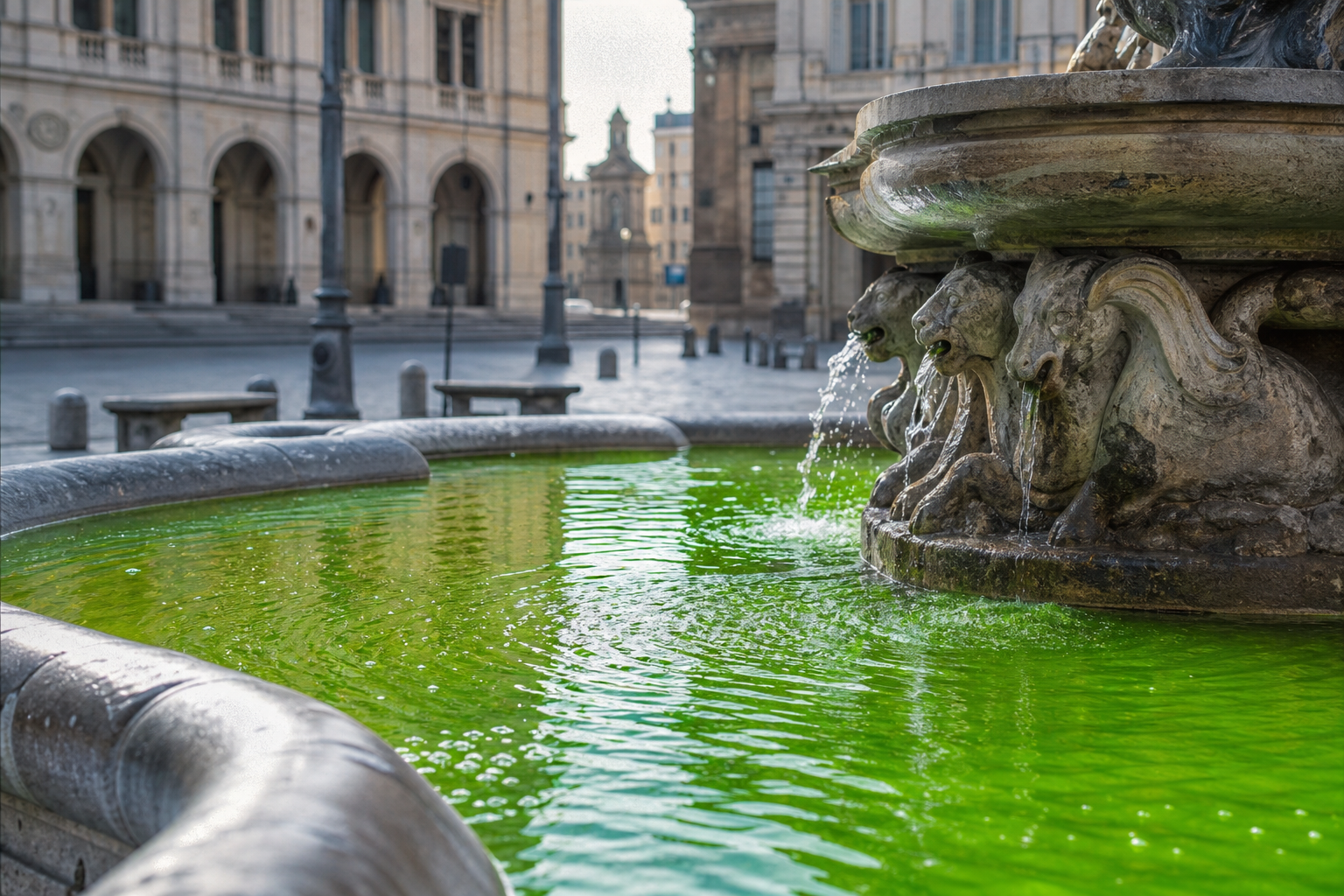
In Bayreuth, on Thursday, May 21, 2026, several fountains were dyed green. According to sources close to the action, the climate movement Extinction Rebellion (XR) is behind it. The action was part of a nationwide protest against the federal government's gas policy – and was intended to conspicuously bring the group's energy policy demands into public space.
Four fountains in Bayreuth were affected: three installations on Maximilianstraße as well as the Wittelsbacher Fountain opposite the Margravial Opera House. The city responded by starting to pump the fountains empty. This gave the symbolic form of protest immediate practical consequences – for the operation and maintenance of the installations as well as for everyday life in the city center.
What Exactly Happened in Bayreuth
According to information about the action, the green coloring was produced with uranine. XR describes the substance as biodegradable and non-toxic; according to the group, only minimal amounts were used on site. Uranine is also used outside of protests – for example as a tracer for leak detection, because it disperses well in water and fluoresces visibly. It is precisely this property that makes it effective for actions in public spaces: the color is immediately present without having to permanently intervene in building structures.
How long the green remains visible depends on light and dilution. According to information about the action, the yellow-green glowing dye should completely fade after a few hours or days, depending on light intensity. Regardless, the city had to react quickly because the fountains are operated and monitored as public facilities.
Nationwide Context: Bayreuth as Part of a Coordinated Wave of Protest
The action in Bayreuth was, according to available information, not isolated, but part of a simultaneous protest in several cities. Bayreuth was named as one of a total of 18 affected cities. The mechanism is typical for decentralized campaigns: a recognizable image – here the green-colored water – appears simultaneously in different places and thus bundles attention beyond local boundaries.
Extinction Rebellion itself sees itself as a decentralized environmental movement, founded in 2018 in Great Britain. The group relies on non-violent civil disobedience and deliberately attention-grabbing disruptions to build political pressure and bring the climate crisis and species extinction more into focus. Within this framework, XR also works with other climate actors, including Ende Gelände, according to its own statements.
What the Protest Is Directed Against – and What Message Is Intended
In terms of content, the fountain coloring was directed against the political focus on fossil gas. XR links this with the accusation of "greenwashing" in energy policy and also criticizes Minister of Economic Affairs Katherina Reiche in this context. Instead, the movement calls for a faster expansion of wind and solar energy as well as greater independence from large corporations.
In other cities, XR spokesperson Manon Gerhardt was also quoted. The thrust remains the same: gas is marked as a climate policy dead end, while renewable energies are presented as the central lever for emission reduction and supply security.
The Three Core Demands: Why XR Creates Such Images
- Tell the Truth: Governments should openly state the scale of the climate crisis and its consequences and declare a climate emergency. For XR, this is not just a matter of communication, but the prerequisite for drastic measures to be discussed as politically legitimate at all.
- Act Now: XR calls for rapid political changes with the goal of reducing greenhouse gas emissions to net zero. The protest against gas is, in this logic, a concrete point of conflict: investments in fossil infrastructure are seen by the movement as a commitment to further emissions and as a brake on the expansion of renewables.
- Beyond Politics: XR advocates for stronger forms of participation such as legally mandated citizens' assemblies, which should help prepare or make climate protection decisions. The movement justifies this with the assumption that party-political routines are too slow and that social majorities are represented differently by randomly selected committees than in classic legislative processes.
Why the Fountain Coloring Is More Than a Local Disturbance
In Bayreuth, the action deliberately targeted central locations in the city center – visible, photographable, immediately disconcerting. Politically, however, the effect lies less in a local decision, but in the staging of a conflict that is being fought at the federal level: How much does Germany continue to rely on gas, how quickly is the expansion of renewable energies being advanced, and what role do government regulations and private investments play?
The case also shows the double effect of such forms of protest. Locally, effort and a concrete intervention in public space arise, to which the municipality must respond. On a supraregional level, the same image is intended to spark a debate – not about the individual fountain, but about energy policy, climate goals, and the question of what means civil protest chooses to force attention. On this day, Bayreuth thus became the stage for a confrontation that extends far beyond the city.
Frequently Asked Questions
Sources
- https://www.bayreuther-tagblatt.de/nachrichten-meldungen-news/umweltschutzbewegung-extinction-rebellion-protestiert-deutschlandweit/, 21.05.262026
- https://www.nn.de/nuernberg/schriller-protest-in-grun-deshalb-ist-brunnenwasser-in-nurnberg-gefarbt-1.15123403
- https://www.sueddeutsche.de/politik/umwelt-gruppe-extinction-rebellion-faerbt-brunnen-aus-protest-gruen-dpa.urn-newsml-dpa-com-20090101-260521-930-109822
- https://extinctionrebellion.de/wer-wir-sind/
- https://www.ddorf-aktuell.de/2026/05/21/duesseldorf-gruenes-wasser-im-schalenbrunnen-ist-aktion-von-extinction-rebellion/