
Nationwide Environmental Protest with Consequences
Green Fountains in Bayreuth: Why Extinction Rebellion is Now Provoking
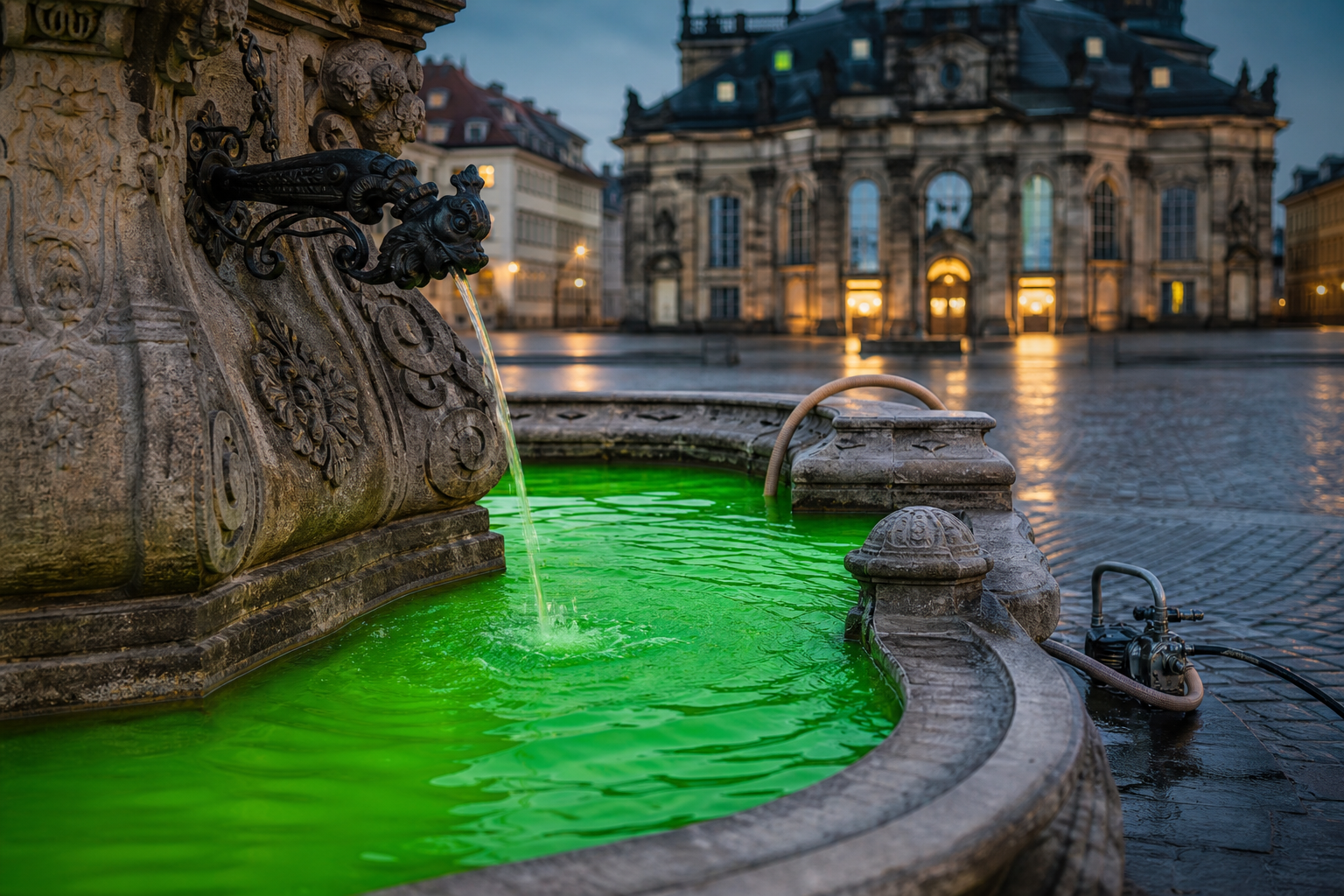
On Thursday, May 21, 2026, four fountains in Bayreuth were dyed green. Three installations on Maximilianstraße and the Wittelsbacher Fountain opposite the Margravial Opera House were affected. The action was part of a nationwide day of protest, during which fountains were colored in a total of 18 cities. In Bayreuth, the municipality responded by pumping the installations empty.
The images are designed so that they cannot be overlooked: bright green in the middle of the city center. This is precisely the purpose of this form of protest. Since its founding in 2018 in the UK, Extinction Rebellion has relied on media-effective interventions in public space—non-violent civil disobedience that forces attention by disrupting processes and putting those responsible under pressure. In this logic, Bayreuth was not a "venue" because of a single local decision, but part of a campaign that played out in many cities at the same time.
Bayreuth is Part of a Nationwide Protest
The fact that the fountain colorings took place on the same day in 18 cities makes the character of the action clear: it was not about an isolated incident, but about coordination and recognizability. Anyone talking about it in one place should find similar images from other cities—and thus perceive the protest as a larger narrative.
At the same time, Bayreuth showed how quickly a symbolic act can have practical consequences. Pumping the fountains empty is not just an optical correction, but an effort: personnel, technology, time. This immediate "follow-up cost" dimension is precisely part of the calculation of such actions. They shift a debate from press releases and talk shows into the everyday life of passersby—and force municipal authorities to make visible responses.
An official statement from the city of Bayreuth documenting or classifying the incident on May 21, 2026, is not yet available on the relevant municipal press pages. Thus, the public mainly has the description of the event through the action itself and the visible measures on site.
What Extinction Rebellion is Aiming for with the Action
Extinction Rebellion sees itself as a decentralized environmental movement. Its stated goal is to push governments to take faster and more comprehensive action against the climate crisis and species extinction through non-violent civil disobedience.
The movement bundles its political goals into three core demands:
- Tell the Truth
- Act Now
- Beyond Politics
In Germany, the fountain action was substantively linked to criticism of an energy policy focus on fossil gas. The protest was also directed against the accusation of "greenwashing" in connection with Economics Minister Katherina Reiche. Extinction Rebellion counters this with the demand for a faster expansion of wind and solar energy and greater independence from large corporations.
Why This Escalation Specifically Through Fountains?
Because fountains as public infrastructure connect several levels at once: they stand for water, cityscape, public good—and are also easily accessible. Coloring them immediately creates a "stop-image" that can be photographed and works without explanatory text. The political message is not conveyed through long chains of argument, but through a visual shock moment: "This is what it looks like when something tips over."
Why, According to the Participants, the Green Color Should Not Pose a Danger
According to information from those involved in the action, uranine was used. The fluorescent dye is also used technically, for example to make water flows visible and for leak detection. The fact that very small amounts can produce an intense yellow-green discoloration is a key point for understanding the action: maximum visibility can be achieved without large quantities of substance being necessary.
Whether one must speak of a "danger" is not only a question of the signal effect, but of a reliable assessment. The activists emphasize that only minimal amounts were used and the substance is biodegradable. In technical product information, uranine is described as suitable for such applications. At the same time, a complete all-clear requires, in case of doubt, an official assessment for the specific individual case—especially since municipal fountains can have different water cycles and technical systems.
According to information about the substance, the coloring fades completely after a few hours or days, depending on the intensity of the light. Politically, this is part of the dramaturgy: the effect is striking, but not permanent. The action is intended to focus attention, not to leave lasting traces.
In the end, Bayreuth shows above all one thing: Extinction Rebellion continues to rely on provocation that can spread quickly—and on images that emotionally charge an energy policy debate. Whether this form of protest generates approval or rejection is open. The only certainty is: the conflict is deliberately carried to where it cannot be overlooked—in the middle of the cities.
Frequently Asked Questions
Sources
- https://www.bayreuther-tagblatt.de/nachrichten-meldungen-news/umweltschutzbewegung-extinction-rebellion-protestiert-deutschlandweit/, 21.05.262026
- https://extinctionrebellion.de/wer-wir-sind/
- https://extinctionrebellion.de/documents/430/PM_2020-08-16_Flug_Muc_02.pdf
- https://www.strickerchemie.de/products_snc/Produktinformationen/Produktdatenblatt%20Uranin.pdf