
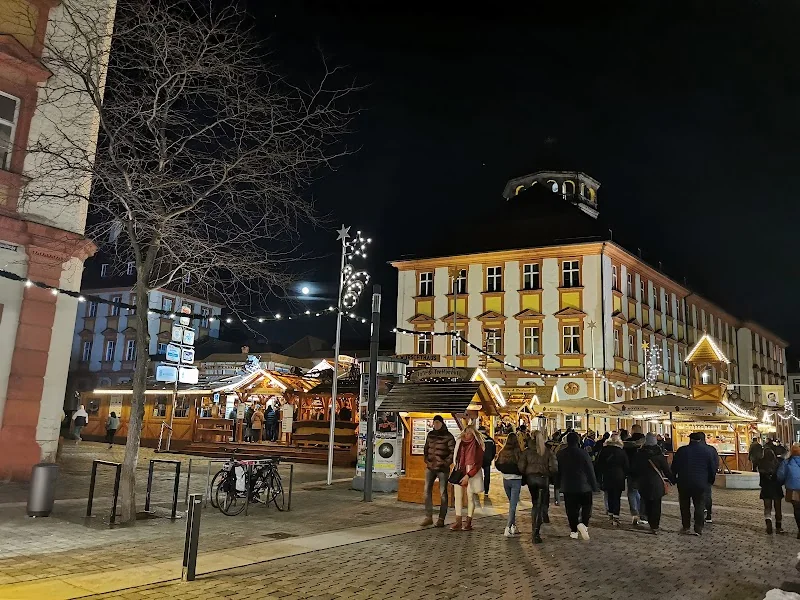
Bayreuth
Richard-Wagner-Straße, 95444 Bayreuth, Deutschland
Richard-Wagner-Straße Bayreuth | RW21 & Parking
The Richard-Wagner-Straße is one of the most prominent addresses in the Bayreuth city center. It connects culture, education, gastronomy, and city history over a short distance and, together with the area around Sternplatz and Villa Wahnfried, forms the RIWA district. For visitors, the street is particularly interesting because several important institutions are located close together: the RW21 with city library and adult education center, the Protestant Educational Institute, the Richard Wagner Museum, as well as other places that make Bayreuth's Wagner heritage directly experienceable. At the same time, the location in the redevelopment area of the eastern city center is part of an active urban development. Those who want to get to know Bayreuth will find here not just an address, but a small urban microcosm of everyday life, culture, and history. This multifacetedness makes the Richard-Wagner-Straße a relevant destination for inquiries about directions, parking, bus connections, events, and cultural places in Bayreuth. ([bayreuth-tourismus.de](https://www.bayreuth-tourismus.de/innenstadt/die-innenstadt-quartiere/riwa-viertel/))
How do I get to Richard-Wagner-Straße in Bayreuth?
The official directions to RW21 show very well how well the Richard-Wagner-Straße is integrated into public transport. For the city library and the adult education center, the stops Oberfrankenhalle, Wahnfried, and Sternplatz are mentioned. At the Oberfrankenhalle stop, lines 304, 316, and 326 stop; the Wahnfried stop is served by lines 302 and 307; the Sternplatz is served by line 314. Additionally, line 223 also serves the Sternplatz and Oberfrankenhalle stops in the evening and on Sunday mornings. For visitors arriving by bike, there are parking spaces directly in front of the entrance. This makes the street suitable for both quick errands and a cultural or library visit without a car. ([stadtbibliothek.bayreuth.de](https://stadtbibliothek.bayreuth.de/kontakt/lage-anfahrt/))
The arrival to the Richard Wagner Museum is also clearly described for bus and car. From Bayreuth main station, line 302 takes visitors towards Sankt Johannis to the Wahnfried stop; from the ZOH, line 307 also goes there towards Aichig. This is particularly convenient for guests who want to visit the museum, Haus Wahnfried, or the surrounding places in the RIWA district. By car, the nearest parking options are located around Wahnfriedstraße, Richard-Wagner-Straße, and in the parking garage Badstraße P7. The combination of bus, bicycle, and short walking distances makes the Richard-Wagner-Straße a city center address that is easily accessible even without local knowledge. ([wagnermuseum.de](https://www.wagnermuseum.de/kontakt/kontakt-und-anfahrt/))
Where can I park on Richard-Wagner-Straße?
Those arriving by car will find several official parking options around Richard-Wagner-Straße. For RW21, the city of Bayreuth mentions the underground garage Sternplatz P8, the parking garages Badstraße P7 and Oberfrankenhalle P1, as well as the Stadthalle parking lot P6. Additionally, parking spaces in the vicinity are mentioned, especially for free short-term parking in Dilchertstraße. This is particularly interesting for visitors who are only briefly visiting the city library, the adult education center, or an appointment in the district. The distances remain short, and the search for parking can be planned much more easily with the mentioned locations. ([stadtbibliothek.bayreuth.de](https://stadtbibliothek.bayreuth.de/kontakt/lage-anfahrt/))
The Richard Wagner Museum adds to this information with specific notes on street parking. Paid parking spaces with parking tickets and a maximum parking duration of two hours are mentioned in Wahnfriedstraße, Richard-Wagner-Straße, Lisztstraße, and Rathstraße. Furthermore, the museum refers to other marked parking spaces and parking garages, including the underground garage Sternplatz P8. For people with an official disabled parking permit, there are additional regulations, such as at the parking disc-required spaces in front of house numbers 43/45, as well as other free options in certain parking areas. This makes the street not only easily accessible but also well organized for different visiting situations. ([wagnermuseum.de](https://www.wagnermuseum.de/kontakt/kontakt-und-anfahrt/))
What places and institutions are located on Richard-Wagner-Straße?
The profile of Richard-Wagner-Straße is strongly shaped by the dense succession of cultural and public institutions. The RW21 at house number 21 is particularly visible. There, the city library, adult education center, youth library, and parts of the city archive work under one roof over more than 5,000 square meters and five floors. The building is thus not only an administrative or educational location but an open citizen center with a high quality of stay. The environment is complemented by the Protestant Educational Institute at house number 24, which offers lectures, seminars, exhibitions, excursions, and study trips. Together, these addresses show that Richard-Wagner-Straße is much more than a name reference: it is a vibrant everyday and educational space in the heart of Bayreuth. ([bayreuth.de](https://www.bayreuth.de/rathaus-buergerservice/bildung-wissen/rw21/))
Additionally, there is the Richard Wagner Museum at house number 48, which is closely connected to the historic Haus Wahnfried. The museum showcases the life and work of Richard Wagner, his impact, and the history of the Bayreuth Festival. Since its opening in 1976 and its reopening in 2015 after a five-year renovation phase, it presents three permanent exhibitions as well as changing special exhibitions. This makes Richard-Wagner-Straße a cultural focal point where literature, music, city history, and science meet. In the everyday life of the RIWA district, there are also small gastronomy businesses, places to stay, and event spaces that prevent the district from appearing too museum-like, but rather as a lively part of the city center. ([wagnermuseum.de](https://www.wagnermuseum.de/en/information/))
Why is Richard-Wagner-Straße historically important?
The historical significance of Richard-Wagner-Straße can only be understood when considering Bayreuth's close connection to Richard Wagner. The official city history cites 1876 as the year of the first festival, where Richard Wagner performed the Ring of the Nibelungen. This development sustainably changed the city and made Bayreuth internationally known. Even later, Wagner remained a shaping element of the city's self-image. The museum at Richard-Wagner-Straße 48 comprehensively documents this connection and makes it clear that here not only a culture of remembrance is maintained, but a central part of Bayreuth's identity is visible. ([bayreuth.de](https://www.bayreuth.de/rathaus-buergerservice/stadtverwaltung/zahlen-fakten-2/stadtgeschichte/))
The historical core also includes Haus Wahnfried. According to the museum, Richard Wagner's former residence is at the center of the current institution. The house was built between 1872 and 1874, and the museum was initially established there in 1976 and reopened in 2015 after a comprehensive renovation. For visitors, this creates a rare connection between an authentic place and modern mediation. Therefore, Richard-Wagner-Straße is not only a route to museums and offices but part of a cultural memory space that permanently makes Bayreuth's Wagner connection visible in the urban landscape. Especially in a city whose history is so closely linked to art, court culture, and festival tradition, this street has a special symbolic density. ([wagnermuseum.de](https://www.wagnermuseum.de/en/information/))
Current events also show how vibrant this connection remains. On the occasion of the 150th anniversary of the Bayreuth Festival, the RiWa street festival will take place on May 23, 2026. According to the city of Bayreuth, everything on that day in Richard-Wagner-Straße will revolve around the namesake; the program ranges from creative and interactive formats to live music, free museum entries, and a lecture at RW21. The event space extends from Sternplatz to Haus Wahnfried. This way, the historical significance of the street is not only preserved but regularly re-staged and made accessible to a wide audience. ([bayreuth.de](https://www.bayreuth.de/bayreuth-feiert-wagners-leben-auf-seiner-strasse/))
What characterizes the RIWA district around Richard-Wagner-Straße?
The Bayreuth Marketing & Tourism GmbH describes the RIWA district as a quarter between Villa Wahnfried and Sternplatz that stands for diversity and variety. In addition to small gastronomy businesses, the city library RW21 as a reading oasis and event venue, as well as the rooms of the adult education center play an important role. The profile is complemented by the Funkhauspassage and the Klimalounge, which indicate further development potential. Even the nightlife here is not loud or excessive, but rather presents itself in a light, early evening form. The result is an urban area that closely connects everyday life, learning, culture, and encounters. ([bayreuth-tourismus.de](https://www.bayreuth-tourismus.de/innenstadt/die-innenstadt-quartiere/riwa-viertel/))
This mix is further enhanced by the urban development of the eastern city center. The redevelopment area H designated by the city aims to strengthen the diversity of uses and functions and to secure valuable historical building substance. In this context, the city mentions, among other things, the renovation of the Margravial Opera House, the redesign of the Opera Street with Sternplatz, the renovation of the synagogue with mikveh, the opera house museum, and RW21 as shaping projects. This shows: Richard-Wagner-Straße should not be viewed in isolation, but as part of a city center that consciously organizes itself between tradition and further development. Those who are on the move here therefore experience not just a few individual buildings, but an entire cultural network. ([bayreuth.de](https://www.bayreuth.de/rathaus-buergerservice/planen-bauen/staedtebaufoerderung/sanierungsgebiete/sanierungsgebiete-innenstadt-uebersicht/sanierungsgebiet-h/))
For visitors, the RIWA district is particularly attractive because many things can be connected on foot. A visit to the museum, an appointment at RW21, a coffee in the district, a detour to Wahnfried, or an event at the Protestant Center are all located close to each other. The street thus functions as an urban axis with many short paths. This combination of accessibility, cultural density, and urban atmosphere makes it so interesting for Bayreuth visitors, residents, and anyone looking for Richard-Wagner-Straße Bayreuth. ([bayreuth-tourismus.de](https://www.bayreuth-tourismus.de/innenstadt/die-innenstadt-quartiere/riwa-viertel/))
Sources:
Show moreShow less
Richard-Wagner-Straße Bayreuth | RW21 & Parking
The Richard-Wagner-Straße is one of the most prominent addresses in the Bayreuth city center. It connects culture, education, gastronomy, and city history over a short distance and, together with the area around Sternplatz and Villa Wahnfried, forms the RIWA district. For visitors, the street is particularly interesting because several important institutions are located close together: the RW21 with city library and adult education center, the Protestant Educational Institute, the Richard Wagner Museum, as well as other places that make Bayreuth's Wagner heritage directly experienceable. At the same time, the location in the redevelopment area of the eastern city center is part of an active urban development. Those who want to get to know Bayreuth will find here not just an address, but a small urban microcosm of everyday life, culture, and history. This multifacetedness makes the Richard-Wagner-Straße a relevant destination for inquiries about directions, parking, bus connections, events, and cultural places in Bayreuth. ([bayreuth-tourismus.de](https://www.bayreuth-tourismus.de/innenstadt/die-innenstadt-quartiere/riwa-viertel/))
How do I get to Richard-Wagner-Straße in Bayreuth?
The official directions to RW21 show very well how well the Richard-Wagner-Straße is integrated into public transport. For the city library and the adult education center, the stops Oberfrankenhalle, Wahnfried, and Sternplatz are mentioned. At the Oberfrankenhalle stop, lines 304, 316, and 326 stop; the Wahnfried stop is served by lines 302 and 307; the Sternplatz is served by line 314. Additionally, line 223 also serves the Sternplatz and Oberfrankenhalle stops in the evening and on Sunday mornings. For visitors arriving by bike, there are parking spaces directly in front of the entrance. This makes the street suitable for both quick errands and a cultural or library visit without a car. ([stadtbibliothek.bayreuth.de](https://stadtbibliothek.bayreuth.de/kontakt/lage-anfahrt/))
The arrival to the Richard Wagner Museum is also clearly described for bus and car. From Bayreuth main station, line 302 takes visitors towards Sankt Johannis to the Wahnfried stop; from the ZOH, line 307 also goes there towards Aichig. This is particularly convenient for guests who want to visit the museum, Haus Wahnfried, or the surrounding places in the RIWA district. By car, the nearest parking options are located around Wahnfriedstraße, Richard-Wagner-Straße, and in the parking garage Badstraße P7. The combination of bus, bicycle, and short walking distances makes the Richard-Wagner-Straße a city center address that is easily accessible even without local knowledge. ([wagnermuseum.de](https://www.wagnermuseum.de/kontakt/kontakt-und-anfahrt/))
Where can I park on Richard-Wagner-Straße?
Those arriving by car will find several official parking options around Richard-Wagner-Straße. For RW21, the city of Bayreuth mentions the underground garage Sternplatz P8, the parking garages Badstraße P7 and Oberfrankenhalle P1, as well as the Stadthalle parking lot P6. Additionally, parking spaces in the vicinity are mentioned, especially for free short-term parking in Dilchertstraße. This is particularly interesting for visitors who are only briefly visiting the city library, the adult education center, or an appointment in the district. The distances remain short, and the search for parking can be planned much more easily with the mentioned locations. ([stadtbibliothek.bayreuth.de](https://stadtbibliothek.bayreuth.de/kontakt/lage-anfahrt/))
The Richard Wagner Museum adds to this information with specific notes on street parking. Paid parking spaces with parking tickets and a maximum parking duration of two hours are mentioned in Wahnfriedstraße, Richard-Wagner-Straße, Lisztstraße, and Rathstraße. Furthermore, the museum refers to other marked parking spaces and parking garages, including the underground garage Sternplatz P8. For people with an official disabled parking permit, there are additional regulations, such as at the parking disc-required spaces in front of house numbers 43/45, as well as other free options in certain parking areas. This makes the street not only easily accessible but also well organized for different visiting situations. ([wagnermuseum.de](https://www.wagnermuseum.de/kontakt/kontakt-und-anfahrt/))
What places and institutions are located on Richard-Wagner-Straße?
The profile of Richard-Wagner-Straße is strongly shaped by the dense succession of cultural and public institutions. The RW21 at house number 21 is particularly visible. There, the city library, adult education center, youth library, and parts of the city archive work under one roof over more than 5,000 square meters and five floors. The building is thus not only an administrative or educational location but an open citizen center with a high quality of stay. The environment is complemented by the Protestant Educational Institute at house number 24, which offers lectures, seminars, exhibitions, excursions, and study trips. Together, these addresses show that Richard-Wagner-Straße is much more than a name reference: it is a vibrant everyday and educational space in the heart of Bayreuth. ([bayreuth.de](https://www.bayreuth.de/rathaus-buergerservice/bildung-wissen/rw21/))
Additionally, there is the Richard Wagner Museum at house number 48, which is closely connected to the historic Haus Wahnfried. The museum showcases the life and work of Richard Wagner, his impact, and the history of the Bayreuth Festival. Since its opening in 1976 and its reopening in 2015 after a five-year renovation phase, it presents three permanent exhibitions as well as changing special exhibitions. This makes Richard-Wagner-Straße a cultural focal point where literature, music, city history, and science meet. In the everyday life of the RIWA district, there are also small gastronomy businesses, places to stay, and event spaces that prevent the district from appearing too museum-like, but rather as a lively part of the city center. ([wagnermuseum.de](https://www.wagnermuseum.de/en/information/))
Why is Richard-Wagner-Straße historically important?
The historical significance of Richard-Wagner-Straße can only be understood when considering Bayreuth's close connection to Richard Wagner. The official city history cites 1876 as the year of the first festival, where Richard Wagner performed the Ring of the Nibelungen. This development sustainably changed the city and made Bayreuth internationally known. Even later, Wagner remained a shaping element of the city's self-image. The museum at Richard-Wagner-Straße 48 comprehensively documents this connection and makes it clear that here not only a culture of remembrance is maintained, but a central part of Bayreuth's identity is visible. ([bayreuth.de](https://www.bayreuth.de/rathaus-buergerservice/stadtverwaltung/zahlen-fakten-2/stadtgeschichte/))
The historical core also includes Haus Wahnfried. According to the museum, Richard Wagner's former residence is at the center of the current institution. The house was built between 1872 and 1874, and the museum was initially established there in 1976 and reopened in 2015 after a comprehensive renovation. For visitors, this creates a rare connection between an authentic place and modern mediation. Therefore, Richard-Wagner-Straße is not only a route to museums and offices but part of a cultural memory space that permanently makes Bayreuth's Wagner connection visible in the urban landscape. Especially in a city whose history is so closely linked to art, court culture, and festival tradition, this street has a special symbolic density. ([wagnermuseum.de](https://www.wagnermuseum.de/en/information/))
Current events also show how vibrant this connection remains. On the occasion of the 150th anniversary of the Bayreuth Festival, the RiWa street festival will take place on May 23, 2026. According to the city of Bayreuth, everything on that day in Richard-Wagner-Straße will revolve around the namesake; the program ranges from creative and interactive formats to live music, free museum entries, and a lecture at RW21. The event space extends from Sternplatz to Haus Wahnfried. This way, the historical significance of the street is not only preserved but regularly re-staged and made accessible to a wide audience. ([bayreuth.de](https://www.bayreuth.de/bayreuth-feiert-wagners-leben-auf-seiner-strasse/))
What characterizes the RIWA district around Richard-Wagner-Straße?
The Bayreuth Marketing & Tourism GmbH describes the RIWA district as a quarter between Villa Wahnfried and Sternplatz that stands for diversity and variety. In addition to small gastronomy businesses, the city library RW21 as a reading oasis and event venue, as well as the rooms of the adult education center play an important role. The profile is complemented by the Funkhauspassage and the Klimalounge, which indicate further development potential. Even the nightlife here is not loud or excessive, but rather presents itself in a light, early evening form. The result is an urban area that closely connects everyday life, learning, culture, and encounters. ([bayreuth-tourismus.de](https://www.bayreuth-tourismus.de/innenstadt/die-innenstadt-quartiere/riwa-viertel/))
This mix is further enhanced by the urban development of the eastern city center. The redevelopment area H designated by the city aims to strengthen the diversity of uses and functions and to secure valuable historical building substance. In this context, the city mentions, among other things, the renovation of the Margravial Opera House, the redesign of the Opera Street with Sternplatz, the renovation of the synagogue with mikveh, the opera house museum, and RW21 as shaping projects. This shows: Richard-Wagner-Straße should not be viewed in isolation, but as part of a city center that consciously organizes itself between tradition and further development. Those who are on the move here therefore experience not just a few individual buildings, but an entire cultural network. ([bayreuth.de](https://www.bayreuth.de/rathaus-buergerservice/planen-bauen/staedtebaufoerderung/sanierungsgebiete/sanierungsgebiete-innenstadt-uebersicht/sanierungsgebiet-h/))
For visitors, the RIWA district is particularly attractive because many things can be connected on foot. A visit to the museum, an appointment at RW21, a coffee in the district, a detour to Wahnfried, or an event at the Protestant Center are all located close to each other. The street thus functions as an urban axis with many short paths. This combination of accessibility, cultural density, and urban atmosphere makes it so interesting for Bayreuth visitors, residents, and anyone looking for Richard-Wagner-Straße Bayreuth. ([bayreuth-tourismus.de](https://www.bayreuth-tourismus.de/innenstadt/die-innenstadt-quartiere/riwa-viertel/))
Sources:
Richard-Wagner-Straße Bayreuth | RW21 & Parking
The Richard-Wagner-Straße is one of the most prominent addresses in the Bayreuth city center. It connects culture, education, gastronomy, and city history over a short distance and, together with the area around Sternplatz and Villa Wahnfried, forms the RIWA district. For visitors, the street is particularly interesting because several important institutions are located close together: the RW21 with city library and adult education center, the Protestant Educational Institute, the Richard Wagner Museum, as well as other places that make Bayreuth's Wagner heritage directly experienceable. At the same time, the location in the redevelopment area of the eastern city center is part of an active urban development. Those who want to get to know Bayreuth will find here not just an address, but a small urban microcosm of everyday life, culture, and history. This multifacetedness makes the Richard-Wagner-Straße a relevant destination for inquiries about directions, parking, bus connections, events, and cultural places in Bayreuth. ([bayreuth-tourismus.de](https://www.bayreuth-tourismus.de/innenstadt/die-innenstadt-quartiere/riwa-viertel/))
How do I get to Richard-Wagner-Straße in Bayreuth?
The official directions to RW21 show very well how well the Richard-Wagner-Straße is integrated into public transport. For the city library and the adult education center, the stops Oberfrankenhalle, Wahnfried, and Sternplatz are mentioned. At the Oberfrankenhalle stop, lines 304, 316, and 326 stop; the Wahnfried stop is served by lines 302 and 307; the Sternplatz is served by line 314. Additionally, line 223 also serves the Sternplatz and Oberfrankenhalle stops in the evening and on Sunday mornings. For visitors arriving by bike, there are parking spaces directly in front of the entrance. This makes the street suitable for both quick errands and a cultural or library visit without a car. ([stadtbibliothek.bayreuth.de](https://stadtbibliothek.bayreuth.de/kontakt/lage-anfahrt/))
The arrival to the Richard Wagner Museum is also clearly described for bus and car. From Bayreuth main station, line 302 takes visitors towards Sankt Johannis to the Wahnfried stop; from the ZOH, line 307 also goes there towards Aichig. This is particularly convenient for guests who want to visit the museum, Haus Wahnfried, or the surrounding places in the RIWA district. By car, the nearest parking options are located around Wahnfriedstraße, Richard-Wagner-Straße, and in the parking garage Badstraße P7. The combination of bus, bicycle, and short walking distances makes the Richard-Wagner-Straße a city center address that is easily accessible even without local knowledge. ([wagnermuseum.de](https://www.wagnermuseum.de/kontakt/kontakt-und-anfahrt/))
Where can I park on Richard-Wagner-Straße?
Those arriving by car will find several official parking options around Richard-Wagner-Straße. For RW21, the city of Bayreuth mentions the underground garage Sternplatz P8, the parking garages Badstraße P7 and Oberfrankenhalle P1, as well as the Stadthalle parking lot P6. Additionally, parking spaces in the vicinity are mentioned, especially for free short-term parking in Dilchertstraße. This is particularly interesting for visitors who are only briefly visiting the city library, the adult education center, or an appointment in the district. The distances remain short, and the search for parking can be planned much more easily with the mentioned locations. ([stadtbibliothek.bayreuth.de](https://stadtbibliothek.bayreuth.de/kontakt/lage-anfahrt/))
The Richard Wagner Museum adds to this information with specific notes on street parking. Paid parking spaces with parking tickets and a maximum parking duration of two hours are mentioned in Wahnfriedstraße, Richard-Wagner-Straße, Lisztstraße, and Rathstraße. Furthermore, the museum refers to other marked parking spaces and parking garages, including the underground garage Sternplatz P8. For people with an official disabled parking permit, there are additional regulations, such as at the parking disc-required spaces in front of house numbers 43/45, as well as other free options in certain parking areas. This makes the street not only easily accessible but also well organized for different visiting situations. ([wagnermuseum.de](https://www.wagnermuseum.de/kontakt/kontakt-und-anfahrt/))
What places and institutions are located on Richard-Wagner-Straße?
The profile of Richard-Wagner-Straße is strongly shaped by the dense succession of cultural and public institutions. The RW21 at house number 21 is particularly visible. There, the city library, adult education center, youth library, and parts of the city archive work under one roof over more than 5,000 square meters and five floors. The building is thus not only an administrative or educational location but an open citizen center with a high quality of stay. The environment is complemented by the Protestant Educational Institute at house number 24, which offers lectures, seminars, exhibitions, excursions, and study trips. Together, these addresses show that Richard-Wagner-Straße is much more than a name reference: it is a vibrant everyday and educational space in the heart of Bayreuth. ([bayreuth.de](https://www.bayreuth.de/rathaus-buergerservice/bildung-wissen/rw21/))
Additionally, there is the Richard Wagner Museum at house number 48, which is closely connected to the historic Haus Wahnfried. The museum showcases the life and work of Richard Wagner, his impact, and the history of the Bayreuth Festival. Since its opening in 1976 and its reopening in 2015 after a five-year renovation phase, it presents three permanent exhibitions as well as changing special exhibitions. This makes Richard-Wagner-Straße a cultural focal point where literature, music, city history, and science meet. In the everyday life of the RIWA district, there are also small gastronomy businesses, places to stay, and event spaces that prevent the district from appearing too museum-like, but rather as a lively part of the city center. ([wagnermuseum.de](https://www.wagnermuseum.de/en/information/))
Why is Richard-Wagner-Straße historically important?
The historical significance of Richard-Wagner-Straße can only be understood when considering Bayreuth's close connection to Richard Wagner. The official city history cites 1876 as the year of the first festival, where Richard Wagner performed the Ring of the Nibelungen. This development sustainably changed the city and made Bayreuth internationally known. Even later, Wagner remained a shaping element of the city's self-image. The museum at Richard-Wagner-Straße 48 comprehensively documents this connection and makes it clear that here not only a culture of remembrance is maintained, but a central part of Bayreuth's identity is visible. ([bayreuth.de](https://www.bayreuth.de/rathaus-buergerservice/stadtverwaltung/zahlen-fakten-2/stadtgeschichte/))
The historical core also includes Haus Wahnfried. According to the museum, Richard Wagner's former residence is at the center of the current institution. The house was built between 1872 and 1874, and the museum was initially established there in 1976 and reopened in 2015 after a comprehensive renovation. For visitors, this creates a rare connection between an authentic place and modern mediation. Therefore, Richard-Wagner-Straße is not only a route to museums and offices but part of a cultural memory space that permanently makes Bayreuth's Wagner connection visible in the urban landscape. Especially in a city whose history is so closely linked to art, court culture, and festival tradition, this street has a special symbolic density. ([wagnermuseum.de](https://www.wagnermuseum.de/en/information/))
Current events also show how vibrant this connection remains. On the occasion of the 150th anniversary of the Bayreuth Festival, the RiWa street festival will take place on May 23, 2026. According to the city of Bayreuth, everything on that day in Richard-Wagner-Straße will revolve around the namesake; the program ranges from creative and interactive formats to live music, free museum entries, and a lecture at RW21. The event space extends from Sternplatz to Haus Wahnfried. This way, the historical significance of the street is not only preserved but regularly re-staged and made accessible to a wide audience. ([bayreuth.de](https://www.bayreuth.de/bayreuth-feiert-wagners-leben-auf-seiner-strasse/))
What characterizes the RIWA district around Richard-Wagner-Straße?
The Bayreuth Marketing & Tourism GmbH describes the RIWA district as a quarter between Villa Wahnfried and Sternplatz that stands for diversity and variety. In addition to small gastronomy businesses, the city library RW21 as a reading oasis and event venue, as well as the rooms of the adult education center play an important role. The profile is complemented by the Funkhauspassage and the Klimalounge, which indicate further development potential. Even the nightlife here is not loud or excessive, but rather presents itself in a light, early evening form. The result is an urban area that closely connects everyday life, learning, culture, and encounters. ([bayreuth-tourismus.de](https://www.bayreuth-tourismus.de/innenstadt/die-innenstadt-quartiere/riwa-viertel/))
This mix is further enhanced by the urban development of the eastern city center. The redevelopment area H designated by the city aims to strengthen the diversity of uses and functions and to secure valuable historical building substance. In this context, the city mentions, among other things, the renovation of the Margravial Opera House, the redesign of the Opera Street with Sternplatz, the renovation of the synagogue with mikveh, the opera house museum, and RW21 as shaping projects. This shows: Richard-Wagner-Straße should not be viewed in isolation, but as part of a city center that consciously organizes itself between tradition and further development. Those who are on the move here therefore experience not just a few individual buildings, but an entire cultural network. ([bayreuth.de](https://www.bayreuth.de/rathaus-buergerservice/planen-bauen/staedtebaufoerderung/sanierungsgebiete/sanierungsgebiete-innenstadt-uebersicht/sanierungsgebiet-h/))
For visitors, the RIWA district is particularly attractive because many things can be connected on foot. A visit to the museum, an appointment at RW21, a coffee in the district, a detour to Wahnfried, or an event at the Protestant Center are all located close to each other. The street thus functions as an urban axis with many short paths. This combination of accessibility, cultural density, and urban atmosphere makes it so interesting for Bayreuth visitors, residents, and anyone looking for Richard-Wagner-Straße Bayreuth. ([bayreuth-tourismus.de](https://www.bayreuth-tourismus.de/innenstadt/die-innenstadt-quartiere/riwa-viertel/))
Sources:
Upcoming Events

Picture Book Cinema: Lieselotte Goes on Vacation
A free family experience at RW21 Bayreuth: Picture Book Cinema with Lieselotte for children aged 4 and up. Experience fantasy, laughter, and reading fun! #FamilyTime

Child and Dog – Safe Together, Strong Together
In this lecture, you will learn how a safe and harmonious interaction between child and dog can succeed.
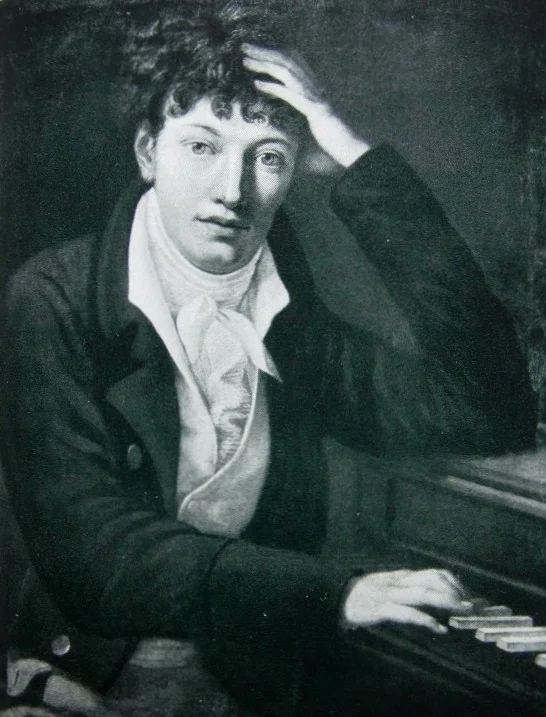
50/150 – Utopia and Echo in Bayreuth
An extraordinary art experience in Bayreuth: 50/150 – Utopia and Echo combines installations, Wagner history, and the present. #Bayreuth #Art
"My Husband, That Is Me Here" – Premiere in Bayreuth
A strong Bayreuth premiere at the Richard Wagner Museum: "My Husband, That Is Me Here" tells festival history anew and compellingly. 23.07.2026, from €8. #Theater
"50/150 – Utopia and Echo" | Projections: "Wahnfried Lights Up!"
When House Wahnfried begins to shine, a special artistic experience arises in Bayreuth: light, image, and sound tell a story. Free admission starting July 23. #Bayreuth #Wahnfried

Summer Reading Club – Read What You Can
Holiday time for book fans: The Summer Reading Club in RW21 Bayreuth combines reading, play, and creative challenges. Free on 07/24/2026. #JoyOfReading
Festivals for Beginners – or: How Do I Experience a Day at the Green Hill
Introductory lectures on the Bayreuth Festival with Museum Director Dr. Sven Friedrich

House Tour at the RW21 City Library
Discover Bayreuth's RW21 from the inside: free house tour with a look behind the scenes, media world, and city history. July 30, 2026, at 4:30 PM. #Bayreuth #RW21
Musical Storytime – As part of Bayreuth Flips
A morning full of stories and sound at RW21 Bayreuth: free musical storytime on August 1, 2026, at 11 AM. #BayreuthFlips #ReadingFestival

Creative Summer Vacation Start in Your Library!
A creative vacation morning for families in Bayreuth: Listen to stories, craft, take home summer keepsakes. On 07.08.2026 free from 6 years. #FamilyTime
Frequently Asked Questions
Reviews
No reviews found