Enjoy sustainably organic & regional in Bayreuth
Sustainable enjoyment in Bayreuth: Organic, regional, fair – Dates, ideas and outlooks
How can Bayreuth taste like the future in the coming weeks and months? This overview compiles upcoming opportunities and recurring dates where you can shop, learn, and enjoy organically, regionally, and fairly – with pragmatic tips for your next planning.
Fair & conscious consumption: upcoming actions and occasions
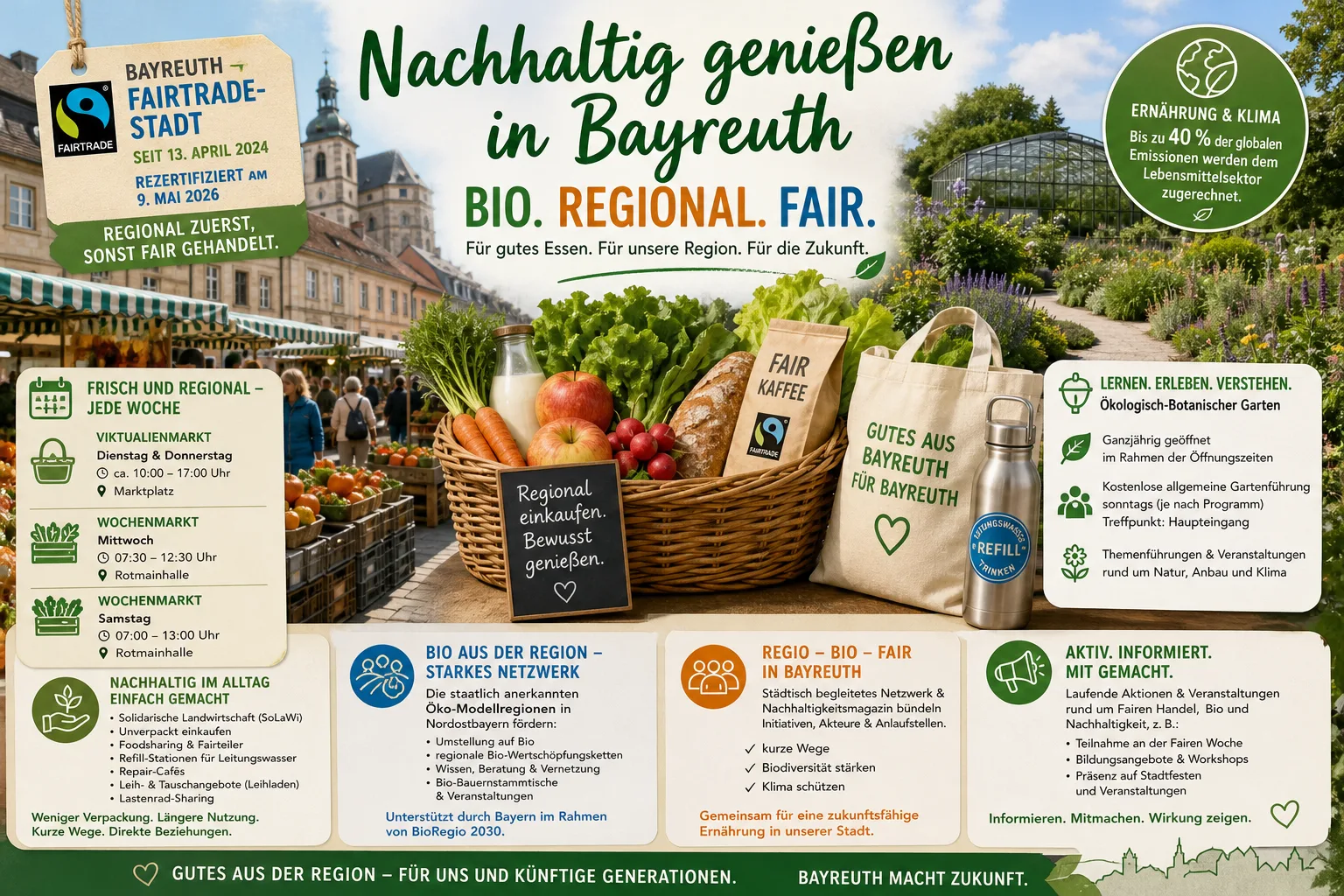
For products that will not be regionally available in the future (e.g. coffee, cocoa, tea, many spices), fair trade becomes especially relevant. In Bayreuth, experience shows that in the coming months, information and participation formats around fair consumption will repeatedly take place – often bundled in nationwide action periods.
Which occasions typically provide impulses in the future
- Fairtrade action periods in autumn: As part of the nationwide Fairtrade action weeks (often in early autumn), tastings, lectures, school activities or action stands are usually initiated – also at the local level.
- Wintertime & gift season: In the coming weeks before the end of the year, many cities will focus on fair chocolate, coffee, and gift consumption; watch for announcements from local initiatives.
Practical tip for your next café or restaurant visit: If you ask for fairly traded coffee/tea and (where possible) for organic certification in the future, you will not only influence your own offer, but also make demand visible – a lever that can work particularly quickly in gastronomy.
Unpackaged, foodsharing, repair: upcoming participation opportunities
If you want to enjoy everyday life more sustainably in Bayreuth in the future, three topics will bring results especially quickly: Reducing packaging, avoiding food waste, and repairing instead of throwing away. Many offers work as recurring dates or open participation structures.
Shopping unpackaged: your next step
At your next unpackaged shopping trip, you will most easily start with dry basics (e.g. pasta, rice, lentils, nuts, muesli). For the future, it is worthwhile to have a small "reusable set" ready: 2–3 screw jars, a box, and a bag.
Foodsharing & passing on: what works well in the coming days
- Use fairteiler: If you have surplus, edible food left over in the next few days, public exchange/drop-off points will be an uncomplicated option.
- Shopping planning for the next week: If you plan "leftover days" in the future (e.g. 1–2 evenings per week), you will noticeably throw away less and often cook more creatively.
Repair cafés & repairing together: worthwhile before buying new
Before you replace a new device, textile, or small piece of furniture in the coming weeks, repair appointments (if announced) will be a good opportunity to save resources and money. For this, in the future, take – if available – accessories, charging cables, purchase receipt, or photos of the defect with you: This will make diagnosis on site easier.
Ecological-Botanical Garden: future tours and learning moments
If you want to vividly connect nutrition, biodiversity, and climate adaptation in the coming months, tours and themed walks in the Ecological-Botanical Garden of the University of Bayreuth will be a particularly accessible opportunity. Such formats are often offered seasonally – with focuses that change throughout the year.
What you can pay attention to on future tours
- Choose seasonal topics: In the coming weeks, depending on the season, topics such as crop diversity, drought adaptation, or soil health will be particularly tangible.
- Link with enjoyment: During the next tour, note 3 plants/varieties that you would like to consciously buy or try in everyday life afterwards (e.g. regional legumes, robust salads, herbs).
- Family and group planning: For a future visit with children, a "search task" will help (e.g. find 5 crops, observe 3 pollinators, explain 1 dry bed).
This will make your next garden visit less of a "walk" and more of a decision aid: Which products you choose in the future will often be more directly oriented towards soil, water, biodiversity, and climate.
Regional – Organic – Fair: what you can make especially effective in the future
For your next purchasing decisions, a simple order will prove itself: regional, then organic – and if both are not possible, fair. This logic becomes especially powerful if you apply it consistently over the next few weeks (instead of just for individual products).
Why this focus will remain relevant in the future
Nutrition will continue to be a central lever for climate protection and resource conservation in the coming years. International institutions such as the FAO and the IPCC repeatedly describe that agriculture, land use, and food value chains contribute significantly to greenhouse gas emissions and at the same time will be strongly affected by climate impacts.
Three decisions you can take into the future from now on
- Prioritize shorter distances: For your next purchase, seasonal, regional products will be particularly sensible, as storage, transport, and cooling are often lower.
- Set organic as the "standard upgrade": If you switch to organic for frequently purchased basics (dairy products/alternatives, eggs, potatoes, bread, vegetables) in the future, the effect will show faster than with rare luxury products.
- Act fairly where regionality ends: For coffee, cocoa, and many spices, fair trade will be one of the clearest indicators of social minimum standards in the future; also pay attention to transparent seal information.
Planning checklist for the next 30 days
If you don't want to approach sustainable enjoyment "sometime", these steps will be realistically implementable for the next four weeks:
- Plan 1 market visit per week (e.g. Tuesday/Thursday or Wednesday/Saturday) and consciously select 3 seasonal products.
- Prepare a reusable set (bag, box, jar) and deliberately save packaging on your next purchase.
- Set 1 fairly traded product as standard (e.g. coffee or chocolate) and stay consistent when repurchasing.
- Introduce 1 "leftover dish" per week so that less food is thrown away in the future.
- Include 1 learning moment: Choose an upcoming tour/event (e.g. in the Botanical Garden) and block it in your calendar.
Sources & Further Reading
- Fairtrade-Towns Germany — Background on Fairtrade municipalities and action formats (accessed 2026-11-04)
- University of Bayreuth — Official information, including on facilities and offers (accessed 2026-11-04)
- Eco-Model Regions Bavaria — Goals and working methods of the eco-model regions (accessed 2026-11-04)
- FAO (Food and Agriculture Organization of the United Nations) — Classifications on food systems, agriculture, and climate (accessed 2026-11-04)
- IPCC (Intergovernmental Panel on Climate Change) — Reports on climate change, land use, and emissions (accessed 2026-11-04)