Sports in Bayreuth: Clubs, Courses & Leisure Activities
Sports in Bayreuth: Clubs, Courses & Leisure Activities – Your Outlook from Fall 2026
Do you want to become more active in Bayreuth in the coming weeks and months – in a club, in university sports, or outdoors in the region? This guide brings together the most important ways to find suitable offers from Fall 2026, orient yourself safely as a beginner, and plan your sports activities throughout the seasons.
Clubs: How to Start in the Coming Season
If you want to train regularly and quickly find connections from Fall 2026, a sports club is often the most stable framework: fixed training times, qualified instructors, and a clear structure – especially helpful if you are new to Bayreuth or want to get back into sports after a break.
This is how you proceed from now on (without wasting time)
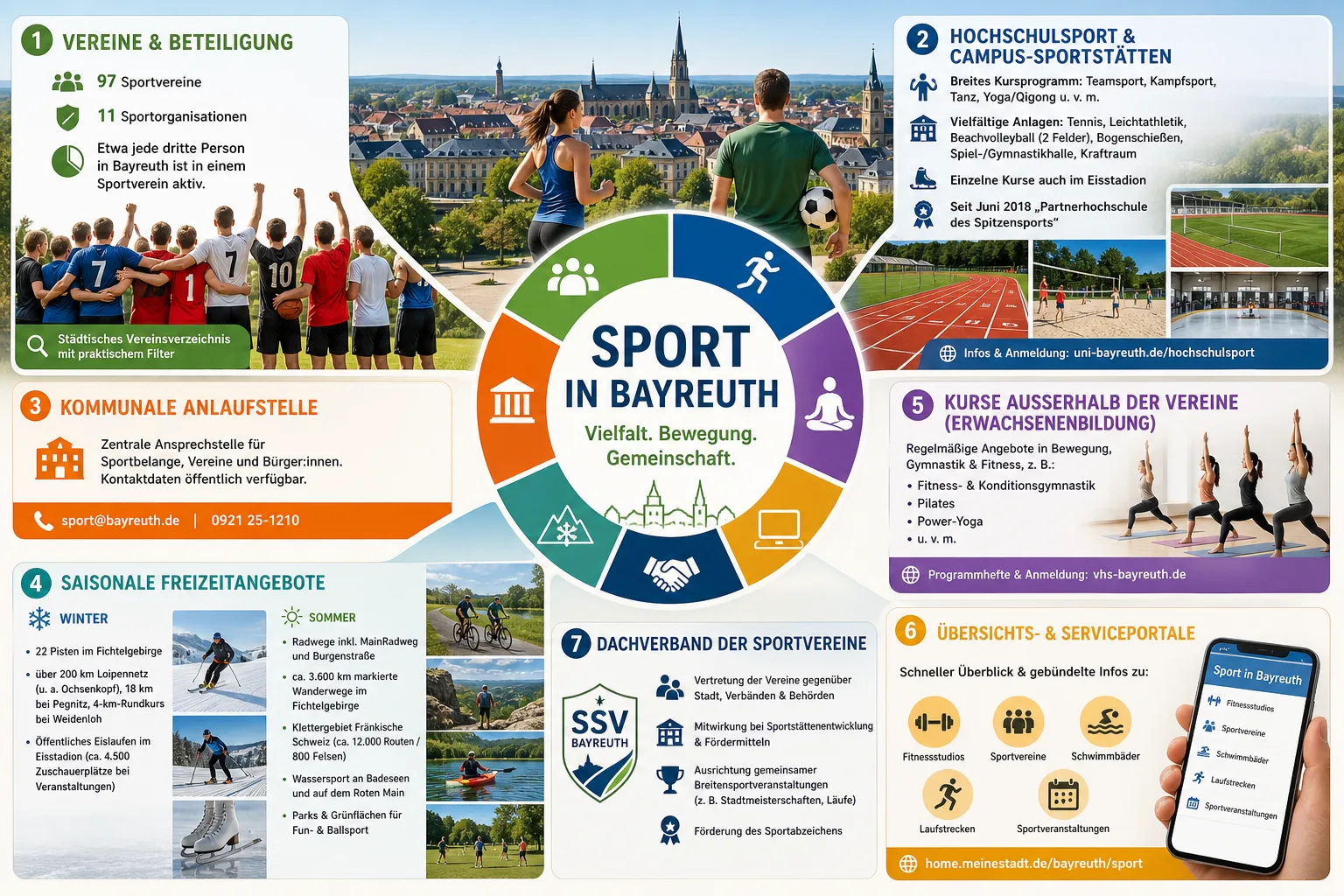
- Use the club directory: Search the city’s club directory specifically by sport and target group (e.g., beginner groups, youth, adults, seniors).
- Arrange a trial training: Contact the club by email/phone and ask for a start date in the next few weeks.
- Check what fits your daily life: Pay attention to training locations (district), times, required equipment, and whether you prefer recreational or competitive orientation.
- Demand transparency: Have membership fees, insurance/liability, and training rules explained to you in advance (reputable clubs state this clearly).
Tip for the coming months: Plan your start so that you can participate regularly for at least 6–8 weeks in a row. Especially at the start of the season (fall/winter), the best routine often develops.
University Sports: Making the Most of Winter Semester 2026/27
If you are studying or working at the University of Bayreuth, university sports is a particularly efficient way to try out a wide range of sports from winter semester 2026/27 – often without long-term club commitment and with clear course formats.
This is how you plan your university sports start in the coming semester
- Check the course program: Read the published course descriptions before the semester starts (target group, level, equipment).
- Note the registration window: Many courses are quickly booked out – decide early on 2–3 priorities.
- Build routines: Combine a “main sport” (e.g., team sport, strength/training, endurance) with a “balance” (e.g., mobility, yoga, technique).
If you want to better combine competitive sports and studies in the coming semesters, find out early about existing support offers and contact persons at the university.
Courses & Fitness: Flexible Options for the Coming Months
Do you want to start right away, but (still) no club structure? Then time-limited courses and flexible fitness offers are ideal: You can test what suits you and adapt your training to exam periods, working hours, or family life.
Which course types are particularly worthwhile from Fall 2026
- Beginner-friendly full-body courses: good for getting back into it, as the intensity can be controlled.
- Back & Mobility: useful if you will be sitting a lot in the coming months (office, lecture hall, home office).
- Endurance formats: helpful if you want to build a solid base for sports like running, cross-country skiing, or team sports by winter.
Decide safely: 5 quality features
- clear course goals (e.g., strength, mobility, endurance) and level indication
- information on health requirements and alternatives in case of complaints
- transparent pricing model and cancellation/participation conditions
- qualified course instructors (license/trainer profile publicly accessible)
- realistic progression (no “quick promises”)
Note: If you have a pre-existing condition or are returning after an injury, clarify before the course starts which intensity level is appropriate for you in the coming weeks.
Outdoor from Now: Hiking, Cycling, Climbing – with a Seasonal Plan
From Fall 2026, the region around Bayreuth is particularly attractive for outdoor sports: pleasant temperatures, clear visibility, and (depending on the weather) good conditions for tour planning. If you want to get out regularly, a simple, safe seasonal plan is worthwhile.
Hiking: Structuring Autumn Tours
For the coming weeks, plan tours with realistic elevation gains and day lengths. Pay attention early on to suitable equipment (layering principle, headlamp, emergency kit) and use official tourism and nature park information for route selection and safety instructions.
Cycling: From Everyday Routes to Training Routes
Use the fall to make your bike setup and routine winterproof: lights, reflectors, weather-appropriate clothing, and a safe route. If you have performance goals for 2027, start now with a basic endurance phase and increase volume moderately.
Climbing (Frankenjura/Franconian Switzerland): Plan Responsibly
If you want to go climbing in the coming months, find out in advance about current access rules, nature conservation requirements, and suitable areas for your level. For beginners, course formats (indoor or supervised outdoors) are the safest way to build up technique and safety skills properly.
Towards Winter 2026/27: Swimming, Ice Skating & Cross-Country Skiing
As it gets colder, it is worthwhile to plan your sports year from late fall 2026 so that you have options both indoors and outdoors. This way, you stay active regardless of the weather and reduce downtime.
Swimming: Winter-Proof Endurance without Joint Stress
Swimming is a good complement to running or strength training in the coming months because it strengthens endurance while being gentle on the joints. Check opening hours and lane occupancy in advance to avoid peak times.
Ice Skating: Technique, Coordination, Fun – with a Focus on Safety
For the winter season 2026/27, ice skating is a strong choice if you want to develop coordination, balance, and leg muscles. Start with short sessions, use well-fitting skates, and – especially for beginners or children – appropriate protective equipment.
Cross-Country Skiing: Building Endurance for the Cold Season
As soon as conditions are right, cross-country skiing is a very effective way to build endurance in winter. As a beginner, first plan technique lessons or supervised sessions and increase volume slowly to avoid overuse.
7-Step Roadmap: How to Find Your Suitable Offer
- Set a goal for the next 12 weeks: e.g., “exercise 2× per week” or “build strength pain-free by December 2026”.
- Clarify the framework: available days, budget, travel time, preferred times.
- Test 2 ways in parallel: e.g., club + course or university sports + outdoor.
- Check beginner-friendliness: level groups, introduction, equipment, injury prevention.
- Build in commitment: fixed appointment in the calendar (like a meeting).
- Measure progress: e.g., training days per week, subjective load, sleep/recovery.
- Decide after 6–8 weeks: What remains permanent, what gets replaced?
If you can’t decide: For the next few months, choose one main activity (routine) and one supplementary activity (balance). This is often more sustainable than starting five new things at once.