
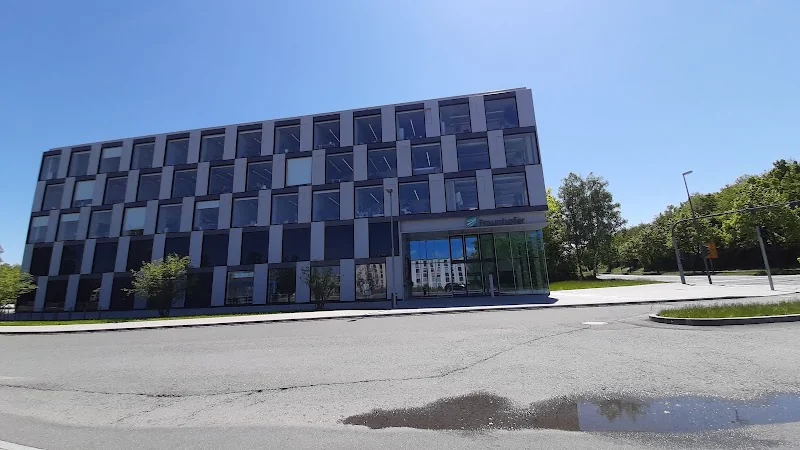
Bayreuth
Universitätsstraße 9, 95447 Bayreuth-Frankengut, Deutschland
Fraunhofer IPA - Project Group | Research & Projects
The Fraunhofer Project Group Process Innovation in Bayreuth is a place where scientific findings meet concrete industrial challenges. As a branch of the Fraunhofer Institute for Production Technology and Automation IPA, the facility works closely with the University of Bayreuth, companies, and other research partners. The focus is not on public events or traditional visitor offerings, but on application-oriented research, technology transfer, and the development of practical solutions for production and logistics. The address is Universitätsstraße 9, 95447 Bayreuth, Germany.
The topics range from additive manufacturing and industrial support processes to intelligent value chains and efficient production systems, supply chains, and remanufacturing. Data analytics, process understanding, digitization, and industrial IoT applications complement the profile. This makes the Fraunhofer Project Group particularly appealing to companies looking to improve production processes, evaluate new technologies, or transfer innovations into operational practice. The proximity to the University of Bayreuth also creates an environment for interdisciplinary collaboration, scientific exchange, and the training of skilled professionals.
Those looking for Fraunhofer IPA projects, the Fraunhofer Project Group in Bayreuth, or specific research collaborations will find here an institution with a clear industrial orientation. The location combines laboratories, a technical center, scientific expertise, and contacts with regional and supra-regional partners. The following overview brings together the most important search topics and location information in an understandable manner.
Fraunhofer IPA Project Group Process Innovation in Bayreuth
The Fraunhofer Project Group Process Innovation is organizationally assigned to the Fraunhofer Institute for Production Technology and Automation IPA. Fraunhofer IPA belongs to the Fraunhofer Society and is engaged in applied research for production technology, automation, and industrial value creation. The Bayreuth project group forms a regionally anchored research location with a close connection to the University of Bayreuth. This connection is crucial for the profile of the institution because scientific competencies from different disciplines are brought together with real questions from companies.
The official location description lists innovative processes, intelligent value chains, and efficient value creation systems as central areas of work. In these areas, it is not solely about individual machines or isolated work steps. Rather, the relationships between product, process, organization, data, material flow, and economic implementation are examined. The goal is to evaluate and design technical possibilities in such a way that a comprehensible benefit arises for industrial partners.
At the Bayreuth location, engineers and scientists work on research and development tasks in production and logistics. The project group is led by Prof. Dr.-Ing. Frank Döpper. Other publicly named contacts include research team leaders for additive processes and remanufacturing operations and management. This shows the thematic breadth of the project group: on one hand, new manufacturing processes and materials are investigated, while on the other hand, the organization of production and return processes as well as the economic use of resources are the focus.
For companies, collaboration can take various forms. This includes initial discussions on a technological challenge, potential analyses, joint research projects, pilot applications, the development of demonstrators, or support during implementation. The project group describes itself as a contact for specific questions, technological challenges, and project ideas. This makes it particularly interesting for small and medium-sized enterprises that want to complement their own research resources or seek access to specialized know-how and suitable infrastructure.
The term process innovation thus stands for a holistic approach. An innovation can lie in a new manufacturing process, data-based process control, an improved supply chain, a resource-saving product strategy, or a combination of several measures. The key is the transferability into industrial practice. Research at the Bayreuth location is therefore closely linked to application cases, metrics, and implementation issues.
Fraunhofer IPA Projects and Research Focus Areas
The Fraunhofer IPA projects of the Bayreuth project group can be assigned to several interconnected fields of topics. One focus is on innovative processes. This primarily includes additive manufacturing with its supporting process steps. Additive processes enable components to be manufactured layer by layer while realizing new geometries, functional integrations, or component consolidations. However, the benefit for companies does not arise solely from the printing process. Equally important are material selection, process parameters, post-processing, quality assurance, cost-effectiveness, and integration into existing production processes.
A second area of focus is intelligent value chains. Manufacturing companies often have data from machines, systems, quality assurance, logistics, and operational organization. However, this data does not always exist in a uniform form and can come from different systems. The project group works on solutions that make data more usable, analyze processes, and identify optimization potentials. Data analytics, process competence, and industrial IoT applications form important foundations.
A third focus is on efficient value creation systems. Here, production systems and supply chains are viewed holistically. Questions may relate to lead times, inventory, setup times, productivity, flexibility, or delivery reliability. Optimizing a single area is often not sufficient if it leads to new bottlenecks elsewhere. Therefore, material flows, capacities, workflows, planning logic, and organizational interfaces are examined together.
Refabrication or remanufacturing is also part of the competence profile. This involves returning, evaluating, reworking, and reusing products, components, or assemblies after a usage phase. Such models can reduce material consumption and resource requirements but pose special demands on disassembly, condition assessment, quality testing, spare parts management, and production planning. The research work thus connects technical, logistical, and business management questions.
The projects are not focused on a single industry. The Fraunhofer Project Group works with companies of various sizes and fields of activity. The common denominator is a production or logistical challenge where scientific methods and practical implementation are to be brought together. This may involve the introduction of a new technology, the improvement of an existing process, or the development of a new value creation model.
For interested parties, it is important to note that not every project is publicly described with complete technical details. Research and industry collaborations may contain confidential data, individual plant configurations, or protected process information. What is publicly visible is primarily the competence profile. Those looking for a specific Fraunhofer IPA project should therefore check the current topics of the project group and contact the named contacts directly.
Additive Manufacturing and Innovative Processes in Bayreuth
Additive manufacturing occupies a central position in the Fraunhofer Project Group Process Innovation. Additive manufacturing refers to processes in which components are created layer by layer from digital design data. Compared to many conventional processes, this allows for the production of complex geometries, the integration of functions into a component, or the consolidation of several individual parts into a unified assembly. These advantages are particularly interesting when weight, space, customization, or functional density play an important role.
Research in Bayreuth does not consider additive manufacturing in isolation. An industrially usable process begins with design and extends through material selection, data preparation, and manufacturing to post-processing, testing, and integration into overall production. Companies must therefore clarify which components are actually suitable for additive processes, what quality requirements apply, and how costs, time, and material usage develop. The project group supports the investigation of such questions with practical projects and suitable laboratories.
An important goal is the industrialization of additive processes. This involves turning a technically feasible process into a stable, repeatable, and economically justifiable process. For industrial use, process parameters must be controlled, data streams documented, and quality characteristics verifiable. Interfaces to existing machines, software solutions, workplaces, and logistics systems must also be taken into account. Thus, additive manufacturing becomes part of a comprehensive production system.
The project group claims to have several fully equipped laboratories for researching new applications. Additionally, an application center for additive manufacturing is mentioned. This infrastructure creates opportunities to investigate materials, processes, and process chains under application-oriented conditions. For industry partners, it is particularly relevant that not only theoretical concepts are considered, but also concrete application scenarios and the transfer into practice.
The University of Bayreuth and the Project Group Process Innovation jointly established the research center Campus Additive.Innovationen in April 2020. Scientists from five faculties, more than 26 chairs, and four non-university research institutions were involved. This interdisciplinary orientation shows that additive manufacturing is not only a topic of classical engineering sciences. Materials science, computer science, economics, environmental research, and other disciplines can contribute to the development of viable solutions.
For companies from Bayreuth, Upper Franconia, and beyond, this creates a regional point of contact for questions regarding 3D printing in industrial applications. The range extends from the initial potential assessment to the development and testing of concrete solutions. Those wishing to use additive manufacturing should evaluate not only the component itself but also the entire process chain. This connection of technology, organization, and economic efficiency characterizes the approach of the Fraunhofer Project Group.
Intelligent Value Chains and Production Optimization
Intelligent value chains are another central search and research focus of the Fraunhofer Project Group. A value chain encompasses far more than manufacturing in a single hall. It includes procurement, material provision, processing, assembly, quality assurance, storage, transport, delivery, and possibly the return of a product. When these areas are digitally connected, information can become available more quickly, and decisions can be made on a more reliable data basis.
The digitization of production often begins with the question of which data is actually available. Machine controls, sensors, ERP systems, quality data, and manual records can have different structures. Without clear data models and suitable interfaces, it is difficult to recognize relationships. The project group therefore deals with the use of data analytics, process competence, and IoT methods to analyze production processes and systematically derive improvements.
A practical goal of production optimization can be the reduction of lead times. Shorter lead times can improve responsiveness but must remain compatible with capacities, quality requirements, and delivery dates. Similarly, inventories can be reduced when material flows and needs are better planned. Setup times may be shortened through standardized processes, suitable planning, or technical support. However, each measure must be evaluated in the context of the entire system.
The Fraunhofer Project Group pursues an approach from conception to implementation. This means that cooperation does not necessarily end with a general digitization strategy. After an analysis, specific requirements can be formulated, pilot solutions developed, and tested in operational practice. For companies, this connection is important because digital tools only generate sustainable benefits when they are accepted by employees, technically integrated, and economically operated.
Small and medium-sized enterprises can also benefit from this type of research. They often have valuable production data and extensive practical experience but do not always have their own teams for data analysis, automation, or process modeling. A research collaboration can help prioritize relevant questions and start with manageable pilot projects. It is not about immediately fully networking every facility. Initially, a clearly defined application case may be sensible, in which benefits, effort, and transferability can be examined.
The intelligent value chain thus remains a tool for better decisions. It does not replace the knowledge of employees or the technical experience in a company. Rather, data and models can complement this knowledge, make patterns visible, and create the basis for continuous improvement. In Bayreuth, production technology expertise, scientific methods, and proximity to regional companies come together for this purpose.
Efficient Value Creation Systems, Supply Chain, and Remanufacturing
Efficient value creation systems form the third major area of focus for the Fraunhofer Project Group Process Innovation. The focus is on production systems and supply chains in both new parts production and spare parts production and remanufacturing. Efficiency is not reduced to a single metric. Productivity, flexibility, delivery reliability, resource use, inventory, lead times, and setup times can all be relevant at the same time. A solution must therefore balance multiple goals.
When designing a production system, the interplay of individual process steps is crucial. A fast work step does not automatically improve overall performance if downstream areas are overloaded or material is missing. Similarly, a high machine efficiency can be associated with long waiting times in the overall system. Method-based analyses help identify bottlenecks, dependencies, and unnecessary paths. On this basis, workflows can be replanned, capacities adjusted, or priorities changed.
Supply chains extend this consideration beyond one's own location. Suppliers, logistics service providers, customers, and return processes influence the stability of a value chain. Fluctuating demand, scarce materials, or long transport routes can affect production. A robust planning must therefore consider not only the current situation but also uncertainties and possible disruptions. Digitization and data analytics can help bring information together more quickly, but they do not replace the strategic assessment of risks and dependencies.
Remanufacturing complements classical new production by reworking already used products or components. The process begins with the return and condition assessment. This is typically followed by disassembly, cleaning, testing, repair or replacement of parts, reassembly, and quality approval. The specific process chain strongly depends on the product and the condition of the returned components. This distinguishes remanufacturing from a completely standardized new parts production.
The research on remanufacturing operations and management connects technical and organizational perspectives. Companies must clarify, for example, how returns are evaluated, work orders are planned, and spare parts are provided. The question of how quality and costs can be reliably determined is also important. A good solution must not only be ecologically sensible but also fit into the operational process and the business model.
The Fraunhofer Project Group supports companies with methodological approaches to increase productivity, flexibility, and delivery reliability. At the same time, lead times, inventories, and setup times can be considered. The benefit of a cooperation arises especially when the analysis is linked to an actionable change. This could be a new planning logic, a changed material flow, a digital decision support tool, or a newly designed process. Thus, the term efficiency becomes a concrete contribution to competitiveness.
Technical Center, Laboratories, and Equipment of the Fraunhofer Project Group
For application-oriented research, an institution needs more than offices and meeting rooms. The Fraunhofer Project Group Process Innovation has technical infrastructure that allows production and manufacturing questions to be investigated under realistic conditions. Publicly mentioned are a production technical center with several connected machine tools, an electronics laboratory, a chemistry laboratory, an application center for additive manufacturing, and a user factory 4.0. This equipment forms the basis for experiments, demonstrators, measurements, and the testing of digital production concepts.
A production technical center allows workflows to be viewed not only in models but also on technical systems and connected process steps. Connected machine tools can demonstrate how machine information is captured, transmitted, and evaluated. For research projects, it is particularly important that technical changes can be controlled and examined. This allows for the comparison of different process parameters, data structures, or organizational variants without immediately altering the ongoing operations of an industrial company.
The electronics laboratory complements the production technology infrastructure with options for electrical, sensory, and data-related questions. The chemistry laboratory can be relevant for investigations concerning materials, surfaces, process media, or process-related properties. The exact use depends on the respective project. Reliable statements about individual machines, processes, or current laboratory occupancy should therefore be directly inquired with the project group.
The user factory 4.0 metaphorically represents the connection of production, digitization, and practical demonstration. The term Industry 4.0 describes not only the networking of machines. Equally important are transparent processes, suitable data models, integrated planning, and the ability to translate information into concrete decisions. A user factory can help companies make new approaches understandable and evaluate potential applications before introducing them in their own operations.
According to Bayern Innovativ, the new building of the project group was inaugurated in August 2015. It mentions a technical center of approximately 800 square meters and space for up to 50 employees. This information describes the building capacity and should not be equated with an event or seating capacity. The facility is designed as a research and technology location, not as a concert hall, exhibition hall, or public event center.
For cooperation partners, the infrastructure is particularly valuable because research ideas become visible and practically verifiable. A digital process can be demonstrated, an additively manufactured component examined, or a production process analyzed based on data. However, the technical equipment does not replace a good project definition. Before starting a collaboration, goals, initial situation, data access, desired outcomes, and possible implementation must be clarified together.
Cooperation with the University of Bayreuth and the Fraunhofer Society
The proximity to the University of Bayreuth shapes the location of the Fraunhofer Project Group Process Innovation. The official representation mentions a close cooperation with the Chair of Environmentally Friendly Production Technology at the University of Bayreuth. Together, they work on topics from production and logistics. This creates an environment for companies where scientific foundations, technical development, and practical application can be connected.
University collaborations provide access to interdisciplinary perspectives. Production questions can, for example, be linked with materials science, computer science, economics, or environmental research. This is particularly relevant for topics such as additive manufacturing, resource efficiency, and digitization. A process may work technically but still leave organizational, ecological, or economic questions open. Interdisciplinary research helps to recognize these connections early.
The Fraunhofer Society stands for applied research with the aim of transferring scientific results into use. The Project Group Process Innovation is not an independent society but an institution of Fraunhofer IPA. This organizational classification is relevant for companies looking for a reliable research partner with a connection to industrial applications. At the same time, the project group remains regionally accessible at the Bayreuth location and connected to the structures of the university.
An example of the connection between Fraunhofer IPA and the University of Bayreuth is Campus Additive.Innovationen. The research center was founded in 2020 to address additive manufacturing interdisciplinary and provide companies with a point of contact for questions regarding the technology. The involvement of several faculties and non-university research institutions shows that the development of new production solutions can benefit from various fields of knowledge.
New collaborations in Bayreuth also address the connection between digitization and sustainability. The research campus Twin Transformation is emerging as a joint project of the business informatics division of Fraunhofer FIT and the Project Group Process Innovation of Fraunhofer IPA in close proximity to the University of Bayreuth. Twin Labs for digital and sustainable production, digital and sustainable organization, and digital and sustainable value creation networks are planned.
For interested parties, the university and non-university networking means that the location is more than just a single laboratory. It is part of a regional innovation ecosystem where companies, research institutions, and the university collaborate. Those with a project idea should describe the question as concretely as possible: What challenge exists, what data and facilities are available, what goal should be achieved, and what timeframe is realistic? On this basis, it can be checked which competencies and funding or cooperation models fit.
Address, Directions, and Contact in Bayreuth
The Fraunhofer Project Group Process Innovation is located at Universitätsstraße 9, 95447 Bayreuth. The location is situated in the vicinity of the University of Bayreuth and is thus integrated into a scientifically and technologically shaped area. For visitors, project partners, and companies, it is advisable to make an appointment in advance. The facility is not a freely accessible event center with an ongoing public program. Access to laboratories, technical areas, and workspaces depends on the respective appointment and contact person.
The published directions mention the A9 motorway for arrival by car. From Berlin or Nuremberg, the route leads to exit 42 Bayreuth-Süd. After the exit, turn right. At the end of Dr.-Konrad-Pöhner-Straße, turn right again into Universitätsstraße. According to the directions, the building of the project group is located on the right side. Those arriving by car should pay attention to the current parking situation and possible visitor regulations.
For arrival by public transport, the Central Bus Station Bayreuth is mentioned as the starting point. From there, bus lines 304 and 306 go to the stop Bayreuth Uni-Verwaltung. The distance from the main train station is given in the directions as about 3.5 kilometers. Depending on the time of day, construction sites, and schedules, connections may change. Therefore, it is advisable to check the current timetable data of the local transport company before the appointment.
The central phone number for the location is +49 921 78516-100. Prof. Dr.-Ing. Frank Döpper is named as the head of the project group. For additive processes and materials, M.Sc. Johann Schorzmann is listed as the research team leader. Dr.-Ing. Jan Koller is mentioned as the research team leader for remanufacturing operations and management. Depending on the concern, contacting the general location address or directly through the appropriate department may be sensible.
The address is also important for search queries because different spellings occur on the internet. Official pages use both Fraunhofer Project Group Process Innovation and Fraunhofer IPA Project Group Process Innovation. The facility is also described as a branch of Fraunhofer IPA at the Bayreuth location. These terms refer to the same research location on Universitätsstraße. The postal code 95447 belongs to the Bayreuth urban area.
Those planning a visit should communicate the occasion, number of people, desired topics, and time frame early. This facilitates preparation and helps find the appropriate contact person. For research collaborations, additional information about the initial situation, existing production data, and technical constraints is helpful. This way, an initial conversation can be conducted purposefully and show more quickly whether a common Fraunhofer IPA project can emerge from an idea.
Sources:
- Fraunhofer Project Group Process Innovation - Official Website
- Fraunhofer IPA - Networks and Collaborations
- Fraunhofer Project Group Process Innovation - Directions and Contact
- Bavaria Innovative - Fraunhofer IPA Project Group Process Innovation
- Fraunhofer IPA - Campus Additive.Innovationen
- Fraunhofer Research Campus Twin Transformation
- University of Bayreuth - Research Institutions with External Partners
Mehr anzeigenWeniger anzeigen
Fraunhofer IPA - Project Group | Research & Projects
The Fraunhofer Project Group Process Innovation in Bayreuth is a place where scientific findings meet concrete industrial challenges. As a branch of the Fraunhofer Institute for Production Technology and Automation IPA, the facility works closely with the University of Bayreuth, companies, and other research partners. The focus is not on public events or traditional visitor offerings, but on application-oriented research, technology transfer, and the development of practical solutions for production and logistics. The address is Universitätsstraße 9, 95447 Bayreuth, Germany.
The topics range from additive manufacturing and industrial support processes to intelligent value chains and efficient production systems, supply chains, and remanufacturing. Data analytics, process understanding, digitization, and industrial IoT applications complement the profile. This makes the Fraunhofer Project Group particularly appealing to companies looking to improve production processes, evaluate new technologies, or transfer innovations into operational practice. The proximity to the University of Bayreuth also creates an environment for interdisciplinary collaboration, scientific exchange, and the training of skilled professionals.
Those looking for Fraunhofer IPA projects, the Fraunhofer Project Group in Bayreuth, or specific research collaborations will find here an institution with a clear industrial orientation. The location combines laboratories, a technical center, scientific expertise, and contacts with regional and supra-regional partners. The following overview brings together the most important search topics and location information in an understandable manner.
Fraunhofer IPA Project Group Process Innovation in Bayreuth
The Fraunhofer Project Group Process Innovation is organizationally assigned to the Fraunhofer Institute for Production Technology and Automation IPA. Fraunhofer IPA belongs to the Fraunhofer Society and is engaged in applied research for production technology, automation, and industrial value creation. The Bayreuth project group forms a regionally anchored research location with a close connection to the University of Bayreuth. This connection is crucial for the profile of the institution because scientific competencies from different disciplines are brought together with real questions from companies.
The official location description lists innovative processes, intelligent value chains, and efficient value creation systems as central areas of work. In these areas, it is not solely about individual machines or isolated work steps. Rather, the relationships between product, process, organization, data, material flow, and economic implementation are examined. The goal is to evaluate and design technical possibilities in such a way that a comprehensible benefit arises for industrial partners.
At the Bayreuth location, engineers and scientists work on research and development tasks in production and logistics. The project group is led by Prof. Dr.-Ing. Frank Döpper. Other publicly named contacts include research team leaders for additive processes and remanufacturing operations and management. This shows the thematic breadth of the project group: on one hand, new manufacturing processes and materials are investigated, while on the other hand, the organization of production and return processes as well as the economic use of resources are the focus.
For companies, collaboration can take various forms. This includes initial discussions on a technological challenge, potential analyses, joint research projects, pilot applications, the development of demonstrators, or support during implementation. The project group describes itself as a contact for specific questions, technological challenges, and project ideas. This makes it particularly interesting for small and medium-sized enterprises that want to complement their own research resources or seek access to specialized know-how and suitable infrastructure.
The term process innovation thus stands for a holistic approach. An innovation can lie in a new manufacturing process, data-based process control, an improved supply chain, a resource-saving product strategy, or a combination of several measures. The key is the transferability into industrial practice. Research at the Bayreuth location is therefore closely linked to application cases, metrics, and implementation issues.
Fraunhofer IPA Projects and Research Focus Areas
The Fraunhofer IPA projects of the Bayreuth project group can be assigned to several interconnected fields of topics. One focus is on innovative processes. This primarily includes additive manufacturing with its supporting process steps. Additive processes enable components to be manufactured layer by layer while realizing new geometries, functional integrations, or component consolidations. However, the benefit for companies does not arise solely from the printing process. Equally important are material selection, process parameters, post-processing, quality assurance, cost-effectiveness, and integration into existing production processes.
A second area of focus is intelligent value chains. Manufacturing companies often have data from machines, systems, quality assurance, logistics, and operational organization. However, this data does not always exist in a uniform form and can come from different systems. The project group works on solutions that make data more usable, analyze processes, and identify optimization potentials. Data analytics, process competence, and industrial IoT applications form important foundations.
A third focus is on efficient value creation systems. Here, production systems and supply chains are viewed holistically. Questions may relate to lead times, inventory, setup times, productivity, flexibility, or delivery reliability. Optimizing a single area is often not sufficient if it leads to new bottlenecks elsewhere. Therefore, material flows, capacities, workflows, planning logic, and organizational interfaces are examined together.
Refabrication or remanufacturing is also part of the competence profile. This involves returning, evaluating, reworking, and reusing products, components, or assemblies after a usage phase. Such models can reduce material consumption and resource requirements but pose special demands on disassembly, condition assessment, quality testing, spare parts management, and production planning. The research work thus connects technical, logistical, and business management questions.
The projects are not focused on a single industry. The Fraunhofer Project Group works with companies of various sizes and fields of activity. The common denominator is a production or logistical challenge where scientific methods and practical implementation are to be brought together. This may involve the introduction of a new technology, the improvement of an existing process, or the development of a new value creation model.
For interested parties, it is important to note that not every project is publicly described with complete technical details. Research and industry collaborations may contain confidential data, individual plant configurations, or protected process information. What is publicly visible is primarily the competence profile. Those looking for a specific Fraunhofer IPA project should therefore check the current topics of the project group and contact the named contacts directly.
Additive Manufacturing and Innovative Processes in Bayreuth
Additive manufacturing occupies a central position in the Fraunhofer Project Group Process Innovation. Additive manufacturing refers to processes in which components are created layer by layer from digital design data. Compared to many conventional processes, this allows for the production of complex geometries, the integration of functions into a component, or the consolidation of several individual parts into a unified assembly. These advantages are particularly interesting when weight, space, customization, or functional density play an important role.
Research in Bayreuth does not consider additive manufacturing in isolation. An industrially usable process begins with design and extends through material selection, data preparation, and manufacturing to post-processing, testing, and integration into overall production. Companies must therefore clarify which components are actually suitable for additive processes, what quality requirements apply, and how costs, time, and material usage develop. The project group supports the investigation of such questions with practical projects and suitable laboratories.
An important goal is the industrialization of additive processes. This involves turning a technically feasible process into a stable, repeatable, and economically justifiable process. For industrial use, process parameters must be controlled, data streams documented, and quality characteristics verifiable. Interfaces to existing machines, software solutions, workplaces, and logistics systems must also be taken into account. Thus, additive manufacturing becomes part of a comprehensive production system.
The project group claims to have several fully equipped laboratories for researching new applications. Additionally, an application center for additive manufacturing is mentioned. This infrastructure creates opportunities to investigate materials, processes, and process chains under application-oriented conditions. For industry partners, it is particularly relevant that not only theoretical concepts are considered, but also concrete application scenarios and the transfer into practice.
The University of Bayreuth and the Project Group Process Innovation jointly established the research center Campus Additive.Innovationen in April 2020. Scientists from five faculties, more than 26 chairs, and four non-university research institutions were involved. This interdisciplinary orientation shows that additive manufacturing is not only a topic of classical engineering sciences. Materials science, computer science, economics, environmental research, and other disciplines can contribute to the development of viable solutions.
For companies from Bayreuth, Upper Franconia, and beyond, this creates a regional point of contact for questions regarding 3D printing in industrial applications. The range extends from the initial potential assessment to the development and testing of concrete solutions. Those wishing to use additive manufacturing should evaluate not only the component itself but also the entire process chain. This connection of technology, organization, and economic efficiency characterizes the approach of the Fraunhofer Project Group.
Intelligent Value Chains and Production Optimization
Intelligent value chains are another central search and research focus of the Fraunhofer Project Group. A value chain encompasses far more than manufacturing in a single hall. It includes procurement, material provision, processing, assembly, quality assurance, storage, transport, delivery, and possibly the return of a product. When these areas are digitally connected, information can become available more quickly, and decisions can be made on a more reliable data basis.
The digitization of production often begins with the question of which data is actually available. Machine controls, sensors, ERP systems, quality data, and manual records can have different structures. Without clear data models and suitable interfaces, it is difficult to recognize relationships. The project group therefore deals with the use of data analytics, process competence, and IoT methods to analyze production processes and systematically derive improvements.
A practical goal of production optimization can be the reduction of lead times. Shorter lead times can improve responsiveness but must remain compatible with capacities, quality requirements, and delivery dates. Similarly, inventories can be reduced when material flows and needs are better planned. Setup times may be shortened through standardized processes, suitable planning, or technical support. However, each measure must be evaluated in the context of the entire system.
The Fraunhofer Project Group pursues an approach from conception to implementation. This means that cooperation does not necessarily end with a general digitization strategy. After an analysis, specific requirements can be formulated, pilot solutions developed, and tested in operational practice. For companies, this connection is important because digital tools only generate sustainable benefits when they are accepted by employees, technically integrated, and economically operated.
Small and medium-sized enterprises can also benefit from this type of research. They often have valuable production data and extensive practical experience but do not always have their own teams for data analysis, automation, or process modeling. A research collaboration can help prioritize relevant questions and start with manageable pilot projects. It is not about immediately fully networking every facility. Initially, a clearly defined application case may be sensible, in which benefits, effort, and transferability can be examined.
The intelligent value chain thus remains a tool for better decisions. It does not replace the knowledge of employees or the technical experience in a company. Rather, data and models can complement this knowledge, make patterns visible, and create the basis for continuous improvement. In Bayreuth, production technology expertise, scientific methods, and proximity to regional companies come together for this purpose.
Efficient Value Creation Systems, Supply Chain, and Remanufacturing
Efficient value creation systems form the third major area of focus for the Fraunhofer Project Group Process Innovation. The focus is on production systems and supply chains in both new parts production and spare parts production and remanufacturing. Efficiency is not reduced to a single metric. Productivity, flexibility, delivery reliability, resource use, inventory, lead times, and setup times can all be relevant at the same time. A solution must therefore balance multiple goals.
When designing a production system, the interplay of individual process steps is crucial. A fast work step does not automatically improve overall performance if downstream areas are overloaded or material is missing. Similarly, a high machine efficiency can be associated with long waiting times in the overall system. Method-based analyses help identify bottlenecks, dependencies, and unnecessary paths. On this basis, workflows can be replanned, capacities adjusted, or priorities changed.
Supply chains extend this consideration beyond one's own location. Suppliers, logistics service providers, customers, and return processes influence the stability of a value chain. Fluctuating demand, scarce materials, or long transport routes can affect production. A robust planning must therefore consider not only the current situation but also uncertainties and possible disruptions. Digitization and data analytics can help bring information together more quickly, but they do not replace the strategic assessment of risks and dependencies.
Remanufacturing complements classical new production by reworking already used products or components. The process begins with the return and condition assessment. This is typically followed by disassembly, cleaning, testing, repair or replacement of parts, reassembly, and quality approval. The specific process chain strongly depends on the product and the condition of the returned components. This distinguishes remanufacturing from a completely standardized new parts production.
The research on remanufacturing operations and management connects technical and organizational perspectives. Companies must clarify, for example, how returns are evaluated, work orders are planned, and spare parts are provided. The question of how quality and costs can be reliably determined is also important. A good solution must not only be ecologically sensible but also fit into the operational process and the business model.
The Fraunhofer Project Group supports companies with methodological approaches to increase productivity, flexibility, and delivery reliability. At the same time, lead times, inventories, and setup times can be considered. The benefit of a cooperation arises especially when the analysis is linked to an actionable change. This could be a new planning logic, a changed material flow, a digital decision support tool, or a newly designed process. Thus, the term efficiency becomes a concrete contribution to competitiveness.
Technical Center, Laboratories, and Equipment of the Fraunhofer Project Group
For application-oriented research, an institution needs more than offices and meeting rooms. The Fraunhofer Project Group Process Innovation has technical infrastructure that allows production and manufacturing questions to be investigated under realistic conditions. Publicly mentioned are a production technical center with several connected machine tools, an electronics laboratory, a chemistry laboratory, an application center for additive manufacturing, and a user factory 4.0. This equipment forms the basis for experiments, demonstrators, measurements, and the testing of digital production concepts.
A production technical center allows workflows to be viewed not only in models but also on technical systems and connected process steps. Connected machine tools can demonstrate how machine information is captured, transmitted, and evaluated. For research projects, it is particularly important that technical changes can be controlled and examined. This allows for the comparison of different process parameters, data structures, or organizational variants without immediately altering the ongoing operations of an industrial company.
The electronics laboratory complements the production technology infrastructure with options for electrical, sensory, and data-related questions. The chemistry laboratory can be relevant for investigations concerning materials, surfaces, process media, or process-related properties. The exact use depends on the respective project. Reliable statements about individual machines, processes, or current laboratory occupancy should therefore be directly inquired with the project group.
The user factory 4.0 metaphorically represents the connection of production, digitization, and practical demonstration. The term Industry 4.0 describes not only the networking of machines. Equally important are transparent processes, suitable data models, integrated planning, and the ability to translate information into concrete decisions. A user factory can help companies make new approaches understandable and evaluate potential applications before introducing them in their own operations.
According to Bayern Innovativ, the new building of the project group was inaugurated in August 2015. It mentions a technical center of approximately 800 square meters and space for up to 50 employees. This information describes the building capacity and should not be equated with an event or seating capacity. The facility is designed as a research and technology location, not as a concert hall, exhibition hall, or public event center.
For cooperation partners, the infrastructure is particularly valuable because research ideas become visible and practically verifiable. A digital process can be demonstrated, an additively manufactured component examined, or a production process analyzed based on data. However, the technical equipment does not replace a good project definition. Before starting a collaboration, goals, initial situation, data access, desired outcomes, and possible implementation must be clarified together.
Cooperation with the University of Bayreuth and the Fraunhofer Society
The proximity to the University of Bayreuth shapes the location of the Fraunhofer Project Group Process Innovation. The official representation mentions a close cooperation with the Chair of Environmentally Friendly Production Technology at the University of Bayreuth. Together, they work on topics from production and logistics. This creates an environment for companies where scientific foundations, technical development, and practical application can be connected.
University collaborations provide access to interdisciplinary perspectives. Production questions can, for example, be linked with materials science, computer science, economics, or environmental research. This is particularly relevant for topics such as additive manufacturing, resource efficiency, and digitization. A process may work technically but still leave organizational, ecological, or economic questions open. Interdisciplinary research helps to recognize these connections early.
The Fraunhofer Society stands for applied research with the aim of transferring scientific results into use. The Project Group Process Innovation is not an independent society but an institution of Fraunhofer IPA. This organizational classification is relevant for companies looking for a reliable research partner with a connection to industrial applications. At the same time, the project group remains regionally accessible at the Bayreuth location and connected to the structures of the university.
An example of the connection between Fraunhofer IPA and the University of Bayreuth is Campus Additive.Innovationen. The research center was founded in 2020 to address additive manufacturing interdisciplinary and provide companies with a point of contact for questions regarding the technology. The involvement of several faculties and non-university research institutions shows that the development of new production solutions can benefit from various fields of knowledge.
New collaborations in Bayreuth also address the connection between digitization and sustainability. The research campus Twin Transformation is emerging as a joint project of the business informatics division of Fraunhofer FIT and the Project Group Process Innovation of Fraunhofer IPA in close proximity to the University of Bayreuth. Twin Labs for digital and sustainable production, digital and sustainable organization, and digital and sustainable value creation networks are planned.
For interested parties, the university and non-university networking means that the location is more than just a single laboratory. It is part of a regional innovation ecosystem where companies, research institutions, and the university collaborate. Those with a project idea should describe the question as concretely as possible: What challenge exists, what data and facilities are available, what goal should be achieved, and what timeframe is realistic? On this basis, it can be checked which competencies and funding or cooperation models fit.
Address, Directions, and Contact in Bayreuth
The Fraunhofer Project Group Process Innovation is located at Universitätsstraße 9, 95447 Bayreuth. The location is situated in the vicinity of the University of Bayreuth and is thus integrated into a scientifically and technologically shaped area. For visitors, project partners, and companies, it is advisable to make an appointment in advance. The facility is not a freely accessible event center with an ongoing public program. Access to laboratories, technical areas, and workspaces depends on the respective appointment and contact person.
The published directions mention the A9 motorway for arrival by car. From Berlin or Nuremberg, the route leads to exit 42 Bayreuth-Süd. After the exit, turn right. At the end of Dr.-Konrad-Pöhner-Straße, turn right again into Universitätsstraße. According to the directions, the building of the project group is located on the right side. Those arriving by car should pay attention to the current parking situation and possible visitor regulations.
For arrival by public transport, the Central Bus Station Bayreuth is mentioned as the starting point. From there, bus lines 304 and 306 go to the stop Bayreuth Uni-Verwaltung. The distance from the main train station is given in the directions as about 3.5 kilometers. Depending on the time of day, construction sites, and schedules, connections may change. Therefore, it is advisable to check the current timetable data of the local transport company before the appointment.
The central phone number for the location is +49 921 78516-100. Prof. Dr.-Ing. Frank Döpper is named as the head of the project group. For additive processes and materials, M.Sc. Johann Schorzmann is listed as the research team leader. Dr.-Ing. Jan Koller is mentioned as the research team leader for remanufacturing operations and management. Depending on the concern, contacting the general location address or directly through the appropriate department may be sensible.
The address is also important for search queries because different spellings occur on the internet. Official pages use both Fraunhofer Project Group Process Innovation and Fraunhofer IPA Project Group Process Innovation. The facility is also described as a branch of Fraunhofer IPA at the Bayreuth location. These terms refer to the same research location on Universitätsstraße. The postal code 95447 belongs to the Bayreuth urban area.
Those planning a visit should communicate the occasion, number of people, desired topics, and time frame early. This facilitates preparation and helps find the appropriate contact person. For research collaborations, additional information about the initial situation, existing production data, and technical constraints is helpful. This way, an initial conversation can be conducted purposefully and show more quickly whether a common Fraunhofer IPA project can emerge from an idea.
Sources:
- Fraunhofer Project Group Process Innovation - Official Website
- Fraunhofer IPA - Networks and Collaborations
- Fraunhofer Project Group Process Innovation - Directions and Contact
- Bavaria Innovative - Fraunhofer IPA Project Group Process Innovation
- Fraunhofer IPA - Campus Additive.Innovationen
- Fraunhofer Research Campus Twin Transformation
- University of Bayreuth - Research Institutions with External Partners
Upcoming Events
"Mission: Bella Bayreuth!" – Practice Briefing
StartING-up: Starting Instead of Hiring?
Pitch-Basics: Presenting Business Ideas Persuasively
Mission: Bella Bayreuth! – Showdown
Frequently Asked Questions
Reviews
No reviews found