
Bayreuth
Friedrich-Ebert-Straße 74, 95448 Bayreuth, Deutschland
Hans-Walter-Wild-Stadion | Parking & Seating Plan
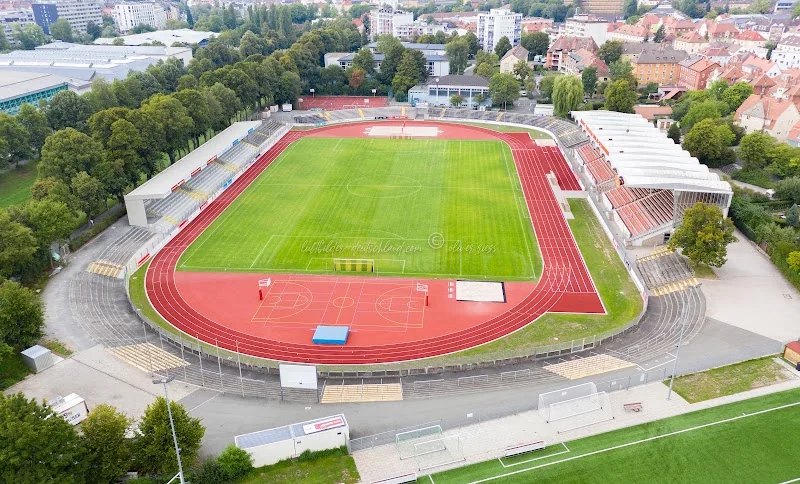
The Hans-Walter-Wild-Stadion is Bayreuth's traditional football and athletics arena and has been closely associated with the sports park on the Red Main for decades. The municipal facility was inaugurated in 1967 with a sports festival and has been named after the former mayor Hans Walter Wild since 2002, who was particularly committed to sports in Bayreuth. Today, the stadium is the home ground of SpVgg Bayreuth, affectionately known as Oldschdod in the city, and is one of the most well-known sports venues in the Wagner city. Depending on the official representation, the capacity is stated as around 20,000 or 21,500 seats; for current home games and marketing, the club's website lists a total capacity of 21,500. Particularly striking is the mix of tradition, proximity to the city, and modernization: In recent years, the stadium has been adapted several times to meet the demands of modern play. At the same time, the character of a municipal multipurpose stadium remains palpable, which has not only experienced football but also great sports and event moments. ([bayreuth.de](https://www.bayreuth.de/tourismus-kultur-freizeit/freizeit-sport-gesundheit/sportstaetten/hans-walter-wild-stadion/))
Directions and Parking at Hans-Walter-Wild-Stadion
Those who want to reach the Hans-Walter-Wild-Stadion by car will find clear and practical guidance on the official pages. The club's website lists the stadium at Friedrich-Ebert-Straße 74 in 95448 Bayreuth and describes the approach via the Bayreuth Nord motorway exit on the A9. Coming from the south, the route leads via the B2 towards the city center, past the Main Bridge, entering at the OMV petrol station; coming from the north, the B2 is also used. This approach is relevant for home fans as well as visiting fans because the stadium is embedded in an urban sports facility and does not function as an isolated single area. For visitors, this means: Arriving early is worthwhile, especially for games with a large turnout when traffic management in the vicinity of the sports park plays a role. The club's website currently also points to traffic management measures around the renewal of the high bridge at the Bayreuth-Nord exit, which can additionally influence route planning. ([spvgg-bayreuth.de](https://www.spvgg-bayreuth.de/heimspiel/anfahrt-parken/))
When it comes to parking, the stadium is very well organized. The parking garage at the sports park in Albrecht-Dürer-Straße 2a is specifically mentioned, which offers around 730 parking spaces for cars. The club's website also lists the conditions: 1.50 euros per started hour, 6.00 euros daily rate, and an event flat rate of 4.00 euros. For coaches, up to eight spaces are available in front of the parking garage at the sports park. This is important for major game days because the stadium regularly hosts matches with high demand, and parking space nearby plays a significant role. Those arriving by train benefit from the short distance to the stadium: According to the club's website, it takes about 10 minutes on foot from Bayreuth main station to the guest entrance, which can be reached via Tunnelstraße, Am Schwarzen Steg, and Albrecht-Dürer-Straße. This mix of central location, parking garage, and walking distance is a real plus for visiting fans. ([spvgg-bayreuth.de](https://www.spvgg-bayreuth.de/heimspiel/anfahrt-parken/))
The municipal classification of the location is also helpful for better understanding the orientation on site. The city of Bayreuth assigns the stadium to the sports park and lists the address as Am Sportpark 3, 95448 Bayreuth. This shows how strongly the area is intended as part of a larger sports ensemble. Therefore, those planning a visit should not only consider the pure stadium address but also the surrounding logic: parking garage, footpaths, sports park, and main station are close together. For football days with many guests, this is ideal because arrival, parking, and the way to the entrance can be organized relatively compactly. At the same time, the location in the middle of the city defines the character of the stadium: it is not an anonymous outskirt, but a real part of the Bayreuth urban fabric. This combination of central accessibility and sports park infrastructure is one of the reasons why the Hans-Walter-Wild-Stadion works so well during home games. ([bayreuth.de](https://www.bayreuth.de/tourismus-kultur-freizeit/freizeit-sport-gesundheit/sportstaetten/hans-walter-wild-stadion/))
Seating Plan, Seats, and Capacity Overview
The topic of seating plan and seats is one of the most frequently searched questions regarding the Hans-Walter-Wild-Stadion, and the official pages provide several important points of reference for this. The city of Bayreuth describes the stadium as a football and athletics arena with around 20,000 seats. SpVgg Bayreuth lists 21,500 as total capacity on its stadium page. For classification, it is therefore important that different counting methods and expansion statuses stand side by side in the official sources. Those orienting themselves to current home games should consider the club's figure of 21,500 as a practically relevant total capacity, while the city page describes the stadium more as a round figure. In both cases, it is clear: The Hans-Walter-Wild-Stadion is one of the larger venues in Northern Bavaria and offers significantly more space than a classic amateur stadium. Especially for games with greater spectator interest, this size is a central location advantage. ([bayreuth.de](https://www.bayreuth.de/rathaus-buergerservice/stadtverwaltung/zahlen-fakten-2/kultur-sport-freizeit/?utm_source=openai))
The seating and grandstand structure is also well documented. In 1974, the arena received a covered grandstand with 3,400 seats. Later, expansion work was added to the west and east curves, with further steps following in 1979 and 1992. In 2018, a new covered standing grandstand was built on the opposite side. For the visitor's perspective, this mix is crucial: a fixed, covered seating area, as well as curves and standing areas that shape the stadium's image. The club's website also mentions the blocks on the opposite side, affectionately referred to as the “Biest,” where the most loyal fans create atmosphere. Additionally, sector separation, new seats, and further modernizations have been implemented for the match operation in recent years. This means: The stadium is not only large but also differentiated in its use. For fans looking for the best seat, the pure number of seats is not the only consideration; the question of whether they prefer the main grandstand, curve, or opposite side also counts. ([bayreuth.de](https://www.bayreuth.de/tourismus-kultur-freizeit/freizeit-sport-gesundheit/sportstaetten/hans-walter-wild-stadion/))
An official seating plan with detailed block numbers is not prominently displayed on the reviewed pages, but the spatial logic of the stadium is described very clearly. Those orienting themselves to the schedule or ticket page quickly recognize that the stadium is particularly designed for football days with different visitor zones. The combination of a covered main grandstand, standing areas, and fan groups on the opposite side creates exactly that classic stadium atmosphere that many visitors associate with the Hans-Walter-Wild-Stadion. For practical planning, it is therefore especially important: The capacity is large, the grandstand structure is multifaceted, and the atmosphere is strongly influenced by the sectors visited. Those seeking a seat with as much comfort as possible will look more in the main grandstand; those who prefer atmosphere and proximity to the action will orient themselves towards the standing areas and the opposite side. ([spvgg-bayreuth.de](https://www.spvgg-bayreuth.de/heimspiel/stadion/))
Today, Match Schedule, and Tickets for Home Games
The interest in “today,” “match today,” and current dates is particularly high among stadium searches, so it is worth taking a look at the schedule page of SpVgg Bayreuth. As of July 16, 2026, the public page lists a friendly match against FC Carl Zeiss Jena on July 17, 2026, at 6:00 PM at the Hans-Walter-Wild-Stadion. For the current day itself, public training sessions at the training ground at Post-SV Bayreuth are noted on the schedule page, which shows that the stadium is not occupied with a home game every day but alternates between match operations and training routines. This mix makes the page very useful for visitors: It shows whether the stadium is a venue on a specific day or not. Since last-minute changes are always possible, the schedule page is the most reliable entry point for anyone planning a stadium visit concretely. ([spvgg-bayreuth.de](https://www.spvgg-bayreuth.de/termine/))
For tickets, the Bayreuth tourism page lists several official sales channels. Football tickets for the Hans-Walter-Wild-Stadion are available at the theater box office in Bayreuth, through advance sales outlets, and at the box office on match days. This is practical for visitors because it allows for both spontaneous and planned stadium visits. At the same time, this ticket logic fits well with the character of the stadium: It is a traditional football address with modern marketing but without overly complicated entry logic. Those who plan early use advance sales or the theater box office; those who decide last minute check the box office. Especially for attractive matches, it is advisable not to clarify the ticket situation only on the day of the event, as the stadium has been reported sold out several times in the past for important matches. This applies to both sporting highlights and matches that generate special attention in the region. ([bayreuth-tourismus.de](https://www.bayreuth-tourismus.de/hans-walter-wild-stadion/))
For search queries regarding “hans walter wild stadium today” or “match today,” it is also important that the stadium is not only used during the season but also plays a role in preparations and friendly matches. The schedule page shows very concrete processes with training locations, test matches, and home game dates. For visitors, this means: The Hans-Walter-Wild-Stadion is an active, regularly played location and not just a pure historical backdrop. Therefore, anyone planning a visit today or in the coming days should keep an eye on not only the stadium page but also the current schedule overview. This way, match days, training times, and ticket information can be clearly separated. This is especially important if you are traveling from outside or want to combine your stadium visit with a stay in the city of Bayreuth. ([spvgg-bayreuth.de](https://www.spvgg-bayreuth.de/termine/))
History, Renovation, and Great Stadium Moments
The history of the Hans-Walter-Wild-Stadion is closely linked to the development of Bayreuth football and municipal sports policy. The stadium was ceremonially opened in 1967 and was designed from the beginning as a football and athletics stadium. Since 1974, SpVgg Bayreuth has played its home games there, after the club was previously based at Jakobshöhe. In 2002, the arena received its current name in honor of the former mayor Hans Walter Wild. The city and the club tell the same basic story from two perspectives: the urban expansion of a sports location and the sporting home of a traditional club. The fact that the stadium has been modernized repeatedly over decades is no coincidence but an expression of its significance for Bayreuth. ([bayreuth.de](https://www.bayreuth.de/tourismus-kultur-freizeit/freizeit-sport-gesundheit/sportstaetten/hans-walter-wild-stadion/))
Particularly formative were the construction steps in the 1970s and 1990s. In 1974, the covered grandstand with 3,400 seats was added, followed later by expansion work on the west and east curves. In 2005, the city of Bayreuth renovated the facility again to secure match operations in the regional league. In 2018, a new covered standing grandstand was built on the opposite side, and further renovation and modernization work followed in 2021 and 2022, including the floodlight system. This is crucial for the stadium atmosphere because evening games are significantly more intense due to the lighting and the covered areas. The club's website even emphasizes that the floodlight system creates perfect conditions for the now frequent and popular evening games. This shows how closely architecture, technology, and fan experience are interconnected. ([bayreuth.de](https://www.bayreuth.de/tourismus-kultur-freizeit/freizeit-sport-gesundheit/sportstaetten/hans-walter-wild-stadion/))
The stadium also has a remarkable history regarding spectator records. Among the sporting highlights are the promotion match to the 1st Bundesliga against Bayer 05 Uerdingen in 1979 with 22,000 spectators, the DFB-Pokal against FC Bayern Munich in 1980 with 18,000 spectators, the Bayernliga championship against TSV 1860 Munich in 1987 with 20,000 spectators, and the DFB-Pokal match against Hamburger SV in 2022 with 14,700 spectators. The event character of the stadium is also particularly spectacular: The city mentions open-air concerts with Rod Stewart, Michael Jackson, Bon Jovi, PUR, Peter Maffay, and Die Toten Hosen. The club's website adds that around 28,000 people wanted to see Michael Jackson on September 2, 1992. This makes it clear that the Hans-Walter-Wild-Stadion is more than just a football arena; it has been and continues to be a stage for great mass moments that extend far beyond league operations. ([bayreuth.de](https://www.bayreuth.de/tourismus-kultur-freizeit/freizeit-sport-gesundheit/sportstaetten/hans-walter-wild-stadion/))
Sports Park on the Main and the Special Stadium Feeling
A significant part of the fascination lies in the location of the stadium in the sports park. The official city page describes it as an essential component of the Bayreuth sports landscape, located in the middle of the city and with several facilities in close proximity. These include the indoor pool of the swimming club, the municipal ice stadium, and the multifunctional Oberfrankenhalle. The club's website adds that the complex is located directly on the Red Main. This combination makes the location special: The stadium is not isolated but part of a sports ensemble that makes Bayreuth visible as a vibrant sports city. Upon arrival, one quickly realizes that various sports and events converge here. This creates a different dynamic than at a pure football location because the place remains present even outside of home games. ([bayreuth.de](https://www.bayreuth.de/tourismus-kultur-freizeit/freizeit-sport-gesundheit/sportstaetten/hans-walter-wild-stadion/))
For the stadium feeling itself, the mix of covered grandstand, standing areas, opposite side, and fan blocks is crucial. The club's website describes the opposite side with the fan block “Biest” as the place of the loudest support. At the same time, sector separation ensures that the different areas can be used in an orderly manner. In practice, this means: The stadium combines classic stadium atmosphere with more modern safety and event structures. This balance is popular with many visitors because it connects emotion and overview. Those who look closely at photos or during their first visit quickly recognize that not only a game takes place here but a well-coordinated interplay of architecture, fans, and event technology. Especially during evening games, the charm of the stadium unfolds when the floodlight system sharpens the view of the grandstands and the opposite side. ([spvgg-bayreuth.de](https://www.spvgg-bayreuth.de/heimspiel/stadion/))
Historically, the location is also linked to Bayreuth's football identity. The roots of SpVgg Bayreuth lie at Jakobshöhe, but since 1974, the Hans-Walter-Wild-Stadion has been the home of the Oldschdod. This relocation marks the transition from a more traditional club site to an urban arena with greater reach. Today, the stadium is therefore not only a venue but also a place of remembrance for the development of Bayreuth sports. The municipal naming, the numerous modernizations, the concert history, and the football highlights together create a profile that is extraordinary in Northern Bavaria. Therefore, those searching for photos, entrances, blocks, or the term track will not end up at an anonymous sports facility but at a stadium with real identity. This identity is precisely why the Hans-Walter-Wild-Stadion remains interesting for both football fans and stadium-goers and city visitors. ([spvgg-bayreuth.de](https://www.spvgg-bayreuth.de/die-oldschdod/jakobshoehe/))
Sources:
The following official pages were used for research on capacity, directions, parking, history, match dates, and stadium structure. They form the basis for the facts presented here and help to verify current information on home games, access, and the stadium's surroundings. ([bayreuth.de](https://www.bayreuth.de/tourismus-kultur-freizeit/freizeit-sport-gesundheit/sportstaetten/hans-walter-wild-stadion/))
Mehr anzeigenWeniger anzeigen
Hans-Walter-Wild-Stadion | Parking & Seating Plan
The Hans-Walter-Wild-Stadion is Bayreuth's traditional football and athletics arena and has been closely associated with the sports park on the Red Main for decades. The municipal facility was inaugurated in 1967 with a sports festival and has been named after the former mayor Hans Walter Wild since 2002, who was particularly committed to sports in Bayreuth. Today, the stadium is the home ground of SpVgg Bayreuth, affectionately known as Oldschdod in the city, and is one of the most well-known sports venues in the Wagner city. Depending on the official representation, the capacity is stated as around 20,000 or 21,500 seats; for current home games and marketing, the club's website lists a total capacity of 21,500. Particularly striking is the mix of tradition, proximity to the city, and modernization: In recent years, the stadium has been adapted several times to meet the demands of modern play. At the same time, the character of a municipal multipurpose stadium remains palpable, which has not only experienced football but also great sports and event moments. ([bayreuth.de](https://www.bayreuth.de/tourismus-kultur-freizeit/freizeit-sport-gesundheit/sportstaetten/hans-walter-wild-stadion/))
Directions and Parking at Hans-Walter-Wild-Stadion
Those who want to reach the Hans-Walter-Wild-Stadion by car will find clear and practical guidance on the official pages. The club's website lists the stadium at Friedrich-Ebert-Straße 74 in 95448 Bayreuth and describes the approach via the Bayreuth Nord motorway exit on the A9. Coming from the south, the route leads via the B2 towards the city center, past the Main Bridge, entering at the OMV petrol station; coming from the north, the B2 is also used. This approach is relevant for home fans as well as visiting fans because the stadium is embedded in an urban sports facility and does not function as an isolated single area. For visitors, this means: Arriving early is worthwhile, especially for games with a large turnout when traffic management in the vicinity of the sports park plays a role. The club's website currently also points to traffic management measures around the renewal of the high bridge at the Bayreuth-Nord exit, which can additionally influence route planning. ([spvgg-bayreuth.de](https://www.spvgg-bayreuth.de/heimspiel/anfahrt-parken/))
When it comes to parking, the stadium is very well organized. The parking garage at the sports park in Albrecht-Dürer-Straße 2a is specifically mentioned, which offers around 730 parking spaces for cars. The club's website also lists the conditions: 1.50 euros per started hour, 6.00 euros daily rate, and an event flat rate of 4.00 euros. For coaches, up to eight spaces are available in front of the parking garage at the sports park. This is important for major game days because the stadium regularly hosts matches with high demand, and parking space nearby plays a significant role. Those arriving by train benefit from the short distance to the stadium: According to the club's website, it takes about 10 minutes on foot from Bayreuth main station to the guest entrance, which can be reached via Tunnelstraße, Am Schwarzen Steg, and Albrecht-Dürer-Straße. This mix of central location, parking garage, and walking distance is a real plus for visiting fans. ([spvgg-bayreuth.de](https://www.spvgg-bayreuth.de/heimspiel/anfahrt-parken/))
The municipal classification of the location is also helpful for better understanding the orientation on site. The city of Bayreuth assigns the stadium to the sports park and lists the address as Am Sportpark 3, 95448 Bayreuth. This shows how strongly the area is intended as part of a larger sports ensemble. Therefore, those planning a visit should not only consider the pure stadium address but also the surrounding logic: parking garage, footpaths, sports park, and main station are close together. For football days with many guests, this is ideal because arrival, parking, and the way to the entrance can be organized relatively compactly. At the same time, the location in the middle of the city defines the character of the stadium: it is not an anonymous outskirt, but a real part of the Bayreuth urban fabric. This combination of central accessibility and sports park infrastructure is one of the reasons why the Hans-Walter-Wild-Stadion works so well during home games. ([bayreuth.de](https://www.bayreuth.de/tourismus-kultur-freizeit/freizeit-sport-gesundheit/sportstaetten/hans-walter-wild-stadion/))
Seating Plan, Seats, and Capacity Overview
The topic of seating plan and seats is one of the most frequently searched questions regarding the Hans-Walter-Wild-Stadion, and the official pages provide several important points of reference for this. The city of Bayreuth describes the stadium as a football and athletics arena with around 20,000 seats. SpVgg Bayreuth lists 21,500 as total capacity on its stadium page. For classification, it is therefore important that different counting methods and expansion statuses stand side by side in the official sources. Those orienting themselves to current home games should consider the club's figure of 21,500 as a practically relevant total capacity, while the city page describes the stadium more as a round figure. In both cases, it is clear: The Hans-Walter-Wild-Stadion is one of the larger venues in Northern Bavaria and offers significantly more space than a classic amateur stadium. Especially for games with greater spectator interest, this size is a central location advantage. ([bayreuth.de](https://www.bayreuth.de/rathaus-buergerservice/stadtverwaltung/zahlen-fakten-2/kultur-sport-freizeit/?utm_source=openai))
The seating and grandstand structure is also well documented. In 1974, the arena received a covered grandstand with 3,400 seats. Later, expansion work was added to the west and east curves, with further steps following in 1979 and 1992. In 2018, a new covered standing grandstand was built on the opposite side. For the visitor's perspective, this mix is crucial: a fixed, covered seating area, as well as curves and standing areas that shape the stadium's image. The club's website also mentions the blocks on the opposite side, affectionately referred to as the “Biest,” where the most loyal fans create atmosphere. Additionally, sector separation, new seats, and further modernizations have been implemented for the match operation in recent years. This means: The stadium is not only large but also differentiated in its use. For fans looking for the best seat, the pure number of seats is not the only consideration; the question of whether they prefer the main grandstand, curve, or opposite side also counts. ([bayreuth.de](https://www.bayreuth.de/tourismus-kultur-freizeit/freizeit-sport-gesundheit/sportstaetten/hans-walter-wild-stadion/))
An official seating plan with detailed block numbers is not prominently displayed on the reviewed pages, but the spatial logic of the stadium is described very clearly. Those orienting themselves to the schedule or ticket page quickly recognize that the stadium is particularly designed for football days with different visitor zones. The combination of a covered main grandstand, standing areas, and fan groups on the opposite side creates exactly that classic stadium atmosphere that many visitors associate with the Hans-Walter-Wild-Stadion. For practical planning, it is therefore especially important: The capacity is large, the grandstand structure is multifaceted, and the atmosphere is strongly influenced by the sectors visited. Those seeking a seat with as much comfort as possible will look more in the main grandstand; those who prefer atmosphere and proximity to the action will orient themselves towards the standing areas and the opposite side. ([spvgg-bayreuth.de](https://www.spvgg-bayreuth.de/heimspiel/stadion/))
Today, Match Schedule, and Tickets for Home Games
The interest in “today,” “match today,” and current dates is particularly high among stadium searches, so it is worth taking a look at the schedule page of SpVgg Bayreuth. As of July 16, 2026, the public page lists a friendly match against FC Carl Zeiss Jena on July 17, 2026, at 6:00 PM at the Hans-Walter-Wild-Stadion. For the current day itself, public training sessions at the training ground at Post-SV Bayreuth are noted on the schedule page, which shows that the stadium is not occupied with a home game every day but alternates between match operations and training routines. This mix makes the page very useful for visitors: It shows whether the stadium is a venue on a specific day or not. Since last-minute changes are always possible, the schedule page is the most reliable entry point for anyone planning a stadium visit concretely. ([spvgg-bayreuth.de](https://www.spvgg-bayreuth.de/termine/))
For tickets, the Bayreuth tourism page lists several official sales channels. Football tickets for the Hans-Walter-Wild-Stadion are available at the theater box office in Bayreuth, through advance sales outlets, and at the box office on match days. This is practical for visitors because it allows for both spontaneous and planned stadium visits. At the same time, this ticket logic fits well with the character of the stadium: It is a traditional football address with modern marketing but without overly complicated entry logic. Those who plan early use advance sales or the theater box office; those who decide last minute check the box office. Especially for attractive matches, it is advisable not to clarify the ticket situation only on the day of the event, as the stadium has been reported sold out several times in the past for important matches. This applies to both sporting highlights and matches that generate special attention in the region. ([bayreuth-tourismus.de](https://www.bayreuth-tourismus.de/hans-walter-wild-stadion/))
For search queries regarding “hans walter wild stadium today” or “match today,” it is also important that the stadium is not only used during the season but also plays a role in preparations and friendly matches. The schedule page shows very concrete processes with training locations, test matches, and home game dates. For visitors, this means: The Hans-Walter-Wild-Stadion is an active, regularly played location and not just a pure historical backdrop. Therefore, anyone planning a visit today or in the coming days should keep an eye on not only the stadium page but also the current schedule overview. This way, match days, training times, and ticket information can be clearly separated. This is especially important if you are traveling from outside or want to combine your stadium visit with a stay in the city of Bayreuth. ([spvgg-bayreuth.de](https://www.spvgg-bayreuth.de/termine/))
History, Renovation, and Great Stadium Moments
The history of the Hans-Walter-Wild-Stadion is closely linked to the development of Bayreuth football and municipal sports policy. The stadium was ceremonially opened in 1967 and was designed from the beginning as a football and athletics stadium. Since 1974, SpVgg Bayreuth has played its home games there, after the club was previously based at Jakobshöhe. In 2002, the arena received its current name in honor of the former mayor Hans Walter Wild. The city and the club tell the same basic story from two perspectives: the urban expansion of a sports location and the sporting home of a traditional club. The fact that the stadium has been modernized repeatedly over decades is no coincidence but an expression of its significance for Bayreuth. ([bayreuth.de](https://www.bayreuth.de/tourismus-kultur-freizeit/freizeit-sport-gesundheit/sportstaetten/hans-walter-wild-stadion/))
Particularly formative were the construction steps in the 1970s and 1990s. In 1974, the covered grandstand with 3,400 seats was added, followed later by expansion work on the west and east curves. In 2005, the city of Bayreuth renovated the facility again to secure match operations in the regional league. In 2018, a new covered standing grandstand was built on the opposite side, and further renovation and modernization work followed in 2021 and 2022, including the floodlight system. This is crucial for the stadium atmosphere because evening games are significantly more intense due to the lighting and the covered areas. The club's website even emphasizes that the floodlight system creates perfect conditions for the now frequent and popular evening games. This shows how closely architecture, technology, and fan experience are interconnected. ([bayreuth.de](https://www.bayreuth.de/tourismus-kultur-freizeit/freizeit-sport-gesundheit/sportstaetten/hans-walter-wild-stadion/))
The stadium also has a remarkable history regarding spectator records. Among the sporting highlights are the promotion match to the 1st Bundesliga against Bayer 05 Uerdingen in 1979 with 22,000 spectators, the DFB-Pokal against FC Bayern Munich in 1980 with 18,000 spectators, the Bayernliga championship against TSV 1860 Munich in 1987 with 20,000 spectators, and the DFB-Pokal match against Hamburger SV in 2022 with 14,700 spectators. The event character of the stadium is also particularly spectacular: The city mentions open-air concerts with Rod Stewart, Michael Jackson, Bon Jovi, PUR, Peter Maffay, and Die Toten Hosen. The club's website adds that around 28,000 people wanted to see Michael Jackson on September 2, 1992. This makes it clear that the Hans-Walter-Wild-Stadion is more than just a football arena; it has been and continues to be a stage for great mass moments that extend far beyond league operations. ([bayreuth.de](https://www.bayreuth.de/tourismus-kultur-freizeit/freizeit-sport-gesundheit/sportstaetten/hans-walter-wild-stadion/))
Sports Park on the Main and the Special Stadium Feeling
A significant part of the fascination lies in the location of the stadium in the sports park. The official city page describes it as an essential component of the Bayreuth sports landscape, located in the middle of the city and with several facilities in close proximity. These include the indoor pool of the swimming club, the municipal ice stadium, and the multifunctional Oberfrankenhalle. The club's website adds that the complex is located directly on the Red Main. This combination makes the location special: The stadium is not isolated but part of a sports ensemble that makes Bayreuth visible as a vibrant sports city. Upon arrival, one quickly realizes that various sports and events converge here. This creates a different dynamic than at a pure football location because the place remains present even outside of home games. ([bayreuth.de](https://www.bayreuth.de/tourismus-kultur-freizeit/freizeit-sport-gesundheit/sportstaetten/hans-walter-wild-stadion/))
For the stadium feeling itself, the mix of covered grandstand, standing areas, opposite side, and fan blocks is crucial. The club's website describes the opposite side with the fan block “Biest” as the place of the loudest support. At the same time, sector separation ensures that the different areas can be used in an orderly manner. In practice, this means: The stadium combines classic stadium atmosphere with more modern safety and event structures. This balance is popular with many visitors because it connects emotion and overview. Those who look closely at photos or during their first visit quickly recognize that not only a game takes place here but a well-coordinated interplay of architecture, fans, and event technology. Especially during evening games, the charm of the stadium unfolds when the floodlight system sharpens the view of the grandstands and the opposite side. ([spvgg-bayreuth.de](https://www.spvgg-bayreuth.de/heimspiel/stadion/))
Historically, the location is also linked to Bayreuth's football identity. The roots of SpVgg Bayreuth lie at Jakobshöhe, but since 1974, the Hans-Walter-Wild-Stadion has been the home of the Oldschdod. This relocation marks the transition from a more traditional club site to an urban arena with greater reach. Today, the stadium is therefore not only a venue but also a place of remembrance for the development of Bayreuth sports. The municipal naming, the numerous modernizations, the concert history, and the football highlights together create a profile that is extraordinary in Northern Bavaria. Therefore, those searching for photos, entrances, blocks, or the term track will not end up at an anonymous sports facility but at a stadium with real identity. This identity is precisely why the Hans-Walter-Wild-Stadion remains interesting for both football fans and stadium-goers and city visitors. ([spvgg-bayreuth.de](https://www.spvgg-bayreuth.de/die-oldschdod/jakobshoehe/))
Sources:
The following official pages were used for research on capacity, directions, parking, history, match dates, and stadium structure. They form the basis for the facts presented here and help to verify current information on home games, access, and the stadium's surroundings. ([bayreuth.de](https://www.bayreuth.de/tourismus-kultur-freizeit/freizeit-sport-gesundheit/sportstaetten/hans-walter-wild-stadion/))
Hans-Walter-Wild-Stadion | Parking & Seating Plan
The Hans-Walter-Wild-Stadion is Bayreuth's traditional football and athletics arena and has been closely associated with the sports park on the Red Main for decades. The municipal facility was inaugurated in 1967 with a sports festival and has been named after the former mayor Hans Walter Wild since 2002, who was particularly committed to sports in Bayreuth. Today, the stadium is the home ground of SpVgg Bayreuth, affectionately known as Oldschdod in the city, and is one of the most well-known sports venues in the Wagner city. Depending on the official representation, the capacity is stated as around 20,000 or 21,500 seats; for current home games and marketing, the club's website lists a total capacity of 21,500. Particularly striking is the mix of tradition, proximity to the city, and modernization: In recent years, the stadium has been adapted several times to meet the demands of modern play. At the same time, the character of a municipal multipurpose stadium remains palpable, which has not only experienced football but also great sports and event moments. ([bayreuth.de](https://www.bayreuth.de/tourismus-kultur-freizeit/freizeit-sport-gesundheit/sportstaetten/hans-walter-wild-stadion/))
Directions and Parking at Hans-Walter-Wild-Stadion
Those who want to reach the Hans-Walter-Wild-Stadion by car will find clear and practical guidance on the official pages. The club's website lists the stadium at Friedrich-Ebert-Straße 74 in 95448 Bayreuth and describes the approach via the Bayreuth Nord motorway exit on the A9. Coming from the south, the route leads via the B2 towards the city center, past the Main Bridge, entering at the OMV petrol station; coming from the north, the B2 is also used. This approach is relevant for home fans as well as visiting fans because the stadium is embedded in an urban sports facility and does not function as an isolated single area. For visitors, this means: Arriving early is worthwhile, especially for games with a large turnout when traffic management in the vicinity of the sports park plays a role. The club's website currently also points to traffic management measures around the renewal of the high bridge at the Bayreuth-Nord exit, which can additionally influence route planning. ([spvgg-bayreuth.de](https://www.spvgg-bayreuth.de/heimspiel/anfahrt-parken/))
When it comes to parking, the stadium is very well organized. The parking garage at the sports park in Albrecht-Dürer-Straße 2a is specifically mentioned, which offers around 730 parking spaces for cars. The club's website also lists the conditions: 1.50 euros per started hour, 6.00 euros daily rate, and an event flat rate of 4.00 euros. For coaches, up to eight spaces are available in front of the parking garage at the sports park. This is important for major game days because the stadium regularly hosts matches with high demand, and parking space nearby plays a significant role. Those arriving by train benefit from the short distance to the stadium: According to the club's website, it takes about 10 minutes on foot from Bayreuth main station to the guest entrance, which can be reached via Tunnelstraße, Am Schwarzen Steg, and Albrecht-Dürer-Straße. This mix of central location, parking garage, and walking distance is a real plus for visiting fans. ([spvgg-bayreuth.de](https://www.spvgg-bayreuth.de/heimspiel/anfahrt-parken/))
The municipal classification of the location is also helpful for better understanding the orientation on site. The city of Bayreuth assigns the stadium to the sports park and lists the address as Am Sportpark 3, 95448 Bayreuth. This shows how strongly the area is intended as part of a larger sports ensemble. Therefore, those planning a visit should not only consider the pure stadium address but also the surrounding logic: parking garage, footpaths, sports park, and main station are close together. For football days with many guests, this is ideal because arrival, parking, and the way to the entrance can be organized relatively compactly. At the same time, the location in the middle of the city defines the character of the stadium: it is not an anonymous outskirt, but a real part of the Bayreuth urban fabric. This combination of central accessibility and sports park infrastructure is one of the reasons why the Hans-Walter-Wild-Stadion works so well during home games. ([bayreuth.de](https://www.bayreuth.de/tourismus-kultur-freizeit/freizeit-sport-gesundheit/sportstaetten/hans-walter-wild-stadion/))
Seating Plan, Seats, and Capacity Overview
The topic of seating plan and seats is one of the most frequently searched questions regarding the Hans-Walter-Wild-Stadion, and the official pages provide several important points of reference for this. The city of Bayreuth describes the stadium as a football and athletics arena with around 20,000 seats. SpVgg Bayreuth lists 21,500 as total capacity on its stadium page. For classification, it is therefore important that different counting methods and expansion statuses stand side by side in the official sources. Those orienting themselves to current home games should consider the club's figure of 21,500 as a practically relevant total capacity, while the city page describes the stadium more as a round figure. In both cases, it is clear: The Hans-Walter-Wild-Stadion is one of the larger venues in Northern Bavaria and offers significantly more space than a classic amateur stadium. Especially for games with greater spectator interest, this size is a central location advantage. ([bayreuth.de](https://www.bayreuth.de/rathaus-buergerservice/stadtverwaltung/zahlen-fakten-2/kultur-sport-freizeit/?utm_source=openai))
The seating and grandstand structure is also well documented. In 1974, the arena received a covered grandstand with 3,400 seats. Later, expansion work was added to the west and east curves, with further steps following in 1979 and 1992. In 2018, a new covered standing grandstand was built on the opposite side. For the visitor's perspective, this mix is crucial: a fixed, covered seating area, as well as curves and standing areas that shape the stadium's image. The club's website also mentions the blocks on the opposite side, affectionately referred to as the “Biest,” where the most loyal fans create atmosphere. Additionally, sector separation, new seats, and further modernizations have been implemented for the match operation in recent years. This means: The stadium is not only large but also differentiated in its use. For fans looking for the best seat, the pure number of seats is not the only consideration; the question of whether they prefer the main grandstand, curve, or opposite side also counts. ([bayreuth.de](https://www.bayreuth.de/tourismus-kultur-freizeit/freizeit-sport-gesundheit/sportstaetten/hans-walter-wild-stadion/))
An official seating plan with detailed block numbers is not prominently displayed on the reviewed pages, but the spatial logic of the stadium is described very clearly. Those orienting themselves to the schedule or ticket page quickly recognize that the stadium is particularly designed for football days with different visitor zones. The combination of a covered main grandstand, standing areas, and fan groups on the opposite side creates exactly that classic stadium atmosphere that many visitors associate with the Hans-Walter-Wild-Stadion. For practical planning, it is therefore especially important: The capacity is large, the grandstand structure is multifaceted, and the atmosphere is strongly influenced by the sectors visited. Those seeking a seat with as much comfort as possible will look more in the main grandstand; those who prefer atmosphere and proximity to the action will orient themselves towards the standing areas and the opposite side. ([spvgg-bayreuth.de](https://www.spvgg-bayreuth.de/heimspiel/stadion/))
Today, Match Schedule, and Tickets for Home Games
The interest in “today,” “match today,” and current dates is particularly high among stadium searches, so it is worth taking a look at the schedule page of SpVgg Bayreuth. As of July 16, 2026, the public page lists a friendly match against FC Carl Zeiss Jena on July 17, 2026, at 6:00 PM at the Hans-Walter-Wild-Stadion. For the current day itself, public training sessions at the training ground at Post-SV Bayreuth are noted on the schedule page, which shows that the stadium is not occupied with a home game every day but alternates between match operations and training routines. This mix makes the page very useful for visitors: It shows whether the stadium is a venue on a specific day or not. Since last-minute changes are always possible, the schedule page is the most reliable entry point for anyone planning a stadium visit concretely. ([spvgg-bayreuth.de](https://www.spvgg-bayreuth.de/termine/))
For tickets, the Bayreuth tourism page lists several official sales channels. Football tickets for the Hans-Walter-Wild-Stadion are available at the theater box office in Bayreuth, through advance sales outlets, and at the box office on match days. This is practical for visitors because it allows for both spontaneous and planned stadium visits. At the same time, this ticket logic fits well with the character of the stadium: It is a traditional football address with modern marketing but without overly complicated entry logic. Those who plan early use advance sales or the theater box office; those who decide last minute check the box office. Especially for attractive matches, it is advisable not to clarify the ticket situation only on the day of the event, as the stadium has been reported sold out several times in the past for important matches. This applies to both sporting highlights and matches that generate special attention in the region. ([bayreuth-tourismus.de](https://www.bayreuth-tourismus.de/hans-walter-wild-stadion/))
For search queries regarding “hans walter wild stadium today” or “match today,” it is also important that the stadium is not only used during the season but also plays a role in preparations and friendly matches. The schedule page shows very concrete processes with training locations, test matches, and home game dates. For visitors, this means: The Hans-Walter-Wild-Stadion is an active, regularly played location and not just a pure historical backdrop. Therefore, anyone planning a visit today or in the coming days should keep an eye on not only the stadium page but also the current schedule overview. This way, match days, training times, and ticket information can be clearly separated. This is especially important if you are traveling from outside or want to combine your stadium visit with a stay in the city of Bayreuth. ([spvgg-bayreuth.de](https://www.spvgg-bayreuth.de/termine/))
History, Renovation, and Great Stadium Moments
The history of the Hans-Walter-Wild-Stadion is closely linked to the development of Bayreuth football and municipal sports policy. The stadium was ceremonially opened in 1967 and was designed from the beginning as a football and athletics stadium. Since 1974, SpVgg Bayreuth has played its home games there, after the club was previously based at Jakobshöhe. In 2002, the arena received its current name in honor of the former mayor Hans Walter Wild. The city and the club tell the same basic story from two perspectives: the urban expansion of a sports location and the sporting home of a traditional club. The fact that the stadium has been modernized repeatedly over decades is no coincidence but an expression of its significance for Bayreuth. ([bayreuth.de](https://www.bayreuth.de/tourismus-kultur-freizeit/freizeit-sport-gesundheit/sportstaetten/hans-walter-wild-stadion/))
Particularly formative were the construction steps in the 1970s and 1990s. In 1974, the covered grandstand with 3,400 seats was added, followed later by expansion work on the west and east curves. In 2005, the city of Bayreuth renovated the facility again to secure match operations in the regional league. In 2018, a new covered standing grandstand was built on the opposite side, and further renovation and modernization work followed in 2021 and 2022, including the floodlight system. This is crucial for the stadium atmosphere because evening games are significantly more intense due to the lighting and the covered areas. The club's website even emphasizes that the floodlight system creates perfect conditions for the now frequent and popular evening games. This shows how closely architecture, technology, and fan experience are interconnected. ([bayreuth.de](https://www.bayreuth.de/tourismus-kultur-freizeit/freizeit-sport-gesundheit/sportstaetten/hans-walter-wild-stadion/))
The stadium also has a remarkable history regarding spectator records. Among the sporting highlights are the promotion match to the 1st Bundesliga against Bayer 05 Uerdingen in 1979 with 22,000 spectators, the DFB-Pokal against FC Bayern Munich in 1980 with 18,000 spectators, the Bayernliga championship against TSV 1860 Munich in 1987 with 20,000 spectators, and the DFB-Pokal match against Hamburger SV in 2022 with 14,700 spectators. The event character of the stadium is also particularly spectacular: The city mentions open-air concerts with Rod Stewart, Michael Jackson, Bon Jovi, PUR, Peter Maffay, and Die Toten Hosen. The club's website adds that around 28,000 people wanted to see Michael Jackson on September 2, 1992. This makes it clear that the Hans-Walter-Wild-Stadion is more than just a football arena; it has been and continues to be a stage for great mass moments that extend far beyond league operations. ([bayreuth.de](https://www.bayreuth.de/tourismus-kultur-freizeit/freizeit-sport-gesundheit/sportstaetten/hans-walter-wild-stadion/))
Sports Park on the Main and the Special Stadium Feeling
A significant part of the fascination lies in the location of the stadium in the sports park. The official city page describes it as an essential component of the Bayreuth sports landscape, located in the middle of the city and with several facilities in close proximity. These include the indoor pool of the swimming club, the municipal ice stadium, and the multifunctional Oberfrankenhalle. The club's website adds that the complex is located directly on the Red Main. This combination makes the location special: The stadium is not isolated but part of a sports ensemble that makes Bayreuth visible as a vibrant sports city. Upon arrival, one quickly realizes that various sports and events converge here. This creates a different dynamic than at a pure football location because the place remains present even outside of home games. ([bayreuth.de](https://www.bayreuth.de/tourismus-kultur-freizeit/freizeit-sport-gesundheit/sportstaetten/hans-walter-wild-stadion/))
For the stadium feeling itself, the mix of covered grandstand, standing areas, opposite side, and fan blocks is crucial. The club's website describes the opposite side with the fan block “Biest” as the place of the loudest support. At the same time, sector separation ensures that the different areas can be used in an orderly manner. In practice, this means: The stadium combines classic stadium atmosphere with more modern safety and event structures. This balance is popular with many visitors because it connects emotion and overview. Those who look closely at photos or during their first visit quickly recognize that not only a game takes place here but a well-coordinated interplay of architecture, fans, and event technology. Especially during evening games, the charm of the stadium unfolds when the floodlight system sharpens the view of the grandstands and the opposite side. ([spvgg-bayreuth.de](https://www.spvgg-bayreuth.de/heimspiel/stadion/))
Historically, the location is also linked to Bayreuth's football identity. The roots of SpVgg Bayreuth lie at Jakobshöhe, but since 1974, the Hans-Walter-Wild-Stadion has been the home of the Oldschdod. This relocation marks the transition from a more traditional club site to an urban arena with greater reach. Today, the stadium is therefore not only a venue but also a place of remembrance for the development of Bayreuth sports. The municipal naming, the numerous modernizations, the concert history, and the football highlights together create a profile that is extraordinary in Northern Bavaria. Therefore, those searching for photos, entrances, blocks, or the term track will not end up at an anonymous sports facility but at a stadium with real identity. This identity is precisely why the Hans-Walter-Wild-Stadion remains interesting for both football fans and stadium-goers and city visitors. ([spvgg-bayreuth.de](https://www.spvgg-bayreuth.de/die-oldschdod/jakobshoehe/))
Sources:
The following official pages were used for research on capacity, directions, parking, history, match dates, and stadium structure. They form the basis for the facts presented here and help to verify current information on home games, access, and the stadium's surroundings. ([bayreuth.de](https://www.bayreuth.de/tourismus-kultur-freizeit/freizeit-sport-gesundheit/sportstaetten/hans-walter-wild-stadion/))
Upcoming Events
Frequently Asked Questions
Reviews
Faith Nyongesa
12. November 2022
Very beautiful, happened to watch a match at night and the floodlights gave darkness a blow, the stadium is beautiful apart from the toilets which were a bit messy.
name name
21. July 2023
Outstanding stadium, great atmosphere, good food and beer.
elizabeth masters
13. December 2025
Forza Bayreuth!
Michael Vogel
19. October 2024
Super.
Mike Kovacs
18. July 2025
Cool.