
Bayreuth
Opernstraße 9, 95444 Bayreuth-Schießhaus, Deutschland
La-Spezia-Platz | Schlossterrassen & Schlossgalerie
The La-Spezia-Platz is one of those places in Bayreuth that at first glance appears to be a pleasant urban space, but upon closer inspection tells much more: about urban development, about art in public spaces, about the Italian partner city La Spezia, and about modern Bayreuth between the historic center and a lively everyday place. Those who arrive here do not move in a classic event venue with fixed rows of seats, but in an urban square that belongs to the city center, shaped by the Schlossgalerie and the Schlossterrassen, and can be understood as part of the cultural path through Bayreuth. Official city and tourism sources locate the area as an important building block of the city center and as a station in a tour of art and urban history. This very mix makes the square interesting: it is public space, meeting point, access point, photo motif, and at the same time a piece of lived partnership history. For visitors, the La-Spezia-Platz is therefore not a casual interstitial space, but a place where Bayreuth's identity is very concentrated. ([bayreuth.de](https://www.bayreuth.de/rathaus-buergerservice/planen-bauen/staedtebaufoerderung/sanierungsgebiete/sanierungsgebiete-innenstadt-uebersicht/sanierungsgebiet-g/))
Schlossterrassen, Schlossgalerie and the Location in the Bayreuth Center
The special strength of the La-Spezia-Platz lies in its location and in the way the space is connected to the surrounding uses. The city of Bayreuth assigns the area to the redevelopment area G and explicitly names the upgrading and activation of public space as a goal. In the same presentation, the La-Spezia-Platz / Schlossterrassen appear as a successful project. This is important for an urban square because it shows that here not only asphalt and through traffic matter, but also the quality of stay, sight lines, and a readable urban structure. The square is located in the vicinity of Kanalstraße, Opernstraße, and the Schlossgalerie, exactly where the city center, administration, culture, and retail meet. Those who explore Bayreuth on foot therefore experience the square as a connecting element between well-known axes of the city and the somewhat quieter, more atmospheric areas at the terraces. The official urban development also emphasizes that the city center has different sub-areas, each with its own qualities. The La-Spezia-Platz belongs to the sub-areas where these qualities become particularly visible: it is open enough for events but at the same time defined enough to create a character of stay. ([bayreuth.de](https://www.bayreuth.de/rathaus-buergerservice/planen-bauen/staedtebaufoerderung/sanierungsgebiete/sanierungsgebiete-innenstadt-uebersicht/sanierungsgebiet-g/))
Another reason why the square is so present in the urban experience lies in the Schlossgalerie. The city of Bayreuth describes there, among other things, offices and specialist departments housed, thus a use that strongly enlivens the square in everyday life. At the same time, there have been repeated public formats in the building and its surroundings, such as exhibitions or municipal appointments, that make the place accessible to visitors. The connection between the square and the Schlossgalerie is therefore not only spatial but functional: here administrative paths, public accesses, and city center visits come together. For search queries like La-Spezia-Platz 1 Bayreuth or Schlossgalerie Bayreuth, this is relevant because these terms usually mean exactly this mix of address, access, and urban use. In practice, this means: those who head to the La-Spezia-Platz arrive at a place that does not seem isolated but rather like a natural part of the inner-city fabric. This is one of the reasons why the square serves as a good orientation point in the city center. It is neither a big-city monument nor just a mere side element, but an urban transition place with real quality of stay. ([bayreuth.de](https://www.bayreuth.de/ausstellung-afrikanischer-kunst-in-den-bueroraeumen-der-schlossgalerie/?utm_source=openai))
Richard Wagner Statue and Art in Public Space
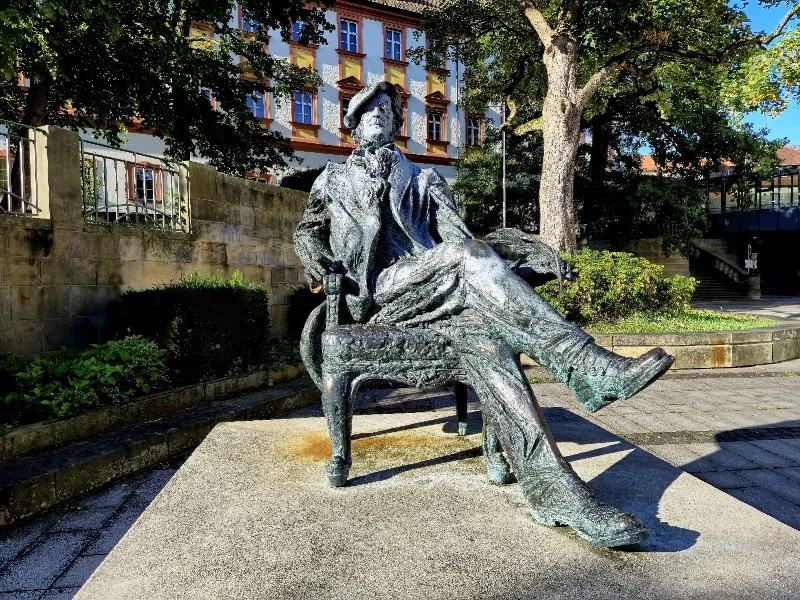
Hardly any topic shapes the perception of the La-Spezia-Platz as strongly as art in public space. The tourism website of Bayreuth lists the square in the context of an art tour and describes the large Richard Wagner statue at La-Spezia-Platz as one of the prominent points in the cityscape. At the same time, in the same route, the sculpture Model Lucy at the corner of Opernstraße/Luitpoldplatz appears as a striking work of art that conceptually connects the axis between the Markgräfliches Opernhaus and the Festspielhaus. This is typical for Bayreuth: the urban space tells cultural connections not only in museums or theaters but also outside in squares and on facades. The La-Spezia-Platz thus stands alongside other places that position the city as a destination for art in public space. The tourism site explicitly states that Bayreuth offers itself as a destination for street art and urban art, and refers to the long development of the sculpture mile. The square is therefore not just a decorative background but part of a curated urban experience. Those interested in architecture, photography, or city walks will find here a compact example of how art, space, and urban history can intertwine. ([bayreuth-tourismus.de](https://www.bayreuth-tourismus.de/bayreuth-in-bildern-richard-wagner-orte/))
Especially exciting is that the art at La-Spezia-Platz does not function detached from Bayreuth's musical identity. The Wagner statue at the square is part of a larger context with the historical Wagner sites of the city, which include the Festspielhaus, Haus Wahnfried, and other places of Wagner's heritage. The tourism site emphasizes that Richard Wagner is an integral part of Bayreuth's history and that the Wagner myth can still be experienced throughout the city today. The La-Spezia-Platz adds a modern urban space to this image: it shows Wagner not as a museum figure behind glass but as a visible presence in public space. For the perception of the city center, this is clever because it not only consolidates the well-known cultural trademarks of Bayreuth at their historical original locations but also extends them into everyday life. This is exactly why the square gains a special quality for visitors: it is not only representative but also narrative. One understands the place better when viewing it as an interface between art, city, and memory. The public artworks thus serve not only for beautification but also for orientation and identity formation. ([bayreuth-tourismus.de](https://www.bayreuth-tourismus.de/bayreuth-in-bildern-richard-wagner-orte/))
La-Spezia-Platz and the City Partnership with La Spezia
The name of the square cannot be understood without the partnership between Bayreuth and La Spezia. The city of Bayreuth has had La Spezia as its Italian partner city since 1999. On the partner cities page, the city describes La Spezia as a modern port and industrial city on the Ligurian coast. Thus, the name of the square is much more than a mere dedication: it is a visible sign of a growing connection between two cities that culturally and socially engage with each other repeatedly. This connection is maintained through official celebrations, exhibitions, gifts, and joint anniversaries. This is particularly visible in Bayreuth, as urban places often also become symbolic places. The La-Spezia-Platz is exactly such a place. It reminds everyday life of the partnership without being intrusive and makes it clear that international relations do not only take place in large halls or on certificates but right in the city center. The naming anchors the relationship between Bayreuth and La Spezia in urban space and makes it tangible for all passersby. ([bayreuth.de](https://www.bayreuth.de/rathaus-buergerservice/stadtverwaltung/partnerstaedte/))
This symbolism became particularly evident in 2019 when Bayreuth celebrated the 20th anniversary of the city partnership with La Spezia and unveiled a Richard Wagner sculpture at La-Spezia-Platz in the same context. The city documents the event in its statistical yearbook as part of the annual review. Later, on the occasion of the 25th anniversary, the city reported again on official meetings, exhibitions, and honors related to the partnership. This shows that the square was not only historically named but still plays a role in municipal life today. This is crucial for people searching for terms like partner city La Spezia or La Spezia Platz Bayreuth: the name stands for a real, living city alliance, not for a random or purely decorative designation. The connection is also culturally and politically interesting because Bayreuth repeatedly associates the partnership with art, encounters, and public visibility. The square thus serves as a symbol of what city partnerships can look like in practice: concrete, visible, and anchored in everyday life. ([bayreuth.de](https://www.bayreuth.de/wp-content/uploads/2021/12/Statistisches-Jahrbuch_2019.pdf?utm_source=openai))
Access, Parking, and Access via the Schlossgalerie
For the practical use of the La-Spezia-Platz, it is particularly important that the area is easily accessible and remains closely connected to the Schlossgalerie. A municipal exposé on the Schlossgalerie describes the office spaces at the corner of La-Spezia-Platz 1 / Kanalstraße 3 and emphasizes that they are accessible via a separate entrance from La-Spezia-Platz as well as through the underground garage. It also mentions an underground garage with a total of 94 parking spaces, of which 51 are assigned to the co-ownership share of the city of Bayreuth. This is very concrete information that is particularly helpful for visitors with cars or for people who want to complete administrative tasks. In everyday life, this means: the La-Spezia-Platz is not a closed place without infrastructure but an urban access point with direct connections to building uses, parking spaces, and city center routes. This is a strong advantage, especially in densely built city center locations. Those coming from the direction of Opernstraße or Kanalstraße quickly reach the area of the Schlossgalerie and the Schlossterrassen. The administration located there also makes the square a place with understandable orientation. It is therefore not only beautiful but also practical. ([bayreuth.de](https://www.bayreuth.de/wp-content/uploads/2023/07/Expose-Schlossgalerie-mit-Gebotsabgabe-web.pdf?utm_source=openai))
The location has also been taken into account in the area of bicycles and micromobility. The city of Bayreuth announced new bicycle parking options at La-Spezia-Platz and supplemented the location as part of its measures for bicycle parking in the city. In another municipal contribution, it is described that mobile bicycle racks were installed at the entrance to the rapid test center at La-Spezia-Platz. This shows that the place remains functional not only for pedestrians but also for cyclists. For a city center location, this combination of underground garage, bicycle parking options, and separate entrance is important because it makes the square attractive for different target groups. Those exploring Bayreuth's city center on foot can use the square as part of a short tour; those arriving by bike find parking options; and those arriving by car benefit from the spatial proximity to the underground garage of the Schlossgalerie. Thus, the La-Spezia-Platz fulfills a classic city center function: it bundles accesses instead of distributing them. This makes it relevant not only for search queries related to parking or access but also for anyone looking for a centrally located, well-connected place in Bayreuth. ([bayreuth.de](https://www.bayreuth.de/bereits-weit-ueber-1-000-abstellplaetze-geschaffen/?utm_source=openai))
Events, City Center Life, and Public Use
The La-Spezia-Platz is not a place that only functions on a few days of the year. Rather, its significance is particularly evident in how often it appears as public space for different uses. The city of Bayreuth has already used the square or the Schlossterrassen for open-air formats, citizen festival programs, neighborhood workshops, and other city center events. In a statement about the future of the city center, it was explicitly pointed out that citizens and interested parties could also exchange ideas outdoors on the La-Spezia-Platz and the Schlossterrassen in good weather. In another contribution, the city reports that Bayreuth associations were able to present themselves on the Schlossterrassen at La-Spezia-Platz as part of the citizen festival. This underscores the role of the square as a platform for encounters. For a city center, this is ideal because squares then are not just traffic areas but places where urban life is displayed. The La-Spezia-Platz is therefore not just a backdrop but an actively used space. This diversity of use is a core of its attractiveness and explains why the square repeatedly appears in organizational and cultural contexts in Bayreuth. ([bayreuth.de](https://www.bayreuth.de/zukunft-der-innenstadt-stadt-laedt-zur-ideenschmiede-ein/?utm_source=openai))
Even beyond festivals and cultural formats, the square regularly appears in official city announcements. The city names it as a place for citizens' assemblies, for municipal services, for test centers, or for other public uses. This makes it clear that the square plays a similar role in urban everyday life as many well-located centers in other cities: it is an address and meeting point, an access point, and a space with high recognition. It is also interesting that the square does not appear in the city's communication in isolation but always in connection with the Schlossgalerie, the Schlossterrassen, and the neighboring city center areas. This interplay makes it so pleasant for visitors. One can arrive there, orient oneself, view art, complete administrative tasks, or continue through the city center from there. For search intentions like la spezia platz 1, schlossgalerie bayreuth, or events bayreuth city center, this is particularly valuable because the square covers various needs simultaneously. The La-Spezia-Platz thus exemplifies a city center that consists not only of shops and streets but of spaces that connect social, cultural, and practical functions. ([bayreuth.de](https://www.bayreuth.de/rathaus-buergerservice/stadtverwaltung/buergerbeteiligung/buergerversammlung2025/?utm_source=openai))
Those who visit the La-Spezia-Platz today experience more than just a single place. They experience an interface of urban history, city partnership, art, administration, and quality of stay. The official urban development designates the area as part of a successfully upgraded public space; tourism sources show it as a station on the way to artworks and Wagner sites; and municipal announcements document its use for festivals, culture, and citizen dialogue. Its special value lies in this combination. The La-Spezia-Platz is not a loud square that defines itself only by size. It resonates through location, significance, and density of stories. That is precisely why a visit is worthwhile for all who want to get to know Bayreuth not only as a festival city but as a vibrant city center with multifaceted public spaces. The square offers a very good entry point for this: urban, central, culturally historically charged, and yet open to everyday life. This balance makes it so interesting. ([bayreuth.de](https://www.bayreuth.de/rathaus-buergerservice/planen-bauen/staedtebaufoerderung/sanierungsgebiete/sanierungsgebiete-innenstadt-uebersicht/sanierungsgebiet-g/))
Sources:
Mehr anzeigenWeniger anzeigen
La-Spezia-Platz | Schlossterrassen & Schlossgalerie
The La-Spezia-Platz is one of those places in Bayreuth that at first glance appears to be a pleasant urban space, but upon closer inspection tells much more: about urban development, about art in public spaces, about the Italian partner city La Spezia, and about modern Bayreuth between the historic center and a lively everyday place. Those who arrive here do not move in a classic event venue with fixed rows of seats, but in an urban square that belongs to the city center, shaped by the Schlossgalerie and the Schlossterrassen, and can be understood as part of the cultural path through Bayreuth. Official city and tourism sources locate the area as an important building block of the city center and as a station in a tour of art and urban history. This very mix makes the square interesting: it is public space, meeting point, access point, photo motif, and at the same time a piece of lived partnership history. For visitors, the La-Spezia-Platz is therefore not a casual interstitial space, but a place where Bayreuth's identity is very concentrated. ([bayreuth.de](https://www.bayreuth.de/rathaus-buergerservice/planen-bauen/staedtebaufoerderung/sanierungsgebiete/sanierungsgebiete-innenstadt-uebersicht/sanierungsgebiet-g/))
Schlossterrassen, Schlossgalerie and the Location in the Bayreuth Center
The special strength of the La-Spezia-Platz lies in its location and in the way the space is connected to the surrounding uses. The city of Bayreuth assigns the area to the redevelopment area G and explicitly names the upgrading and activation of public space as a goal. In the same presentation, the La-Spezia-Platz / Schlossterrassen appear as a successful project. This is important for an urban square because it shows that here not only asphalt and through traffic matter, but also the quality of stay, sight lines, and a readable urban structure. The square is located in the vicinity of Kanalstraße, Opernstraße, and the Schlossgalerie, exactly where the city center, administration, culture, and retail meet. Those who explore Bayreuth on foot therefore experience the square as a connecting element between well-known axes of the city and the somewhat quieter, more atmospheric areas at the terraces. The official urban development also emphasizes that the city center has different sub-areas, each with its own qualities. The La-Spezia-Platz belongs to the sub-areas where these qualities become particularly visible: it is open enough for events but at the same time defined enough to create a character of stay. ([bayreuth.de](https://www.bayreuth.de/rathaus-buergerservice/planen-bauen/staedtebaufoerderung/sanierungsgebiete/sanierungsgebiete-innenstadt-uebersicht/sanierungsgebiet-g/))
Another reason why the square is so present in the urban experience lies in the Schlossgalerie. The city of Bayreuth describes there, among other things, offices and specialist departments housed, thus a use that strongly enlivens the square in everyday life. At the same time, there have been repeated public formats in the building and its surroundings, such as exhibitions or municipal appointments, that make the place accessible to visitors. The connection between the square and the Schlossgalerie is therefore not only spatial but functional: here administrative paths, public accesses, and city center visits come together. For search queries like La-Spezia-Platz 1 Bayreuth or Schlossgalerie Bayreuth, this is relevant because these terms usually mean exactly this mix of address, access, and urban use. In practice, this means: those who head to the La-Spezia-Platz arrive at a place that does not seem isolated but rather like a natural part of the inner-city fabric. This is one of the reasons why the square serves as a good orientation point in the city center. It is neither a big-city monument nor just a mere side element, but an urban transition place with real quality of stay. ([bayreuth.de](https://www.bayreuth.de/ausstellung-afrikanischer-kunst-in-den-bueroraeumen-der-schlossgalerie/?utm_source=openai))
Richard Wagner Statue and Art in Public Space
Hardly any topic shapes the perception of the La-Spezia-Platz as strongly as art in public space. The tourism website of Bayreuth lists the square in the context of an art tour and describes the large Richard Wagner statue at La-Spezia-Platz as one of the prominent points in the cityscape. At the same time, in the same route, the sculpture Model Lucy at the corner of Opernstraße/Luitpoldplatz appears as a striking work of art that conceptually connects the axis between the Markgräfliches Opernhaus and the Festspielhaus. This is typical for Bayreuth: the urban space tells cultural connections not only in museums or theaters but also outside in squares and on facades. The La-Spezia-Platz thus stands alongside other places that position the city as a destination for art in public space. The tourism site explicitly states that Bayreuth offers itself as a destination for street art and urban art, and refers to the long development of the sculpture mile. The square is therefore not just a decorative background but part of a curated urban experience. Those interested in architecture, photography, or city walks will find here a compact example of how art, space, and urban history can intertwine. ([bayreuth-tourismus.de](https://www.bayreuth-tourismus.de/bayreuth-in-bildern-richard-wagner-orte/))
Especially exciting is that the art at La-Spezia-Platz does not function detached from Bayreuth's musical identity. The Wagner statue at the square is part of a larger context with the historical Wagner sites of the city, which include the Festspielhaus, Haus Wahnfried, and other places of Wagner's heritage. The tourism site emphasizes that Richard Wagner is an integral part of Bayreuth's history and that the Wagner myth can still be experienced throughout the city today. The La-Spezia-Platz adds a modern urban space to this image: it shows Wagner not as a museum figure behind glass but as a visible presence in public space. For the perception of the city center, this is clever because it not only consolidates the well-known cultural trademarks of Bayreuth at their historical original locations but also extends them into everyday life. This is exactly why the square gains a special quality for visitors: it is not only representative but also narrative. One understands the place better when viewing it as an interface between art, city, and memory. The public artworks thus serve not only for beautification but also for orientation and identity formation. ([bayreuth-tourismus.de](https://www.bayreuth-tourismus.de/bayreuth-in-bildern-richard-wagner-orte/))
La-Spezia-Platz and the City Partnership with La Spezia
The name of the square cannot be understood without the partnership between Bayreuth and La Spezia. The city of Bayreuth has had La Spezia as its Italian partner city since 1999. On the partner cities page, the city describes La Spezia as a modern port and industrial city on the Ligurian coast. Thus, the name of the square is much more than a mere dedication: it is a visible sign of a growing connection between two cities that culturally and socially engage with each other repeatedly. This connection is maintained through official celebrations, exhibitions, gifts, and joint anniversaries. This is particularly visible in Bayreuth, as urban places often also become symbolic places. The La-Spezia-Platz is exactly such a place. It reminds everyday life of the partnership without being intrusive and makes it clear that international relations do not only take place in large halls or on certificates but right in the city center. The naming anchors the relationship between Bayreuth and La Spezia in urban space and makes it tangible for all passersby. ([bayreuth.de](https://www.bayreuth.de/rathaus-buergerservice/stadtverwaltung/partnerstaedte/))
This symbolism became particularly evident in 2019 when Bayreuth celebrated the 20th anniversary of the city partnership with La Spezia and unveiled a Richard Wagner sculpture at La-Spezia-Platz in the same context. The city documents the event in its statistical yearbook as part of the annual review. Later, on the occasion of the 25th anniversary, the city reported again on official meetings, exhibitions, and honors related to the partnership. This shows that the square was not only historically named but still plays a role in municipal life today. This is crucial for people searching for terms like partner city La Spezia or La Spezia Platz Bayreuth: the name stands for a real, living city alliance, not for a random or purely decorative designation. The connection is also culturally and politically interesting because Bayreuth repeatedly associates the partnership with art, encounters, and public visibility. The square thus serves as a symbol of what city partnerships can look like in practice: concrete, visible, and anchored in everyday life. ([bayreuth.de](https://www.bayreuth.de/wp-content/uploads/2021/12/Statistisches-Jahrbuch_2019.pdf?utm_source=openai))
Access, Parking, and Access via the Schlossgalerie
For the practical use of the La-Spezia-Platz, it is particularly important that the area is easily accessible and remains closely connected to the Schlossgalerie. A municipal exposé on the Schlossgalerie describes the office spaces at the corner of La-Spezia-Platz 1 / Kanalstraße 3 and emphasizes that they are accessible via a separate entrance from La-Spezia-Platz as well as through the underground garage. It also mentions an underground garage with a total of 94 parking spaces, of which 51 are assigned to the co-ownership share of the city of Bayreuth. This is very concrete information that is particularly helpful for visitors with cars or for people who want to complete administrative tasks. In everyday life, this means: the La-Spezia-Platz is not a closed place without infrastructure but an urban access point with direct connections to building uses, parking spaces, and city center routes. This is a strong advantage, especially in densely built city center locations. Those coming from the direction of Opernstraße or Kanalstraße quickly reach the area of the Schlossgalerie and the Schlossterrassen. The administration located there also makes the square a place with understandable orientation. It is therefore not only beautiful but also practical. ([bayreuth.de](https://www.bayreuth.de/wp-content/uploads/2023/07/Expose-Schlossgalerie-mit-Gebotsabgabe-web.pdf?utm_source=openai))
The location has also been taken into account in the area of bicycles and micromobility. The city of Bayreuth announced new bicycle parking options at La-Spezia-Platz and supplemented the location as part of its measures for bicycle parking in the city. In another municipal contribution, it is described that mobile bicycle racks were installed at the entrance to the rapid test center at La-Spezia-Platz. This shows that the place remains functional not only for pedestrians but also for cyclists. For a city center location, this combination of underground garage, bicycle parking options, and separate entrance is important because it makes the square attractive for different target groups. Those exploring Bayreuth's city center on foot can use the square as part of a short tour; those arriving by bike find parking options; and those arriving by car benefit from the spatial proximity to the underground garage of the Schlossgalerie. Thus, the La-Spezia-Platz fulfills a classic city center function: it bundles accesses instead of distributing them. This makes it relevant not only for search queries related to parking or access but also for anyone looking for a centrally located, well-connected place in Bayreuth. ([bayreuth.de](https://www.bayreuth.de/bereits-weit-ueber-1-000-abstellplaetze-geschaffen/?utm_source=openai))
Events, City Center Life, and Public Use
The La-Spezia-Platz is not a place that only functions on a few days of the year. Rather, its significance is particularly evident in how often it appears as public space for different uses. The city of Bayreuth has already used the square or the Schlossterrassen for open-air formats, citizen festival programs, neighborhood workshops, and other city center events. In a statement about the future of the city center, it was explicitly pointed out that citizens and interested parties could also exchange ideas outdoors on the La-Spezia-Platz and the Schlossterrassen in good weather. In another contribution, the city reports that Bayreuth associations were able to present themselves on the Schlossterrassen at La-Spezia-Platz as part of the citizen festival. This underscores the role of the square as a platform for encounters. For a city center, this is ideal because squares then are not just traffic areas but places where urban life is displayed. The La-Spezia-Platz is therefore not just a backdrop but an actively used space. This diversity of use is a core of its attractiveness and explains why the square repeatedly appears in organizational and cultural contexts in Bayreuth. ([bayreuth.de](https://www.bayreuth.de/zukunft-der-innenstadt-stadt-laedt-zur-ideenschmiede-ein/?utm_source=openai))
Even beyond festivals and cultural formats, the square regularly appears in official city announcements. The city names it as a place for citizens' assemblies, for municipal services, for test centers, or for other public uses. This makes it clear that the square plays a similar role in urban everyday life as many well-located centers in other cities: it is an address and meeting point, an access point, and a space with high recognition. It is also interesting that the square does not appear in the city's communication in isolation but always in connection with the Schlossgalerie, the Schlossterrassen, and the neighboring city center areas. This interplay makes it so pleasant for visitors. One can arrive there, orient oneself, view art, complete administrative tasks, or continue through the city center from there. For search intentions like la spezia platz 1, schlossgalerie bayreuth, or events bayreuth city center, this is particularly valuable because the square covers various needs simultaneously. The La-Spezia-Platz thus exemplifies a city center that consists not only of shops and streets but of spaces that connect social, cultural, and practical functions. ([bayreuth.de](https://www.bayreuth.de/rathaus-buergerservice/stadtverwaltung/buergerbeteiligung/buergerversammlung2025/?utm_source=openai))
Those who visit the La-Spezia-Platz today experience more than just a single place. They experience an interface of urban history, city partnership, art, administration, and quality of stay. The official urban development designates the area as part of a successfully upgraded public space; tourism sources show it as a station on the way to artworks and Wagner sites; and municipal announcements document its use for festivals, culture, and citizen dialogue. Its special value lies in this combination. The La-Spezia-Platz is not a loud square that defines itself only by size. It resonates through location, significance, and density of stories. That is precisely why a visit is worthwhile for all who want to get to know Bayreuth not only as a festival city but as a vibrant city center with multifaceted public spaces. The square offers a very good entry point for this: urban, central, culturally historically charged, and yet open to everyday life. This balance makes it so interesting. ([bayreuth.de](https://www.bayreuth.de/rathaus-buergerservice/planen-bauen/staedtebaufoerderung/sanierungsgebiete/sanierungsgebiete-innenstadt-uebersicht/sanierungsgebiet-g/))
Sources:
La-Spezia-Platz | Schlossterrassen & Schlossgalerie
The La-Spezia-Platz is one of those places in Bayreuth that at first glance appears to be a pleasant urban space, but upon closer inspection tells much more: about urban development, about art in public spaces, about the Italian partner city La Spezia, and about modern Bayreuth between the historic center and a lively everyday place. Those who arrive here do not move in a classic event venue with fixed rows of seats, but in an urban square that belongs to the city center, shaped by the Schlossgalerie and the Schlossterrassen, and can be understood as part of the cultural path through Bayreuth. Official city and tourism sources locate the area as an important building block of the city center and as a station in a tour of art and urban history. This very mix makes the square interesting: it is public space, meeting point, access point, photo motif, and at the same time a piece of lived partnership history. For visitors, the La-Spezia-Platz is therefore not a casual interstitial space, but a place where Bayreuth's identity is very concentrated. ([bayreuth.de](https://www.bayreuth.de/rathaus-buergerservice/planen-bauen/staedtebaufoerderung/sanierungsgebiete/sanierungsgebiete-innenstadt-uebersicht/sanierungsgebiet-g/))
Schlossterrassen, Schlossgalerie and the Location in the Bayreuth Center
The special strength of the La-Spezia-Platz lies in its location and in the way the space is connected to the surrounding uses. The city of Bayreuth assigns the area to the redevelopment area G and explicitly names the upgrading and activation of public space as a goal. In the same presentation, the La-Spezia-Platz / Schlossterrassen appear as a successful project. This is important for an urban square because it shows that here not only asphalt and through traffic matter, but also the quality of stay, sight lines, and a readable urban structure. The square is located in the vicinity of Kanalstraße, Opernstraße, and the Schlossgalerie, exactly where the city center, administration, culture, and retail meet. Those who explore Bayreuth on foot therefore experience the square as a connecting element between well-known axes of the city and the somewhat quieter, more atmospheric areas at the terraces. The official urban development also emphasizes that the city center has different sub-areas, each with its own qualities. The La-Spezia-Platz belongs to the sub-areas where these qualities become particularly visible: it is open enough for events but at the same time defined enough to create a character of stay. ([bayreuth.de](https://www.bayreuth.de/rathaus-buergerservice/planen-bauen/staedtebaufoerderung/sanierungsgebiete/sanierungsgebiete-innenstadt-uebersicht/sanierungsgebiet-g/))
Another reason why the square is so present in the urban experience lies in the Schlossgalerie. The city of Bayreuth describes there, among other things, offices and specialist departments housed, thus a use that strongly enlivens the square in everyday life. At the same time, there have been repeated public formats in the building and its surroundings, such as exhibitions or municipal appointments, that make the place accessible to visitors. The connection between the square and the Schlossgalerie is therefore not only spatial but functional: here administrative paths, public accesses, and city center visits come together. For search queries like La-Spezia-Platz 1 Bayreuth or Schlossgalerie Bayreuth, this is relevant because these terms usually mean exactly this mix of address, access, and urban use. In practice, this means: those who head to the La-Spezia-Platz arrive at a place that does not seem isolated but rather like a natural part of the inner-city fabric. This is one of the reasons why the square serves as a good orientation point in the city center. It is neither a big-city monument nor just a mere side element, but an urban transition place with real quality of stay. ([bayreuth.de](https://www.bayreuth.de/ausstellung-afrikanischer-kunst-in-den-bueroraeumen-der-schlossgalerie/?utm_source=openai))
Richard Wagner Statue and Art in Public Space
Hardly any topic shapes the perception of the La-Spezia-Platz as strongly as art in public space. The tourism website of Bayreuth lists the square in the context of an art tour and describes the large Richard Wagner statue at La-Spezia-Platz as one of the prominent points in the cityscape. At the same time, in the same route, the sculpture Model Lucy at the corner of Opernstraße/Luitpoldplatz appears as a striking work of art that conceptually connects the axis between the Markgräfliches Opernhaus and the Festspielhaus. This is typical for Bayreuth: the urban space tells cultural connections not only in museums or theaters but also outside in squares and on facades. The La-Spezia-Platz thus stands alongside other places that position the city as a destination for art in public space. The tourism site explicitly states that Bayreuth offers itself as a destination for street art and urban art, and refers to the long development of the sculpture mile. The square is therefore not just a decorative background but part of a curated urban experience. Those interested in architecture, photography, or city walks will find here a compact example of how art, space, and urban history can intertwine. ([bayreuth-tourismus.de](https://www.bayreuth-tourismus.de/bayreuth-in-bildern-richard-wagner-orte/))
Especially exciting is that the art at La-Spezia-Platz does not function detached from Bayreuth's musical identity. The Wagner statue at the square is part of a larger context with the historical Wagner sites of the city, which include the Festspielhaus, Haus Wahnfried, and other places of Wagner's heritage. The tourism site emphasizes that Richard Wagner is an integral part of Bayreuth's history and that the Wagner myth can still be experienced throughout the city today. The La-Spezia-Platz adds a modern urban space to this image: it shows Wagner not as a museum figure behind glass but as a visible presence in public space. For the perception of the city center, this is clever because it not only consolidates the well-known cultural trademarks of Bayreuth at their historical original locations but also extends them into everyday life. This is exactly why the square gains a special quality for visitors: it is not only representative but also narrative. One understands the place better when viewing it as an interface between art, city, and memory. The public artworks thus serve not only for beautification but also for orientation and identity formation. ([bayreuth-tourismus.de](https://www.bayreuth-tourismus.de/bayreuth-in-bildern-richard-wagner-orte/))
La-Spezia-Platz and the City Partnership with La Spezia
The name of the square cannot be understood without the partnership between Bayreuth and La Spezia. The city of Bayreuth has had La Spezia as its Italian partner city since 1999. On the partner cities page, the city describes La Spezia as a modern port and industrial city on the Ligurian coast. Thus, the name of the square is much more than a mere dedication: it is a visible sign of a growing connection between two cities that culturally and socially engage with each other repeatedly. This connection is maintained through official celebrations, exhibitions, gifts, and joint anniversaries. This is particularly visible in Bayreuth, as urban places often also become symbolic places. The La-Spezia-Platz is exactly such a place. It reminds everyday life of the partnership without being intrusive and makes it clear that international relations do not only take place in large halls or on certificates but right in the city center. The naming anchors the relationship between Bayreuth and La Spezia in urban space and makes it tangible for all passersby. ([bayreuth.de](https://www.bayreuth.de/rathaus-buergerservice/stadtverwaltung/partnerstaedte/))
This symbolism became particularly evident in 2019 when Bayreuth celebrated the 20th anniversary of the city partnership with La Spezia and unveiled a Richard Wagner sculpture at La-Spezia-Platz in the same context. The city documents the event in its statistical yearbook as part of the annual review. Later, on the occasion of the 25th anniversary, the city reported again on official meetings, exhibitions, and honors related to the partnership. This shows that the square was not only historically named but still plays a role in municipal life today. This is crucial for people searching for terms like partner city La Spezia or La Spezia Platz Bayreuth: the name stands for a real, living city alliance, not for a random or purely decorative designation. The connection is also culturally and politically interesting because Bayreuth repeatedly associates the partnership with art, encounters, and public visibility. The square thus serves as a symbol of what city partnerships can look like in practice: concrete, visible, and anchored in everyday life. ([bayreuth.de](https://www.bayreuth.de/wp-content/uploads/2021/12/Statistisches-Jahrbuch_2019.pdf?utm_source=openai))
Access, Parking, and Access via the Schlossgalerie
For the practical use of the La-Spezia-Platz, it is particularly important that the area is easily accessible and remains closely connected to the Schlossgalerie. A municipal exposé on the Schlossgalerie describes the office spaces at the corner of La-Spezia-Platz 1 / Kanalstraße 3 and emphasizes that they are accessible via a separate entrance from La-Spezia-Platz as well as through the underground garage. It also mentions an underground garage with a total of 94 parking spaces, of which 51 are assigned to the co-ownership share of the city of Bayreuth. This is very concrete information that is particularly helpful for visitors with cars or for people who want to complete administrative tasks. In everyday life, this means: the La-Spezia-Platz is not a closed place without infrastructure but an urban access point with direct connections to building uses, parking spaces, and city center routes. This is a strong advantage, especially in densely built city center locations. Those coming from the direction of Opernstraße or Kanalstraße quickly reach the area of the Schlossgalerie and the Schlossterrassen. The administration located there also makes the square a place with understandable orientation. It is therefore not only beautiful but also practical. ([bayreuth.de](https://www.bayreuth.de/wp-content/uploads/2023/07/Expose-Schlossgalerie-mit-Gebotsabgabe-web.pdf?utm_source=openai))
The location has also been taken into account in the area of bicycles and micromobility. The city of Bayreuth announced new bicycle parking options at La-Spezia-Platz and supplemented the location as part of its measures for bicycle parking in the city. In another municipal contribution, it is described that mobile bicycle racks were installed at the entrance to the rapid test center at La-Spezia-Platz. This shows that the place remains functional not only for pedestrians but also for cyclists. For a city center location, this combination of underground garage, bicycle parking options, and separate entrance is important because it makes the square attractive for different target groups. Those exploring Bayreuth's city center on foot can use the square as part of a short tour; those arriving by bike find parking options; and those arriving by car benefit from the spatial proximity to the underground garage of the Schlossgalerie. Thus, the La-Spezia-Platz fulfills a classic city center function: it bundles accesses instead of distributing them. This makes it relevant not only for search queries related to parking or access but also for anyone looking for a centrally located, well-connected place in Bayreuth. ([bayreuth.de](https://www.bayreuth.de/bereits-weit-ueber-1-000-abstellplaetze-geschaffen/?utm_source=openai))
Events, City Center Life, and Public Use
The La-Spezia-Platz is not a place that only functions on a few days of the year. Rather, its significance is particularly evident in how often it appears as public space for different uses. The city of Bayreuth has already used the square or the Schlossterrassen for open-air formats, citizen festival programs, neighborhood workshops, and other city center events. In a statement about the future of the city center, it was explicitly pointed out that citizens and interested parties could also exchange ideas outdoors on the La-Spezia-Platz and the Schlossterrassen in good weather. In another contribution, the city reports that Bayreuth associations were able to present themselves on the Schlossterrassen at La-Spezia-Platz as part of the citizen festival. This underscores the role of the square as a platform for encounters. For a city center, this is ideal because squares then are not just traffic areas but places where urban life is displayed. The La-Spezia-Platz is therefore not just a backdrop but an actively used space. This diversity of use is a core of its attractiveness and explains why the square repeatedly appears in organizational and cultural contexts in Bayreuth. ([bayreuth.de](https://www.bayreuth.de/zukunft-der-innenstadt-stadt-laedt-zur-ideenschmiede-ein/?utm_source=openai))
Even beyond festivals and cultural formats, the square regularly appears in official city announcements. The city names it as a place for citizens' assemblies, for municipal services, for test centers, or for other public uses. This makes it clear that the square plays a similar role in urban everyday life as many well-located centers in other cities: it is an address and meeting point, an access point, and a space with high recognition. It is also interesting that the square does not appear in the city's communication in isolation but always in connection with the Schlossgalerie, the Schlossterrassen, and the neighboring city center areas. This interplay makes it so pleasant for visitors. One can arrive there, orient oneself, view art, complete administrative tasks, or continue through the city center from there. For search intentions like la spezia platz 1, schlossgalerie bayreuth, or events bayreuth city center, this is particularly valuable because the square covers various needs simultaneously. The La-Spezia-Platz thus exemplifies a city center that consists not only of shops and streets but of spaces that connect social, cultural, and practical functions. ([bayreuth.de](https://www.bayreuth.de/rathaus-buergerservice/stadtverwaltung/buergerbeteiligung/buergerversammlung2025/?utm_source=openai))
Those who visit the La-Spezia-Platz today experience more than just a single place. They experience an interface of urban history, city partnership, art, administration, and quality of stay. The official urban development designates the area as part of a successfully upgraded public space; tourism sources show it as a station on the way to artworks and Wagner sites; and municipal announcements document its use for festivals, culture, and citizen dialogue. Its special value lies in this combination. The La-Spezia-Platz is not a loud square that defines itself only by size. It resonates through location, significance, and density of stories. That is precisely why a visit is worthwhile for all who want to get to know Bayreuth not only as a festival city but as a vibrant city center with multifaceted public spaces. The square offers a very good entry point for this: urban, central, culturally historically charged, and yet open to everyday life. This balance makes it so interesting. ([bayreuth.de](https://www.bayreuth.de/rathaus-buergerservice/planen-bauen/staedtebaufoerderung/sanierungsgebiete/sanierungsgebiete-innenstadt-uebersicht/sanierungsgebiet-g/))
Sources:
Upcoming Events

The Blues
Bayreuth goes interactive: The Blues let a floor projection emerge live at the neuseum. On 07/28/2026 from 10:00 AM, free. #Bayreuth #Innovation

XR meets Didactics - FLINTA* Workshops
Two days of XR, Didactics, and team spirit in Bayreuth: free FLINTA* workshops at the neuseum, with practical experience, a certificate, and plenty of future energy. #Bayreuth #XR
Frequently Asked Questions
Reviews
No reviews found