
Bayreuth
Maximilianstraße 18, 95444 Bayreuth, Deutschland
Market Fountain - Famabrunnen | Photos & History
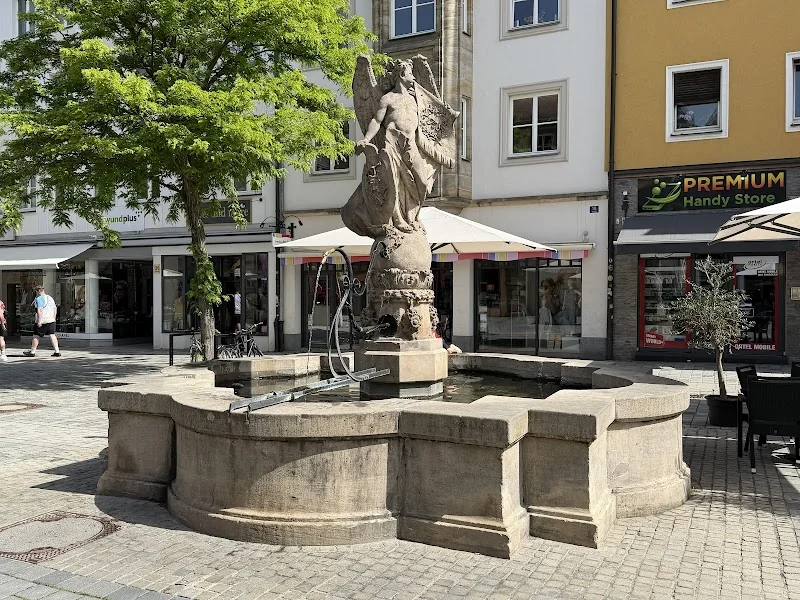
The Market Fountain - Famabrunnen is one of the most distinctive fountain installations in the Bayreuth city center and is much more than just a decorative element in the street scene. Those walking along Maximilianstraße encounter a piece of city history that connects art, power display, and urban everyday life. The baroque fountain stands in the historic center between the marketplace, pedestrian zone, and the defining rows of houses of the old residence city. As a work by Elias Räntz from the early 18th century, it is a monument that still attracts attention today, even if one is specifically looking for photos, history, or the correct designation. The unique mix of urban furniture, artwork, and memorial site makes the Famabrunnen an ideal destination for anyone wanting to explore Bayreuth on foot. The fact that the fountain has been moved several times and now stands again in its old place adds a strong historical depth. This blend of change and continuity shapes its charm and explains why the name often appears in search queries alongside topics such as reviews, images, directions, or baroque history. ([bayreuth-tourismus.de](https://www.bayreuth-tourismus.de/wp-content/uploads/2024/06/bt-aktuell-juli24-WEB.pdf))
History of the Market Fountain in Bayreuth
The history of the Famabrunnen does not begin in the Middle Ages, but in the baroque Bayreuth of the early 18th century. In 1708, the fountain was commissioned by the then Margrave Christian Ernst and crafted by court sculptor Elias Räntz. An official Bayreuth publication describes it as a fountain monument that originally stood in the Ehrenhof of the Old Castle and was intended to proclaim the glorious deeds of the margrave in direct correspondence with the Margrave Fountain from 1705. It quickly becomes clear that the fountain was part of a conscious courtly urban space design and not just a practical water object. The monument register also confirms its classification as a baroque work with a central sandstone figure from 1708. Historical sources also show that the fountain bore various names over time. An old city guide from 1891 mentions three fountains in the market: the upper one with the statue of Fama, the middle one with Hercules, and the lower one with Neptune. This tradition explains why the name Fama Fountain has become so entrenched in Bayreuth. For today’s city visitor, it is important: The fountain is a work of the baroque period, but at the same time a core piece of Bayreuth's identity. It connects the margravial representation with the public space of the present and makes visible how strongly the city center has been shaped by the courtly era. ([bayreuth-tourismus.de](https://www.bayreuth-tourismus.de/wp-content/uploads/2024/06/bt-aktuell-juli24-WEB.pdf))
Photos of the Famabrunnen: The Best Perspectives
Those searching for Market Fountain photos will find in Bayreuth a motif that offers many good image axes in a compact space. The monument register describes the fountain as a structure with a curved basin and a central sandstone figure; this very shape makes it photographically interesting because the sculpture, the basin, and the surrounding facade alignment together create a clearly readable cityscape. The fountain appears particularly strong in the context of Maximilianstraße, which the city itself describes as its market and an important place for strolling, celebrating, and lingering. Therefore, for pictures, it is worthwhile not only to take a direct look at the figure but also to capture the broader view with the street alignment, surrounding buildings, and the vibrant city center. The fountain's location in the middle of the public space provides another strength: it can be integrated into the city's everyday life without tickets and without waiting time. Especially early in the day or on quiet weekdays, it creates the impression of a very clear, almost museum-like motif in the open air, while on market days or during events, urban life becomes more visible. This interplay between calm and movement is particularly appealing for photos because the fountain is never isolated but always in dialogue with the city. Those who love documentary shots should also capture details such as the sandstone surface, the water basin, and the proportions to the surroundings. Those looking for atmospheric city images can use the fountain as a visual link between the old town and the pedestrian zone. ([geodaten.bayern.de](https://geodaten.bayern.de/denkmal_static_data/externe_denkmalliste/pdf/denkmalliste_merge_462000.pdf))
Access and Parking in the Bayreuth City Center
The Famabrunnen is located in one of the most accessible city center locations in Bayreuth, and this is a significant advantage for visitors. The city of Bayreuth has over 6,000 public and private parking spaces within 500 meters of the city center. These are distributed in parking garages, underground garages, parking lots, and along the streets. This means for visiting the Market Fountain: One does not have to park directly in front of the fountain but can comfortably start the city walk from a nearby garage or public parking lot. Particularly convenient is that the city also offers mobile parking via EasyPark. For electric vehicles with E-plates, parking in public city areas is free of charge as long as the respective maximum parking duration is observed and a parking disc is used. For visitors arriving by bus, bicycle, or motorhome, the city also provides additional parking spaces and infrastructure. Since the Famabrunnen is located right in the area of Maximilianstraße or the marketplace, the combination of parking and a short walk is often the most pleasant solution. Those who want to experience the city center will benefit doubly: The path to the fountain automatically leads through the pedestrian zone and thus through the historic city center, which continues to shape Bayreuth's character today. For a relaxed arrival, it is therefore less about the exact parking position than about orientation towards the center, the marketplace, and the inner-city parking options. Right there, the actual visit almost begins by itself with a small city stroll. ([bayreuth.de](https://www.bayreuth.de/rathaus-buergerservice/verkehr-oepnv/parken-in-der-innenstadt/))
Market Fountain and the Middle Ages: What is Historically Correct
The keyword Market Fountain medieval is understandable because the fountain appears very old at first glance and stands in the middle of a historic urban space. However, historically correct is: The current Famabrunnen is not a medieval structure but a work of the baroque period. Its commission and execution in 1708 clearly place it in the era of margravial representation. This difference is important because it makes the fountain even more interesting. It stands in a location that is deeply rooted in the history of Bayreuth, yet is itself a product of the early 18th century. Thus, it connects two temporal layers: the older, evolved urban structure around the market and the consciously staged art of the baroque. The city of Bayreuth describes Maximilianstraße as its market and emphasizes how strongly this area is used as a place for shopping, lingering, and urban activities. The monument register, in turn, explicitly names the fountain with a curved basin and sandstone figure. For visitors, this creates an exciting contrast: one stands before a baroque art monument, but in the context of a city center that has functioned as a center of public life for centuries. Therefore, those searching for medieval traces should appreciate the context of the square, but read the fountain itself correctly as a baroque ornamental fountain. This factual classification prevents misunderstandings and also helps with the search intent: It is not the Middle Ages that is the topic here, but the artistic urban space design of the baroque in a historically evolved center. ([geodaten.bayern.de](https://geodaten.bayern.de/denkmal_static_data/externe_denkmalliste/pdf/denkmalliste_merge_462000.pdf))
Why the Fountain is Also Searched as Fama Fountain
When searching for the Market Fountain, very different terms appear in Bayreuth: Famabrunnen, Fama Fountain, Market Fountain, upper fountain, or simply the fountain at the market. This variety is no coincidence but typical for a monument that has long been part of the public vernacular. A historical Bayreuth city guide from 1891 explicitly names the upper fountain at the market with the statue of Fama. This explains why the designation Fama Fountain has become established in the city’s memory. At the same time, the current monument register lists the object as Famabrunnen. So, when searching for the name, one encounters several variants that all refer to the same object in the area of Maximilianstraße. For SEO and for visitors, this variety is even helpful because it better reflects the real search language than a single rigid spelling. Particularly interesting is that the historical naming is not just a matter of language but also opens a view into the symbolism of the fountain. The upper fountain at the market was already associated with Fama, the ancient personification of fame, in the 19th century. This transforms a pure place name into a cultural-historical symbol. The fact that the modern website of Bayreuth Tourism highlights the fountain as a work in the heart of Bayreuth shows how present the monument has remained in today’s cityscape. The search query Market Fountain Weimar, on the other hand, is likely a case of mistaken identity or a search detour that in content asks for the same motif but means Bayreuth. Therefore, for the actual visit, the clear assignment counts: Bayreuth, Maximilianstraße, Famabrunnen. ([bayreuth.de](https://www.bayreuth.de/wp-content/uploads/2019/02/Bayreuth-Wegweiser-1891.pdf))
Reviews, City Strolls, and Practical Tips for Visiting
Those searching for reviews of the Market Fountain usually do not expect a classic event location but a short, atmospheric stop in the urban space. This is precisely the strength of the Famabrunnen: It is freely accessible, located in the historic center, and can be easily integrated into a visit to Bayreuth. This makes it ideal for anyone wanting to explore the city center on foot without long planning or admission tickets. The fountain serves as a fixed point in the cityscape. It can be used as a meeting point, as a photo motif, or as a starting point for a walk through Maximilianstraße. A visit is particularly worthwhile in conjunction with the neighboring historic buildings, as the fountain is not isolated but part of a densely woven city center with a strong quality of stay. The city explicitly describes the area as a place for shopping, lingering, and as a center for festivals, markets, and public viewings. This explains why the Famabrunnen is perceived in most reviews not only as a monument but as part of a vibrant urban experience. In the location data you provided, the value is also 4.3 stars from 10 reviews, which speaks for a rather small but positively perceived destination. Practically, this means: The fountain is not a long program point but a very good stop on a stroll through Bayreuth. Those who take their time can enjoy the sandstone figure, the sightlines to Maximilianstraße, and the interplay with the pedestrian zone in peace. Especially because the place is openly accessible, historically significant, and photogenic, it is excellent for spontaneous city visits, short breaks, and pictures with real Bayreuth feeling. ([bayreuth.de](https://www.bayreuth.de/wirtschaft-forschung/wirtschaftsstandort/stadtteile/innenstadt/))
Sources:
Mehr anzeigenWeniger anzeigen
Market Fountain - Famabrunnen | Photos & History
The Market Fountain - Famabrunnen is one of the most distinctive fountain installations in the Bayreuth city center and is much more than just a decorative element in the street scene. Those walking along Maximilianstraße encounter a piece of city history that connects art, power display, and urban everyday life. The baroque fountain stands in the historic center between the marketplace, pedestrian zone, and the defining rows of houses of the old residence city. As a work by Elias Räntz from the early 18th century, it is a monument that still attracts attention today, even if one is specifically looking for photos, history, or the correct designation. The unique mix of urban furniture, artwork, and memorial site makes the Famabrunnen an ideal destination for anyone wanting to explore Bayreuth on foot. The fact that the fountain has been moved several times and now stands again in its old place adds a strong historical depth. This blend of change and continuity shapes its charm and explains why the name often appears in search queries alongside topics such as reviews, images, directions, or baroque history. ([bayreuth-tourismus.de](https://www.bayreuth-tourismus.de/wp-content/uploads/2024/06/bt-aktuell-juli24-WEB.pdf))
History of the Market Fountain in Bayreuth
The history of the Famabrunnen does not begin in the Middle Ages, but in the baroque Bayreuth of the early 18th century. In 1708, the fountain was commissioned by the then Margrave Christian Ernst and crafted by court sculptor Elias Räntz. An official Bayreuth publication describes it as a fountain monument that originally stood in the Ehrenhof of the Old Castle and was intended to proclaim the glorious deeds of the margrave in direct correspondence with the Margrave Fountain from 1705. It quickly becomes clear that the fountain was part of a conscious courtly urban space design and not just a practical water object. The monument register also confirms its classification as a baroque work with a central sandstone figure from 1708. Historical sources also show that the fountain bore various names over time. An old city guide from 1891 mentions three fountains in the market: the upper one with the statue of Fama, the middle one with Hercules, and the lower one with Neptune. This tradition explains why the name Fama Fountain has become so entrenched in Bayreuth. For today’s city visitor, it is important: The fountain is a work of the baroque period, but at the same time a core piece of Bayreuth's identity. It connects the margravial representation with the public space of the present and makes visible how strongly the city center has been shaped by the courtly era. ([bayreuth-tourismus.de](https://www.bayreuth-tourismus.de/wp-content/uploads/2024/06/bt-aktuell-juli24-WEB.pdf))
Photos of the Famabrunnen: The Best Perspectives
Those searching for Market Fountain photos will find in Bayreuth a motif that offers many good image axes in a compact space. The monument register describes the fountain as a structure with a curved basin and a central sandstone figure; this very shape makes it photographically interesting because the sculpture, the basin, and the surrounding facade alignment together create a clearly readable cityscape. The fountain appears particularly strong in the context of Maximilianstraße, which the city itself describes as its market and an important place for strolling, celebrating, and lingering. Therefore, for pictures, it is worthwhile not only to take a direct look at the figure but also to capture the broader view with the street alignment, surrounding buildings, and the vibrant city center. The fountain's location in the middle of the public space provides another strength: it can be integrated into the city's everyday life without tickets and without waiting time. Especially early in the day or on quiet weekdays, it creates the impression of a very clear, almost museum-like motif in the open air, while on market days or during events, urban life becomes more visible. This interplay between calm and movement is particularly appealing for photos because the fountain is never isolated but always in dialogue with the city. Those who love documentary shots should also capture details such as the sandstone surface, the water basin, and the proportions to the surroundings. Those looking for atmospheric city images can use the fountain as a visual link between the old town and the pedestrian zone. ([geodaten.bayern.de](https://geodaten.bayern.de/denkmal_static_data/externe_denkmalliste/pdf/denkmalliste_merge_462000.pdf))
Access and Parking in the Bayreuth City Center
The Famabrunnen is located in one of the most accessible city center locations in Bayreuth, and this is a significant advantage for visitors. The city of Bayreuth has over 6,000 public and private parking spaces within 500 meters of the city center. These are distributed in parking garages, underground garages, parking lots, and along the streets. This means for visiting the Market Fountain: One does not have to park directly in front of the fountain but can comfortably start the city walk from a nearby garage or public parking lot. Particularly convenient is that the city also offers mobile parking via EasyPark. For electric vehicles with E-plates, parking in public city areas is free of charge as long as the respective maximum parking duration is observed and a parking disc is used. For visitors arriving by bus, bicycle, or motorhome, the city also provides additional parking spaces and infrastructure. Since the Famabrunnen is located right in the area of Maximilianstraße or the marketplace, the combination of parking and a short walk is often the most pleasant solution. Those who want to experience the city center will benefit doubly: The path to the fountain automatically leads through the pedestrian zone and thus through the historic city center, which continues to shape Bayreuth's character today. For a relaxed arrival, it is therefore less about the exact parking position than about orientation towards the center, the marketplace, and the inner-city parking options. Right there, the actual visit almost begins by itself with a small city stroll. ([bayreuth.de](https://www.bayreuth.de/rathaus-buergerservice/verkehr-oepnv/parken-in-der-innenstadt/))
Market Fountain and the Middle Ages: What is Historically Correct
The keyword Market Fountain medieval is understandable because the fountain appears very old at first glance and stands in the middle of a historic urban space. However, historically correct is: The current Famabrunnen is not a medieval structure but a work of the baroque period. Its commission and execution in 1708 clearly place it in the era of margravial representation. This difference is important because it makes the fountain even more interesting. It stands in a location that is deeply rooted in the history of Bayreuth, yet is itself a product of the early 18th century. Thus, it connects two temporal layers: the older, evolved urban structure around the market and the consciously staged art of the baroque. The city of Bayreuth describes Maximilianstraße as its market and emphasizes how strongly this area is used as a place for shopping, lingering, and urban activities. The monument register, in turn, explicitly names the fountain with a curved basin and sandstone figure. For visitors, this creates an exciting contrast: one stands before a baroque art monument, but in the context of a city center that has functioned as a center of public life for centuries. Therefore, those searching for medieval traces should appreciate the context of the square, but read the fountain itself correctly as a baroque ornamental fountain. This factual classification prevents misunderstandings and also helps with the search intent: It is not the Middle Ages that is the topic here, but the artistic urban space design of the baroque in a historically evolved center. ([geodaten.bayern.de](https://geodaten.bayern.de/denkmal_static_data/externe_denkmalliste/pdf/denkmalliste_merge_462000.pdf))
Why the Fountain is Also Searched as Fama Fountain
When searching for the Market Fountain, very different terms appear in Bayreuth: Famabrunnen, Fama Fountain, Market Fountain, upper fountain, or simply the fountain at the market. This variety is no coincidence but typical for a monument that has long been part of the public vernacular. A historical Bayreuth city guide from 1891 explicitly names the upper fountain at the market with the statue of Fama. This explains why the designation Fama Fountain has become established in the city’s memory. At the same time, the current monument register lists the object as Famabrunnen. So, when searching for the name, one encounters several variants that all refer to the same object in the area of Maximilianstraße. For SEO and for visitors, this variety is even helpful because it better reflects the real search language than a single rigid spelling. Particularly interesting is that the historical naming is not just a matter of language but also opens a view into the symbolism of the fountain. The upper fountain at the market was already associated with Fama, the ancient personification of fame, in the 19th century. This transforms a pure place name into a cultural-historical symbol. The fact that the modern website of Bayreuth Tourism highlights the fountain as a work in the heart of Bayreuth shows how present the monument has remained in today’s cityscape. The search query Market Fountain Weimar, on the other hand, is likely a case of mistaken identity or a search detour that in content asks for the same motif but means Bayreuth. Therefore, for the actual visit, the clear assignment counts: Bayreuth, Maximilianstraße, Famabrunnen. ([bayreuth.de](https://www.bayreuth.de/wp-content/uploads/2019/02/Bayreuth-Wegweiser-1891.pdf))
Reviews, City Strolls, and Practical Tips for Visiting
Those searching for reviews of the Market Fountain usually do not expect a classic event location but a short, atmospheric stop in the urban space. This is precisely the strength of the Famabrunnen: It is freely accessible, located in the historic center, and can be easily integrated into a visit to Bayreuth. This makes it ideal for anyone wanting to explore the city center on foot without long planning or admission tickets. The fountain serves as a fixed point in the cityscape. It can be used as a meeting point, as a photo motif, or as a starting point for a walk through Maximilianstraße. A visit is particularly worthwhile in conjunction with the neighboring historic buildings, as the fountain is not isolated but part of a densely woven city center with a strong quality of stay. The city explicitly describes the area as a place for shopping, lingering, and as a center for festivals, markets, and public viewings. This explains why the Famabrunnen is perceived in most reviews not only as a monument but as part of a vibrant urban experience. In the location data you provided, the value is also 4.3 stars from 10 reviews, which speaks for a rather small but positively perceived destination. Practically, this means: The fountain is not a long program point but a very good stop on a stroll through Bayreuth. Those who take their time can enjoy the sandstone figure, the sightlines to Maximilianstraße, and the interplay with the pedestrian zone in peace. Especially because the place is openly accessible, historically significant, and photogenic, it is excellent for spontaneous city visits, short breaks, and pictures with real Bayreuth feeling. ([bayreuth.de](https://www.bayreuth.de/wirtschaft-forschung/wirtschaftsstandort/stadtteile/innenstadt/))
Sources:
Market Fountain - Famabrunnen | Photos & History
The Market Fountain - Famabrunnen is one of the most distinctive fountain installations in the Bayreuth city center and is much more than just a decorative element in the street scene. Those walking along Maximilianstraße encounter a piece of city history that connects art, power display, and urban everyday life. The baroque fountain stands in the historic center between the marketplace, pedestrian zone, and the defining rows of houses of the old residence city. As a work by Elias Räntz from the early 18th century, it is a monument that still attracts attention today, even if one is specifically looking for photos, history, or the correct designation. The unique mix of urban furniture, artwork, and memorial site makes the Famabrunnen an ideal destination for anyone wanting to explore Bayreuth on foot. The fact that the fountain has been moved several times and now stands again in its old place adds a strong historical depth. This blend of change and continuity shapes its charm and explains why the name often appears in search queries alongside topics such as reviews, images, directions, or baroque history. ([bayreuth-tourismus.de](https://www.bayreuth-tourismus.de/wp-content/uploads/2024/06/bt-aktuell-juli24-WEB.pdf))
History of the Market Fountain in Bayreuth
The history of the Famabrunnen does not begin in the Middle Ages, but in the baroque Bayreuth of the early 18th century. In 1708, the fountain was commissioned by the then Margrave Christian Ernst and crafted by court sculptor Elias Räntz. An official Bayreuth publication describes it as a fountain monument that originally stood in the Ehrenhof of the Old Castle and was intended to proclaim the glorious deeds of the margrave in direct correspondence with the Margrave Fountain from 1705. It quickly becomes clear that the fountain was part of a conscious courtly urban space design and not just a practical water object. The monument register also confirms its classification as a baroque work with a central sandstone figure from 1708. Historical sources also show that the fountain bore various names over time. An old city guide from 1891 mentions three fountains in the market: the upper one with the statue of Fama, the middle one with Hercules, and the lower one with Neptune. This tradition explains why the name Fama Fountain has become so entrenched in Bayreuth. For today’s city visitor, it is important: The fountain is a work of the baroque period, but at the same time a core piece of Bayreuth's identity. It connects the margravial representation with the public space of the present and makes visible how strongly the city center has been shaped by the courtly era. ([bayreuth-tourismus.de](https://www.bayreuth-tourismus.de/wp-content/uploads/2024/06/bt-aktuell-juli24-WEB.pdf))
Photos of the Famabrunnen: The Best Perspectives
Those searching for Market Fountain photos will find in Bayreuth a motif that offers many good image axes in a compact space. The monument register describes the fountain as a structure with a curved basin and a central sandstone figure; this very shape makes it photographically interesting because the sculpture, the basin, and the surrounding facade alignment together create a clearly readable cityscape. The fountain appears particularly strong in the context of Maximilianstraße, which the city itself describes as its market and an important place for strolling, celebrating, and lingering. Therefore, for pictures, it is worthwhile not only to take a direct look at the figure but also to capture the broader view with the street alignment, surrounding buildings, and the vibrant city center. The fountain's location in the middle of the public space provides another strength: it can be integrated into the city's everyday life without tickets and without waiting time. Especially early in the day or on quiet weekdays, it creates the impression of a very clear, almost museum-like motif in the open air, while on market days or during events, urban life becomes more visible. This interplay between calm and movement is particularly appealing for photos because the fountain is never isolated but always in dialogue with the city. Those who love documentary shots should also capture details such as the sandstone surface, the water basin, and the proportions to the surroundings. Those looking for atmospheric city images can use the fountain as a visual link between the old town and the pedestrian zone. ([geodaten.bayern.de](https://geodaten.bayern.de/denkmal_static_data/externe_denkmalliste/pdf/denkmalliste_merge_462000.pdf))
Access and Parking in the Bayreuth City Center
The Famabrunnen is located in one of the most accessible city center locations in Bayreuth, and this is a significant advantage for visitors. The city of Bayreuth has over 6,000 public and private parking spaces within 500 meters of the city center. These are distributed in parking garages, underground garages, parking lots, and along the streets. This means for visiting the Market Fountain: One does not have to park directly in front of the fountain but can comfortably start the city walk from a nearby garage or public parking lot. Particularly convenient is that the city also offers mobile parking via EasyPark. For electric vehicles with E-plates, parking in public city areas is free of charge as long as the respective maximum parking duration is observed and a parking disc is used. For visitors arriving by bus, bicycle, or motorhome, the city also provides additional parking spaces and infrastructure. Since the Famabrunnen is located right in the area of Maximilianstraße or the marketplace, the combination of parking and a short walk is often the most pleasant solution. Those who want to experience the city center will benefit doubly: The path to the fountain automatically leads through the pedestrian zone and thus through the historic city center, which continues to shape Bayreuth's character today. For a relaxed arrival, it is therefore less about the exact parking position than about orientation towards the center, the marketplace, and the inner-city parking options. Right there, the actual visit almost begins by itself with a small city stroll. ([bayreuth.de](https://www.bayreuth.de/rathaus-buergerservice/verkehr-oepnv/parken-in-der-innenstadt/))
Market Fountain and the Middle Ages: What is Historically Correct
The keyword Market Fountain medieval is understandable because the fountain appears very old at first glance and stands in the middle of a historic urban space. However, historically correct is: The current Famabrunnen is not a medieval structure but a work of the baroque period. Its commission and execution in 1708 clearly place it in the era of margravial representation. This difference is important because it makes the fountain even more interesting. It stands in a location that is deeply rooted in the history of Bayreuth, yet is itself a product of the early 18th century. Thus, it connects two temporal layers: the older, evolved urban structure around the market and the consciously staged art of the baroque. The city of Bayreuth describes Maximilianstraße as its market and emphasizes how strongly this area is used as a place for shopping, lingering, and urban activities. The monument register, in turn, explicitly names the fountain with a curved basin and sandstone figure. For visitors, this creates an exciting contrast: one stands before a baroque art monument, but in the context of a city center that has functioned as a center of public life for centuries. Therefore, those searching for medieval traces should appreciate the context of the square, but read the fountain itself correctly as a baroque ornamental fountain. This factual classification prevents misunderstandings and also helps with the search intent: It is not the Middle Ages that is the topic here, but the artistic urban space design of the baroque in a historically evolved center. ([geodaten.bayern.de](https://geodaten.bayern.de/denkmal_static_data/externe_denkmalliste/pdf/denkmalliste_merge_462000.pdf))
Why the Fountain is Also Searched as Fama Fountain
When searching for the Market Fountain, very different terms appear in Bayreuth: Famabrunnen, Fama Fountain, Market Fountain, upper fountain, or simply the fountain at the market. This variety is no coincidence but typical for a monument that has long been part of the public vernacular. A historical Bayreuth city guide from 1891 explicitly names the upper fountain at the market with the statue of Fama. This explains why the designation Fama Fountain has become established in the city’s memory. At the same time, the current monument register lists the object as Famabrunnen. So, when searching for the name, one encounters several variants that all refer to the same object in the area of Maximilianstraße. For SEO and for visitors, this variety is even helpful because it better reflects the real search language than a single rigid spelling. Particularly interesting is that the historical naming is not just a matter of language but also opens a view into the symbolism of the fountain. The upper fountain at the market was already associated with Fama, the ancient personification of fame, in the 19th century. This transforms a pure place name into a cultural-historical symbol. The fact that the modern website of Bayreuth Tourism highlights the fountain as a work in the heart of Bayreuth shows how present the monument has remained in today’s cityscape. The search query Market Fountain Weimar, on the other hand, is likely a case of mistaken identity or a search detour that in content asks for the same motif but means Bayreuth. Therefore, for the actual visit, the clear assignment counts: Bayreuth, Maximilianstraße, Famabrunnen. ([bayreuth.de](https://www.bayreuth.de/wp-content/uploads/2019/02/Bayreuth-Wegweiser-1891.pdf))
Reviews, City Strolls, and Practical Tips for Visiting
Those searching for reviews of the Market Fountain usually do not expect a classic event location but a short, atmospheric stop in the urban space. This is precisely the strength of the Famabrunnen: It is freely accessible, located in the historic center, and can be easily integrated into a visit to Bayreuth. This makes it ideal for anyone wanting to explore the city center on foot without long planning or admission tickets. The fountain serves as a fixed point in the cityscape. It can be used as a meeting point, as a photo motif, or as a starting point for a walk through Maximilianstraße. A visit is particularly worthwhile in conjunction with the neighboring historic buildings, as the fountain is not isolated but part of a densely woven city center with a strong quality of stay. The city explicitly describes the area as a place for shopping, lingering, and as a center for festivals, markets, and public viewings. This explains why the Famabrunnen is perceived in most reviews not only as a monument but as part of a vibrant urban experience. In the location data you provided, the value is also 4.3 stars from 10 reviews, which speaks for a rather small but positively perceived destination. Practically, this means: The fountain is not a long program point but a very good stop on a stroll through Bayreuth. Those who take their time can enjoy the sandstone figure, the sightlines to Maximilianstraße, and the interplay with the pedestrian zone in peace. Especially because the place is openly accessible, historically significant, and photogenic, it is excellent for spontaneous city visits, short breaks, and pictures with real Bayreuth feeling. ([bayreuth.de](https://www.bayreuth.de/wirtschaft-forschung/wirtschaftsstandort/stadtteile/innenstadt/))
Sources:
Upcoming Events

Wine Festival at the Marketplace
Experience the Wine Festival in Bayreuth from August 6 to 10, 2026. A highlight for wine lovers at the marketplace.

Bayreuth Wine Festival 2026
Visit the Bayreuth Wine Festival 2026 in the historic marketplace. Enjoy a large selection of wines and culinary delights.

Bayreuth Children's Festival 2026
Visit the Bayreuth Children's Festival 2026 and experience a day full of fun and adventure for the whole family at the marketplace!
Frequently Asked Questions
Reviews
No reviews found