
Bayreuth
Bernecker Str. 9, 95448 Bayreuth, Deutschland
Order Castle St. Georgen | History & Order Church
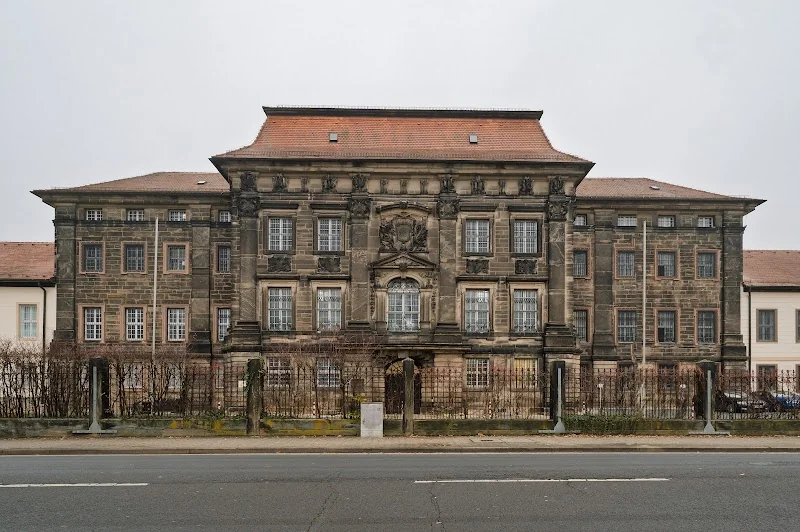
The Order Castle St. Georgen is one of those places in Bayreuth where history is not only told but remains spatially tangible to this day. Anyone who engages with St. Georgen encounters a baroque city foundation, the representative order of a margravial plan, and a later use that has transformed the building into a completely different reality. This tension makes the Order Castle so interesting for seekers, history enthusiasts, and visitors: it is not an isolated monument but part of a historical ensemble, the traces of which overlap in the district, in church architecture, and in its current use as a correctional facility. The city of Bayreuth describes St. Georgen as a historically grown, originally independent baroque district with clearly recognizable basic structures that still convey urbanity and quality of stay today. The Order Castle is part of this core but is also a building whose current function strongly shapes access. This makes it, for example, a place where historical identity, representative architecture, and modern institutions intertwine. For this reason, many people not only seek the history of the castle itself but also the Order Church, photos, practical parking tips, and the question of what one can actually see in St. Georgen. ([bayreuth.de](https://www.bayreuth.de/wirtschaft-forschung/wirtschaftsstandort/stadtteile/quartiersentwicklung-soziale-stadt/))
How the Order Castle St. Georgen was created
The creation of the Order Castle is closely linked to Margrave Georg Wilhelm, who had St. Georgen established as an independent baroque new foundation. The official brief information from the St. Georgen-Bayreuth correctional facility states that construction of the reformatory and workhouse began in 1724, with an estimated capacity for about 200 inmates, construction costs of 9,670 guilders, actual costs of 18,000 guilders, and completion in 1735. This timeframe is important because it shows that the Order Castle was not intended as a mere single building but as part of a functionally planned facility with social, representative, and urban planning significance. In the building directory of the Bavarian Ministry of Justice, Castle St. Georgen is also described as a three-story building with a protruding central section and heavy baroque decoration, dated from 1725 to 1727 and attributed to Johann David Räntz. This makes it clear that the site carries various historical layers: early planning phase, baroque shaping, later adaptation, and current institutional use. For visitors, this is exciting because the building does not appear as an isolated ornament but as a historical document in stone. It represents a prince who consistently enforced his city idea and an era in which architecture was meant to be not only beautiful but also orderly, symbolic, and powerful. Especially in Bayreuth, where the margravial history has strongly shaped the cityscape, the Order Castle is therefore a central building block of cultural memory. ([justiz.bayern.de](https://www.justiz.bayern.de/media/pdf/justizvollzug/bayreuth_2021.pdf))
However, the history of the Order Castle does not end with its founding period. The official justice brief overview already shows that the building has been altered several times over the centuries: alterations and extensions occurred around 1860, 1901, 1960, 1981, 1989, and 1994. This is crucial for the perception of the castle because it indicates how the function of the place has shifted repeatedly. From an early margravial facility, it became part of the modern prison; from the representative building in the baroque plan, it became a house that today is part of a security-relevant institution. These changes make the Order Castle historically credible and interesting: it is not a frozen open-air monument but a living object with administration, renovations, and a new role. Therefore, when searching for the term “Order Castle,” one often first encounters the correctional facility or entries related to judicial architecture. This is not a contradiction but the ongoing biography of the building. The building list of the Ministry of Justice explicitly mentions Castle St. Georgen at Bernecker Straße 9 and assigns it to the correctional facility. This also clarifies why the visibility of the castle in everyday life is limited: it is part of a security area, not a freely accessible museum. Nevertheless, the historical substance remains recognizable and forms a very special contrast to its current function. ([justiz.bayern.de](https://www.justiz.bayern.de/media/pdf/justizvollzug/bayreuth_2021.pdf))
Why the Order Castle and Order Church belong together
To understand the Order Castle, one must also consider the Order Church. The official church website describes St. Georgen as a uniformly planned urban complex from the baroque period. The first houses were built in 1702, the foundation stone of the church was laid in 1705, the consecration took place in 1711, and the tower was completed in 1718. These dates already show that the castle, church, and city layout emerged from a coherent design. The church itself has a cross-shaped floor plan based on a Greek cross, and its facade is divided by pilasters. The orientation is particularly important: the altar in the Order Church does not face east but north because the church was integrated into the alignment of the baroque urban complex towards the former Order Castle. At this point, it becomes visible how strictly urban planning followed the representative center. The castle was therefore not just a lord's seat on the edge but a reference point around which the spatial order was oriented. The church itself was intended for the community, as a court and family church and as a spiritual meeting place for the Order of Sincerity founded by Georg Wilhelm. Therefore, the term “Order Church” is not just a name but a reference to a political and cultural function that was closely connected to the castle. Today, those who search for “Order Castle” and “Order Church” simultaneously are, in truth, looking for the history of this baroque overall idea. ([ordenskirche.de](https://www.ordenskirche.de/seite/505294/ordenskirche.html))
The church website also provides an important insight into the material and symbolic language of the ensemble. At the center is the baptismal font by Elias Räntz from 1716; above it are ceiling paintings with biblical scenes, and in several places, the connection between liturgy, art, and court representation becomes clear. Particularly striking is the margrave's box, which was intended for Georg Wilhelm and refers to the builder through the red velvet drapery with coat of arms, initials, and order ribbon. The fact that the knights of the order had to gather in the church annually on St. George's Day also shows the close intertwining of power, piety, and representation. The official name “Order Church” established itself precisely because of the coat of arms panels and the order-related use. For photo inquiries, it is also interesting that the church website explicitly offers documentation of all images as well as a 360° panoramic view. This means that even if the Order Castle itself is only partially accessible, the cultural environment can be very well visualized. The ensemble thus functions doubly: as a historical reminder of the baroque city foundation and as a visible sign of a still vibrant district identity. From an SEO perspective, this is important because many users are not only searching for the castle but for the entire St. Georgen complex. ([ordenskirche.de](https://www.ordenskirche.de/seite/505294/ordenskirche.html))
Order Castle St. Georgen today: Part of the JVA Bayreuth
Today, the Order Castle St. Georgen is not a freely accessible excursion destination but part of the St. Georgen-Bayreuth correctional facility. The official brief information from the facility makes it clear that the Order Castle is classified as Institution II; it houses buildings E to H with pre-trial detention, medical department, tuberculosis hospital, and open prison section. The Bavarian Ministry of Justice describes the building at Bernecker Straße 9 as the former Castle St. Georgen, three stories high, with a protruding central section and heavy baroque decoration. In another official source, the large correctional facility St. Georgen-Bayreuth is mentioned with 932 detention places. For seekers, this is a central point because many expect a museum, a guided tour, or at least regular opening hours when visiting a castle. This is not the case here. The historical substance is present, but it exists within the framework of a security-relevant correctional operation. This fact also explains why one often finds more online about the church ensemble, tours in the district, or historical classifications than about classic visitor information for the castle itself. The Order Castle is thus a monument with institutional presence. This mixture makes it relevant: it is not a romantically isolated castle but a place where Bayreuth's history continues in a completely different context to this day. Those interested in historical changes in use will find here a particularly vivid example of how baroque architecture can be integrated into modern administrative and correctional structures. ([justiz.bayern.de](https://www.justiz.bayern.de/media/pdf/justizvollzug/bayreuth_2021.pdf))
For visitors, the rules are therefore clear and important. The official JVA website states that appointments must be made at least the day before and that telephone registration is only possible at certain times. A valid ID or passport is mandatory; a driver's license is not sufficient. Minors under 14 years of age require a copy of their birth certificate instead. There is a strict no-smoking and no-photography policy in the visitor waiting room and visiting rooms. The number of visitors per inmate visit is also limited, and visiting rooms are assigned based on suitability and arrangement. This information is important for SEO and user-friendliness because search interest is often practical: Where can I go, what can I bring, how does the visit proceed, where do I park? The official site answers these questions very concretely. Therefore, anyone with an appointment in the vicinity of the Order Castle should prepare for a clearly regulated, formally organized visiting procedure. For most travelers, the castle remains not freely accessible, but it still remains a significant historical point that can at least be contextualized from the outside in relation to the city history and the district of St. Georgen. The combination of restrictive access and strong historical presence is one of the reasons why the Order Castle is so frequently searched online. ([justiz.bayern.de](https://www.justiz.bayern.de/justizvollzug/anstalten/jva-bayreuth/))
Location, access, and parking at Bernecker Straße
The Order Castle St. Georgen is located in the historic district of St. Georgen, which the city of Bayreuth describes as an originally independent baroque city foundation. The city's redevelopment area refers to St. Georgen and “island” and classifies the program area northeast of the Bayreuth main train station, extending to Bernecker Straße. This is very helpful for orientation because it makes the place visible not just as a single address but as part of a grown urban quarter. St. Georgen is not a random peripheral area but a district with a strong identity, historical street market, typical houses, cultural events, and visible traces of its baroque planning. The Order Castle is thus situated in an area that the city itself describes as historically shaped and urbanistically interesting. Therefore, anyone driving to Bernecker Straße 9 is moving through a neighborhood where history, redevelopment, and the present are closely intertwined. For visitors, it is important: access questions should primarily be viewed in connection with the purpose of the visit. Those with an appointment at the JVA must follow the official security and visitor rules. Those exploring St. Georgen as a district will find more classic walking paths and cultural-historical destinations such as the Order Church, the historical street market, or other projects of the district management. The location of the Order Castle makes it a place that is both topographically and culturally embedded. The castle is therefore not alone but part of an urban environment that consciously refers to history. ([bayreuth.de](https://www.bayreuth.de/rathaus-buergerservice/planen-bauen/staedtebaufoerderung/sanierungsgebiete/sanierungsgebiet-f/))
When it comes to parking, the official instruction from the JVA is clear: visitor parking is located in front of the gate of the St. Georgen-Bayreuth correctional facility; parking is not allowed in front of the visitor entrance. This is useful, concrete information as it directly answers typical uncertainties when searching for “Parking Order Castle St. Georgen” or “Parking JVA Bayreuth.” Equally important is the note on the appointment requirement: visitor registration must be completed no later than the day before, and no registration is possible on weekends. For outsiders, the castle should therefore not be treated like a normal cultural destination. Those entering it as a search term in Google often seek not only history but also practical orientation. This is where the official regulation helps: park in front of the gate, not at the entrance, and only appear with prior registration. In the surrounding area, it is worth looking at the district of St. Georgen itself, as the city of Bayreuth describes it as a lively area with cultural projects, star market, music festival, and renovated neighborhoods. This means that even if the castle itself cannot be freely visited, the surroundings offer enough historical and atmospheric touchpoints for a short or longer walk through the district. Therefore, when visiting Bayreuth, one can discover St. Georgen as an independent building block of the city and contextualize the Order Castle as part of this larger story. ([justiz.bayern.de](https://www.justiz.bayern.de/justizvollzug/anstalten/jva-bayreuth/))
Photos, architecture, and the special effect of the place
Many people search for “Order Church St. Georgen photos” because the visual impact of the ensemble is a large part of its fascination. The official church website responds precisely to this: it not only offers the page on building and art history but also documentation of all images and a 360° panoramic view. This structure already shows that the Order Church can be thought of as a place of imagery, even if the Order Castle, as part of the JVA, is not freely accessible. Inside the church, the cross-shaped floor plan, the centrally placed baptismal font, the organ-pulpit altar, and the richly decorated ceiling paintings are the dominant motifs. The proximity of the castle indirectly continues to resonate because the church was integrated into the alignment of the baroque urban complex toward the former Order Castle. Therefore, those searching for photos receive not only decorative views but a visual narrative: baroque order, spiritual symbolism, court representation, and urban planning intertwine. The church is thus not merely a beautiful space but a key to understanding the entire place. This is also valuable for a good SEO structure because seekers often combine terms like “photos,” “history,” “Order Church,” and “Order Castle.” The official image documentation and the 360° view provide users with exactly that initial orientation, which is often the most important for historical sites. ([ordenskirche.de](https://www.ordenskirche.de/seite/505294/ordenskirche.html))
The architecture of the surroundings is also remarkable. The city of Bayreuth describes St. Georgen as a historically grown, originally independent baroque quarter with clearly recognizable basic structures, street market, typical houses, and other historical buildings such as the Order Church and the Princess House. Additionally, there are the cellar facilities of the Stern von St. Georgen and various urban redevelopment projects. This means that anyone photographing on-site sees not just a single building but an entire historical layering. The Order Castle itself remains discreet and security-oriented in its current function, but this creates a strong contrast between architecture and use. This contrast is photographically interesting because it makes visible stories of power, change, and repurposing. For many visitors, this is precisely the special effect of the place: the baroque form remains recognizable, yet the present writes a completely different use over it. Such places are rare because they are not merely a backdrop but real historical transition points. Those wanting to understand Bayreuth's baroque side should therefore not only look at the famous center but also consider St. Georgen. The Order Castle is a central marker that continues to shape the spatial and historical identity of the district to this day. ([bayreuth.de](https://www.bayreuth.de/wirtschaft-forschung/wirtschaftsstandort/stadtteile/quartiersentwicklung-soziale-stadt/))
Experience St. Georgen: Tours, district, and event environment
St. Georgen is today not only a historical district but also a vibrant neighborhood with recurring events and tourist offerings. Bayreuth Tourism offers a thematic tour “Small and large attractions in baroque St. Georgen,” focusing on the Order Church, Matrosengasse, and other places in the district. The city of Bayreuth also describes recurring formats such as the star market during Advent and the music festival “St. Georgen swings,” which culturally highlight the district. This is particularly valuable for visitors because it provides a realistic picture of the area: St. Georgen is not a museum-like empty space but a quarter with everyday life, community, culture, and historical depth. In this context, the Order Castle is more of a strong historical focal point than a classic excursion destination with opening hours. Those searching online for the castle often seek a quick answer to the question of what actually characterizes this place. The answer is: a baroque planning center, a historical place of power and function, a current justice facility, and an anchor point in a district that visibly preserves its history. For this reason, the Order Castle also belongs to the larger narrative of Bayreuth's urban history, which ranges from margravial planning to current neighborhood projects. The official city history emphasizes that St. Georgen was an independent town until 1811; this independence is still felt in the cityscape and in the clear historical structure today. ([bayreuth-tourismus.de](https://www.bayreuth-tourismus.de/entdecken/fuehrungen/))
For practical planning, this means: Those searching for the Order Castle St. Georgen should clearly distinguish their purpose of visit. As a historical research point, the castle is a central component of Bayreuth's baroque history. As a place of visit, it is subject to the rules of a correctional facility. As part of a district with tours, church visits, and cultural formats, it is embedded in a broad environment that can make the excursion worthwhile. The most important real facts can be summarized simply: baroque foundation under Georg Wilhelm, official location at Bernecker Straße 9, current affiliation with the St. Georgen-Bayreuth correctional facility, visitor parking in front of the gate, and no free visits like in a museum. For search engines, this is an ideal combination because it serves both information search and local orientation. For people on-site or traveling, it is a place with a clear profile and unusual history. Bayreuth thrives on such connections between court art, urban development, and current uses. The Order Castle St. Georgen is one of the most striking examples of this. Those who engage with it discover not only a castle but a piece of urban development that spans from the baroque to the present. ([justiz.bayern.de](https://www.justiz.bayern.de/media/pdf/justizvollzug/bayreuth_2021.pdf))
Sources:
- Bavarian State Ministry of Justice - Buildings of the Bavarian Justice
- Bavarian State Ministry of Justice - JVA St. Georgen-Bayreuth
- Ev.-Luth. Congregation St. Georgen - Order Church
- City of Bayreuth - Bayreuth City History
- City of Bayreuth - Neighborhood Development St. Georgen
- City of Bayreuth - Redevelopment Area F St. Georgen and Island
- Bayreuth Marketing & Tourism GmbH - Tours in Bayreuth
Mehr anzeigenWeniger anzeigen
Order Castle St. Georgen | History & Order Church
The Order Castle St. Georgen is one of those places in Bayreuth where history is not only told but remains spatially tangible to this day. Anyone who engages with St. Georgen encounters a baroque city foundation, the representative order of a margravial plan, and a later use that has transformed the building into a completely different reality. This tension makes the Order Castle so interesting for seekers, history enthusiasts, and visitors: it is not an isolated monument but part of a historical ensemble, the traces of which overlap in the district, in church architecture, and in its current use as a correctional facility. The city of Bayreuth describes St. Georgen as a historically grown, originally independent baroque district with clearly recognizable basic structures that still convey urbanity and quality of stay today. The Order Castle is part of this core but is also a building whose current function strongly shapes access. This makes it, for example, a place where historical identity, representative architecture, and modern institutions intertwine. For this reason, many people not only seek the history of the castle itself but also the Order Church, photos, practical parking tips, and the question of what one can actually see in St. Georgen. ([bayreuth.de](https://www.bayreuth.de/wirtschaft-forschung/wirtschaftsstandort/stadtteile/quartiersentwicklung-soziale-stadt/))
How the Order Castle St. Georgen was created
The creation of the Order Castle is closely linked to Margrave Georg Wilhelm, who had St. Georgen established as an independent baroque new foundation. The official brief information from the St. Georgen-Bayreuth correctional facility states that construction of the reformatory and workhouse began in 1724, with an estimated capacity for about 200 inmates, construction costs of 9,670 guilders, actual costs of 18,000 guilders, and completion in 1735. This timeframe is important because it shows that the Order Castle was not intended as a mere single building but as part of a functionally planned facility with social, representative, and urban planning significance. In the building directory of the Bavarian Ministry of Justice, Castle St. Georgen is also described as a three-story building with a protruding central section and heavy baroque decoration, dated from 1725 to 1727 and attributed to Johann David Räntz. This makes it clear that the site carries various historical layers: early planning phase, baroque shaping, later adaptation, and current institutional use. For visitors, this is exciting because the building does not appear as an isolated ornament but as a historical document in stone. It represents a prince who consistently enforced his city idea and an era in which architecture was meant to be not only beautiful but also orderly, symbolic, and powerful. Especially in Bayreuth, where the margravial history has strongly shaped the cityscape, the Order Castle is therefore a central building block of cultural memory. ([justiz.bayern.de](https://www.justiz.bayern.de/media/pdf/justizvollzug/bayreuth_2021.pdf))
However, the history of the Order Castle does not end with its founding period. The official justice brief overview already shows that the building has been altered several times over the centuries: alterations and extensions occurred around 1860, 1901, 1960, 1981, 1989, and 1994. This is crucial for the perception of the castle because it indicates how the function of the place has shifted repeatedly. From an early margravial facility, it became part of the modern prison; from the representative building in the baroque plan, it became a house that today is part of a security-relevant institution. These changes make the Order Castle historically credible and interesting: it is not a frozen open-air monument but a living object with administration, renovations, and a new role. Therefore, when searching for the term “Order Castle,” one often first encounters the correctional facility or entries related to judicial architecture. This is not a contradiction but the ongoing biography of the building. The building list of the Ministry of Justice explicitly mentions Castle St. Georgen at Bernecker Straße 9 and assigns it to the correctional facility. This also clarifies why the visibility of the castle in everyday life is limited: it is part of a security area, not a freely accessible museum. Nevertheless, the historical substance remains recognizable and forms a very special contrast to its current function. ([justiz.bayern.de](https://www.justiz.bayern.de/media/pdf/justizvollzug/bayreuth_2021.pdf))
Why the Order Castle and Order Church belong together
To understand the Order Castle, one must also consider the Order Church. The official church website describes St. Georgen as a uniformly planned urban complex from the baroque period. The first houses were built in 1702, the foundation stone of the church was laid in 1705, the consecration took place in 1711, and the tower was completed in 1718. These dates already show that the castle, church, and city layout emerged from a coherent design. The church itself has a cross-shaped floor plan based on a Greek cross, and its facade is divided by pilasters. The orientation is particularly important: the altar in the Order Church does not face east but north because the church was integrated into the alignment of the baroque urban complex towards the former Order Castle. At this point, it becomes visible how strictly urban planning followed the representative center. The castle was therefore not just a lord's seat on the edge but a reference point around which the spatial order was oriented. The church itself was intended for the community, as a court and family church and as a spiritual meeting place for the Order of Sincerity founded by Georg Wilhelm. Therefore, the term “Order Church” is not just a name but a reference to a political and cultural function that was closely connected to the castle. Today, those who search for “Order Castle” and “Order Church” simultaneously are, in truth, looking for the history of this baroque overall idea. ([ordenskirche.de](https://www.ordenskirche.de/seite/505294/ordenskirche.html))
The church website also provides an important insight into the material and symbolic language of the ensemble. At the center is the baptismal font by Elias Räntz from 1716; above it are ceiling paintings with biblical scenes, and in several places, the connection between liturgy, art, and court representation becomes clear. Particularly striking is the margrave's box, which was intended for Georg Wilhelm and refers to the builder through the red velvet drapery with coat of arms, initials, and order ribbon. The fact that the knights of the order had to gather in the church annually on St. George's Day also shows the close intertwining of power, piety, and representation. The official name “Order Church” established itself precisely because of the coat of arms panels and the order-related use. For photo inquiries, it is also interesting that the church website explicitly offers documentation of all images as well as a 360° panoramic view. This means that even if the Order Castle itself is only partially accessible, the cultural environment can be very well visualized. The ensemble thus functions doubly: as a historical reminder of the baroque city foundation and as a visible sign of a still vibrant district identity. From an SEO perspective, this is important because many users are not only searching for the castle but for the entire St. Georgen complex. ([ordenskirche.de](https://www.ordenskirche.de/seite/505294/ordenskirche.html))
Order Castle St. Georgen today: Part of the JVA Bayreuth
Today, the Order Castle St. Georgen is not a freely accessible excursion destination but part of the St. Georgen-Bayreuth correctional facility. The official brief information from the facility makes it clear that the Order Castle is classified as Institution II; it houses buildings E to H with pre-trial detention, medical department, tuberculosis hospital, and open prison section. The Bavarian Ministry of Justice describes the building at Bernecker Straße 9 as the former Castle St. Georgen, three stories high, with a protruding central section and heavy baroque decoration. In another official source, the large correctional facility St. Georgen-Bayreuth is mentioned with 932 detention places. For seekers, this is a central point because many expect a museum, a guided tour, or at least regular opening hours when visiting a castle. This is not the case here. The historical substance is present, but it exists within the framework of a security-relevant correctional operation. This fact also explains why one often finds more online about the church ensemble, tours in the district, or historical classifications than about classic visitor information for the castle itself. The Order Castle is thus a monument with institutional presence. This mixture makes it relevant: it is not a romantically isolated castle but a place where Bayreuth's history continues in a completely different context to this day. Those interested in historical changes in use will find here a particularly vivid example of how baroque architecture can be integrated into modern administrative and correctional structures. ([justiz.bayern.de](https://www.justiz.bayern.de/media/pdf/justizvollzug/bayreuth_2021.pdf))
For visitors, the rules are therefore clear and important. The official JVA website states that appointments must be made at least the day before and that telephone registration is only possible at certain times. A valid ID or passport is mandatory; a driver's license is not sufficient. Minors under 14 years of age require a copy of their birth certificate instead. There is a strict no-smoking and no-photography policy in the visitor waiting room and visiting rooms. The number of visitors per inmate visit is also limited, and visiting rooms are assigned based on suitability and arrangement. This information is important for SEO and user-friendliness because search interest is often practical: Where can I go, what can I bring, how does the visit proceed, where do I park? The official site answers these questions very concretely. Therefore, anyone with an appointment in the vicinity of the Order Castle should prepare for a clearly regulated, formally organized visiting procedure. For most travelers, the castle remains not freely accessible, but it still remains a significant historical point that can at least be contextualized from the outside in relation to the city history and the district of St. Georgen. The combination of restrictive access and strong historical presence is one of the reasons why the Order Castle is so frequently searched online. ([justiz.bayern.de](https://www.justiz.bayern.de/justizvollzug/anstalten/jva-bayreuth/))
Location, access, and parking at Bernecker Straße
The Order Castle St. Georgen is located in the historic district of St. Georgen, which the city of Bayreuth describes as an originally independent baroque city foundation. The city's redevelopment area refers to St. Georgen and “island” and classifies the program area northeast of the Bayreuth main train station, extending to Bernecker Straße. This is very helpful for orientation because it makes the place visible not just as a single address but as part of a grown urban quarter. St. Georgen is not a random peripheral area but a district with a strong identity, historical street market, typical houses, cultural events, and visible traces of its baroque planning. The Order Castle is thus situated in an area that the city itself describes as historically shaped and urbanistically interesting. Therefore, anyone driving to Bernecker Straße 9 is moving through a neighborhood where history, redevelopment, and the present are closely intertwined. For visitors, it is important: access questions should primarily be viewed in connection with the purpose of the visit. Those with an appointment at the JVA must follow the official security and visitor rules. Those exploring St. Georgen as a district will find more classic walking paths and cultural-historical destinations such as the Order Church, the historical street market, or other projects of the district management. The location of the Order Castle makes it a place that is both topographically and culturally embedded. The castle is therefore not alone but part of an urban environment that consciously refers to history. ([bayreuth.de](https://www.bayreuth.de/rathaus-buergerservice/planen-bauen/staedtebaufoerderung/sanierungsgebiete/sanierungsgebiet-f/))
When it comes to parking, the official instruction from the JVA is clear: visitor parking is located in front of the gate of the St. Georgen-Bayreuth correctional facility; parking is not allowed in front of the visitor entrance. This is useful, concrete information as it directly answers typical uncertainties when searching for “Parking Order Castle St. Georgen” or “Parking JVA Bayreuth.” Equally important is the note on the appointment requirement: visitor registration must be completed no later than the day before, and no registration is possible on weekends. For outsiders, the castle should therefore not be treated like a normal cultural destination. Those entering it as a search term in Google often seek not only history but also practical orientation. This is where the official regulation helps: park in front of the gate, not at the entrance, and only appear with prior registration. In the surrounding area, it is worth looking at the district of St. Georgen itself, as the city of Bayreuth describes it as a lively area with cultural projects, star market, music festival, and renovated neighborhoods. This means that even if the castle itself cannot be freely visited, the surroundings offer enough historical and atmospheric touchpoints for a short or longer walk through the district. Therefore, when visiting Bayreuth, one can discover St. Georgen as an independent building block of the city and contextualize the Order Castle as part of this larger story. ([justiz.bayern.de](https://www.justiz.bayern.de/justizvollzug/anstalten/jva-bayreuth/))
Photos, architecture, and the special effect of the place
Many people search for “Order Church St. Georgen photos” because the visual impact of the ensemble is a large part of its fascination. The official church website responds precisely to this: it not only offers the page on building and art history but also documentation of all images and a 360° panoramic view. This structure already shows that the Order Church can be thought of as a place of imagery, even if the Order Castle, as part of the JVA, is not freely accessible. Inside the church, the cross-shaped floor plan, the centrally placed baptismal font, the organ-pulpit altar, and the richly decorated ceiling paintings are the dominant motifs. The proximity of the castle indirectly continues to resonate because the church was integrated into the alignment of the baroque urban complex toward the former Order Castle. Therefore, those searching for photos receive not only decorative views but a visual narrative: baroque order, spiritual symbolism, court representation, and urban planning intertwine. The church is thus not merely a beautiful space but a key to understanding the entire place. This is also valuable for a good SEO structure because seekers often combine terms like “photos,” “history,” “Order Church,” and “Order Castle.” The official image documentation and the 360° view provide users with exactly that initial orientation, which is often the most important for historical sites. ([ordenskirche.de](https://www.ordenskirche.de/seite/505294/ordenskirche.html))
The architecture of the surroundings is also remarkable. The city of Bayreuth describes St. Georgen as a historically grown, originally independent baroque quarter with clearly recognizable basic structures, street market, typical houses, and other historical buildings such as the Order Church and the Princess House. Additionally, there are the cellar facilities of the Stern von St. Georgen and various urban redevelopment projects. This means that anyone photographing on-site sees not just a single building but an entire historical layering. The Order Castle itself remains discreet and security-oriented in its current function, but this creates a strong contrast between architecture and use. This contrast is photographically interesting because it makes visible stories of power, change, and repurposing. For many visitors, this is precisely the special effect of the place: the baroque form remains recognizable, yet the present writes a completely different use over it. Such places are rare because they are not merely a backdrop but real historical transition points. Those wanting to understand Bayreuth's baroque side should therefore not only look at the famous center but also consider St. Georgen. The Order Castle is a central marker that continues to shape the spatial and historical identity of the district to this day. ([bayreuth.de](https://www.bayreuth.de/wirtschaft-forschung/wirtschaftsstandort/stadtteile/quartiersentwicklung-soziale-stadt/))
Experience St. Georgen: Tours, district, and event environment
St. Georgen is today not only a historical district but also a vibrant neighborhood with recurring events and tourist offerings. Bayreuth Tourism offers a thematic tour “Small and large attractions in baroque St. Georgen,” focusing on the Order Church, Matrosengasse, and other places in the district. The city of Bayreuth also describes recurring formats such as the star market during Advent and the music festival “St. Georgen swings,” which culturally highlight the district. This is particularly valuable for visitors because it provides a realistic picture of the area: St. Georgen is not a museum-like empty space but a quarter with everyday life, community, culture, and historical depth. In this context, the Order Castle is more of a strong historical focal point than a classic excursion destination with opening hours. Those searching online for the castle often seek a quick answer to the question of what actually characterizes this place. The answer is: a baroque planning center, a historical place of power and function, a current justice facility, and an anchor point in a district that visibly preserves its history. For this reason, the Order Castle also belongs to the larger narrative of Bayreuth's urban history, which ranges from margravial planning to current neighborhood projects. The official city history emphasizes that St. Georgen was an independent town until 1811; this independence is still felt in the cityscape and in the clear historical structure today. ([bayreuth-tourismus.de](https://www.bayreuth-tourismus.de/entdecken/fuehrungen/))
For practical planning, this means: Those searching for the Order Castle St. Georgen should clearly distinguish their purpose of visit. As a historical research point, the castle is a central component of Bayreuth's baroque history. As a place of visit, it is subject to the rules of a correctional facility. As part of a district with tours, church visits, and cultural formats, it is embedded in a broad environment that can make the excursion worthwhile. The most important real facts can be summarized simply: baroque foundation under Georg Wilhelm, official location at Bernecker Straße 9, current affiliation with the St. Georgen-Bayreuth correctional facility, visitor parking in front of the gate, and no free visits like in a museum. For search engines, this is an ideal combination because it serves both information search and local orientation. For people on-site or traveling, it is a place with a clear profile and unusual history. Bayreuth thrives on such connections between court art, urban development, and current uses. The Order Castle St. Georgen is one of the most striking examples of this. Those who engage with it discover not only a castle but a piece of urban development that spans from the baroque to the present. ([justiz.bayern.de](https://www.justiz.bayern.de/media/pdf/justizvollzug/bayreuth_2021.pdf))
Sources:
- Bavarian State Ministry of Justice - Buildings of the Bavarian Justice
- Bavarian State Ministry of Justice - JVA St. Georgen-Bayreuth
- Ev.-Luth. Congregation St. Georgen - Order Church
- City of Bayreuth - Bayreuth City History
- City of Bayreuth - Neighborhood Development St. Georgen
- City of Bayreuth - Redevelopment Area F St. Georgen and Island
- Bayreuth Marketing & Tourism GmbH - Tours in Bayreuth
Order Castle St. Georgen | History & Order Church
The Order Castle St. Georgen is one of those places in Bayreuth where history is not only told but remains spatially tangible to this day. Anyone who engages with St. Georgen encounters a baroque city foundation, the representative order of a margravial plan, and a later use that has transformed the building into a completely different reality. This tension makes the Order Castle so interesting for seekers, history enthusiasts, and visitors: it is not an isolated monument but part of a historical ensemble, the traces of which overlap in the district, in church architecture, and in its current use as a correctional facility. The city of Bayreuth describes St. Georgen as a historically grown, originally independent baroque district with clearly recognizable basic structures that still convey urbanity and quality of stay today. The Order Castle is part of this core but is also a building whose current function strongly shapes access. This makes it, for example, a place where historical identity, representative architecture, and modern institutions intertwine. For this reason, many people not only seek the history of the castle itself but also the Order Church, photos, practical parking tips, and the question of what one can actually see in St. Georgen. ([bayreuth.de](https://www.bayreuth.de/wirtschaft-forschung/wirtschaftsstandort/stadtteile/quartiersentwicklung-soziale-stadt/))
How the Order Castle St. Georgen was created
The creation of the Order Castle is closely linked to Margrave Georg Wilhelm, who had St. Georgen established as an independent baroque new foundation. The official brief information from the St. Georgen-Bayreuth correctional facility states that construction of the reformatory and workhouse began in 1724, with an estimated capacity for about 200 inmates, construction costs of 9,670 guilders, actual costs of 18,000 guilders, and completion in 1735. This timeframe is important because it shows that the Order Castle was not intended as a mere single building but as part of a functionally planned facility with social, representative, and urban planning significance. In the building directory of the Bavarian Ministry of Justice, Castle St. Georgen is also described as a three-story building with a protruding central section and heavy baroque decoration, dated from 1725 to 1727 and attributed to Johann David Räntz. This makes it clear that the site carries various historical layers: early planning phase, baroque shaping, later adaptation, and current institutional use. For visitors, this is exciting because the building does not appear as an isolated ornament but as a historical document in stone. It represents a prince who consistently enforced his city idea and an era in which architecture was meant to be not only beautiful but also orderly, symbolic, and powerful. Especially in Bayreuth, where the margravial history has strongly shaped the cityscape, the Order Castle is therefore a central building block of cultural memory. ([justiz.bayern.de](https://www.justiz.bayern.de/media/pdf/justizvollzug/bayreuth_2021.pdf))
However, the history of the Order Castle does not end with its founding period. The official justice brief overview already shows that the building has been altered several times over the centuries: alterations and extensions occurred around 1860, 1901, 1960, 1981, 1989, and 1994. This is crucial for the perception of the castle because it indicates how the function of the place has shifted repeatedly. From an early margravial facility, it became part of the modern prison; from the representative building in the baroque plan, it became a house that today is part of a security-relevant institution. These changes make the Order Castle historically credible and interesting: it is not a frozen open-air monument but a living object with administration, renovations, and a new role. Therefore, when searching for the term “Order Castle,” one often first encounters the correctional facility or entries related to judicial architecture. This is not a contradiction but the ongoing biography of the building. The building list of the Ministry of Justice explicitly mentions Castle St. Georgen at Bernecker Straße 9 and assigns it to the correctional facility. This also clarifies why the visibility of the castle in everyday life is limited: it is part of a security area, not a freely accessible museum. Nevertheless, the historical substance remains recognizable and forms a very special contrast to its current function. ([justiz.bayern.de](https://www.justiz.bayern.de/media/pdf/justizvollzug/bayreuth_2021.pdf))
Why the Order Castle and Order Church belong together
To understand the Order Castle, one must also consider the Order Church. The official church website describes St. Georgen as a uniformly planned urban complex from the baroque period. The first houses were built in 1702, the foundation stone of the church was laid in 1705, the consecration took place in 1711, and the tower was completed in 1718. These dates already show that the castle, church, and city layout emerged from a coherent design. The church itself has a cross-shaped floor plan based on a Greek cross, and its facade is divided by pilasters. The orientation is particularly important: the altar in the Order Church does not face east but north because the church was integrated into the alignment of the baroque urban complex towards the former Order Castle. At this point, it becomes visible how strictly urban planning followed the representative center. The castle was therefore not just a lord's seat on the edge but a reference point around which the spatial order was oriented. The church itself was intended for the community, as a court and family church and as a spiritual meeting place for the Order of Sincerity founded by Georg Wilhelm. Therefore, the term “Order Church” is not just a name but a reference to a political and cultural function that was closely connected to the castle. Today, those who search for “Order Castle” and “Order Church” simultaneously are, in truth, looking for the history of this baroque overall idea. ([ordenskirche.de](https://www.ordenskirche.de/seite/505294/ordenskirche.html))
The church website also provides an important insight into the material and symbolic language of the ensemble. At the center is the baptismal font by Elias Räntz from 1716; above it are ceiling paintings with biblical scenes, and in several places, the connection between liturgy, art, and court representation becomes clear. Particularly striking is the margrave's box, which was intended for Georg Wilhelm and refers to the builder through the red velvet drapery with coat of arms, initials, and order ribbon. The fact that the knights of the order had to gather in the church annually on St. George's Day also shows the close intertwining of power, piety, and representation. The official name “Order Church” established itself precisely because of the coat of arms panels and the order-related use. For photo inquiries, it is also interesting that the church website explicitly offers documentation of all images as well as a 360° panoramic view. This means that even if the Order Castle itself is only partially accessible, the cultural environment can be very well visualized. The ensemble thus functions doubly: as a historical reminder of the baroque city foundation and as a visible sign of a still vibrant district identity. From an SEO perspective, this is important because many users are not only searching for the castle but for the entire St. Georgen complex. ([ordenskirche.de](https://www.ordenskirche.de/seite/505294/ordenskirche.html))
Order Castle St. Georgen today: Part of the JVA Bayreuth
Today, the Order Castle St. Georgen is not a freely accessible excursion destination but part of the St. Georgen-Bayreuth correctional facility. The official brief information from the facility makes it clear that the Order Castle is classified as Institution II; it houses buildings E to H with pre-trial detention, medical department, tuberculosis hospital, and open prison section. The Bavarian Ministry of Justice describes the building at Bernecker Straße 9 as the former Castle St. Georgen, three stories high, with a protruding central section and heavy baroque decoration. In another official source, the large correctional facility St. Georgen-Bayreuth is mentioned with 932 detention places. For seekers, this is a central point because many expect a museum, a guided tour, or at least regular opening hours when visiting a castle. This is not the case here. The historical substance is present, but it exists within the framework of a security-relevant correctional operation. This fact also explains why one often finds more online about the church ensemble, tours in the district, or historical classifications than about classic visitor information for the castle itself. The Order Castle is thus a monument with institutional presence. This mixture makes it relevant: it is not a romantically isolated castle but a place where Bayreuth's history continues in a completely different context to this day. Those interested in historical changes in use will find here a particularly vivid example of how baroque architecture can be integrated into modern administrative and correctional structures. ([justiz.bayern.de](https://www.justiz.bayern.de/media/pdf/justizvollzug/bayreuth_2021.pdf))
For visitors, the rules are therefore clear and important. The official JVA website states that appointments must be made at least the day before and that telephone registration is only possible at certain times. A valid ID or passport is mandatory; a driver's license is not sufficient. Minors under 14 years of age require a copy of their birth certificate instead. There is a strict no-smoking and no-photography policy in the visitor waiting room and visiting rooms. The number of visitors per inmate visit is also limited, and visiting rooms are assigned based on suitability and arrangement. This information is important for SEO and user-friendliness because search interest is often practical: Where can I go, what can I bring, how does the visit proceed, where do I park? The official site answers these questions very concretely. Therefore, anyone with an appointment in the vicinity of the Order Castle should prepare for a clearly regulated, formally organized visiting procedure. For most travelers, the castle remains not freely accessible, but it still remains a significant historical point that can at least be contextualized from the outside in relation to the city history and the district of St. Georgen. The combination of restrictive access and strong historical presence is one of the reasons why the Order Castle is so frequently searched online. ([justiz.bayern.de](https://www.justiz.bayern.de/justizvollzug/anstalten/jva-bayreuth/))
Location, access, and parking at Bernecker Straße
The Order Castle St. Georgen is located in the historic district of St. Georgen, which the city of Bayreuth describes as an originally independent baroque city foundation. The city's redevelopment area refers to St. Georgen and “island” and classifies the program area northeast of the Bayreuth main train station, extending to Bernecker Straße. This is very helpful for orientation because it makes the place visible not just as a single address but as part of a grown urban quarter. St. Georgen is not a random peripheral area but a district with a strong identity, historical street market, typical houses, cultural events, and visible traces of its baroque planning. The Order Castle is thus situated in an area that the city itself describes as historically shaped and urbanistically interesting. Therefore, anyone driving to Bernecker Straße 9 is moving through a neighborhood where history, redevelopment, and the present are closely intertwined. For visitors, it is important: access questions should primarily be viewed in connection with the purpose of the visit. Those with an appointment at the JVA must follow the official security and visitor rules. Those exploring St. Georgen as a district will find more classic walking paths and cultural-historical destinations such as the Order Church, the historical street market, or other projects of the district management. The location of the Order Castle makes it a place that is both topographically and culturally embedded. The castle is therefore not alone but part of an urban environment that consciously refers to history. ([bayreuth.de](https://www.bayreuth.de/rathaus-buergerservice/planen-bauen/staedtebaufoerderung/sanierungsgebiete/sanierungsgebiet-f/))
When it comes to parking, the official instruction from the JVA is clear: visitor parking is located in front of the gate of the St. Georgen-Bayreuth correctional facility; parking is not allowed in front of the visitor entrance. This is useful, concrete information as it directly answers typical uncertainties when searching for “Parking Order Castle St. Georgen” or “Parking JVA Bayreuth.” Equally important is the note on the appointment requirement: visitor registration must be completed no later than the day before, and no registration is possible on weekends. For outsiders, the castle should therefore not be treated like a normal cultural destination. Those entering it as a search term in Google often seek not only history but also practical orientation. This is where the official regulation helps: park in front of the gate, not at the entrance, and only appear with prior registration. In the surrounding area, it is worth looking at the district of St. Georgen itself, as the city of Bayreuth describes it as a lively area with cultural projects, star market, music festival, and renovated neighborhoods. This means that even if the castle itself cannot be freely visited, the surroundings offer enough historical and atmospheric touchpoints for a short or longer walk through the district. Therefore, when visiting Bayreuth, one can discover St. Georgen as an independent building block of the city and contextualize the Order Castle as part of this larger story. ([justiz.bayern.de](https://www.justiz.bayern.de/justizvollzug/anstalten/jva-bayreuth/))
Photos, architecture, and the special effect of the place
Many people search for “Order Church St. Georgen photos” because the visual impact of the ensemble is a large part of its fascination. The official church website responds precisely to this: it not only offers the page on building and art history but also documentation of all images and a 360° panoramic view. This structure already shows that the Order Church can be thought of as a place of imagery, even if the Order Castle, as part of the JVA, is not freely accessible. Inside the church, the cross-shaped floor plan, the centrally placed baptismal font, the organ-pulpit altar, and the richly decorated ceiling paintings are the dominant motifs. The proximity of the castle indirectly continues to resonate because the church was integrated into the alignment of the baroque urban complex toward the former Order Castle. Therefore, those searching for photos receive not only decorative views but a visual narrative: baroque order, spiritual symbolism, court representation, and urban planning intertwine. The church is thus not merely a beautiful space but a key to understanding the entire place. This is also valuable for a good SEO structure because seekers often combine terms like “photos,” “history,” “Order Church,” and “Order Castle.” The official image documentation and the 360° view provide users with exactly that initial orientation, which is often the most important for historical sites. ([ordenskirche.de](https://www.ordenskirche.de/seite/505294/ordenskirche.html))
The architecture of the surroundings is also remarkable. The city of Bayreuth describes St. Georgen as a historically grown, originally independent baroque quarter with clearly recognizable basic structures, street market, typical houses, and other historical buildings such as the Order Church and the Princess House. Additionally, there are the cellar facilities of the Stern von St. Georgen and various urban redevelopment projects. This means that anyone photographing on-site sees not just a single building but an entire historical layering. The Order Castle itself remains discreet and security-oriented in its current function, but this creates a strong contrast between architecture and use. This contrast is photographically interesting because it makes visible stories of power, change, and repurposing. For many visitors, this is precisely the special effect of the place: the baroque form remains recognizable, yet the present writes a completely different use over it. Such places are rare because they are not merely a backdrop but real historical transition points. Those wanting to understand Bayreuth's baroque side should therefore not only look at the famous center but also consider St. Georgen. The Order Castle is a central marker that continues to shape the spatial and historical identity of the district to this day. ([bayreuth.de](https://www.bayreuth.de/wirtschaft-forschung/wirtschaftsstandort/stadtteile/quartiersentwicklung-soziale-stadt/))
Experience St. Georgen: Tours, district, and event environment
St. Georgen is today not only a historical district but also a vibrant neighborhood with recurring events and tourist offerings. Bayreuth Tourism offers a thematic tour “Small and large attractions in baroque St. Georgen,” focusing on the Order Church, Matrosengasse, and other places in the district. The city of Bayreuth also describes recurring formats such as the star market during Advent and the music festival “St. Georgen swings,” which culturally highlight the district. This is particularly valuable for visitors because it provides a realistic picture of the area: St. Georgen is not a museum-like empty space but a quarter with everyday life, community, culture, and historical depth. In this context, the Order Castle is more of a strong historical focal point than a classic excursion destination with opening hours. Those searching online for the castle often seek a quick answer to the question of what actually characterizes this place. The answer is: a baroque planning center, a historical place of power and function, a current justice facility, and an anchor point in a district that visibly preserves its history. For this reason, the Order Castle also belongs to the larger narrative of Bayreuth's urban history, which ranges from margravial planning to current neighborhood projects. The official city history emphasizes that St. Georgen was an independent town until 1811; this independence is still felt in the cityscape and in the clear historical structure today. ([bayreuth-tourismus.de](https://www.bayreuth-tourismus.de/entdecken/fuehrungen/))
For practical planning, this means: Those searching for the Order Castle St. Georgen should clearly distinguish their purpose of visit. As a historical research point, the castle is a central component of Bayreuth's baroque history. As a place of visit, it is subject to the rules of a correctional facility. As part of a district with tours, church visits, and cultural formats, it is embedded in a broad environment that can make the excursion worthwhile. The most important real facts can be summarized simply: baroque foundation under Georg Wilhelm, official location at Bernecker Straße 9, current affiliation with the St. Georgen-Bayreuth correctional facility, visitor parking in front of the gate, and no free visits like in a museum. For search engines, this is an ideal combination because it serves both information search and local orientation. For people on-site or traveling, it is a place with a clear profile and unusual history. Bayreuth thrives on such connections between court art, urban development, and current uses. The Order Castle St. Georgen is one of the most striking examples of this. Those who engage with it discover not only a castle but a piece of urban development that spans from the baroque to the present. ([justiz.bayern.de](https://www.justiz.bayern.de/media/pdf/justizvollzug/bayreuth_2021.pdf))
Sources:
- Bavarian State Ministry of Justice - Buildings of the Bavarian Justice
- Bavarian State Ministry of Justice - JVA St. Georgen-Bayreuth
- Ev.-Luth. Congregation St. Georgen - Order Church
- City of Bayreuth - Bayreuth City History
- City of Bayreuth - Neighborhood Development St. Georgen
- City of Bayreuth - Redevelopment Area F St. Georgen and Island
- Bayreuth Marketing & Tourism GmbH - Tours in Bayreuth
Frequently Asked Questions
Reviews
No reviews found