
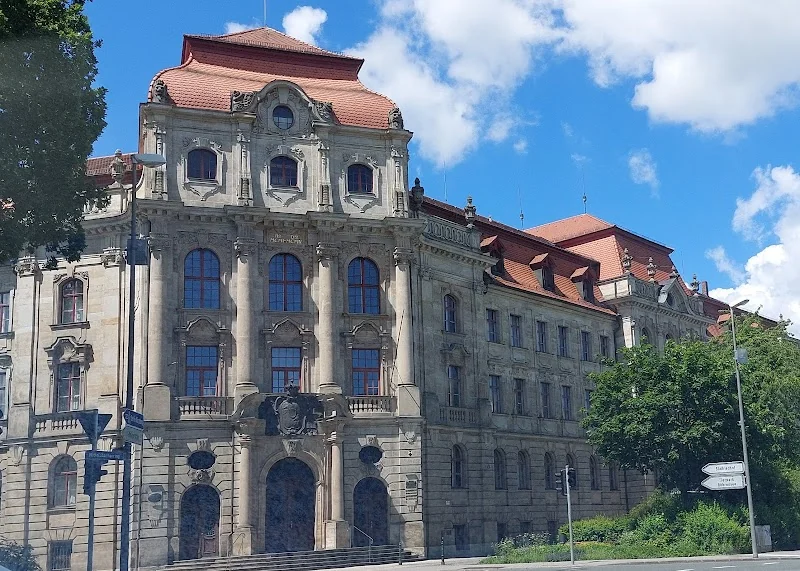
Bayreuth
Kanalstraße 3, 95444 Bayreuth, Deutschland
Schloßgalerie Bayreuth | Photos & Opening Hours
The Schloßgalerie Bayreuth is a location with a multifaceted history and a very changeable profile today: The building at La-Spezia-Platz 1 or Kanalstraße 3 was long a municipal administrative site, was built in 1998, and offers around 4,550 square meters of usable space as well as an underground garage with 94 parking spaces on two levels. At the same time, the Schloßgalerie is used for exhibitions, special formats, and inclusive offerings. Those looking for photos, opening hours, or directions usually want to find not just an address but to understand how this place in the center of Bayreuth functions today and what distinguishes it from classical museums or pure office buildings. This text aims to provide reliable facts, clear orientation, and an overview of the most important usage and visitor topics. ([bayreuth.de](https://www.bayreuth.de/wp-content/uploads/2023/07/Expose-Schlossgalerie-mit-Gebotsabgabe-web.pdf?utm_source=openai))
Address, Location, and Orientation at the Schloßgalerie Bayreuth
The exact orientation is simple because the Schloßgalerie is located at two well-known city center axes: La-Spezia-Platz 1 and Kanalstraße 3 in 95444 Bayreuth. In the official event data, the building also appears with the atrium as the main entrance, which is important for visitors looking for not just a postal address but the actual access. The location is central, immediately in the urban environment of Luitpoldplatz and the new town hall, in an area where many routes can be completed on foot. This is particularly relevant for seekers because the name Schloßgalerie easily evokes a classic shopping center, while the building is more read as a multifunctional urban space today. Those viewing photos also recognize the modern character of the building: clear lines, glass surfaces, and an urban architecture that consciously contrasts with the historical surroundings. Thus, an address is created that not only wants to be found but also understood. ([region-bayreuth.de](https://region-bayreuth.de/veranstaltung/75-bayreuther-kunstausstellung-aktuelle-werke-bayreuth-95444-aa2jbv))
For ongoing classification, it is also important that the city of Bayreuth has put the property up for sale in 2024, after the offices housed there had moved out. This significantly changes the perception of the location: The Schloßgalerie is not a classically permanently open public house with an unchanging operation, but a place whose use shifts depending on the phase and occasion. However, this is also where its search interest lies. Users search for address, photos, admission, or opening hours because the place in Bayreuth has repeatedly been visible for administration, art, and public appointments. This mix of urban everyday life and cultural programming makes the Schloßgalerie an address that can be read both functionally and culturally. For orientation in the city center, this is an advantage because the location remains firmly anchored in perception, even as the use changes. ([bayreuth.de](https://www.bayreuth.de/dienststellen-der-stadt-ziehen-aus-der-schlossgalerie-aus/?utm_source=openai))
Opening Hours and Current Access to the Schloßgalerie
The question of opening hours is one of the most important search queries, but at the Schloßgalerie, it can only be answered based on the respective purpose of use. According to the official reports from the city of Bayreuth, the building was vacated as an administrative site in 2024 and put up for sale; a permanent standard operation for the general public is no longer described there. Instead, opening hours appear whenever a specific exhibition or event is taking place. Practically, this means: Anyone wishing to visit the Schloßgalerie should always check the current event notice instead of assuming fixed house opening hours. This is important for orientation because the search intention often stems from classical museum situations, which do not apply here one-to-one. The location is thus today less a place with a rigid opening schedule than a flexibly used event and administrative space. ([bayreuth.de](https://www.bayreuth.de/dienststellen-der-stadt-ziehen-aus-der-schlossgalerie-aus/?utm_source=openai))
A good example of this is the 75th Bayreuth Art Exhibition: According to the Art Association and event portal, the Schloßgalerie was open daily from 10 a.m. to 6 p.m., with the opening taking place in July 2025 in the atrium or at the main entrance of the Schloßgalerie. These opening hours are thus not considered a general permanent rule but as a specific framework for a single exhibition. This results in two levels for SEO and visitor inquiries: On the one hand, people search for the building itself, and on the other hand, for the respective program. Separating both avoids misunderstandings and allows for better visit planning. For the Schloßgalerie, this means: Opening hours, admission, and access currently depend on the occasion, not on a museum standard model. This flexible use is typical for a place that moves between art, city administration, and public presentation. ([kunstverein-bayreuth.de](https://kunstverein-bayreuth.de/tag/ausstellung/?utm_source=openai))
Directions, Parking, and Underground Garage in the City Center
In terms of access, the location in the city center plays the main role. The Schloßgalerie is so centrally located that many destinations in the Bayreuth city center can be reached in a short distance, and the official event data also points to paid parking and bicycle parking spaces. This fits the usage profile: Those coming to an exhibition, a meeting, or an appointment primarily need a practical way to get there, not just a pretty address. For drivers, it is important that the Schloßgalerie is not located as a remote object on the outskirts of town, but as a city-center location with direct access to footpaths, squares, and central traffic axes. This allows visits to be easily combined with other errands in the city center. The search terms directions and parking thus hit the core very accurately because they provide real planning assistance for the location. ([region-bayreuth.de](https://region-bayreuth.de/veranstaltung/75-bayreuther-kunstausstellung-aktuelle-werke-bayreuth-95444-aa2jbv))
Particularly interesting is the technical side of the building: The city’s exposé mentions an underground garage with 94 parking spaces on two levels, as well as two basements and access via a modern office and commercial building with ground floor to 5th floor. This is a strong feature for a location in the city center, as visitors benefit from consolidated parking directly at the object. In practice, this means: Those looking to park at Schloßgalerie Bayreuth usually want not only free parking spaces but also to know whether it is a central, covered, and directly connected parking area. The available documents confirm exactly that. For attending an event, this is a plus because short distances, proximity to the city center, and weather-independent parking come together. Thus, the Schloßgalerie is also logistically a very typical Bayreuth city center location. ([bayreuth.de](https://www.bayreuth.de/wp-content/uploads/2023/07/Expose-Schlossgalerie-mit-Gebotsabgabe-web.pdf?utm_source=openai))
Exhibitions in the Atrium and Typical Events
The atrium is one of the defining spaces of the Schloßgalerie and is mentioned multiple times as an event location in the official reports. For example, the city council met here during the pandemic, and exhibitions and openings also took place here or at the main entrance. This is central to the perception of the house because the atrium takes on the function of an open, communicative interior space: It is neither a pure corridor nor a classic hall, but a place where public engagement is created. For this reason, the Schloßgalerie is well-suited for cultural formats where encounters, art, and information intersect. Those searching for Schloßgalerie Bayreuth Atrium are usually looking for the heart of the house. The public events show that this space is not only architecturally interesting but also plays a clear role in urban life. ([bayreuth.de](https://www.bayreuth.de/stadtratssitzung-in-der-schlossgalerie/))
Art also plays a recurring role here. In the 75th Bayreuth Art Exhibition, 130 current works by 107 artists were on display at the Schloßgalerie, and admission was free. The Art Association Bayreuth uses the location as a place for contemporary art, exchange, and public perception. As early as 2021, the Iwalewahaus presented African art there in the office spaces of the Schloßgalerie, accompanied by information and events from BayFinK. This shows how flexibly the place is used in cultural contexts: sometimes as an exhibition space, sometimes as a communicative intermediate space, sometimes as a place for inclusive mediation. For search inquiries related to programs, exhibitions, and tickets, this is particularly relevant because the Schloßgalerie is not just a backdrop but regularly becomes part of the program itself. This changing programming makes it culturally visible for Bayreuth. ([region-bayreuth.de](https://region-bayreuth.de/veranstaltung/75-bayreuther-kunstausstellung-aktuelle-werke-bayreuth-95444-aa2jbv))
Accessibility, Equipment, and Building Profile
The Schloßgalerie is also remarkable from the perspective of accessibility because the city of Bayreuth has set up rooms for the disability commissioner, the inclusion and integration office there. An indoor guiding system for the blind connects the entrance at Kanalstraße 3 with the second floor, allowing visually impaired individuals to move more independently within the building. Additionally, inclusive information stations with DGS videos and info cards have been implemented to make content more understandable. This is more than a technical measure: it shows that the location has been consciously designed to be inclusive, not just functional. Those searching for accessibility or photos will find here a place where architecture, administration, and accessibility converge. For a location page, this is valuable because such details often provide users with the decisive answer as to whether a visit is feasible. ([bayreuth.de](https://www.bayreuth.de/indoor-blindenleitsystem-in-der-schlossgalerie/))
The building profile also supports this impression. In the city’s exposé, the Schloßgalerie is described as a building constructed in 1998 with around 4,550 square meters of usable space; it also includes five upper floors, two basements, district heating, and the large underground garage. These key figures make it clear that this is not a small passage but an urban complex with several levels. Especially in connection with the atrium, the offices, and the exhibition spaces, a building emerges that can accommodate different requirements: administration, consulting, art mediation, and special use. For users, this is practical because it allows a wide range of search inquiries to be answered, from underground garage to seating options to public appointments. The building is thus not only barrier-free in individual elements but also functionally broad-based. ([bayreuth.de](https://www.bayreuth.de/wp-content/uploads/2023/07/Expose-Schlossgalerie-mit-Gebotsabgabe-web.pdf?utm_source=openai))
From Castle History to Today's Location
Historically, the Schloßgalerie is particularly interesting due to its predecessor building. The city of Bayreuth describes the so-called Stenohaus as the former seedbed of the Iwalewahaus: There, Ulli Beier created meeting points for art and literature that connected to the spiritual total works of art of the Igbo in West Nigeria. This connection is culturally significant for Bayreuth because it shows that the place was already a space for exchange and creative production before its current form. The Schloßgalerie is thus not simply located randomly in the city center but on a site with a cultural prehistory. For seekers looking for castle history, peculiarities, or background, this continuity is exciting: The name may sound modern, but the place already carries a longer, content-laden memory within it. This also explains why exhibitions and cultural collaborations work so well here. ([bayreuth.de](https://www.bayreuth.de/ausstellung-afrikanischer-kunst-in-den-bueroraeumen-der-schlossgalerie/))
The recent history then shows the transition from an administrative site to a currently more flexible use. The city reported in 2024 the move-out of the offices; among the affected facilities were economic development, environmental and climate protection, as well as the media center of the city and district. Shortly thereafter, the property was put up for sale. For external perception, this means: The Schloßgalerie remains a well-known name in the urban landscape, but its use has shifted and is now more oriented towards events and individual public occasions. This is precisely why search terms like opening hours, photos, directions, and parking remain relevant. They help to classify a place that stands between past and present. The Schloßgalerie Bayreuth is thus a good example of a building that redefines itself over time without losing its significance in the center of Bayreuth. ([bayreuth.de](https://www.bayreuth.de/dienststellen-der-stadt-ziehen-aus-der-schlossgalerie-aus/?utm_source=openai))
Sources:
- City of Bayreuth – Offices moved out of the Schloßgalerie
- City of Bayreuth – Exhibition of African Art in the Office Spaces of the Schloßgalerie
- City of Bayreuth – Indoor Guiding System for the Blind in the Schloßgalerie
- City of Bayreuth – Exposé Schloßgalerie (PDF)
- Art Association Bayreuth – Keyword Archive Exhibition
- Region Bayreuth – 75th Bayreuth Art Exhibition
Mehr anzeigenWeniger anzeigen
Schloßgalerie Bayreuth | Photos & Opening Hours
The Schloßgalerie Bayreuth is a location with a multifaceted history and a very changeable profile today: The building at La-Spezia-Platz 1 or Kanalstraße 3 was long a municipal administrative site, was built in 1998, and offers around 4,550 square meters of usable space as well as an underground garage with 94 parking spaces on two levels. At the same time, the Schloßgalerie is used for exhibitions, special formats, and inclusive offerings. Those looking for photos, opening hours, or directions usually want to find not just an address but to understand how this place in the center of Bayreuth functions today and what distinguishes it from classical museums or pure office buildings. This text aims to provide reliable facts, clear orientation, and an overview of the most important usage and visitor topics. ([bayreuth.de](https://www.bayreuth.de/wp-content/uploads/2023/07/Expose-Schlossgalerie-mit-Gebotsabgabe-web.pdf?utm_source=openai))
Address, Location, and Orientation at the Schloßgalerie Bayreuth
The exact orientation is simple because the Schloßgalerie is located at two well-known city center axes: La-Spezia-Platz 1 and Kanalstraße 3 in 95444 Bayreuth. In the official event data, the building also appears with the atrium as the main entrance, which is important for visitors looking for not just a postal address but the actual access. The location is central, immediately in the urban environment of Luitpoldplatz and the new town hall, in an area where many routes can be completed on foot. This is particularly relevant for seekers because the name Schloßgalerie easily evokes a classic shopping center, while the building is more read as a multifunctional urban space today. Those viewing photos also recognize the modern character of the building: clear lines, glass surfaces, and an urban architecture that consciously contrasts with the historical surroundings. Thus, an address is created that not only wants to be found but also understood. ([region-bayreuth.de](https://region-bayreuth.de/veranstaltung/75-bayreuther-kunstausstellung-aktuelle-werke-bayreuth-95444-aa2jbv))
For ongoing classification, it is also important that the city of Bayreuth has put the property up for sale in 2024, after the offices housed there had moved out. This significantly changes the perception of the location: The Schloßgalerie is not a classically permanently open public house with an unchanging operation, but a place whose use shifts depending on the phase and occasion. However, this is also where its search interest lies. Users search for address, photos, admission, or opening hours because the place in Bayreuth has repeatedly been visible for administration, art, and public appointments. This mix of urban everyday life and cultural programming makes the Schloßgalerie an address that can be read both functionally and culturally. For orientation in the city center, this is an advantage because the location remains firmly anchored in perception, even as the use changes. ([bayreuth.de](https://www.bayreuth.de/dienststellen-der-stadt-ziehen-aus-der-schlossgalerie-aus/?utm_source=openai))
Opening Hours and Current Access to the Schloßgalerie
The question of opening hours is one of the most important search queries, but at the Schloßgalerie, it can only be answered based on the respective purpose of use. According to the official reports from the city of Bayreuth, the building was vacated as an administrative site in 2024 and put up for sale; a permanent standard operation for the general public is no longer described there. Instead, opening hours appear whenever a specific exhibition or event is taking place. Practically, this means: Anyone wishing to visit the Schloßgalerie should always check the current event notice instead of assuming fixed house opening hours. This is important for orientation because the search intention often stems from classical museum situations, which do not apply here one-to-one. The location is thus today less a place with a rigid opening schedule than a flexibly used event and administrative space. ([bayreuth.de](https://www.bayreuth.de/dienststellen-der-stadt-ziehen-aus-der-schlossgalerie-aus/?utm_source=openai))
A good example of this is the 75th Bayreuth Art Exhibition: According to the Art Association and event portal, the Schloßgalerie was open daily from 10 a.m. to 6 p.m., with the opening taking place in July 2025 in the atrium or at the main entrance of the Schloßgalerie. These opening hours are thus not considered a general permanent rule but as a specific framework for a single exhibition. This results in two levels for SEO and visitor inquiries: On the one hand, people search for the building itself, and on the other hand, for the respective program. Separating both avoids misunderstandings and allows for better visit planning. For the Schloßgalerie, this means: Opening hours, admission, and access currently depend on the occasion, not on a museum standard model. This flexible use is typical for a place that moves between art, city administration, and public presentation. ([kunstverein-bayreuth.de](https://kunstverein-bayreuth.de/tag/ausstellung/?utm_source=openai))
Directions, Parking, and Underground Garage in the City Center
In terms of access, the location in the city center plays the main role. The Schloßgalerie is so centrally located that many destinations in the Bayreuth city center can be reached in a short distance, and the official event data also points to paid parking and bicycle parking spaces. This fits the usage profile: Those coming to an exhibition, a meeting, or an appointment primarily need a practical way to get there, not just a pretty address. For drivers, it is important that the Schloßgalerie is not located as a remote object on the outskirts of town, but as a city-center location with direct access to footpaths, squares, and central traffic axes. This allows visits to be easily combined with other errands in the city center. The search terms directions and parking thus hit the core very accurately because they provide real planning assistance for the location. ([region-bayreuth.de](https://region-bayreuth.de/veranstaltung/75-bayreuther-kunstausstellung-aktuelle-werke-bayreuth-95444-aa2jbv))
Particularly interesting is the technical side of the building: The city’s exposé mentions an underground garage with 94 parking spaces on two levels, as well as two basements and access via a modern office and commercial building with ground floor to 5th floor. This is a strong feature for a location in the city center, as visitors benefit from consolidated parking directly at the object. In practice, this means: Those looking to park at Schloßgalerie Bayreuth usually want not only free parking spaces but also to know whether it is a central, covered, and directly connected parking area. The available documents confirm exactly that. For attending an event, this is a plus because short distances, proximity to the city center, and weather-independent parking come together. Thus, the Schloßgalerie is also logistically a very typical Bayreuth city center location. ([bayreuth.de](https://www.bayreuth.de/wp-content/uploads/2023/07/Expose-Schlossgalerie-mit-Gebotsabgabe-web.pdf?utm_source=openai))
Exhibitions in the Atrium and Typical Events
The atrium is one of the defining spaces of the Schloßgalerie and is mentioned multiple times as an event location in the official reports. For example, the city council met here during the pandemic, and exhibitions and openings also took place here or at the main entrance. This is central to the perception of the house because the atrium takes on the function of an open, communicative interior space: It is neither a pure corridor nor a classic hall, but a place where public engagement is created. For this reason, the Schloßgalerie is well-suited for cultural formats where encounters, art, and information intersect. Those searching for Schloßgalerie Bayreuth Atrium are usually looking for the heart of the house. The public events show that this space is not only architecturally interesting but also plays a clear role in urban life. ([bayreuth.de](https://www.bayreuth.de/stadtratssitzung-in-der-schlossgalerie/))
Art also plays a recurring role here. In the 75th Bayreuth Art Exhibition, 130 current works by 107 artists were on display at the Schloßgalerie, and admission was free. The Art Association Bayreuth uses the location as a place for contemporary art, exchange, and public perception. As early as 2021, the Iwalewahaus presented African art there in the office spaces of the Schloßgalerie, accompanied by information and events from BayFinK. This shows how flexibly the place is used in cultural contexts: sometimes as an exhibition space, sometimes as a communicative intermediate space, sometimes as a place for inclusive mediation. For search inquiries related to programs, exhibitions, and tickets, this is particularly relevant because the Schloßgalerie is not just a backdrop but regularly becomes part of the program itself. This changing programming makes it culturally visible for Bayreuth. ([region-bayreuth.de](https://region-bayreuth.de/veranstaltung/75-bayreuther-kunstausstellung-aktuelle-werke-bayreuth-95444-aa2jbv))
Accessibility, Equipment, and Building Profile
The Schloßgalerie is also remarkable from the perspective of accessibility because the city of Bayreuth has set up rooms for the disability commissioner, the inclusion and integration office there. An indoor guiding system for the blind connects the entrance at Kanalstraße 3 with the second floor, allowing visually impaired individuals to move more independently within the building. Additionally, inclusive information stations with DGS videos and info cards have been implemented to make content more understandable. This is more than a technical measure: it shows that the location has been consciously designed to be inclusive, not just functional. Those searching for accessibility or photos will find here a place where architecture, administration, and accessibility converge. For a location page, this is valuable because such details often provide users with the decisive answer as to whether a visit is feasible. ([bayreuth.de](https://www.bayreuth.de/indoor-blindenleitsystem-in-der-schlossgalerie/))
The building profile also supports this impression. In the city’s exposé, the Schloßgalerie is described as a building constructed in 1998 with around 4,550 square meters of usable space; it also includes five upper floors, two basements, district heating, and the large underground garage. These key figures make it clear that this is not a small passage but an urban complex with several levels. Especially in connection with the atrium, the offices, and the exhibition spaces, a building emerges that can accommodate different requirements: administration, consulting, art mediation, and special use. For users, this is practical because it allows a wide range of search inquiries to be answered, from underground garage to seating options to public appointments. The building is thus not only barrier-free in individual elements but also functionally broad-based. ([bayreuth.de](https://www.bayreuth.de/wp-content/uploads/2023/07/Expose-Schlossgalerie-mit-Gebotsabgabe-web.pdf?utm_source=openai))
From Castle History to Today's Location
Historically, the Schloßgalerie is particularly interesting due to its predecessor building. The city of Bayreuth describes the so-called Stenohaus as the former seedbed of the Iwalewahaus: There, Ulli Beier created meeting points for art and literature that connected to the spiritual total works of art of the Igbo in West Nigeria. This connection is culturally significant for Bayreuth because it shows that the place was already a space for exchange and creative production before its current form. The Schloßgalerie is thus not simply located randomly in the city center but on a site with a cultural prehistory. For seekers looking for castle history, peculiarities, or background, this continuity is exciting: The name may sound modern, but the place already carries a longer, content-laden memory within it. This also explains why exhibitions and cultural collaborations work so well here. ([bayreuth.de](https://www.bayreuth.de/ausstellung-afrikanischer-kunst-in-den-bueroraeumen-der-schlossgalerie/))
The recent history then shows the transition from an administrative site to a currently more flexible use. The city reported in 2024 the move-out of the offices; among the affected facilities were economic development, environmental and climate protection, as well as the media center of the city and district. Shortly thereafter, the property was put up for sale. For external perception, this means: The Schloßgalerie remains a well-known name in the urban landscape, but its use has shifted and is now more oriented towards events and individual public occasions. This is precisely why search terms like opening hours, photos, directions, and parking remain relevant. They help to classify a place that stands between past and present. The Schloßgalerie Bayreuth is thus a good example of a building that redefines itself over time without losing its significance in the center of Bayreuth. ([bayreuth.de](https://www.bayreuth.de/dienststellen-der-stadt-ziehen-aus-der-schlossgalerie-aus/?utm_source=openai))
Sources:
- City of Bayreuth – Offices moved out of the Schloßgalerie
- City of Bayreuth – Exhibition of African Art in the Office Spaces of the Schloßgalerie
- City of Bayreuth – Indoor Guiding System for the Blind in the Schloßgalerie
- City of Bayreuth – Exposé Schloßgalerie (PDF)
- Art Association Bayreuth – Keyword Archive Exhibition
- Region Bayreuth – 75th Bayreuth Art Exhibition
Schloßgalerie Bayreuth | Photos & Opening Hours
The Schloßgalerie Bayreuth is a location with a multifaceted history and a very changeable profile today: The building at La-Spezia-Platz 1 or Kanalstraße 3 was long a municipal administrative site, was built in 1998, and offers around 4,550 square meters of usable space as well as an underground garage with 94 parking spaces on two levels. At the same time, the Schloßgalerie is used for exhibitions, special formats, and inclusive offerings. Those looking for photos, opening hours, or directions usually want to find not just an address but to understand how this place in the center of Bayreuth functions today and what distinguishes it from classical museums or pure office buildings. This text aims to provide reliable facts, clear orientation, and an overview of the most important usage and visitor topics. ([bayreuth.de](https://www.bayreuth.de/wp-content/uploads/2023/07/Expose-Schlossgalerie-mit-Gebotsabgabe-web.pdf?utm_source=openai))
Address, Location, and Orientation at the Schloßgalerie Bayreuth
The exact orientation is simple because the Schloßgalerie is located at two well-known city center axes: La-Spezia-Platz 1 and Kanalstraße 3 in 95444 Bayreuth. In the official event data, the building also appears with the atrium as the main entrance, which is important for visitors looking for not just a postal address but the actual access. The location is central, immediately in the urban environment of Luitpoldplatz and the new town hall, in an area where many routes can be completed on foot. This is particularly relevant for seekers because the name Schloßgalerie easily evokes a classic shopping center, while the building is more read as a multifunctional urban space today. Those viewing photos also recognize the modern character of the building: clear lines, glass surfaces, and an urban architecture that consciously contrasts with the historical surroundings. Thus, an address is created that not only wants to be found but also understood. ([region-bayreuth.de](https://region-bayreuth.de/veranstaltung/75-bayreuther-kunstausstellung-aktuelle-werke-bayreuth-95444-aa2jbv))
For ongoing classification, it is also important that the city of Bayreuth has put the property up for sale in 2024, after the offices housed there had moved out. This significantly changes the perception of the location: The Schloßgalerie is not a classically permanently open public house with an unchanging operation, but a place whose use shifts depending on the phase and occasion. However, this is also where its search interest lies. Users search for address, photos, admission, or opening hours because the place in Bayreuth has repeatedly been visible for administration, art, and public appointments. This mix of urban everyday life and cultural programming makes the Schloßgalerie an address that can be read both functionally and culturally. For orientation in the city center, this is an advantage because the location remains firmly anchored in perception, even as the use changes. ([bayreuth.de](https://www.bayreuth.de/dienststellen-der-stadt-ziehen-aus-der-schlossgalerie-aus/?utm_source=openai))
Opening Hours and Current Access to the Schloßgalerie
The question of opening hours is one of the most important search queries, but at the Schloßgalerie, it can only be answered based on the respective purpose of use. According to the official reports from the city of Bayreuth, the building was vacated as an administrative site in 2024 and put up for sale; a permanent standard operation for the general public is no longer described there. Instead, opening hours appear whenever a specific exhibition or event is taking place. Practically, this means: Anyone wishing to visit the Schloßgalerie should always check the current event notice instead of assuming fixed house opening hours. This is important for orientation because the search intention often stems from classical museum situations, which do not apply here one-to-one. The location is thus today less a place with a rigid opening schedule than a flexibly used event and administrative space. ([bayreuth.de](https://www.bayreuth.de/dienststellen-der-stadt-ziehen-aus-der-schlossgalerie-aus/?utm_source=openai))
A good example of this is the 75th Bayreuth Art Exhibition: According to the Art Association and event portal, the Schloßgalerie was open daily from 10 a.m. to 6 p.m., with the opening taking place in July 2025 in the atrium or at the main entrance of the Schloßgalerie. These opening hours are thus not considered a general permanent rule but as a specific framework for a single exhibition. This results in two levels for SEO and visitor inquiries: On the one hand, people search for the building itself, and on the other hand, for the respective program. Separating both avoids misunderstandings and allows for better visit planning. For the Schloßgalerie, this means: Opening hours, admission, and access currently depend on the occasion, not on a museum standard model. This flexible use is typical for a place that moves between art, city administration, and public presentation. ([kunstverein-bayreuth.de](https://kunstverein-bayreuth.de/tag/ausstellung/?utm_source=openai))
Directions, Parking, and Underground Garage in the City Center
In terms of access, the location in the city center plays the main role. The Schloßgalerie is so centrally located that many destinations in the Bayreuth city center can be reached in a short distance, and the official event data also points to paid parking and bicycle parking spaces. This fits the usage profile: Those coming to an exhibition, a meeting, or an appointment primarily need a practical way to get there, not just a pretty address. For drivers, it is important that the Schloßgalerie is not located as a remote object on the outskirts of town, but as a city-center location with direct access to footpaths, squares, and central traffic axes. This allows visits to be easily combined with other errands in the city center. The search terms directions and parking thus hit the core very accurately because they provide real planning assistance for the location. ([region-bayreuth.de](https://region-bayreuth.de/veranstaltung/75-bayreuther-kunstausstellung-aktuelle-werke-bayreuth-95444-aa2jbv))
Particularly interesting is the technical side of the building: The city’s exposé mentions an underground garage with 94 parking spaces on two levels, as well as two basements and access via a modern office and commercial building with ground floor to 5th floor. This is a strong feature for a location in the city center, as visitors benefit from consolidated parking directly at the object. In practice, this means: Those looking to park at Schloßgalerie Bayreuth usually want not only free parking spaces but also to know whether it is a central, covered, and directly connected parking area. The available documents confirm exactly that. For attending an event, this is a plus because short distances, proximity to the city center, and weather-independent parking come together. Thus, the Schloßgalerie is also logistically a very typical Bayreuth city center location. ([bayreuth.de](https://www.bayreuth.de/wp-content/uploads/2023/07/Expose-Schlossgalerie-mit-Gebotsabgabe-web.pdf?utm_source=openai))
Exhibitions in the Atrium and Typical Events
The atrium is one of the defining spaces of the Schloßgalerie and is mentioned multiple times as an event location in the official reports. For example, the city council met here during the pandemic, and exhibitions and openings also took place here or at the main entrance. This is central to the perception of the house because the atrium takes on the function of an open, communicative interior space: It is neither a pure corridor nor a classic hall, but a place where public engagement is created. For this reason, the Schloßgalerie is well-suited for cultural formats where encounters, art, and information intersect. Those searching for Schloßgalerie Bayreuth Atrium are usually looking for the heart of the house. The public events show that this space is not only architecturally interesting but also plays a clear role in urban life. ([bayreuth.de](https://www.bayreuth.de/stadtratssitzung-in-der-schlossgalerie/))
Art also plays a recurring role here. In the 75th Bayreuth Art Exhibition, 130 current works by 107 artists were on display at the Schloßgalerie, and admission was free. The Art Association Bayreuth uses the location as a place for contemporary art, exchange, and public perception. As early as 2021, the Iwalewahaus presented African art there in the office spaces of the Schloßgalerie, accompanied by information and events from BayFinK. This shows how flexibly the place is used in cultural contexts: sometimes as an exhibition space, sometimes as a communicative intermediate space, sometimes as a place for inclusive mediation. For search inquiries related to programs, exhibitions, and tickets, this is particularly relevant because the Schloßgalerie is not just a backdrop but regularly becomes part of the program itself. This changing programming makes it culturally visible for Bayreuth. ([region-bayreuth.de](https://region-bayreuth.de/veranstaltung/75-bayreuther-kunstausstellung-aktuelle-werke-bayreuth-95444-aa2jbv))
Accessibility, Equipment, and Building Profile
The Schloßgalerie is also remarkable from the perspective of accessibility because the city of Bayreuth has set up rooms for the disability commissioner, the inclusion and integration office there. An indoor guiding system for the blind connects the entrance at Kanalstraße 3 with the second floor, allowing visually impaired individuals to move more independently within the building. Additionally, inclusive information stations with DGS videos and info cards have been implemented to make content more understandable. This is more than a technical measure: it shows that the location has been consciously designed to be inclusive, not just functional. Those searching for accessibility or photos will find here a place where architecture, administration, and accessibility converge. For a location page, this is valuable because such details often provide users with the decisive answer as to whether a visit is feasible. ([bayreuth.de](https://www.bayreuth.de/indoor-blindenleitsystem-in-der-schlossgalerie/))
The building profile also supports this impression. In the city’s exposé, the Schloßgalerie is described as a building constructed in 1998 with around 4,550 square meters of usable space; it also includes five upper floors, two basements, district heating, and the large underground garage. These key figures make it clear that this is not a small passage but an urban complex with several levels. Especially in connection with the atrium, the offices, and the exhibition spaces, a building emerges that can accommodate different requirements: administration, consulting, art mediation, and special use. For users, this is practical because it allows a wide range of search inquiries to be answered, from underground garage to seating options to public appointments. The building is thus not only barrier-free in individual elements but also functionally broad-based. ([bayreuth.de](https://www.bayreuth.de/wp-content/uploads/2023/07/Expose-Schlossgalerie-mit-Gebotsabgabe-web.pdf?utm_source=openai))
From Castle History to Today's Location
Historically, the Schloßgalerie is particularly interesting due to its predecessor building. The city of Bayreuth describes the so-called Stenohaus as the former seedbed of the Iwalewahaus: There, Ulli Beier created meeting points for art and literature that connected to the spiritual total works of art of the Igbo in West Nigeria. This connection is culturally significant for Bayreuth because it shows that the place was already a space for exchange and creative production before its current form. The Schloßgalerie is thus not simply located randomly in the city center but on a site with a cultural prehistory. For seekers looking for castle history, peculiarities, or background, this continuity is exciting: The name may sound modern, but the place already carries a longer, content-laden memory within it. This also explains why exhibitions and cultural collaborations work so well here. ([bayreuth.de](https://www.bayreuth.de/ausstellung-afrikanischer-kunst-in-den-bueroraeumen-der-schlossgalerie/))
The recent history then shows the transition from an administrative site to a currently more flexible use. The city reported in 2024 the move-out of the offices; among the affected facilities were economic development, environmental and climate protection, as well as the media center of the city and district. Shortly thereafter, the property was put up for sale. For external perception, this means: The Schloßgalerie remains a well-known name in the urban landscape, but its use has shifted and is now more oriented towards events and individual public occasions. This is precisely why search terms like opening hours, photos, directions, and parking remain relevant. They help to classify a place that stands between past and present. The Schloßgalerie Bayreuth is thus a good example of a building that redefines itself over time without losing its significance in the center of Bayreuth. ([bayreuth.de](https://www.bayreuth.de/dienststellen-der-stadt-ziehen-aus-der-schlossgalerie-aus/?utm_source=openai))
Sources:
- City of Bayreuth – Offices moved out of the Schloßgalerie
- City of Bayreuth – Exhibition of African Art in the Office Spaces of the Schloßgalerie
- City of Bayreuth – Indoor Guiding System for the Blind in the Schloßgalerie
- City of Bayreuth – Exposé Schloßgalerie (PDF)
- Art Association Bayreuth – Keyword Archive Exhibition
- Region Bayreuth – 75th Bayreuth Art Exhibition
Upcoming Events
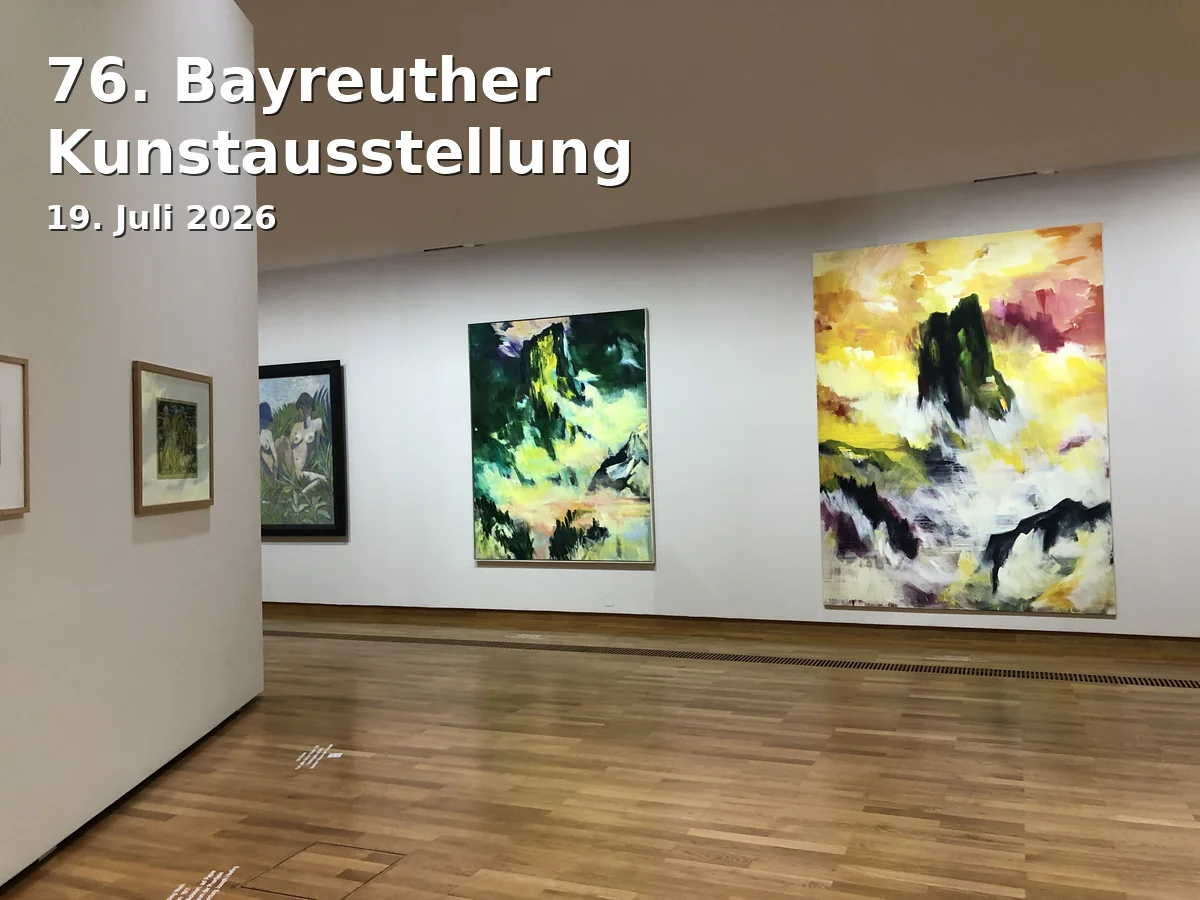
76th Bayreuth Art Exhibition
Experience contemporary artworks in the Castle Gallery Bayreuth. An exhibition of regional and national artists.
Vernissage for the 76th Bayreuth Art Exhibition 2026
Bayreuth displays contemporary art in all its tension: Vernissage, award ceremony, and strong positions in the Schlossgalerie. Admission free. #Bayreuth #Art

Richard Moves In – and Valhalla Comes Alive
Explore the exhibition by Michael Apitz at the Schlossgalerie Bayreuth and immerse yourself in the world of myths.
Frequently Asked Questions
Reviews
Myriam
27. May 2024
See Bayreuth and die.....no, I'd rather live there, the city practically breathes Richard WAGNER!!! A must!! The residents are friendly and helpful, and they seem happy to live in this tidy, quiet city......I love Bayreuth 😉
Maximilian K
3. December 2021
Super great staff at the Corona testing station. Whether BRK or the employees of the city of Bayreuth. Everyone is friendly and accommodating.
Jutta Tripke
27. November 2021
Testing center staff very nice despite a lot of stress👍🤗
Jörg Tannreuther
15. December 2021
Nice staff! You like to go there
Lasseju
22. September 2022
Very nice, everything is great. Thank you