
Hugo Harrer
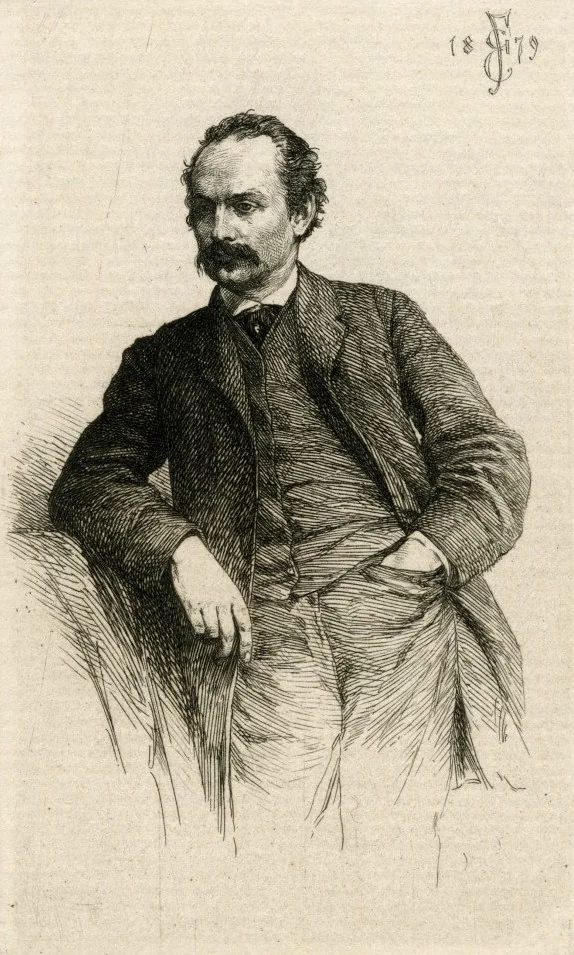
Image from Wikipedia
Image from Wikipedia
Hugo Harrer – Landscapes, Architecture, and the View of Light in Italy
A Quiet Master of the Düsseldorf School between Rome, Nuremberg, and Munich
Hugo Paul Harrer was a German landscape and architectural painter of the 19th century, whose work stands in the tradition of the Düsseldorf School and continues to impress today with its precision, observation of nature, and atmospheric clarity. Born in 1836 and died in 1876 in Rome, he is among those artists who developed their artistic signature not through an academic career, but through self-study, studio visits, and intensive observation of reality. His painting combines an eye for architectural forms with a sensitive perception of light, space, and topography.
Harrer is not an artist of loud fame but a painter of concentrated seeing. Therein lies his significance: He perceived architecture not merely as a motif but as a carrier of mood, history, and urban experience. His landscapes and views unfold that calm, precise visual language which gained its particular appeal in the 19th century between realistic observation and poetic transfiguration.
Biographical Background and Early Training
Harrer was born on February 6, 1836, in Eberswalde; however, older biographical accounts rather mention Hirschberg in Silesia as his place of birth and December 8, 1876, as the date of his death. These differing records highlight how incomplete the documentation of his career has remained to this day. What is certain, however, is that he originally intended to become an architect, but soon turned to painting and developed into an independent artist without permanent Academy attendance.
His education was unconventional and simultaneously typical for many artists of the time who sought their path between craft discipline and free observation. Harrer worked in private study in the studios of friends, studied nature carefully, and shaped a painting style that focused on closeness to reality and compositional clarity. This early independence influenced his entire artistic development.
Nuremberg, Munich, and the Path to Painting
The first paintings were created in Nuremberg, where the buildings of the city inspired him to early attempts at architectural painting. Here, a central motif of his oeuvre becomes visible: the interest in historically significant urban spaces, facades, alleys, and ruins. Architecture appeared to him not as a rigid object but as a living surface on which time, weather, and history become visible.
Later, Harrer moved to Munich to be inspired by the painting of Carl Theodor von Piloty. Even without a formal Academy degree, he was thus part of an art scene in which historical sensitivity and pictorial effect were closely linked. The Munich years solidified his eye for compositional structure and narrative density, without sacrificing his individual independence.
Rome as an Artistic Turning Point
Due to a chest ailment, Harrer went to Rome in 1861 or October 1862, where he joined Ludwig Passini and painted studies from nature. For him, Rome became not only a refuge but a productive resonance space. The city opened up access to Italian light, ancient and baroque forms of architecture, as well as that mix of ruins, everyday life, and expansive landscapes that decisively shaped his work.
After his stay in Rome, he returned there again and created a large stock of studies and sketches as a basis for oil paintings. It is precisely in the connection between observed reality on site and later condensed pictorial compositions in the studio that the strength of his work lies. Harrer submitted works to German art exhibitions, primarily presenting painterly depictions of street scenes, ruins, and Italian coastal landscapes.
Düsseldorf, International Stages, and Exhibition Presence
In the years 1867/1868, Harrer stayed in Düsseldorf, in the art landscape that was formative for the Düsseldorf School. His affiliation with this environment explains the combination of realistic precision, atmospheric elaboration, and a clear choice of motifs. The school emphasized careful observation of nature, narrative picture organization, and great attention to atmospheres, which is also evident in Harrer’s works.
His presence at exhibitions is documented through historical catalogs. For instance, he appeared at the Royal Academy of Arts in Berlin in 1877 with a large marine painting featuring Capri and a view of Rocca di Papa. Such entries show that his motifs were not limited to architecture and cityscapes but also included the Italian coastal area and the connection between nature and architecture.
Style, Technique, and Artistic Signature
The German Biography describes Harrer as “a thoroughly modern realist” who wanted to represent objects exactly as he saw them. This sentence precisely summarizes his art: Harrer did not seek romantic exaggeration but the credible appearance of things. His painting thrives on careful observation, calm area composition, and a fine relationship of light, shadow, and architectural structure.
Particularly important to him was the form of painterly representation. Especially in street scenes, ruins, and coastal views, the tension between documentary fidelity and poetic atmosphere becomes apparent. Harrer’s images thus act like visual notes from a culture of travel and perception in the 19th century, in which Italy became a yearned-for space for many German artists.
Work, Motifs, and Art Historical Classification
Harrer’s preferred subjects included Italian urban spaces, Roman ruins, coastal landscapes, and architectural vedute. These themes anchor him in the tradition of a painting that translates the seen into artistically composed pictorial spaces. The motif of the ruin plays a special role: it combines historical depth with painterly elegance while simultaneously referencing the transience of culture.
His works are now primarily present in art historical collections, exhibition contexts, and auction databases. There, the market value of his works can also be traced. For research, Harrer is interesting because he serves as a transitional figure between academic painting tradition, realistic nature study, and the Italian-influenced visual memory of 19th-century German artists.
Reception, Aftermath, and Cultural Significance
Although Harrer did not become a canonical great name, he possesses art historical relevance. His images appear in museum and collection contexts, particularly in the context of exhibitions on 19th-century art. It becomes clear how much his architectural and landscape images make visible the relationship between nature, built space, and historical memory.
The aftermath of his work lies less in spectacular fame than in the quiet persuasive power of his visual language. Harrer represents a painting that transforms observation into mood and organizes reality with compositional discipline. It is precisely this blend of accuracy and atmosphere that makes him intriguing for lovers of the Düsseldorf School and Italian vedute painting.
Discography, Charts, and Current Projects
As Hugo Harrer was a painter of the 19th century, there is no musical discography, no charts, and no current music projects. New albums, singles, or tours are also not part of his biography. The appropriate art historical perspective therefore focuses on his pictorial oeuvre, his exhibition venues, and his position within the Düsseldorf School.
This circumstance underscores the historical classification of the artist: Harrer is not a pop, rock, or jazz act but a visual artist whose work can be traced through exhibition catalogs, auction records, and biographical sources. For a SEO-strong artist page, precise art historical embedding is therefore crucial.
Conclusion: Why Hugo Harrer Still Fascinates Today
Hugo Harrer fascinates through the quiet sovereignty of his vision. He combined architecture and landscape into pictorial spaces that are supported by observation, light feeling, and realistic accuracy. His career demonstrates how far an artist could progress without a classical Academy career if talent, discipline, and nature study came together.
Anyone interested in the Düsseldorf School, Italian vedute, and 19th-century art should rediscover Hugo Harrer. His images invite one to examine the relationship between space, history, and mood with sharpened perception. A live experience in the true sense is not offered by his painting on stage, but in front of the original: there unfolds the quiet power of an artist who transformed the seen into art with remarkable clarity.
Official Channels of Hugo Harrer:
- Instagram: no official profile found
- Facebook: no official profile found
- YouTube: no official profile found
- Spotify: no official profile found
- TikTok: no official profile found
Sources:
- Wikipedia – Hugo Harrer
- German Biography – Harrer, Hugo
- Academy of Arts – Catalog of Works by Living Artists at the Exhibition of the Royal Academy of Arts in Berlin in the State Exhibition Building, 1877
- Swiss Art Exhibition in St. Gallen, 1877
- Kunstpalast – Artists of the Düsseldorf School
- Cottbus News – Hugo Paul Harrer: Between Capri and Rome
- Artnet – Hugo Paul Harrer
- Wikipedia: Image and Text Source