
- Exhibitions & Museums
- Literature & Readings
- Other
- Inside
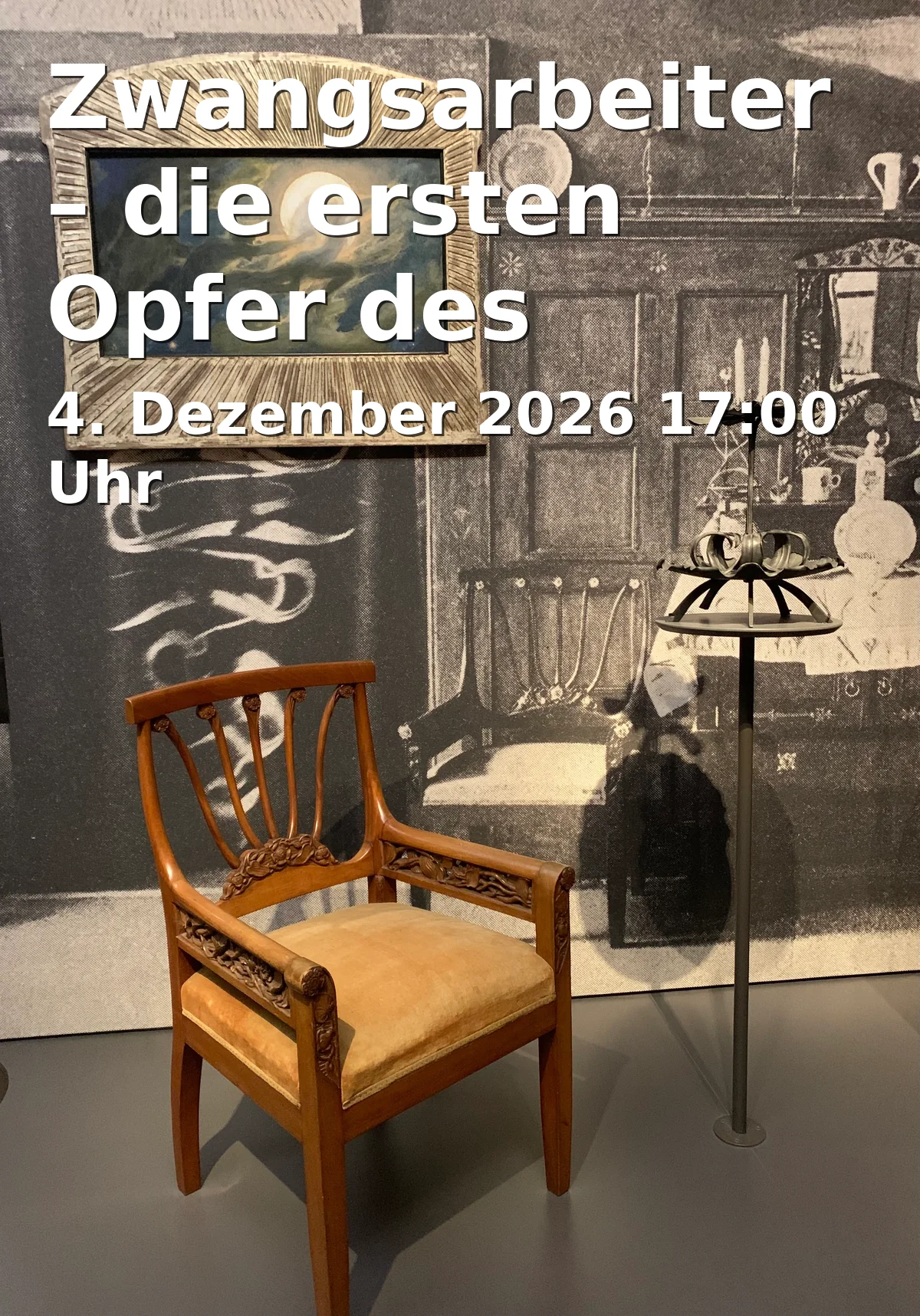
Forced Labor at the Bayreuth Compensation Archive: Memory of the Victims of the Cold War
- Date and Time
- 4. December 2026, 17:00
- Location
- Bundesarchiv LastenausgleichsarchivDr.-Franz-Straße 1, 95445 Bayreuth-Schießhaus, Deutschland
About this Event
Memory of Forced Labor and the Long Path to Recognition
The lecture Forced Labor – the First Victims of the Cold War at the Bayreuth Compensation Archive addresses forced labor during the years 1939 to 1945 and the difficult history of rehabilitation and compensation. The focus is on individuals who were deprived of rights, deported, and forced to work in Nazi Germany – and whose claims for recognition remained unmet for a long time after 1945.
Historical Experience between War and Post-War Period
Forced labor was a central exploitation structure of the Nazi regime. Millions of people from occupied European countries had to work in agriculture, industry, and arms production. Their life paths were marked by violence, uprooting, hunger, and the loss of personal freedom.
The event looks not only at the years 1939 to 1945 but also at the post-history. After liberation, many affected individuals faced new uncertainties: return, political instrumentalization, and decades of delayed or inadequate compensation shaped their further life paths.
The Difficult Path to Rehabilitation and Compensation
The examination of historical sources here acquires a political and societal dimension. Documents, memories, and administrative records reveal how complicated the recognition of Nazi injustices proceeded in the various political systems of the post-war period. Especially the compensation of former forced laborers was reassessed only after long debates and international negotiations.
The Bayreuth Compensation Archive provides a particularly suitable framework for this topic. The exhibition atmosphere and proximity to archival traditions allow for a concentrated aesthetic and historical experience: the focus is not on spectacular staging, but on a detailed engagement with sources, biographies, and cultures of remembrance.
Cultural Education through Historical Sources
The lecture connects political education with contemporary historical research. It invites critical questioning of concepts such as rehabilitation, restitution, and compensation and aims to place the perspectives of those affected more in the center. For the examination of sources in a broader sense, this means: each source refers to concrete individuals whose experiences must not disappear into abstract numbers.
The topic also holds significance for the present. The engagement with forced labor, memory politics, and the acknowledgment of injustices sharpens the view of the responsibility of state institutions and societal actors. The artistic experience in the sense of an aesthetic experience transforms here into an urgent historical encounter that connects knowledge, empathy, and judgment.
Conclusion: An Important Evening of Remembrance
Visitors can expect an informative lecture on forced labor from 1939 to 1945 as well as the long path to rehabilitation and compensation for those affected. Those who wish to understand history closely from sources, institutional responsibility, and human biographies will find a striking place for engagement in the Bayreuth Compensation Archive. The visit opens up a deeper historical experience and sets a sign for a living culture of remembrance.
Official Channels of Bayreuth Compensation Archive:
- Instagram: no official profile found
- Facebook: no official profile found
- YouTube: no official profile found
- Website: no official profile found
Sources:
Frequently Asked Questions
Ähnliche Veranstaltungen
 Kostenlos
17. Nov. 2026 16:0017. November 2026 16:00
StartING-up: Starting Instead of Hiring?
Sonstige Veranstaltungen
 Kostenlos
17. Nov. 2026 16:3017. November 2026 16:30
Pop-up City Lab "Mission: Help Grandma!"
Sonstige Veranstaltungen

17. Nov. 2026 18:0017. November 2026 18:00
Cultural Change is Possible... and It Has Always Been There!
Sonstige Veranstaltungen
 Kostenlos
17. Nov. 2026 18:1517. November 2026 18:15
Science Against Fascism
Sonstige Veranstaltungen
 15,00 €
17. Nov. 2026 19:0017. November 2026 19:00
CANCELED: How do we fight as a family? How can we escape old patterns?
Kinder
 Kostenlos
18. Nov. 2026 13:0018. November 2026 13:00
AI Prototyping: From Idea to First AI Prototype
Sonstige Veranstaltungen

18. Nov. 2026 16:0018. November 2026 16:00
Conference on Plant-Based Nutrition
Sonstige Veranstaltungen
 10,00 €
18. Nov. 2026 18:0018. November 2026 18:00
Canvas – Reading with bestselling author Ursula Poznanski
Literatur
 Kostenlos
18. Nov. 2026 18:0018. November 2026 18:00
City Talk Extra: How Societies Deal with Uncertainty
Sonstige Veranstaltungen
 Kostenlos
18. Nov. 2026 19:0018. November 2026 19:00
AfriKaleidoskop meets ARTE: Dokumentarfilme über Krieg, Widerstand und Hoffnung in der DR Kongo und im Sudan
Ausstellungen